Leather Jacket Market Size
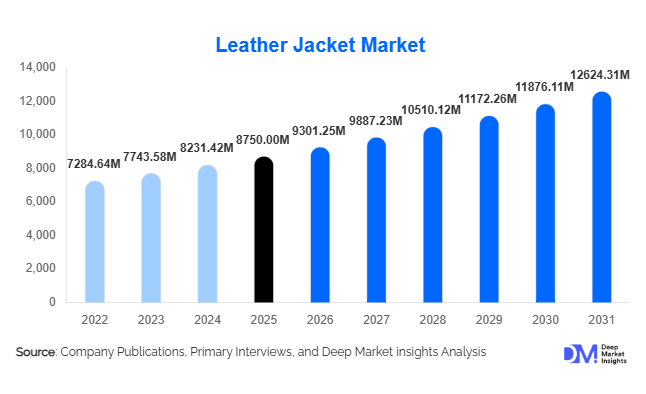
According to Deep Market Insights, the global leather jacket market size was valued at USD 8,750 million in 2025 and is projected to grow from USD 9,301.25 million in 2026 to reach USD 12,624.31 million by 2031, expanding at a CAGR of 6.3% during the forecast period (2026–2031). The leather jacket market growth is primarily driven by rising global fashion consciousness, increasing disposable income across emerging economies, and the growing popularity of premium and sustainable outerwear. The integration of e-commerce platforms and digital retail strategies has further expanded consumer reach, while innovations in vegan and eco-friendly leather alternatives are reshaping the industry landscape.
Key Market Insights
- Sustainable and vegan leather alternatives are gaining rapid traction, driven by increasing environmental awareness and regulatory pressure on animal-based products.
- Fashion and lifestyle applications dominate demand, accounting for over 70% of the total market share globally.
- Asia-Pacific leads the global market, supported by strong manufacturing capabilities and rising domestic consumption.
- North America remains a high-value market, driven by premium product demand and strong brand presence.
- Online retail is the fastest-growing distribution channel, fueled by digital transformation and direct-to-consumer strategies.
- The mid-range pricing segment dominates, balancing affordability and quality across global consumer bases.
What are the latest trends in the leather jacket market?
Shift Toward Sustainable and Vegan Leather
The leather jacket market is witnessing a significant shift toward sustainable materials, particularly vegan leather derived from plant-based sources such as cactus, mushroom, and pineapple fibers. Brands are increasingly adopting eco-friendly production methods, reducing reliance on animal-based leather due to ethical concerns and environmental regulations. This transition is supported by growing consumer awareness and demand for cruelty-free fashion. Many companies are also investing in biodegradable materials and low-impact tanning processes to align with global sustainability goals. The rise of circular fashion, including recycling and upcycling initiatives, is further reinforcing this trend, positioning sustainability as a central pillar of future market growth.
Digitalization and Direct-to-Consumer Expansion
Digital transformation is reshaping the leather jacket market, with brands leveraging e-commerce platforms, AI-driven personalization, and virtual try-on technologies to enhance customer engagement. Direct-to-consumer (D2C) models are enabling manufacturers to bypass intermediaries, improving profit margins and offering competitive pricing. Social media and influencer marketing are playing a crucial role in shaping consumer preferences, particularly among younger demographics. Augmented reality tools and data analytics are helping brands optimize inventory and forecast demand more accurately, reducing operational inefficiencies and enhancing the overall shopping experience.
What are the key drivers in the leather jacket market?
Rising Global Fashion Awareness
Leather jackets continue to be a timeless fashion staple, consistently featured in global fashion cycles and celebrity endorsements. Their versatility across casual and premium segments ensures sustained demand. The increasing influence of social media and fashion influencers is further accelerating adoption, particularly among younger consumers.
Growth in Disposable Income
Rising disposable income in emerging economies such as India, China, and Brazil is enabling consumers to spend more on premium apparel. Leather jackets, often perceived as aspirational products, benefit significantly from this trend. Expanding middle-class populations are driving higher consumption of mid-range and premium segments globally.
What are the restraints for the global market?
High Cost of Genuine Leather
The high cost of raw materials, particularly genuine leather, remains a major restraint for the market. Price volatility in animal hides and processing costs impacts product pricing, limiting accessibility in price-sensitive regions and affecting profit margins for manufacturers.
Environmental and Ethical Concerns
Growing concerns regarding animal welfare and the environmental impact of leather production are challenging traditional market dynamics. Regulatory pressures and consumer activism are pushing brands to adopt sustainable alternatives, increasing operational costs and requiring significant investment in innovation.
What are the key opportunities in the leather jacket industry?
Expansion in Emerging Markets
Emerging economies in the Asia-Pacific and Latin America present significant growth opportunities due to rising urbanization, increasing disposable income, and growing adoption of Western fashion trends. Brands that localize product offerings and pricing strategies can capture untapped demand in these regions.
Technological Integration in Manufacturing and Retail
The adoption of advanced technologies such as AI-driven design, 3D prototyping, and digital retail platforms is creating new opportunities for market participants. These innovations enable faster production cycles, improved customization, and enhanced customer experiences, providing a competitive advantage to early adopters.
Report Scope
| Report Metric | Details |
|---|---|
| Market Size in 2025 | USD 8750 Million |
| Market Size in 2026 | USD 9301.25 Million |
| Market Size in 2031 | USD 12624.31 Million |
| CAGR | 6.3% (2026-2031) |
| Base Year for Estimation | 2025 |
| Historical Data | 2022-2024 |
| Forecast Period | 2026-2031 |
| Report Coverage | Revenue Forecast, Competitive Landscape, Supply Chain Disruption, Growth Factors, Environment & Regulatory Landscape and Trends |
| Geographies Covered | North America, Europe, APAC, Middle East and Africa, LATAM |
| Countries Covered | U.S., Canada, U.K., Germany, France, Spain, Italy, Russia, Nordic, Benelux, Rest of Europe, China, Korea, Japan, India, Australia, Singapore, Taiwan, South East Asia, Rest of Asia-Pacific, UAE, Turky, Saudi Arabia, South Africa, Egypt, Nigeria, Rest of MEA, Brazil, Mexico, Argentina, Chile, Colombia, Rest of LATAM |
Explore more data points, trends and opportunities Download Free Sample Report
Material Type Insights
Genuine leather continues to dominate the global leather jacket market, accounting for approximately 62% share in 2025. This leadership is primarily driven by its superior durability, premium texture, and long product lifecycle, which justify higher price points and reinforce its positioning in the luxury and mid-range segments. Additionally, strong brand heritage associated with genuine leather products, especially in Europe and North America, supports sustained consumer preference. However, the segment’s growth is gradually stabilizing due to rising environmental scrutiny and higher production costs. In contrast, faux leather and vegan leather segments are gaining strong momentum. Vegan leather, in particular, is emerging as the fastest-growing material segment, driven by regulatory support for sustainable manufacturing, increasing consumer inclination toward cruelty-free products, and technological advancements in bio-based materials. Brands investing in plant-based alternatives and low-impact production processes are expected to capture significant incremental market share over the forecast period.
Product Type Insights
Biker jackets lead the product segment with around 28% market share, supported by their timeless appeal and strong association with youth culture, rebellion, and motorcycling heritage. Their versatility across both fashion and functional applications has enabled them to remain relevant across generations, making them a consistent revenue driver. The segment also benefits from strong visibility in media, celebrity endorsements, and recurring fashion cycles. Bomber and racer jackets follow closely, gaining traction particularly among younger consumers due to their casual styling and adaptability to urban fashion trends. Seasonal demand, especially in colder climates, further boosts sales of these products. Continuous design innovation, including lightweight materials and hybrid styles, is helping brands maintain consumer interest and expand their product portfolios.
End-User Insights
Men represent the largest end-user segment, contributing approximately 55% of the global market in 2025. This dominance is driven by historically higher adoption rates, broader product availability, and strong demand for classic styles such as biker and bomber jackets. However, the women’s segment is witnessing faster growth, fueled by increasing fashion consciousness, expanding design diversity, and rising participation of women in premium apparel consumption. The introduction of gender-neutral and inclusive designs is also reshaping market dynamics, encouraging cross-segment adoption. Additionally, targeted marketing campaigns and influencer-driven promotions are accelerating demand among female consumers, making this segment a key growth driver for the future.
Price Range Insights
The mid-range segment (USD 100–300) dominates the market with nearly 48% share, as it strikes an optimal balance between affordability and perceived quality. This segment appeals to a broad consumer base, particularly in emerging markets where aspirational buying behavior is strong. The premium segment is expanding steadily, driven by increasing demand for branded and luxury products, higher disposable incomes, and the growing influence of global fashion houses. Premium consumers are willing to pay for craftsmanship, exclusivity, and brand value, resulting in higher profit margins. Meanwhile, the economy segment caters to price-sensitive consumers, particularly in developing regions, but faces intense competition and margin pressures due to the availability of low-cost alternatives.
Distribution Channel Insights
Offline retail remains the dominant distribution channel, accounting for approximately 60% of the market share, as consumers prefer physical inspection to assess fit, texture, and quality, critical factors for leather apparel purchases. Specialty stores, department stores, and brand outlets continue to play a significant role in influencing purchase decisions through personalized customer experiences. However, online retail is the fastest-growing channel, driven by increasing internet penetration, smartphone usage, and the convenience of home shopping. E-commerce platforms and direct-to-consumer (D2C) strategies are enabling brands to expand their global reach, offer competitive pricing, and leverage data analytics for targeted marketing. The integration of virtual try-on tools and AI-driven recommendations is further enhancing online conversion rates.
Application Insights
Fashion and lifestyle applications dominate the leather jacket market with over 70% share, reflecting the transformation of leather jackets from purely functional outerwear to essential fashion statements. This segment is driven by evolving style trends, celebrity influence, and the growing importance of personal identity expression through apparel. Motorcycling and protective wear remain significant secondary applications, particularly in regions with high two-wheeler usage, such as the Asia-Pacific and parts of Europe. In these markets, safety regulations and increasing awareness of protective gear are supporting steady demand. Additionally, niche applications in the entertainment and media industries continue to influence mainstream fashion trends, indirectly boosting overall market demand.
Explore more data points, trends and opportunities Download Free Sample Report
Leather Jacket Market Segmentations
By Material Type
- Genuine Leather
- Faux Leather
- Vegan Leather
By Product Type
- Biker Jackets
- Bomber Jackets
- Racer Jackets
- Flight Jackets
- Blazers & Fashion Jackets
- Trench/Long Leather Coats
By End-User
- Men
- Women
- Kids
By Price Range
- Economy (Below USD 100)
- Mid-range (USD 100–300)
- Premium (Above USD 300)
By Distribution Channel
- Online Retail
- Offline Retail
By Application
- Fashion & Lifestyle
- Motorcycling & Protective Wear
- Aviation & Military Apparel
- Entertainment & Media
Regional Insights
North America
North America accounts for approximately 30% of the global leather jacket market, with the United States being the primary contributor. Regional growth is driven by high disposable income, strong consumer preference for premium and branded apparel, and a well-established fashion industry. The presence of leading global brands and extensive retail networks further supports market expansion. Additionally, the region benefits from high e-commerce penetration and advanced digital marketing strategies, enabling brands to reach a wider audience. Seasonal demand, particularly during fall and winter, along with strong influence from pop culture and celebrity fashion, continues to drive consistent sales growth.
Europe
Europe holds around 28% market share, led by key countries such as Italy, France, Germany, and the UK. The region’s growth is driven by its strong fashion heritage, high consumer awareness of quality and craftsmanship, and significant presence of luxury brands. Italy plays a crucial role as both a major producer and exporter, benefiting from its advanced leather processing industry. Additionally, increasing demand for sustainable and ethically sourced products is influencing purchasing decisions across Western Europe. Government regulations promoting eco-friendly manufacturing and the growing popularity of premium fashion further contribute to regional market growth.
Asia-Pacific
Asia-Pacific is the largest and fastest-growing region, contributing approximately 32% of the global market share and expanding at a CAGR of around 7.5%. Growth in this region is driven by rapid urbanization, rising disposable income, and increasing adoption of Western fashion trends. China dominates both production and consumption, supported by large-scale manufacturing capabilities and strong domestic demand. India is emerging as a key growth market due to its expanding middle-class population and growing retail infrastructure. Additionally, the region benefits from cost-effective production, export-oriented manufacturing, and increasing penetration of e-commerce platforms, which are significantly boosting market accessibility.
Latin America
Latin America accounts for approximately 5% of the global market, with Brazil and Mexico leading demand. Regional growth is supported by increasing urbanization, expanding retail networks, and the rising influence of global fashion trends. The growing middle class and improving economic conditions in select countries are encouraging higher spending on fashion apparel. However, market growth is somewhat constrained by economic volatility and price sensitivity among consumers. Despite these challenges, increasing digital retail adoption and international brand expansion are expected to drive steady growth in the coming years.
Middle East & Africa
The Middle East & Africa region contributes around 5% share, with demand concentrated in countries such as the UAE and South Africa. Growth in the Middle East is primarily driven by high disposable income, strong demand for luxury fashion, and increasing penetration of international brands. Tourism and expatriate populations further boost demand for premium apparel. In Africa, export-oriented manufacturing and improving retail infrastructure are supporting market development. Additionally, rising urbanization and gradual adoption of global fashion trends are contributing to increased consumption, although the market remains relatively nascent compared to other regions.