Laser Printer Market Size
According to Deep Market Insights, the global laser printer market size was valued at USD 48.5 billion in 2025 and is projected to grow from USD 50.97 billion in 2026 to reach USD 65.37 billion by 2031, expanding at a CAGR of 5.1% during the forecast period (2026–2031). The market growth is primarily driven by rising demand for high-speed, multifunctional printing solutions across enterprises, increasing adoption of wireless and cloud-enabled printers, and strong growth in emerging markets such as Asia-Pacific, where SMEs and government digitization initiatives are fueling demand.
Key Market Insights
- Monochrome and multifunction printers dominate due to their cost-efficiency and ability to consolidate office workflows, making them indispensable for large enterprises and institutions.
- Wireless and cloud-enabled printers are gaining traction, reflecting the growing preference for mobile and IoT-integrated office solutions that enhance productivity and reduce operational costs.
- Asia-Pacific is the largest market, led by China and India, driven by manufacturing hubs, SME growth, and government programs promoting domestic printing technology.
- North America maintains a significant share, particularly the United States, due to high enterprise adoption and advanced managed print services.
- Industrial and specialized applications, including logistics, healthcare, and packaging, are emerging as high-margin growth segments.
- Technological integration, such as predictive maintenance, AI-based diagnostics, and cloud printing, is reshaping product offerings and customer engagement.
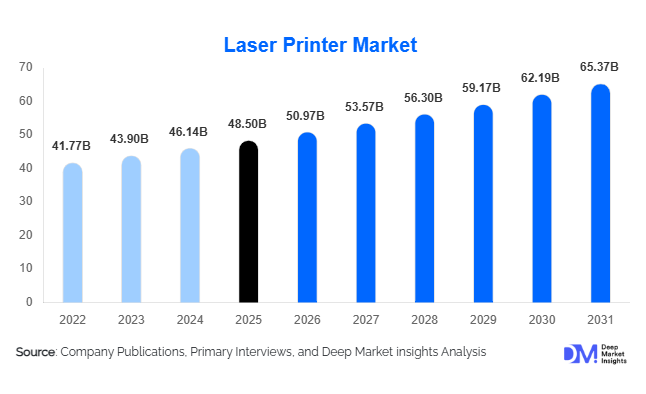
What are the latest trends in the laser printer market?
Shift Toward Multifunction and Wireless Solutions
Laser printer manufacturers are increasingly focusing on multifunction printers (MFPs) that combine printing, scanning, copying, and faxing into a single device. Wireless and cloud-enabled printers are being designed for seamless integration with office networks, mobile devices, and cloud storage platforms. This trend is particularly evident in SMEs and large enterprises seeking to reduce office space requirements and operational costs while enabling remote printing capabilities. Predictive maintenance features and energy-efficient designs further enhance adoption.
Industrial and Niche Printing Applications
Beyond traditional office documentation, laser printers are being used for specialized applications such as barcode labeling, packaging, and healthcare documentation. High-precision color and monochrome printers are being adopted in logistics, pharmaceutical, and legal sectors where accuracy, speed, and compliance are critical. This trend is fueling demand for high-speed, high-volume printers with advanced features such as secure printing, data encryption, and automated workflow integration.
What are the key drivers in the laser printer market?
Cost Efficiency and High-Volume Capability
Laser printers remain cost-effective in high-volume printing environments, with a lower cost per page compared to inkjet alternatives. This is especially relevant for large enterprises, educational institutions, and government offices that require continuous printing of documents, invoices, and records. The operational savings from reduced toner consumption and maintenance cycles further reinforce laser printers’ adoption.
Technological Advancements
Features such as wireless connectivity, cloud integration, mobile printing, and IoT-enabled predictive maintenance are enhancing user convenience and operational efficiency. Enterprises are increasingly adopting smart laser printers that can be monitored remotely, provide usage analytics, and offer automated troubleshooting. This technology adoption is accelerating upgrades and replacing legacy devices.
Emerging Market Expansion
Rapid urbanization, SME growth, and government digital initiatives in regions like Asia-Pacific and Latin America are driving demand for reliable and affordable laser printing solutions. These markets are witnessing strong growth in both color and monochrome MFP adoption, fueled by rising office infrastructure and institutional documentation needs.
What are the restraints for the global market?
Digitalization and Paperless Initiatives
The global shift toward digital documentation, e-invoicing, and paperless office policies is gradually reducing demand for printed materials, particularly in developed economies. Enterprises implementing full-scale digital workflows may limit replacement cycles, affecting market growth.
High Initial Investment for Advanced Models
High-speed, multifunction, and color laser printers involve high upfront costs. Price-sensitive small businesses and home users may prefer more affordable alternatives or cloud-based printing services, potentially limiting market penetration in certain segments.
What are the key opportunities in the laser printer industry?
Managed Print Services (MPS)
Enterprises are increasingly outsourcing printing infrastructure to third-party MPS providers. This reduces operational costs, ensures device uptime, and provides recurring revenue streams for manufacturers. MPS adoption is particularly attractive in large organizations and government agencies seeking to streamline printing workflows and integrate smart analytics for cost management.
IoT and Cloud Integration
IoT-enabled printers capable of predictive maintenance, usage tracking, and cloud connectivity are creating opportunities for manufacturers to differentiate products. These technologies improve operational efficiency, reduce downtime, and support hybrid work environments where employees print remotely or from mobile devices.
Emerging Regional Demand
Rapid SME growth and government digital initiatives in Asia-Pacific, Africa, and Latin America are generating strong demand for cost-efficient laser printers. Governments supporting domestic manufacturing and technological upgrades present additional opportunities for local and global market participants. Specialized applications, such as healthcare documentation and logistics labeling, also offer high-margin growth areas with limited competition.
Report Scope
| Report Metric | Details |
|---|---|
| Market Size in 2025 | USD 48.5 Billion |
| Market Size in 2026 | USD 50.97 Billion |
| Market Size in 2031 | USD 65.37 Billion |
| CAGR | 5.1% (2026-2031) |
| Base Year for Estimation | 2025 |
| Historical Data | 2022-2024 |
| Forecast Period | 2026-2031 |
| Report Coverage | Revenue Forecast, Competitive Landscape, Supply Chain Disruption, Growth Factors, Environment & Regulatory Landscape and Trends |
| Geographies Covered | North America, Europe, APAC, Middle East and Africa, LATAM |
| Countries Covered | U.S., Canada, U.K., Germany, France, Spain, Italy, Russia, Nordic, Benelux, Rest of Europe, China, Korea, Japan, India, Australia, Singapore, Taiwan, South East Asia, Rest of Asia-Pacific, UAE, Turky, Saudi Arabia, South Africa, Egypt, Nigeria, Rest of MEA, Brazil, Mexico, Argentina, Chile, Colombia, Rest of LATAM |
Explore more data points, trends and opportunities Download Free Sample Report
Product Type Insights
Monochrome laser printers continue to dominate the global market, accounting for a significant share due to their affordability, low cost per page, and high reliability in high-volume printing environments. Their leadership is primarily driven by enterprise demand, where bulk document printing does not require color output, particularly in sectors such as BFSI, government, and legal services. Additionally, monochrome printers offer longer duty cycles and lower maintenance requirements, making them ideal for continuous operations. Color laser printers are witnessing steady growth, especially in professional and commercial applications such as marketing, advertising, packaging, and design. The increasing need for high-quality visual output, combined with declining prices of color printing technology, is supporting adoption among SMEs and creative industries. Businesses are increasingly leveraging in-house color printing to reduce outsourcing costs and improve turnaround times.
Multifunction printers (MFPs) represent the leading product category globally, driven by their ability to integrate printing, scanning, copying, and faxing into a single device. This consolidation reduces capital expenditure, optimizes office space, and enhances workflow efficiency, particularly in hybrid work environments. Organizations are increasingly adopting MFPs as part of digital workflow automation strategies, further reinforcing their dominance. By speed, medium-speed printers (21–40 ppm) lead the market as they offer an optimal balance between performance and cost. This segment is particularly favored by SMEs and mid-sized enterprises that require efficient printing capabilities without investing in high-end industrial printers. The growing adoption of these printers is also supported by increasing office digitization and moderate-volume printing requirements.
Application Insights
Office documentation remains the largest application segment, contributing nearly 60% of the global market in 2025. This dominance is driven by consistent demand for invoices, contracts, reports, and compliance-related documentation across industries such as banking, healthcare, education, and government. Despite digital transformation initiatives, regulatory requirements and operational needs continue to sustain high volumes of printed documents. Industrial and specialized applications are emerging as high-growth segments within the laser printer market. Applications such as barcode labeling, packaging, pharmaceutical documentation, and logistics tracking require high-speed, precise, and durable printing solutions. The rapid expansion of e-commerce and global supply chains has significantly increased demand for labeling and packaging printers, particularly in logistics hubs.
Healthcare documentation is another critical application area, driven by the need for patient records, prescriptions, and compliance documentation. Similarly, legal and financial sectors rely heavily on secure and high-quality printing solutions. These applications are accelerating the adoption of advanced laser printers equipped with features such as data encryption, secure printing, and cloud integration, ensuring both efficiency and data protection.
Distribution Channel Insights
Offline distribution channels continue to dominate the market, accounting for approximately 62% of total sales. This is primarily due to large enterprise and government procurement processes, which rely on direct vendor contracts, bulk purchasing agreements, and customized solutions. System integrators and authorized distributors play a crucial role in delivering end-to-end printing infrastructure, including installation, maintenance, and managed print services. However, online channels are rapidly gaining momentum, particularly in the SME and home office segments. E-commerce platforms provide greater accessibility, competitive pricing, and a wider product range, making them attractive for small-scale buyers. The convenience of product comparison, customer reviews, and doorstep delivery is accelerating the shift toward online purchasing.
Additionally, manufacturers are increasingly promoting subscription-based models and managed print services (MPS), enabling customers to pay based on usage rather than upfront investment. This shift toward service-based models is improving customer retention, generating recurring revenue streams, and transforming traditional distribution dynamics.
End-Use Insights
Large enterprises represent the largest end-use segment, accounting for approximately 38% of the global market. Their dominance is driven by high-volume printing requirements, adoption of advanced multifunction printers, and increasing reliance on managed print services. These organizations prioritize efficiency, security, and scalability, leading to continuous upgrades of printing infrastructure. The BFSI sector is a key contributor, driven by extensive documentation needs, regulatory compliance, and customer transaction records. Healthcare is among the fastest-growing segments, supported by rising patient volumes, digitization of medical records, and strict documentation requirements. Educational institutions also contribute significantly, particularly in emerging markets where student enrollment and institutional infrastructure are expanding.
Emerging industries such as logistics, e-commerce, and manufacturing are creating new demand avenues. The rapid growth of online retail and global trade is driving the need for labeling, packaging, and shipment documentation. Export-driven demand from manufacturing hubs such as China and India further supports global market expansion, as these countries produce and distribute laser printers across international markets.
Explore more data points, trends and opportunities Download Free Sample Report
Laser Printer Market Segmentations
By Product Type
- Monochrome Laser Printers
- Color Laser Printers
- Multifunction Laser Printers (MFPs)
- High-Speed Production Laser Printers
By Application
- Office Documentation
- Commercial Printing
- Industrial Labeling & Packaging
- Healthcare & Legal Documentation
By Distribution Channel
- Online Retail
- Direct Enterprise Sales
- IT Resellers & System Integrators
- Retail & Specialty Electronics Stores
By End-Use
- Large Enterprises
- Small & Medium Enterprises (SMEs)
- Government & Public Sector
- Educational Institutions
- Residential/Home Offices
Regional Insights
North America
North America accounts for approximately 27% of the global market, with the United States being the dominant contributor. Regional growth is primarily driven by high enterprise adoption, widespread implementation of managed print services, and strong technological infrastructure. The presence of large corporate offices, financial institutions, and healthcare facilities sustains demand for high-performance and secure printing solutions. Additionally, the rapid adoption of cloud-based workflows and hybrid work models is accelerating demand for wireless and IoT-enabled printers. Continuous upgrades of legacy systems and emphasis on cybersecurity in printing are further supporting market growth in this region.
Europe
Europe holds around 22% of the market, led by Germany, the United Kingdom, and France. Growth in this region is driven by stringent regulatory frameworks related to data security, environmental sustainability, and workplace compliance. Enterprises are increasingly adopting energy-efficient and eco-friendly printers to meet EU sustainability standards. The region also benefits from strong demand in healthcare and legal sectors, where documentation requirements remain high. Additionally, the shift toward circular economy practices and recycling of printing consumables is influencing purchasing decisions and driving innovation among manufacturers.
Asia-Pacific
Asia-Pacific is the largest and fastest-growing region, accounting for approximately 38% of the global market. China leads as both a major producer and consumer, supported by its robust manufacturing ecosystem and export capabilities. India is emerging as a high-growth market with a CAGR of around 7%, driven by rapid SME expansion, government initiatives such as “Make in India,” and increasing digital infrastructure. Japan and Australia represent mature markets with stable demand, focusing on advanced and high-quality printing solutions. The region’s growth is further fueled by urbanization, rising literacy rates, and increasing adoption of office automation technologies.
Latin America
Latin America is experiencing moderate growth, with Brazil and Mexico serving as key markets. The expansion of SMEs, retail, and commercial sectors is driving demand for cost-effective printing solutions. Growth is also supported by increasing logistics and packaging activities, particularly in e-commerce and export-oriented industries. However, economic fluctuations and budget constraints in certain countries may limit the rapid adoption of high-end printing technologies. Despite these challenges, gradual digitalization and infrastructure improvements are expected to sustain market growth.
Middle East & Africa
The Middle East & Africa region is an emerging market with growing adoption of laser printers, particularly in the UAE, Saudi Arabia, and South Africa. Growth drivers include increasing investments in smart offices, government digitization initiatives, and the expansion of commercial infrastructure. The Middle East is witnessing rising demand for high-end and enterprise-grade printing solutions, supported by strong economic development and corporate presence. In Africa, demand is driven by improving educational infrastructure, government documentation needs, and gradual industrialization. The region’s long-term growth potential is supported by ongoing investments in technology and business expansion.
Key Players in the Laser Printer Market
- HP Inc.
- Canon Inc.
- Brother Industries Ltd.
- Seiko Epson Corporation
- Xerox Holdings Corporation
- Ricoh Company Ltd.
- Konica Minolta Inc.
- Lexmark International Inc.
- Kyocera Corporation
- Toshiba Tec Corporation
- Sharp Corporation
- Dell Technologies
- Samsung Electronics
- Panasonic Corporation
- Oki Electric Industry Co., Ltd.