Laptop Bag Market Size
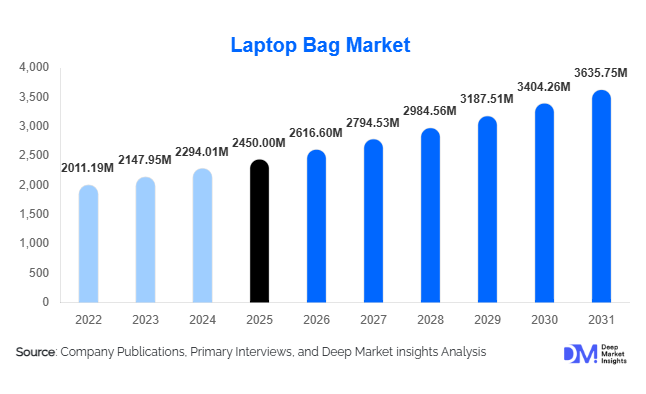
According to Deep Market Insights, the global laptop bag market size was valued at USD 2,450 million in 2025 and is projected to grow from USD 2,616.60 million in 2026 to reach USD 3,635.75 million by 2031, expanding at a CAGR of 6.8% during the forecast period (2026–2031). The laptop bag market growth is primarily driven by increasing laptop penetration, the global shift toward hybrid work environments, and rising demand for portable, protective, and multifunctional carrying solutions. The market has evolved significantly from basic utility products to lifestyle-oriented accessories, with consumers prioritizing durability, design aesthetics, and advanced features such as anti-theft protection and smart charging capabilities.
Key Market Insights
- Backpack laptop bags dominate the market, driven by ergonomic design and suitability for both professionals and students.
- Asia-Pacific leads global demand, supported by large student populations and rapid digital adoption in countries like China and India.
- Online retail channels are expanding rapidly, accounting for a growing share of total sales due to convenience and competitive pricing.
- The mid-range pricing segment remains the largest, balancing affordability and quality across emerging economies.
- Smart and anti-theft laptop bags are gaining traction, especially among urban professionals and frequent travelers.
- Sustainability trends are influencing purchasing decisions, with eco-friendly and recycled material bags gaining popularity in developed markets.
What are the latest trends in the laptop bag market?
Rise of Smart and Functional Laptop Bags
The integration of smart features such as USB charging ports, RFID protection, and GPS tracking is transforming traditional laptop bags into multifunctional accessories. These innovations cater to tech-savvy consumers and digital professionals who prioritize convenience and security. Manufacturers are increasingly focusing on modular designs, allowing users to organize multiple devices and accessories efficiently. The demand for anti-theft features, including hidden zippers and lockable compartments, is also rising, particularly in urban and travel-centric use cases.
Sustainable and Eco-friendly Product Development
Environmental awareness is reshaping product development strategies in the laptop bag market. Companies are adopting recycled polyester, organic fabrics, and biodegradable materials to meet consumer demand for sustainable products. Brands are also emphasizing ethical sourcing and transparent supply chains. This trend is particularly strong in Europe and North America, where environmentally conscious consumers are willing to pay a premium for eco-friendly alternatives, driving innovation and differentiation in the market.
What are the key drivers in the laptop bag market?
Growth in Remote Work and Hybrid Work Models
The widespread adoption of remote and hybrid work arrangements has significantly increased reliance on laptops, driving consistent demand for laptop bags. Professionals require portable, durable, and organized carrying solutions to support flexible work environments, boosting market growth.
Expansion of Digital Education
The increasing use of laptops in education, particularly in emerging markets, is a major growth driver. Governments and institutions are promoting digital learning, leading to higher laptop ownership among students. This has created strong demand for affordable and durable laptop bags.
What are the restraints for the global market?
Price Sensitivity in Emerging Markets
Consumers in developing regions often prioritize affordability over premium features, limiting the adoption of high-end laptop bags. This price sensitivity impacts overall profit margins for manufacturers and restricts premium segment expansion.
Competition from the Unorganized Sector
The presence of low-cost, unbranded, and counterfeit products poses a significant challenge to established brands. These products create pricing pressure and reduce brand loyalty, particularly in price-sensitive markets across Asia and Africa.
What are the key opportunities in the laptop bag industry?
Expansion in Emerging Economies
Rapid urbanization and increasing digital adoption in countries such as India, Indonesia, and Brazil present significant growth opportunities. Rising laptop usage among students and small businesses is driving demand for cost-effective laptop bags, encouraging market expansion.
Integration of Advanced Technology
The incorporation of smart features such as USB charging and anti-theft systems provides opportunities for product differentiation. As consumers increasingly seek convenience and security, technology-enabled bags are expected to gain a higher market share, especially in premium segments.
Report Scope
| Report Metric | Details |
|---|---|
| Market Size in 2025 | USD 2450 Million |
| Market Size in 2026 | USD 2616.60 Million |
| Market Size in 2031 | USD 3635.75 Million |
| CAGR | 6.8% (2026-2031) |
| Base Year for Estimation | 2025 |
| Historical Data | 2022-2024 |
| Forecast Period | 2026-2031 |
| Report Coverage | Revenue Forecast, Competitive Landscape, Supply Chain Disruption, Growth Factors, Environment & Regulatory Landscape and Trends |
| Geographies Covered | North America, Europe, APAC, Middle East and Africa, LATAM |
| Countries Covered | U.S., Canada, U.K., Germany, France, Spain, Italy, Russia, Nordic, Benelux, Rest of Europe, China, Korea, Japan, India, Australia, Singapore, Taiwan, South East Asia, Rest of Asia-Pacific, UAE, Turky, Saudi Arabia, South Africa, Egypt, Nigeria, Rest of MEA, Brazil, Mexico, Argentina, Chile, Colombia, Rest of LATAM |
Explore more data points, trends and opportunities Download Free Sample Report
Product Type Insights
Backpack laptop bags dominate the global market with approximately 42% share in 2025, primarily driven by their ergonomic design, superior weight distribution, and versatility across multiple end-use scenarios, including corporate commuting, education, and travel. The rising preference for hands-free mobility, particularly among urban professionals and students, has further strengthened demand for backpack variants. Additionally, innovations such as anti-theft compartments, USB charging ports, and multi-device storage are reinforcing their leadership position. Messenger and briefcase-style laptop bags continue to cater to corporate professionals who prioritize formal aesthetics and structured designs, particularly in developed markets. Meanwhile, sleeves and covers are gaining traction among minimalist users seeking lightweight and cost-effective protection for short-distance use. Convertible and hybrid laptop bags, which combine features of backpacks and briefcases, are emerging as a niche but fast-growing segment, driven by the evolving needs of hybrid workers and frequent travelers who require multifunctionality and adaptability.
Material Type Insights
Polyester remains the leading material segment, accounting for around 35% of the global market share in 2025, due to its durability, lightweight properties, water resistance, and cost efficiency. Its widespread availability and ease of manufacturing make it the preferred choice for mass-market products. Nylon follows closely, offering enhanced strength and abrasion resistance, making it suitable for premium and travel-focused bags. Leather and synthetic leather segments cater to premium and luxury consumers, driven by increasing demand for aesthetically appealing and brand-oriented products, particularly among corporate users. However, the most notable emerging trend is the rising adoption of eco-friendly materials such as recycled polyester and organic fabrics. This shift is driven by growing environmental awareness, stringent sustainability regulations in regions like Europe, and increasing consumer willingness to pay a premium for sustainable products, positioning eco-materials as a future growth driver.
Distribution Channel Insights
Online distribution channels account for nearly 46% of the global market, making them the dominant sales channel in 2025. This growth is driven by the rapid expansion of e-commerce platforms, increased smartphone penetration, and consumer preference for convenience, competitive pricing, and product variety. Direct-to-consumer (D2C) strategies adopted by brands have further strengthened online sales by improving margins and enhancing customer engagement. Features such as customer reviews, easy returns, and personalized recommendations are also influencing purchasing decisions. Offline channels, including specialty stores, hypermarkets, and brand outlets, continue to play a significant role, particularly in emerging markets where physical retail infrastructure remains strong, and consumers prefer in-store product evaluation. Additionally, offline retail is crucial for premium and luxury segments, where tactile experience and brand interaction influence purchase decisions.
End-Use Insights
Corporate professionals represent the largest end-use segment, contributing approximately 34% of the global market share in 2025. This dominance is driven by widespread laptop usage across industries and the need for durable, stylish, and functional carrying solutions. The segment benefits significantly from the continued adoption of hybrid work models, which require professionals to commute with laptops frequently. The student segment is the fastest-growing, supported by the rapid expansion of digital education, government initiatives promoting e-learning, and increasing laptop accessibility in emerging economies. Additionally, emerging segments such as gamers and tech professionals are driving demand for premium, high-capacity laptop bags with enhanced protection and storage features. The travel segment is also contributing to growth, as consumers increasingly seek multi-functional bags that combine laptop storage with travel utility.
Explore more data points, trends and opportunities Download Free Sample Report
Laptop Bag Market Segmentations
By Product Type
- Backpack Laptop Bags
- Messenger Laptop Bags
- Sleeve/Cover Laptop Bags
- Rolling/Briefcase Laptop Bags
- Convertible/Hybrid Laptop Bags
By Material Type
- Polyester
- Nylon
- Leather
- Synthetic Leather
- Canvas/Fabric Blends
- Eco-friendly/Recycled Materials
By Distribution Channel
- Online Retail
- Hypermarkets/Supermarkets
- Specialty Stores
- Brand Stores
By End User
- Students
- Corporate Professionals
- Gamers & Tech Professionals
- Travelers
Regional Insights
Asia-Pacific
Asia-Pacific leads the global laptop bag market with approximately 35% share in 2025, driven by a combination of a large population base, rising disposable incomes, and rapid digital transformation. China dominates as both a manufacturing hub and a major exporter, benefiting from established supply chains and cost-efficient production capabilities. India is the fastest-growing market in the region, with an estimated CAGR of around 9%, supported by government-led initiatives such as digital education programs and increasing laptop penetration among students and small businesses. The region’s growth is further fueled by expanding e-commerce platforms, urbanization, and a growing middle-class population, which is driving demand for both affordable and mid-range laptop bags.
North America
North America accounts for approximately 32% of the global market share, with the United States leading regional demand. Growth in this region is driven by high disposable income, strong corporate infrastructure, and widespread adoption of premium and technologically advanced laptop bags. The increasing trend of remote and hybrid work has significantly boosted demand for functional and stylish laptop bags. Additionally, consumers in North America show a strong preference for branded and high-quality products, supporting premium segment growth. The region also benefits from a well-established retail ecosystem and high penetration of e-commerce, which further accelerates market expansion.
Europe
Europe holds around 22% of the global market share, with key contributions from Germany, the UK, and France. The region’s growth is primarily driven by strong sustainability trends, with consumers increasingly opting for eco-friendly and ethically manufactured products. Regulatory frameworks promoting environmental responsibility are encouraging manufacturers to adopt sustainable materials and production processes. Additionally, Europe’s mature corporate sector and high adoption of laptops in education and professional environments are supporting steady demand. The region is also witnessing growing interest in premium and designer laptop bags, particularly among urban consumers.
Middle East & Africa
The Middle East and Africa region is experiencing steady growth, supported by expanding education sectors, increasing expatriate workforce, and rising digital adoption. The UAE is a key market, driven by high-income consumers and strong demand for premium and luxury laptop bags. South Africa leads demand in the African region, supported by growing corporate activity and improving access to digital devices. Additionally, government investments in education and digital infrastructure across several African countries are contributing to increased laptop usage, thereby driving demand for laptop bags. The region also benefits from rising retail expansion and growing awareness of branded products.
Latin America
Latin America demonstrates moderate growth, with Brazil and Mexico as the leading markets. The region’s demand is driven by increasing digitalization, growing student population, and expanding corporate sectors. However, economic volatility and price sensitivity continue to influence purchasing behavior, with a strong preference for mid-range and affordable products. Growth is further supported by the gradual expansion of e-commerce platforms, improving product accessibility across urban and semi-urban areas. Additionally, rising awareness of product quality and brand value is expected to support long-term market development in the region.