Lactation Massagers Market Size
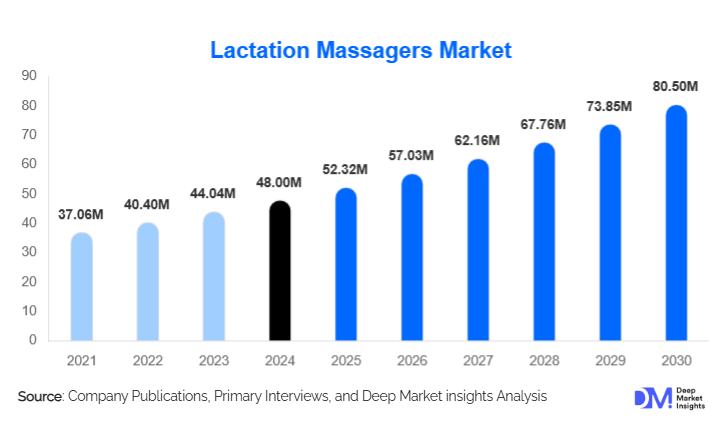
According to Deep Market Insights, the global lactation massagers market size was valued at USD 48.00 million in 2025 and is projected to grow from USD 52.32 million in 2026 to reach USD 80.50 million by 2031, expanding at a CAGR of 9% during the forecast period (2026–2031). The lactation massagers market growth is primarily driven by rising awareness of maternal health, increasing adoption of technologically advanced devices, and the growing population of working mothers seeking convenient breastfeeding solutions.
Key Market Insights
- Electric and wearable lactation massagers are gaining traction, providing hands-free, efficient solutions that cater to modern mothers balancing work and home responsibilities.
- North America dominates the global market, led by the U.S. and Canada, owing to high disposable income, technological adoption, and extensive e-commerce penetration.
- Asia-Pacific is emerging as the fastest-growing region, driven by increasing awareness of postpartum care, rising urbanization, and expanding middle-class populations in India and China.
- Online retail channels are rapidly expanding, providing mothers with convenient access to a wide range of lactation massagers, product reviews, and delivery services.
- Integration of smart technologies, including mobile apps, IoT-enabled tracking, and customizable massager settings, is redefining user experiences and driving premium product adoption.
- Hospitals and lactation support centers are increasingly procuring professional-grade devices, reinforcing institutional demand for the market.
Lactation Massagers Market latest trends
Smart and Wearable Massagers
The market is witnessing a shift toward wearable and smart lactation massagers. These devices allow hands-free operation, discreet usage, and real-time tracking of milk flow through connected mobile applications. Such advancements cater to working mothers who require flexibility and convenience. Wearable massagers also integrate quiet motors and ergonomic designs to improve comfort, representing a premium segment with higher profit margins.
Rising Adoption through E-Commerce Platforms
Online retail platforms are reshaping the way lactation massagers are purchased. Direct-to-consumer websites, e-commerce giants, and specialized baby care portals allow mothers to access diverse options, compare features, read reviews, and avail delivery at home. Subscription-based and membership-driven models are emerging, offering recurring shipments of complementary products such as breast pads and replacement parts, enhancing consumer retention and recurring revenue opportunities for manufacturers.
Lactation Massagers Market key drivers
Increasing Awareness of Maternal Health
Global awareness campaigns about postpartum care, breastfeeding benefits, and infant nutrition are strongly influencing the adoption of lactation massagers. Mothers are increasingly educated on how proper lactation support enhances milk flow, reduces discomfort, and promotes infant health, driving demand for both home-use and professional-grade devices.
Growing Working Mother Population
As the number of women in the workforce increases worldwide, the demand for convenient breastfeeding solutions grows. Portable and wearable lactation massagers help mothers maintain breastfeeding schedules without compromising professional commitments, contributing significantly to market expansion.
Technological Advancements in Devices
Electric and combination lactation massagers with multiple suction and massage modes, ergonomic designs, and app integration are enhancing user convenience and satisfaction. Features such as quiet operation, adjustable settings, and real-time tracking have encouraged adoption, particularly in premium consumer segments.
Lactation Massagers Market restraints for the global market?
High Cost of Advanced Devices
Electric and wearable lactation massagers are more expensive than manual devices, limiting adoption in price-sensitive regions. Consumers in developing markets often opt for affordable manual massagers, slowing the growth of the premium segment.
Cultural and Social Barriers
In certain regions, breastfeeding products face social stigma or low awareness, restricting market penetration. Overcoming cultural resistance and educating mothers remains a key challenge for manufacturers aiming to expand globally.
Lactation Massagers Market key opportunities
Expansion in Emerging Markets
Asia-Pacific and Latin America present strong growth potential due to increasing urbanization, maternal health initiatives, and rising disposable income. Programs promoting postpartum care, supported by government and NGO interventions, are creating favorable conditions for both domestic and international players.
Integration with Smart Technologies
Incorporating IoT-enabled features, mobile apps, and real-time tracking provides opportunities to differentiate products in a competitive market. Smart massagers allow mothers to monitor milk flow, track breastfeeding schedules, and customize device settings, appealing to tech-savvy consumers willing to pay a premium for convenience.
Collaborations with Healthcare Providers
Partnerships with hospitals, lactation consultants, and maternity clinics provide long-term institutional contracts and enhance credibility. Education programs, product endorsements, and professional recommendations drive higher adoption rates, especially in regions with low consumer awareness.
Report Scope
| Report Metric | Details |
|---|---|
| Market Size in 2025 | USD 48 Million |
| Market Size in 2026 | USD 52.32 Million |
| Market Size in 2031 | USD 80.50 Million |
| CAGR | 9% (2026-2031) |
| Base Year for Estimation | 2025 |
| Historical Data | 2022-2024 |
| Forecast Period | 2026-2031 |
| Report Coverage | Revenue Forecast, Competitive Landscape, Supply Chain Disruption, Growth Factors, Environment & Regulatory Landscape and Trends |
| Geographies Covered | North America, Europe, APAC, Middle East and Africa, LATAM |
| Countries Covered | U.S., Canada, U.K., Germany, France, Spain, Italy, Russia, Nordic, Benelux, Rest of Europe, China, Korea, Japan, India, Australia, Singapore, Taiwan, South East Asia, Rest of Asia-Pacific, UAE, Turky, Saudi Arabia, South Africa, Egypt, Nigeria, Rest of MEA, Brazil, Mexico, Argentina, Chile, Colombia, Rest of LATAM |
Explore more data points, trends and opportunities Download Free Sample Report
Product Type Insights
Electric lactation massagers dominate the market, holding a 45% share in 2025, due to their efficiency, convenience, and growing adoption among home users. Manual massagers remain relevant in price-sensitive regions, while wearable massagers are emerging as a premium segment catering to working mothers seeking hands-free operation. Combination models integrating suction and massage are popular in professional healthcare settings for enhanced comfort and faster milk expression.
Application Insights
Individual consumers represent the largest application segment, accounting for 55% of the 2025 market share, driven by rising home-use adoption. Hospitals and maternity clinics follow as a professional segment, procuring a combination of high-end devices for lactation therapy. Lactation support centers and consulting services are an emerging application, leveraging advanced massagers for therapeutic and educational purposes, further expanding institutional demand globally.
Distribution Channel Insights
Online retail channels account for 40% of market share, offering convenience, wider product selection, and direct delivery. Offline retail, including pharmacies and specialty maternity stores, follows with 35% share. Direct institutional sales, especially to hospitals and clinics, are also increasing. The rise of e-commerce and subscription-based models is strengthening recurring revenue streams and improving brand penetration globally.
Explore more data points, trends and opportunities Download Free Sample Report
Lactation Massagers Market Segmentations
By Product Type
- Manual Lactation Massagers
- Electric Lactation Massagers
- Wearable Lactation Massagers
- Combination Lactation Massagers (Massage + Suction)
By Mode of Operation
- Massage-Based Devices
- Vacuum Suction-Based Devices
- Dual-Function (Massage & Suction)
By End Use
- Individual/Home Use
- Hospitals & Maternity Clinics
- Lactation Support Centers
By Distribution Channel
- Online Retail (E-commerce & Brand Websites)
- Pharmacies & Drug Stores
- Specialty Maternity & Baby Stores
- Direct Institutional Sales
Regional Insights
North America
North America dominates with a 35% share in 2025. High disposable income, technological adoption, and widespread online retail penetration drive demand. U.S. and Canadian mothers increasingly prefer electric and wearable massagers, while hospitals and lactation consultants are actively procuring professional-grade devices.
Europe
Europe holds 25% of the global market, with Germany, the U.K., and France leading adoption. Consumers favor premium and technologically advanced devices, and growing awareness campaigns support sustained growth. Eco-conscious and ergonomic designs are particularly preferred in this region.
Asia-Pacific
APAC is the fastest-growing region (10% CAGR), led by China, India, and Japan. Urbanization, rising maternal health awareness, and growing middle-class populations drive demand. Increased hospital infrastructure and rising e-commerce adoption further support market growth.
Latin America
Brazil and Argentina are emerging markets with increasing adoption due to higher awareness and urban maternal health initiatives. Outbound imports of premium devices are significant due to limited domestic manufacturing.
Middle East & Africa
The Middle East, led by the UAE and Saudi Arabia, is gradually adopting lactation massagers, particularly premium and wearable devices. Africa’s demand is concentrated in urban centers with rising healthcare infrastructure, supported by government initiatives and NGO programs promoting maternal health.
Key Players in the Lactation Massagers Market
- Medela AG
- Philips Avent
- Lansinoh Laboratories
- Haakaa
- Ameda
- Spectra Baby USA
- Ardo Medical AG
- Evenflo Company, Inc.
- Chicco (Artsana Group)
- Tommee Tippee
- Nuk
- Suavinex
- Baby Ono
- Freemie
- Willow