Lab Consumables Market Size
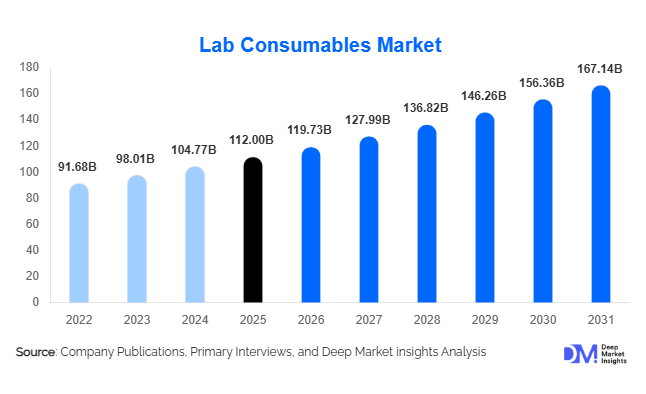
According to Deep Market Insights, the global lab consumables market size was valued at USD 112 billion in 2025 and is projected to grow from USD 119.73 billion in 2026 to reach USD 167.14 billion by 2031, expanding at a CAGR of 6.9% during the forecast period (2026–2031). The market growth is primarily driven by the rising demand for clinical diagnostics, increasing pharmaceutical and biotechnology R&D activities, and the growing adoption of laboratory automation. Lab consumables play a critical role across healthcare, research, and industrial testing environments due to their recurring usage and essential role in ensuring accuracy, sterility, and efficiency in laboratory workflows.
Key Market Insights
- Plastic consumables dominate the market, accounting for over 40% share, driven by single-use applications and compatibility with automated systems.
- Clinical diagnostics is the leading application segment, supported by increasing testing volumes and rising global disease burden.
- North America leads the global market, benefiting from advanced healthcare infrastructure and high R&D expenditure.
- Asia-Pacific is the fastest-growing region, driven by expanding healthcare infrastructure and government investments in biotechnology.
- Automation and high-throughput workflows are increasing the demand for precision-engineered consumables.
- Sustainability concerns are encouraging the development of eco-friendly and recyclable lab consumables.
What are the latest trends in the lab consumables market?
Shift Toward Single-Use and Sterile Consumables
The growing emphasis on contamination control and operational efficiency has accelerated the adoption of single-use consumables across laboratories. Biopharmaceutical manufacturing and clinical research environments increasingly rely on disposable plasticware to reduce cross-contamination risks and minimize cleaning requirements. This trend is particularly prominent in cell culture, biologics production, and molecular diagnostics, where sterility is critical. Manufacturers are expanding their portfolios with pre-sterilized, ready-to-use consumables, enabling faster turnaround times and improved laboratory productivity.
Integration of Automation-Compatible Consumables
The adoption of laboratory automation is reshaping the consumables landscape. Automated liquid handling systems, robotic platforms, and high-throughput screening technologies require highly standardized consumables with precise dimensions and quality consistency. As a result, there is increasing demand for automation-friendly products such as robotic pipette tips, microplates, and barcode-enabled consumables. These innovations improve traceability, reduce human error, and enhance reproducibility, making them essential for modern laboratories focused on efficiency and scalability.
What are the key drivers in the lab consumables market?
Rising Demand for Diagnostics and Testing
The increasing prevalence of chronic diseases, infectious diseases, and aging populations has led to a surge in diagnostic testing worldwide. Hospitals and diagnostic laboratories require large volumes of consumables such as test kits, pipette tips, and sample containers to support routine and specialized testing. Preventive healthcare trends and growing awareness of early disease detection are further fueling demand, making diagnostics a major growth driver for the market.
Expansion of Pharmaceutical and Biotechnology R&D
Global investments in drug discovery, biologics, and vaccine development are significantly boosting demand for lab consumables. Research activities rely heavily on consumables for experiments, assays, and sample analysis. The increasing number of clinical trials and advancements in personalized medicine are driving continuous consumption of high-quality consumables, particularly in genomics and proteomics research.
What are the restraints for the global market?
Environmental Concerns Related to Plastic Waste
The widespread use of disposable plastic consumables has raised significant environmental concerns. Regulatory bodies and organizations are pushing for reduced plastic waste and sustainable alternatives. This creates pressure on manufacturers to innovate with biodegradable or recyclable materials, which can increase production costs and impact profitability.
Cost Sensitivity in Emerging Markets
Price sensitivity among laboratories, especially in developing regions, poses a challenge for market growth. Budget constraints often lead to a preference for low-cost or locally manufactured alternatives, limiting the adoption of premium products. This can impact margins for global players and create competitive pricing pressures.
What are the key opportunities in the lab consumables industry?
Growth in Emerging Markets
Emerging economies such as India, China, and Brazil present significant growth opportunities due to increasing investments in healthcare infrastructure and research capabilities. Expanding diagnostic networks and government initiatives supporting biotechnology are driving demand for lab consumables. Establishing local manufacturing and distribution networks can help companies tap into these high-growth regions effectively.
Advancements in Biologics and Cell-Based Research
The rapid growth of biologics, including monoclonal antibodies and cell therapies, is creating strong demand for specialized consumables. Products such as cell culture media, sterile flasks, and filtration systems are critical for these applications. Companies that develop innovative, high-performance consumables tailored to biologics research can capture premium market segments and achieve higher margins.
Report Scope
| Report Metric | Details |
|---|---|
| Market Size in 2025 | USD 112 Billion |
| Market Size in 2026 | USD 119.73 Billion |
| Market Size in 2031 | USD 167.14 Billion |
| CAGR | 6.9% (2026-2031) |
| Base Year for Estimation | 2025 |
| Historical Data | 2022-2024 |
| Forecast Period | 2026-2031 |
| Report Coverage | Revenue Forecast, Competitive Landscape, Supply Chain Disruption, Growth Factors, Environment & Regulatory Landscape and Trends |
| Geographies Covered | North America, Europe, APAC, Middle East and Africa, LATAM |
| Countries Covered | U.S., Canada, U.K., Germany, France, Spain, Italy, Russia, Nordic, Benelux, Rest of Europe, China, Korea, Japan, India, Australia, Singapore, Taiwan, South East Asia, Rest of Asia-Pacific, UAE, Turky, Saudi Arabia, South Africa, Egypt, Nigeria, Rest of MEA, Brazil, Mexico, Argentina, Chile, Colombia, Rest of LATAM |
Explore more data points, trends and opportunities Download Free Sample Report
Product Type Insights
Plasticware continues to lead the product segment with approximately 42% market share in 2025, primarily driven by its cost-effectiveness, scalability, and compatibility with modern automated laboratory systems. The increasing shift toward single-use consumables in clinical and research environments has significantly strengthened demand for plasticware, particularly in applications requiring sterility and contamination control. Additionally, the rapid expansion of high-throughput screening and robotic liquid handling systems has reinforced the dominance of plastic consumables such as pipette tips, microplates, and tubes, as these are specifically designed for precision and repeatability.
Glassware maintains a stable presence in niche and specialized applications, particularly where high-temperature resistance, chemical inertness, and reusability are essential. Laboratories involved in analytical chemistry and certain industrial testing processes continue to rely on glassware despite the broader shift toward disposables. Meanwhile, filtration and chromatography consumables are experiencing steady growth due to increasing demand in pharmaceutical quality control, environmental monitoring, and food safety testing. These segments are benefiting from stricter regulatory frameworks and the need for accurate separation and purification processes. Cell culture consumables are among the fastest-growing categories, driven by the surge in biologics, vaccine production, and regenerative medicine, where sterile and high-performance consumables are critical for maintaining cell viability and experimental integrity.
Application Insights
Clinical diagnostics dominates the application segment, accounting for nearly 30% of the global market in 2025. This leadership position is primarily driven by the high frequency of diagnostic testing, the increasing prevalence of chronic and infectious diseases, and the global emphasis on preventive healthcare. The continuous need for routine testing, including blood analysis, molecular diagnostics, and point-of-care testing, ensures a steady and recurring demand for consumables.
Drug discovery and development remain key growth drivers, supported by rising pharmaceutical R&D investments and the expansion of biologics pipelines. Consumables play a critical role in every stage of drug development, from initial screening to clinical trials, leading to consistent demand. Genomics and proteomics are emerging as high-growth application areas, fueled by advancements in sequencing technologies and the increasing adoption of precision medicine. These fields require specialized consumables such as PCR plates, reagents, and sample preparation kits, contributing to their rapid expansion. Additionally, environmental and food testing applications are gaining momentum due to stringent global regulations related to safety, quality assurance, and compliance, further diversifying the application landscape.
Distribution Channel Insights
Direct sales dominate the distribution landscape with over 55% market share, as large pharmaceutical companies, hospitals, and research institutions prefer long-term procurement contracts with manufacturers. This approach ensures consistent product quality, regulatory compliance, and cost optimization through bulk purchasing agreements. Direct engagement with manufacturers also enables customization of consumables based on specific laboratory requirements, further strengthening this channel’s dominance.
Third-party distributors play a vital role in expanding market reach, particularly in emerging economies and smaller laboratory setups where direct procurement may not be feasible. These distributors provide logistical support, inventory management, and access to a wide range of products from multiple manufacturers. Meanwhile, e-commerce platforms are rapidly gaining traction, driven by digital transformation and the need for convenient procurement solutions. Online channels offer price transparency, quick comparisons, and doorstep delivery, making them particularly attractive for small and medium-sized laboratories. The integration of digital procurement systems and inventory management tools is expected to further accelerate the growth of this segment.
End-User Insights
Pharmaceutical and biotechnology companies represent the largest end-user segment, accounting for approximately 35% of the global market. This dominance is driven by extensive R&D activities, increasing biologics production, and the growing number of clinical trials worldwide. The need for high-quality, standardized consumables in drug development processes ensures sustained demand from this segment.
Hospitals and diagnostic laboratories are among the fastest-growing end-users, supported by rising patient volumes, expanding diagnostic capabilities, and increasing adoption of advanced testing technologies. The shift toward preventive healthcare and early diagnosis is further boosting consumable usage in this segment. Academic and research institutes continue to play a significant role, driven by government funding, scientific innovation, and collaborative research initiatives. Contract research organizations (CROs) are also witnessing rapid expansion, as pharmaceutical companies increasingly outsource research activities to reduce costs and improve efficiency. This trend is contributing to higher consumption of lab consumables across outsourced research environments.
Explore more data points, trends and opportunities Download Free Sample Report
Lab Consumables Market Segmentations
By Product Type
- Plasticware
- Glassware
- Filtration Consumables
- Chromatography Consumables
- Cell Culture Consumables
- Diagnostics Consumables
- Liquid Handling Consumables
By Application
- Clinical Diagnostics
- Drug Discovery & Development
- Genomics & Proteomics
- Environmental Testing
- Food & Beverage Testing
- Academic Research
By Distribution Channel
- Direct Sales
- Third-Party Distributors
- E-commerce Platforms
By End-User
- Pharmaceutical & Biotechnology Companies
- Hospitals & Diagnostic Laboratories
- Academic & Research Institutes
- Contract Research Organizations (CROs)
- Food & Environmental Testing Laboratories
By Material
- Plastic
- Glass
- Others
Regional Insights
North America
North America remains the largest market, accounting for approximately 38% of the global share in 2025, with the United States leading demand. The region’s dominance is driven by its well-established healthcare infrastructure, high concentration of pharmaceutical and biotechnology companies, and substantial R&D expenditure. Additionally, strong government funding for life sciences research, coupled with the presence of advanced diagnostic laboratories, continues to fuel demand for lab consumables. The increasing adoption of automation and precision medicine further strengthens growth in this region. Canada complements this growth through investments in academic research and biotechnology innovation, contributing to a stable and mature market environment.
Europe
Europe accounts for around 27% of the global market, with major contributions from Germany, the UK, and France. The region’s growth is driven by stringent regulatory standards, which necessitate high-quality consumables for compliance in pharmaceutical and clinical applications. Additionally, strong government support for research and innovation, particularly in the European Union, is boosting demand. The presence of established pharmaceutical companies and a robust healthcare system further enhances market stability. Increasing focus on sustainability and eco-friendly consumables is also shaping product innovation and procurement strategies across the region.
Asia-Pacific
Asia-Pacific is the fastest-growing region, with a CAGR exceeding 8%, driven by the rapid expansion of healthcare infrastructure and increasing investments in biotechnology. China accounts for nearly 18% of global demand, supported by large-scale manufacturing capabilities, government initiatives, and a growing domestic research ecosystem. India is emerging as a high-growth market due to policy initiatives, rising healthcare spending, and expansion of diagnostic networks. Japan remains a technologically advanced market, characterized by strong adoption of automation and high-quality standards. The region’s growth is further supported by cost advantages, increasing clinical trial activities, and the rising presence of global pharmaceutical companies.
Latin America
Latin America holds approximately 7% market share, with Brazil and Mexico leading regional demand. Growth in this region is primarily driven by improving healthcare infrastructure, increasing access to diagnostic services, and rising government investments in public health. Expanding pharmaceutical manufacturing and growing awareness of disease prevention are also contributing to higher consumption of lab consumables. Additionally, international collaborations and import-driven supply chains are supporting market expansion in the region.
Middle East & Africa
The Middle East & Africa region accounts for about 5% of the global market, with growth driven by ongoing healthcare infrastructure development and increasing government focus on improving diagnostic capabilities. Countries such as the UAE and Saudi Arabia are investing heavily in healthcare modernization and research facilities, which is boosting demand for lab consumables. In Africa, gradual improvements in healthcare access and international funding for disease control programs are supporting market growth. The region is also witnessing increasing adoption of advanced diagnostic technologies, further driving demand for high-quality consumables.
Key Players in the Lab Consumables Market
- Thermo Fisher Scientific
- Danaher Corporation
- Merck KGaA
- Corning Incorporated
- Eppendorf AG
- Sartorius AG
- Bio-Rad Laboratories
- Agilent Technologies
- PerkinElmer
- Avantor Inc.
- VWR International
- Greiner Bio-One
- Tecan Group
- Hamilton Company
- Lonza Group