Kitchen Towel Market Size
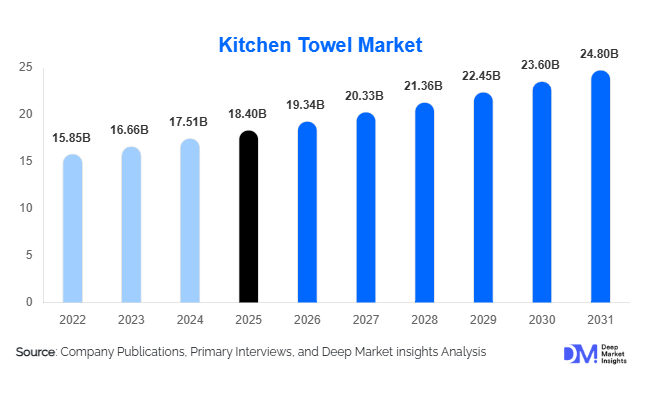
According to Deep Market Insights, the global kitchen towel market size was valued at USD 18.4 billion in 2025 and is projected to grow from USD 19.34 billion in 2026 to reach USD 24.80 billion by 2031, expanding at a CAGR of 5.1% during the forecast period (2026–2031). The kitchen towel market growth is primarily driven by rising hygiene awareness, increased adoption of disposable and eco-friendly towels, expansion of commercial foodservice and hospitality industries, and the growing popularity of premium and technologically advanced kitchen towel products.
Key Market Insights
- Paper-based kitchen towels dominate the market, offering convenience, hygiene, and widespread adoption in both residential and commercial kitchens.
- Eco-friendly and sustainable towels, including bamboo and organic cotton options, are gaining traction, driven by environmental awareness and regulatory initiatives in Europe and North America.
- North America leads the global market, with the U.S. accounting for the largest household consumption and institutional demand.
- Asia-Pacific is the fastest-growing region, propelled by rising urbanization, increasing disposable incomes, and the expansion of organized retail chains in China, India, and Southeast Asia.
- Technological innovations such as ultra-absorbent multi-ply towels, antimicrobial coatings, and embossed designs are reshaping consumer preferences and enabling premium product offerings.
- E-commerce and modern retail channels, including online subscriptions and direct-to-consumer platforms, are increasing market accessibility and boosting growth in premium and sustainable product segments.
What are the latest trends in the kitchen towel market?
Shift Toward Eco-Friendly and Sustainable Products
Manufacturers are increasingly producing towels made from bamboo fiber, recycled paper, and organic cotton to cater to environmentally conscious consumers. Sustainable product offerings are supported by certifications such as FSC and PEFC, and companies are integrating biodegradable and recyclable packaging. This trend is particularly strong in Europe and North America, where consumers prioritize eco-friendly alternatives. The demand for reusable microfiber towels and compostable paper towels is also growing, providing long-term revenue potential for forward-looking manufacturers.
Premium and Technologically Enhanced Kitchen Towels
Innovations in material technology, such as ultra-absorbent multi-ply paper and antimicrobial-treated towels, are transforming the market. Embossed designs and improved fiber engineering enhance durability and liquid retention, allowing manufacturers to command higher margins in premium segments. These products cater to both household and commercial users seeking efficiency, hygiene, and durability. The rise of subscription-based e-commerce models is also allowing premium towel brands to reach tech-savvy, convenience-oriented consumers globally.
What are the key drivers in the kitchen towel market?
Growing Awareness of Hygiene and Food Safety
The increasing focus on hygiene in food preparation and residential kitchens has accelerated demand for disposable paper towels. Consumers prefer products that reduce the risk of bacterial contamination compared to reusable cloth towels. The COVID-19 pandemic further heightened global awareness of cleanliness, reinforcing the importance of high-quality kitchen towels in households and commercial kitchens alike.
Expansion of Foodservice and Hospitality Industries
Hotels, restaurants, catering services, and institutional kitchens represent significant consumers of kitchen towels, especially in bulk quantities. The global growth of quick-service restaurants and cloud kitchens drives continuous institutional demand. Regions such as Asia-Pacific and the Middle East are witnessing high adoption due to urbanization and expanding hospitality infrastructure, directly boosting market growth.
Retail and E-Commerce Penetration
The proliferation of supermarkets, hypermarkets, and online platforms has made kitchen towels widely accessible. E-commerce channels provide convenient delivery, subscription models, and direct brand engagement, fueling adoption of premium and eco-friendly products. Digital platforms also enable consumers to compare products, read reviews, and choose higher-value options, driving overall revenue growth in the market.
What are the restraints for the global market?
Volatility in Raw Material Prices
Price fluctuations in wood pulp, recycled paper, and energy costs impact the cost of paper-based kitchen towels. These variances can reduce profit margins for manufacturers, particularly in competitive retail markets. Efficient supply chain management and cost optimization remain critical to mitigating this restraint.
Environmental Concerns Over Disposable Products
While disposable towels offer convenience, they raise concerns regarding waste generation and deforestation. Governments and consumers are promoting reusable alternatives, increasing regulatory pressures on manufacturers to adopt sustainable practices and materials.
What are the key opportunities in the kitchen towel market?
Expansion of Sustainable Product Lines
The growing demand for eco-friendly materials presents significant opportunities for manufacturers to expand bamboo, organic cotton, and recycled paper towel lines. Sustainability-oriented innovations, including compostable towels and recyclable packaging, are likely to capture environmentally conscious consumer segments and increase brand loyalty.
Institutional and Foodservice Demand
The rapid growth of hotels, restaurants, catering, hospitals, and cloud kitchens represents a substantial opportunity. Bulk contracts for paper towels in commercial kitchens can provide long-term, high-volume sales. Emerging economies in Asia-Pacific, Latin America, and the Middle East present high growth potential due to expanding hospitality infrastructure and increasing hygiene awareness.
Technological and Premium Product Innovation
Advanced manufacturing techniques and product innovations, such as ultra-absorbent multi-ply towels and antimicrobial treatments, allow companies to target premium segments with higher margins. Combining functionality, sustainability, and aesthetics creates differentiated products, enhancing market competitiveness. E-commerce subscriptions and digital marketing further enable manufacturers to reach tech-savvy consumers efficiently.
Report Scope
| Report Metric | Details |
|---|---|
| Market Size in 2025 | USD 18.4 Billion |
| Market Size in 2026 | USD 19.34 Billion |
| Market Size in 2031 | USD 24.80 Billion |
| CAGR | 5.1% (2026-2031) |
| Base Year for Estimation | 2025 |
| Historical Data | 2022-2024 |
| Forecast Period | 2026-2031 |
| Report Coverage | Revenue Forecast, Competitive Landscape, Supply Chain Disruption, Growth Factors, Environment & Regulatory Landscape and Trends |
| Geographies Covered | North America, Europe, APAC, Middle East and Africa, LATAM |
| Countries Covered | U.S., Canada, U.K., Germany, France, Spain, Italy, Russia, Nordic, Benelux, Rest of Europe, China, Korea, Japan, India, Australia, Singapore, Taiwan, South East Asia, Rest of Asia-Pacific, UAE, Turky, Saudi Arabia, South Africa, Egypt, Nigeria, Rest of MEA, Brazil, Mexico, Argentina, Chile, Colombia, Rest of LATAM |
Explore more data points, trends and opportunities Download Free Sample Report
Product Type Insights
Paper-based kitchen towels dominate the global market, accounting for approximately 58% of total demand in 2025. The leadership of this segment is primarily driven by the increasing consumer preference for disposable cleaning products that provide superior hygiene, convenience, and quick disposal after use. Paper towels are widely used across both residential kitchens and commercial foodservice environments because they effectively prevent cross-contamination compared to reusable cloth towels. Their high absorbency, affordability, and availability in multiple packaging formats, including roll packs and folded sheets, further strengthen their adoption across retail and institutional channels.
The growth of quick-service restaurants, cloud kitchens, and institutional food preparation facilities has also reinforced the demand for disposable paper towels. Commercial kitchens require large volumes of cleaning materials to maintain strict food safety standards, making paper towels a preferred solution. Additionally, technological advancements in tissue manufacturing, including multi-ply structures, embossed textures, and enhanced fiber engineering, have improved absorbency and durability, allowing manufacturers to introduce premium paper towel products with higher margins. Reusable fabric towels, such as cotton, microfiber, and terry cloth variants, serve a growing niche segment focused on sustainability and long-term cost savings. These products are increasingly favored by environmentally conscious consumers seeking reusable alternatives to disposable paper products. Meanwhile, bamboo-based and biodegradable kitchen towels are emerging in developed markets as manufacturers respond to rising demand for eco-friendly cleaning products. The market is gradually shifting toward high-performance and sustainable solutions that combine durability, absorbency, and reduced environmental impact.
Application Insights
Surface cleaning represents the largest application segment in the kitchen towel market, accounting for approximately 42% of global demand in 2025. This segment leads primarily because kitchen countertops, dining surfaces, and cooking areas require frequent cleaning to maintain hygiene and food safety standards. Disposable kitchen towels are widely used for wiping spills, removing grease, and sanitizing surfaces, making them a staple in both household and commercial kitchens. The rising awareness of food hygiene and contamination prevention has significantly increased the use of kitchen towels for surface cleaning. Restaurants, hotels, and catering services rely heavily on disposable paper towels to ensure safe food preparation environments and comply with health regulations. Additionally, increasing consumer awareness about bacterial contamination in reusable cleaning cloths has further boosted demand for disposable surface cleaning solutions.
Dish drying and food handling applications also represent important segments of the market. Many consumers use highly absorbent kitchen towels to dry utensils, glassware, and cookware efficiently. In food preparation environments, paper towels are frequently used for handling raw ingredients, draining excess oil from fried foods, and maintaining cleanliness during cooking processes. Oil and grease absorption applications are witnessing steady growth due to rising global cooking activity and the expansion of restaurant chains. Premium kitchen towels with high absorbency levels are increasingly used for removing excess oil during food preparation. In addition, the development of antimicrobial and antibacterial kitchen towels is creating new application areas where hygiene and sanitation are critical.
Distribution Channel Insights
Supermarkets and hypermarkets remain the dominant distribution channel for kitchen towels, accounting for approximately 45% of global sales in 2025. The leadership of this segment is primarily driven by the extensive product availability, competitive pricing, anencouragechase options offered by large retail chains. Consumers prefer purchasing household essentials such as kitchen towels during routine grocery shopping, making supermarkets a key sales channel for both global and private label brands. Retailers frequently promote kitchen towels through bundled packaging, discounts, and promotional campaigns, which encourages higher purchase volumes. Private label brands offered by supermarket chains have also gained traction due to their competitive pricing and acceptable product quality, creating strong competition for established manufacturers.
E-commerce platforms represent the fastest-growing distribution channel in the kitchen towel market. Online retail is gaining popularity due to the convenience of home delivery, subscription-based purchase models, and the ability to compare product features and prices easily. Many consumers now purchase household consumables through online grocery platforms, which has accelerated demand for premium and eco-friendly kitchen towels available exclusively through digital channels. Specialty home and kitchen stores serve niche consumer segments seeking premium and reusable towel products. Meanwhile, wholesale distribution channels play a critical role in supplying bulk quantities to restaurants, hotels, hospitals, and institutional kitchens. These commercial buyers typically rely on wholesale suppliers to ensure consistent supply and cost efficiency.
End-Use Insights
Residential households represent the largest end-use segment in the kitchen towel market, accounting for approximately 60% of global consumption. The dominance of this segment is driven by increasing household hygiene awareness, rising urbanization, and the growing popularity of home cooking activities. Kitchen towels are widely used in daily household tasks such as wiping surfaces, drying dishes, and cleaning food preparation areas. The HoReCa sector, including hotels, restaurants, and cafés, is the fastest-growing end-use segment, expanding at an estimated CAGR of around 6%. The growth of global foodservice chains, quick-service restaurants, and cloud kitchens has significantly increased the demand for disposable paper towels in commercial kitchens. These establishments require high volumes of cleaning materials to maintain strict sanitation standards and ensure efficient kitchen operations.
Institutional kitchens such as hospitals, schools, universities, and corporate cafeterias also represent an important end-use segment. Hospitals, in particular, require strict hygiene protocols in food preparation areas, which drives demand for disposable kitchen towels that minimize contamination risks. Educational institutions and large corporate campuses similarly depend on bulk purchases of kitchen towels to support large-scale meal preparation facilities. Export-driven demand is also evident in countries with strong pulp and paper manufacturing industries. Countries such as China, Indonesia, and Brazil produce large volumes of paper-based kitchen towels at competitive costs and export them to international markets. This export activity supports global supply and strengthens the role of emerging economies in the kitchen towel value chain.
Explore more data points, trends and opportunities Download Free Sample Report
Kitchen Towel Market Segmentations
By Product Type
- Paper-Based Kitchen Towels
- Reusable Fabric Kitchen Towels
- Eco-Friendly / Sustainable Kitchen Towels
By Application
- Surface Cleaning
- Dish Drying
- Food Preparation and Handling
- Oil and Grease Absorption
- Multipurpose Kitchen Cleaning
By Distribution Channel
- Supermarkets and Hypermarkets
- Convenience Stores
- Specialty Home & Kitchen Stores
- Online Retail / E-Commerce
- Wholesale and Institutional Supply
By End-Use
- Residential Households
- Hotels, Restaurants, and Cafés
- Institutional Kitchens
- Food Processing Facilities
Regional Insights
North America
North America is the largest regional market for kitchen towels, accounting for approximately 34% of global demand in 2025. The United States represents the largest consumer market due to high household penetration of disposable paper towels and strong demand from the hospitality and foodservice industries. Consumers in the region place a strong emphasis on hygiene, convenience, and product quality, which drives consistent demand for premium kitchen towel products.
The presence of major tissue manufacturers, well-established retail infrastructure, and high disposable incomes further support market growth. Additionally, the widespread adoption of e-commerce grocery platforms has strengthened product accessibility and consumer convenience. Canada also contributes significantly to regional demand, driven by high purchasing power and growing interest in eco-friendly and sustainable household products.
Europe
Europe holds approximately 28% of the global kitchen towel market, with major demand coming from Germany, the United Kingdom, France, and Italy. The region is characterized by strong consumer awareness of environmental sustainability and stringent regulations governing paper production and waste management. As a result, there is a strong shift toward recycled paper towels and biodegradable cleaning products. European consumers are also increasingly adopting reusable fabric towels and premium multi-ply paper products that offer higher durability and efficiency. The expansion of organized retail chains and the popularity of private label brands further support the growth of the kitchen towel market across Europe.
Asia-Pacific
Asia-Pacific is the fastest-growing region in the global kitchen towel market, with an expected CAGR of approximately 6–7% during the forecast period. Rapid urbanization, increasing disposable income levels, and expanding middle-class populations are major factors driving growth in this region. China represents the largest market due to its massive consumer base and rapidly expanding retail sector. The country’s large-scale pulp and paper manufacturing industry also supports both domestic consumption and export activity. India is witnessing increasing adoption of disposable kitchen products as organized retail chains and e-commerce platforms expand across urban areas.
Japan and South Korea maintain high per-capita consumption of tissue and paper products due to strong hygiene standards and consumer preferences for premium household products. The rapid growth of the foodservice sector across Southeast Asia is also contributing to rising demand for kitchen towels in commercial kitchens.
Latin America
Latin America accounts for approximately 6–7% of the global market, with Brazil and Mexico representing the largest regional markets. Growth in this region is supported by expanding urban populations, increasing retail penetration, and rising disposable incomes among middle-class consumers. The hospitality and restaurant sectors are also expanding in major metropolitan areas, which is driving commercial demand for disposable kitchen towels. Additionally, increasing consumer awareness of kitchen hygiene and cleaning convenience is encouraging households to adopt paper-based kitchen towels instead of traditional cleaning cloths.
Middle East & Africa
The Middle East and Africa region represents approximately 5% of global kitchen towel demand. The market is primarily driven by the rapid growth of hospitality, tourism, and foodservice industries in countries such as the United Arab Emirates, Saudi Arabia, and South Africa. The expansion of hotels, restaurants, and catering services in major tourism hubs has significantly increased institutional demand for disposable cleaning products. Additionally, government initiatives to develop tourism infrastructure across the Middle East are contributing to increased consumption of kitchen towels in commercial establishments. In Africa, rising urbanization and the gradual expansion of modern retail channels are improving product accessibility. Local manufacturing and distribution networks are also expanding, supporting the growth of paper-based household cleaning products across emerging African markets.
Key Players in the Kitchen Towel Market
- Kimberly-Clark Corporation
- Procter & Gamble
- Essity AB
- Georgia-Pacific LLC
- Sofidel Group
- Cascades Inc.
- Metsä Group
- Vinda International Holdings
- WEPA Group
- Renova Group
- Kruger Products
- Clearwater Paper Corporation
- Hengan International Group
- Oji Holdings Corporation
- Asia Pulp & Paper