Kitchen Cooking Meat Thermometer Market Size
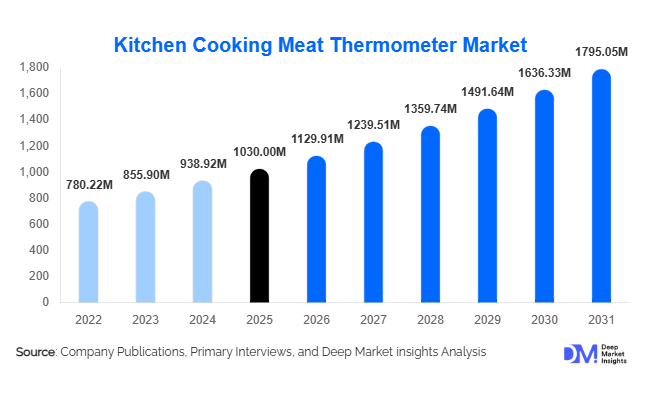
According to Deep Market Insights, the global kitchen cooking meat thermometer market size was valued at USD 1,030 million in 2025 and is projected to grow from USD 1,129.91 million in 2026 to reach USD 1,795.05 million by 2031, expanding at a CAGR of 9.7% during the forecast period (2026–2031). The market growth is primarily driven by increasing awareness regarding food safety, rising adoption of precision cooking tools, and the growing popularity of home-based culinary activities. Additionally, the expansion of BBQ and grilling culture, particularly in developed regions, and the rapid adoption of smart kitchen appliances are significantly contributing to the demand for advanced meat thermometers.
Key Market Insights
- Digital and smart thermometers are rapidly replacing analog variants, driven by accuracy, ease of use, and connectivity features.
- Wireless and app-enabled thermometers are gaining traction, particularly among tech-savvy home cooks and professional chefs.
- North America dominates the global market, supported by strong grilling culture and high consumer awareness of food safety.
- Asia-Pacific is the fastest-growing region, driven by urbanization, rising disposable income, and adoption of modern kitchen appliances.
- Residential demand accounts for the majority share, fueled by increased home cooking and interest in gourmet meal preparation.
- E-commerce channels are expanding rapidly, enabling wider accessibility and product comparison for consumers globally.
What are the latest trends in the kitchen cooking meat thermometer market?
Smart and Connected Thermometers Gaining Momentum
The integration of smart technologies is transforming the meat thermometer market. Bluetooth and Wi-Fi-enabled thermometers allow users to monitor cooking temperatures remotely through mobile applications, providing real-time alerts and cooking recommendations. These devices are particularly popular among BBQ enthusiasts and professional chefs who require precise temperature control over extended cooking durations. Manufacturers are increasingly focusing on app integration, cloud-based monitoring, and compatibility with smart home ecosystems, enhancing user convenience and engagement. Multi-probe smart thermometers are also gaining popularity, allowing simultaneous monitoring of multiple food items, which is especially useful in commercial kitchens and outdoor grilling scenarios.
Rising Popularity of Precision Cooking at Home
Consumers are increasingly adopting precision cooking techniques to achieve restaurant-quality results at home. The influence of cooking shows, social media food content, and culinary experimentation has significantly boosted demand for instant-read and probe thermometers. Home cooks are prioritizing accuracy to ensure food safety and consistency, particularly when preparing meats, baked goods, and confectionery items. This trend is further supported by the growing availability of affordable digital thermometers, making precision cooking tools accessible to a broader consumer base.
What are the key drivers in the kitchen cooking meat thermometer market?
Growing Awareness of Food Safety Standards
Increasing awareness regarding foodborne illnesses and the importance of cooking meat to safe internal temperatures is a key driver of market growth. Regulatory bodies and food safety organizations are emphasizing the use of thermometers in both residential and commercial kitchens. This has led to higher adoption rates, particularly in developed regions where compliance with food safety standards is stringent.
Expansion of BBQ and Grilling Culture
The growing popularity of BBQ and grilling, especially in North America and Europe, is significantly driving demand for meat thermometers. Outdoor cooking events, backyard grilling, and smoking techniques require precise temperature monitoring, making thermometers an essential tool. This cultural trend is also spreading to emerging markets, further boosting global demand.
What are the restraints for the global market?
Price Sensitivity in Emerging Markets
In developing regions, consumers often prioritize affordability over advanced features, limiting the adoption of premium digital and smart thermometers. Low-cost alternatives and traditional cooking practices continue to dominate, posing a challenge for market penetration.
Reliance on Traditional Cooking Methods
Many consumers, particularly in emerging economies, rely on visual cues and cooking experience rather than measurement tools. This limits the widespread adoption of thermometers, especially among older demographics and rural households.
What are the key opportunities in the kitchen cooking meat thermometer industry?
Integration with Smart Kitchen Ecosystems
The increasing adoption of smart home technologies presents a significant opportunity for manufacturers to develop connected thermometers integrated with voice assistants and mobile applications. These products can offer enhanced functionality such as automated cooking alerts, recipe recommendations, and remote monitoring, appealing to modern consumers seeking convenience and efficiency.
Expansion in Emerging Markets
Rapid urbanization and rising disposable incomes in regions such as Asia-Pacific and Latin America are creating new growth opportunities. Manufacturers can target these markets by offering affordable digital thermometers and localized product designs tailored to regional cooking preferences.
Report Scope
| Report Metric | Details |
|---|---|
| Market Size in 2025 | USD 1030 Million |
| Market Size in 2026 | USD 1129.91 Million |
| Market Size in 2031 | USD 1795.05 Million |
| CAGR | 9.7% (2026-2031) |
| Base Year for Estimation | 2025 |
| Historical Data | 2022-2024 |
| Forecast Period | 2026-2031 |
| Report Coverage | Revenue Forecast, Competitive Landscape, Supply Chain Disruption, Growth Factors, Environment & Regulatory Landscape and Trends |
| Geographies Covered | North America, Europe, APAC, Middle East and Africa, LATAM |
| Countries Covered | U.S., Canada, U.K., Germany, France, Spain, Italy, Russia, Nordic, Benelux, Rest of Europe, China, Korea, Japan, India, Australia, Singapore, Taiwan, South East Asia, Rest of Asia-Pacific, UAE, Turky, Saudi Arabia, South Africa, Egypt, Nigeria, Rest of MEA, Brazil, Mexico, Argentina, Chile, Colombia, Rest of LATAM |
Explore more data points, trends and opportunities Download Free Sample Report
Product Type Insights
Instant-read digital thermometers continue to dominate the global market, accounting for approximately 38% of the total market share in 2025. This leading position is primarily driven by their superior convenience, rapid response time, and user-friendly design, which cater effectively to both novice and experienced home cooks. The growing emphasis on food safety and the need for accurate temperature measurement in everyday cooking further reinforce their adoption. Additionally, their relatively lower price point compared to advanced smart devices makes them highly accessible across a wide consumer base, particularly in price-sensitive markets. As consumers increasingly seek efficient and reliable kitchen tools, instant-read thermometers remain the preferred choice for quick, on-the-go temperature checks.Other product categories, including leave-in probe thermometers, are witnessing strong demand in commercial and semi-professional environments where continuous temperature monitoring is critical. These devices are extensively used in restaurant kitchens, catering services, and BBQ applications, where maintaining consistent cooking temperatures is essential for food quality and safety compliance. Meanwhile, wireless and smart thermometers are emerging as a high-growth segment, supported by the increasing penetration of smart home ecosystems and connected devices. Features such as remote monitoring via mobile applications, multi-probe capabilities, real-time alerts, and integration with IoT platforms are driving their adoption among tech-savvy consumers and professional chefs. As digitalization continues to reshape kitchen environments, the demand for advanced thermometer solutions is expected to accelerate significantly.
Application Insights
BBQ and grilling applications represent the leading segment in the market, contributing nearly 30% of the total demand in 2025. This dominance is largely fueled by the strong outdoor cooking culture in developed regions, particularly in North America and parts of Europe, where grilling is deeply embedded in social and recreational activities. The increasing popularity of backyard gatherings, weekend barbecues, and seasonal grilling events has significantly boosted the demand for precise temperature monitoring tools. Moreover, the growing consumer focus on achieving restaurant-quality results at home has further driven the adoption of food thermometers in grilling applications.Meat cooking remains a core application segment, underpinned by the critical need to ensure proper internal temperatures for both taste and food safety. Thermometers play a vital role in preventing undercooking or overcooking, especially for poultry, beef, and seafood, thereby enhancing their indispensability in both residential and commercial kitchens. Additionally, the baking and confectionery segment is gaining steady traction, driven by the rising popularity of home baking trends and precision cooking techniques. Consumers are increasingly adopting thermometers to achieve consistent results in delicate recipes such as chocolates, pastries, and bread, where temperature accuracy is crucial. This shift toward precision-oriented cooking practices is expected to further expand the application scope of food thermometers.
Distribution Channel Insights
Offline retail channels continue to dominate the distribution landscape, accounting for around 60% of the market share. Supermarkets, hypermarkets, and specialty kitchen stores remain key sales avenues due to their ability to provide hands-on product experience, immediate purchase availability, and trusted brand visibility. Consumers often prefer offline channels for kitchen tools to physically assess product quality, usability, and durability before making a purchase decision. Additionally, strong retail networks and in-store promotions contribute to sustained sales through these channels.However, the online retail segment is experiencing rapid expansion and is expected to significantly reshape the market dynamics over the forecast period. The growth of e-commerce platforms is driven by increasing internet penetration, convenience of home delivery, and access to a wide range of products across different price points and brands. Online platforms also offer detailed product comparisons, user reviews, and competitive pricing, which influence purchasing decisions, particularly for advanced digital and smart thermometers. The rising preference for direct-to-consumer sales models and the expansion of global e-commerce giants are further accelerating the shift toward online channels, making them a critical growth driver for the market.
End-Use Insights
The residential segment dominates the global food thermometer market, contributing approximately 62% of total demand. This leadership is primarily driven by the increasing adoption of modern kitchen appliances and the growing interest in gourmet cooking among households. The rise of cooking shows, social media food content, and digital recipe platforms has encouraged consumers to experiment with diverse cuisines and cooking techniques, thereby boosting the demand for accurate temperature measurement tools. Additionally, heightened awareness regarding food safety and hygiene, particularly in the post-pandemic era, has further strengthened the adoption of food thermometers in home kitchens.The commercial segment, encompassing restaurants, hotels, catering services, and food processing units, is also witnessing steady growth. This expansion is largely attributed to stringent food safety regulations and compliance requirements imposed by health authorities across various regions. Commercial kitchens require precise temperature control to ensure consistency, quality, and safety in large-scale food preparation. The increasing number of foodservice establishments, coupled with the growing demand for high-quality dining experiences, is driving the adoption of advanced thermometer solutions in this segment. Furthermore, the integration of digital technologies in commercial kitchens is expected to create additional growth opportunities.
Explore more data points, trends and opportunities Download Free Sample Report
Kitchen Cooking Meat Thermometer Market Segmentations
By Product Type
- Instant-Read Thermometers
- Leave-In Thermometers
- Wireless & Smart Thermometers
- Infrared Thermometers
By Technology
- Digital Thermometers
- Analog Thermometers
By Application
- Meat Cooking
- BBQ & Grilling
- Baking & Confectionery
- Smoking & Roasting
- Liquid & Oil Temperature Measurement
By End-Use
- Residential
- Commercial
By Distribution Channel
- Online Retail
- Offline Retail
Regional Insights
North America
North America holds the largest share of the global food thermometer market, accounting for approximately 34% in 2025. The region’s dominance is supported by a combination of cultural, technological, and regulatory factors. The United States leads the market due to its strong BBQ and grilling culture, high consumer awareness regarding food safety, and widespread adoption of smart kitchen devices. The presence of established market players and continuous product innovation further strengthen regional growth. Additionally, increasing consumer inclination toward premium and connected kitchen appliances is driving demand for advanced thermometer solutions. In Canada, the growing popularity of outdoor cooking, coupled with rising disposable income and lifestyle changes, is contributing to steady market expansion. The region also benefits from well-established retail and e-commerce infrastructure, facilitating easy product accessibility.
Europe
Europe accounts for around 27% of the market share, with key contributions from countries such as Germany, the United Kingdom, and France. The region’s growth is primarily driven by stringent food safety regulations and standards that mandate accurate temperature monitoring in both residential and commercial settings. A mature and well-developed foodservice industry further supports demand for food thermometers, particularly in professional kitchens. Additionally, increasing consumer awareness about food quality and hygiene is encouraging the adoption of thermometers in home cooking. The growing trend of gourmet cooking and baking, along with rising demand for premium kitchen tools, is also contributing to market expansion. Technological advancements and the increasing penetration of smart kitchen appliances are expected to further enhance growth prospects in the region.
Asia-Pacific
Asia-Pacific is the fastest-growing region in the global market, with a CAGR exceeding 11%. Rapid urbanization, rising disposable incomes, and changing consumer lifestyles are key factors driving market growth across countries such as China, India, and Japan. The increasing adoption of modern kitchen appliances and the growing influence of Western cooking practices are significantly boosting demand for food thermometers. In addition, the expansion of the middle-class population and the rising popularity of home cooking and baking are contributing to increased product penetration. The region is also witnessing strong growth in e-commerce, which is enhancing product accessibility and driving sales of advanced digital and smart thermometers. Furthermore, the expanding foodservice industry and increasing focus on food safety standards are expected to create substantial growth opportunities in the coming years.
Latin America
Latin America is experiencing steady growth in the food thermometer market, with countries such as Brazil and Mexico leading regional demand. The market expansion is supported by increasing consumer awareness regarding food safety and the gradual adoption of modern cooking tools. Cultural preferences for grilled and barbecued foods also contribute to the growing demand for thermometers in the region. Additionally, the rising penetration of organized retail and e-commerce platforms is improving product availability and accessibility. Economic development and urbanization are further encouraging consumers to invest in kitchen appliances, including food thermometers, thereby supporting market growth.
Middle East & Africa
The Middle East & Africa region is witnessing moderate growth, driven by the expanding hospitality and tourism sectors, particularly in countries such as the United Arab Emirates and Saudi Arabia. The increasing number of hotels, restaurants, and catering services is creating demand for precise temperature monitoring solutions to ensure food quality and safety. Rising disposable incomes and changing consumer lifestyles are also contributing to the adoption of modern kitchen appliances in residential settings. Additionally, the growing influence of international cuisines and cooking practices is encouraging the use of food thermometers. While the market is still developing, improving retail infrastructure and increasing awareness are expected to support gradual growth in the region.