Kitchen Cleaning Brush Market Size
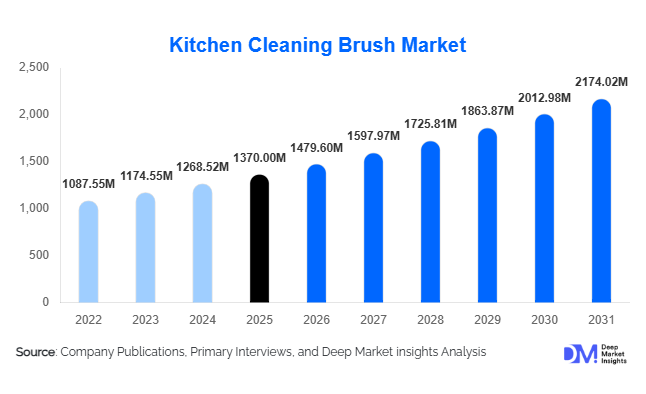
According to Deep Market Insights, the global kitchen cleaning brush market size was valued at USD 1,370 million in 2025 and is projected to grow from USD 1,479.60 million in 2026 to reach USD 2,174.02 million by 2031, expanding at a CAGR of 8.0% during the forecast period (2026–2031). The kitchen cleaning brush market growth is primarily driven by rising hygiene awareness, increasing urbanization, and the expansion of residential and commercial kitchen infrastructure globally. Additionally, growing consumer preference for durable, ergonomic, and eco-friendly cleaning tools is reshaping product innovation and market dynamics.
Key Market Insights
- Demand for eco-friendly and biodegradable kitchen brushes is rising significantly, driven by sustainability concerns and regulatory pressure on plastic usage.
- Commercial kitchens and foodservice establishments are key growth drivers, supported by the global expansion of restaurants, cloud kitchens, and catering services.
- Asia-Pacific dominates the global market, led by high population density, strong manufacturing capabilities, and increasing urban consumption.
- North America and Europe are witnessing premiumization trends, with higher adoption of ergonomic and technologically advanced cleaning brushes.
- Online retail channels are expanding rapidly, driven by convenience, product variety, and competitive pricing.
- Technological innovation, including electric brushes and antimicrobial materials, is transforming product differentiation and consumer engagement.
What are the latest trends in the kitchen cleaning brush market?
Shift Toward Sustainable and Eco-Friendly Products
The market is increasingly witnessing a transition toward environmentally sustainable products. Consumers are actively seeking alternatives to plastic-based brushes, leading to a surge in demand for bamboo handles, natural fiber bristles, and recyclable materials. Manufacturers are responding by introducing biodegradable product lines and reducing plastic packaging. This trend is particularly strong in Europe and North America, where regulatory frameworks and consumer awareness are pushing companies toward greener production practices. Sustainability certifications and eco-labeling are also becoming key differentiators, influencing purchasing decisions and brand loyalty.
Adoption of Technologically Advanced Cleaning Tools
Technological integration is emerging as a key trend in the kitchen cleaning brush market. Electric cleaning brushes, battery-operated scrubbers, and brushes with antimicrobial coatings are gaining traction among urban consumers. These innovations enhance cleaning efficiency, reduce manual effort, and improve hygiene standards. Additionally, modular designs with replaceable heads and multi-functional usage are attracting consumers looking for long-term value. Smart home integration and premium kitchen tools are further accelerating the adoption of technologically advanced cleaning solutions.
What are the key drivers in the kitchen cleaning brush market?
Increasing Hygiene Awareness
Rising awareness regarding kitchen hygiene and sanitation is a primary driver of market growth. Consumers are increasingly prioritizing cleanliness to prevent contamination and maintain health standards. This has led to higher replacement frequency of cleaning tools and increased demand for specialized brushes designed for different kitchen applications.
Growth of Urban Households and Changing Lifestyles
Rapid urbanization and the rise of nuclear families are contributing significantly to market expansion. With increasing disposable income and busy lifestyles, consumers are investing in efficient and durable kitchen cleaning tools. The trend toward modern kitchens and organized living spaces is further boosting demand for innovative cleaning products.
Expansion of the Foodservice Industry
The global growth of restaurants, hotels, and catering services is driving large-scale demand for kitchen cleaning brushes. Commercial kitchens require frequent and rigorous cleaning, resulting in consistent procurement of high-quality cleaning tools. The rise of cloud kitchens and food delivery platforms is further amplifying this demand.
What are the restraints for the global market?
Intense Price Competition in the Economy Segment
The market faces significant price competition, particularly in the low-cost segment. Limited product differentiation and the presence of numerous local manufacturers result in pricing pressures, reducing profit margins for established players.
Availability of Substitute Cleaning Products
The presence of alternatives such as sponges, scrub pads, and automated dishwashers poses a challenge to market growth. In developed markets, increasing dishwasher penetration is reducing reliance on manual cleaning tools, impacting demand for traditional brushes.
What are the key opportunities in the kitchen cleaning brush industry?
Rising Demand for Sustainable Solutions
The increasing focus on sustainability presents a major opportunity for market players. Companies investing in biodegradable materials, reusable designs, and eco-friendly packaging can capture a growing segment of environmentally conscious consumers. Regulatory restrictions on plastics further strengthen this opportunity.
Expansion in Emerging Markets
Emerging economies in Asia-Pacific, Latin America, and Africa offer significant growth potential due to rising urbanization, increasing disposable income, and expanding retail networks. Local manufacturing and cost-effective product offerings can help companies penetrate these high-growth markets.
Report Scope
| Report Metric | Details |
|---|---|
| Market Size in 2025 | USD 1370 Million |
| Market Size in 2026 | USD 1479.60 Million |
| Market Size in 2031 | USD 2174.02 Million |
| CAGR | 8% (2026-2031) |
| Base Year for Estimation | 2025 |
| Historical Data | 2022-2024 |
| Forecast Period | 2026-2031 |
| Report Coverage | Revenue Forecast, Competitive Landscape, Supply Chain Disruption, Growth Factors, Environment & Regulatory Landscape and Trends |
| Geographies Covered | North America, Europe, APAC, Middle East and Africa, LATAM |
| Countries Covered | U.S., Canada, U.K., Germany, France, Spain, Italy, Russia, Nordic, Benelux, Rest of Europe, China, Korea, Japan, India, Australia, Singapore, Taiwan, South East Asia, Rest of Asia-Pacific, UAE, Turky, Saudi Arabia, South Africa, Egypt, Nigeria, Rest of MEA, Brazil, Mexico, Argentina, Chile, Colombia, Rest of LATAM |
Explore more data points, trends and opportunities Download Free Sample Report
Product Type Insights
The product type segment of the kitchen cleaning brush market is characterized by a diverse portfolio catering to varying cleaning intensities and consumer preferences. Dish cleaning brushes continue to dominate the market, accounting for approximately 32% of total demand, primarily due to their indispensable role in daily kitchen activities across both residential and commercial settings. Their ergonomic designs, durability, and cost-effectiveness make them a staple product with high replacement frequency. The dominance of this segment is further supported by increasing awareness regarding hygiene and the need for efficient cleaning solutions in everyday use.Scrub brushes and multi-purpose brushes are also gaining significant traction, particularly in heavy-duty cleaning applications where tougher stains and grease removal are required. The growth of this segment is driven by the rising demand for versatile tools capable of handling multiple surfaces, including utensils, countertops, and sinks. Consumers are increasingly inclined toward products that offer multifunctionality, thereby reducing the need for multiple cleaning tools and enhancing convenience.
Electric cleaning brushes represent a rapidly expanding niche within the market, supported by technological advancements and growing consumer inclination toward automation and convenience-driven products. These brushes reduce manual effort and improve cleaning efficiency, making them particularly attractive in urban households and commercial kitchens where time-saving solutions are prioritized. Additionally, innovations such as rechargeable batteries, interchangeable heads, and water-resistant designs are further propelling segment growth.Overall, the market is witnessing a gradual transition toward multi-functional and technologically enhanced cleaning tools. Manufacturers are focusing on product innovation, incorporating features such as antimicrobial bristles, eco-friendly materials, and ergonomic handles to enhance usability and long-term value, thereby strengthening the growth trajectory of advanced product segments.
Application Insights
In terms of application, household usage accounts for the largest share of the market, driven by the essential nature of kitchen cleaning activities and the frequent need for replacing worn-out brushes. The consistent demand from residential users is fueled by increasing hygiene awareness, changing lifestyles, and the growing adoption of modern kitchen tools. The leading driver for this segment is the high frequency of daily cleaning tasks, which ensures a stable and recurring demand cycle.Commercial applications, including restaurants, hotels, and catering services, represent the fastest-growing segment within the market. This growth is primarily driven by the rapid expansion of the global foodservice industry, rising consumer preference for dining out, and the proliferation of quick-service restaurants and cloud kitchens. The need for durable, high-performance cleaning tools capable of handling large volumes of dishwashing and maintaining strict hygiene standards is a key factor supporting this segment’s growth.
Institutional applications, such as hospitals, educational institutions, and corporate facilities, are also witnessing increasing demand. This is largely due to stringent sanitation protocols and regulatory requirements that mandate the use of effective cleaning tools to prevent contamination and ensure public safety. The increasing emphasis on cleanliness in shared spaces, particularly in the post-pandemic environment, continues to create new opportunities within this segment.The emergence of cloud kitchens and delivery-only food services is further expanding the application landscape, creating additional demand for efficient and long-lasting kitchen cleaning tools that can withstand intensive usage patterns.
Distribution Channel Insights
The distribution channel landscape of the kitchen cleaning brush market is evolving with the coexistence of traditional and modern retail formats. Offline retail channels, including supermarkets, hypermarkets, and specialty stores, continue to dominate the market with a share of around 60%. The leading driver for this segment is consumer preference for physically evaluating product quality, durability, and design before making a purchase. Immediate product availability and the ability to compare multiple options in-store also contribute to the sustained dominance of offline channels.However, online retail is emerging as a high-growth segment, driven by the increasing penetration of e-commerce platforms and digital payment systems. Consumers are increasingly attracted to the convenience of home delivery, extensive product variety, and competitive pricing offered by online platforms. The rise of direct-to-consumer brands and the growing influence of digital marketing and social media are further reshaping purchasing behavior, particularly among younger, tech-savvy consumers.Additionally, subscription-based models and bulk purchasing options available online are gaining popularity among commercial buyers, further accelerating the shift toward digital channels. As a result, manufacturers are adopting omnichannel strategies to enhance market reach and improve customer engagement across both offline and online platforms.
End-Use Insights
Based on end-use, residential households remain the largest segment, contributing nearly 58% of the overall market. The leading driver for this segment is the consistent and repetitive nature of kitchen cleaning activities in households, which leads to frequent product replacement and sustained demand. Increasing urbanization, rising disposable incomes, and the growing adoption of modern kitchen practices are further supporting the expansion of this segment.The commercial segment, encompassing restaurants, hotels, and catering services, is the fastest-growing end-use category. This growth is driven by the increasing global demand for food services, expansion of hospitality infrastructure, and rising consumer inclination toward dining and food delivery services. The need for high-quality, durable cleaning tools capable of maintaining hygiene standards in high-volume operations is a key factor fueling demand in this segment.Institutional end-use, including healthcare facilities, educational institutions, and corporate offices, is also experiencing steady growth. The rising emphasis on hygiene and sanitation, particularly in healthcare settings where infection control is critical, is driving the adoption of effective cleaning solutions. Government regulations and compliance standards further reinforce the demand for reliable and hygienic kitchen cleaning tools in institutional environments.
Explore more data points, trends and opportunities Download Free Sample Report
Kitchen Cleaning Brush Market Segmentations
By Product Type
- Dish Cleaning Brushes
- Bottle Cleaning Brushes
- Scrub Brushes
- Vegetable Cleaning Brushes
- Sink & Drain Cleaning Brushes
- Multi-purpose Kitchen Brushes
- Electric Cleaning Brushes
By Bristle Material
- Plastic Bristles
- Natural Fiber Bristles
- Metal Bristles
- Silicone Bristles
Distribution Channel
- Online Retail
- Supermarkets/Hypermarkets
- Convenience Stores
- Specialty Kitchenware Stores
- Wholesale & Institutional Sales
Regional Insights
North America
North America accounts for approximately 25% of the global market, with the United States being the primary contributor. The region’s growth is driven by high consumer awareness regarding hygiene and cleanliness, along with a strong preference for premium and technologically advanced products. The widespread adoption of electric and ergonomic cleaning tools reflects the region’s inclination toward convenience and innovation. Additionally, the presence of well-established retail infrastructure, both offline and online, ensures easy product availability. Growing demand for eco-friendly and sustainable cleaning products, supported by increasing environmental consciousness among consumers, further acts as a key driver for regional growth.
Europe
Europe holds around 22% of the market share, with major contributions from countries such as Germany, the United Kingdom, and France. The region is a global leader in sustainability initiatives, which significantly influences consumer purchasing behavior and product development strategies. The primary driver of growth in Europe is the strong emphasis on environmentally friendly products, including biodegradable and recyclable kitchen cleaning brushes. Strict environmental regulations and policies imposed by regulatory bodies encourage manufacturers to innovate and develop sustainable alternatives. Additionally, high standards of living and strong awareness regarding hygiene contribute to steady market expansion across the region.
Asia-Pacific
Asia-Pacific dominates the global market with an approximate share of 38%, driven by its large population base and rapid urbanization. Countries such as China and India play a crucial role due to their strong manufacturing capabilities and expanding consumer markets. The key driver for regional growth is the rising disposable income and the rapid expansion of the middle-class population, which is increasing spending on household and kitchen products. Furthermore, changing lifestyles, increased awareness of hygiene, and the growing penetration of modern retail and e-commerce platforms are significantly boosting demand. India, in particular, is emerging as one of the fastest-growing markets, supported by urban expansion, increasing nuclear households, and rising demand for affordable yet efficient cleaning solutions.
Latin America
Latin America accounts for around 8% of the global market, with Brazil and Mexico being the leading contributors. The region’s growth is primarily driven by improving economic conditions and the gradual expansion of organized retail sectors. Increasing urbanization and rising consumer awareness regarding hygiene are also supporting demand for kitchen cleaning tools. The leading driver for growth in this region is the strong reliance on residential consumption, coupled with the increasing availability of affordable products through both traditional and modern retail channels.
Middle East & Africa
The Middle East & Africa region is experiencing steady growth, supported by rapid urbanization and the expansion of the hospitality and tourism sectors. Key countries such as the UAE and Saudi Arabia are driving regional demand due to significant investments in infrastructure development and an increasing number of hotels and restaurants. The primary growth driver in this region is the expanding hospitality industry, which requires high-quality cleaning tools to maintain hygiene standards. Additionally, rising disposable incomes and improving living standards are contributing to increased adoption of modern kitchen cleaning products across urban households.
Key Players in the Kitchen Cleaning Brush Market
- OXO International
- Carlisle FoodService Products
- Libman Company
- Casabella Holdings
- 3M (Scotch-Brite)
- Rubbermaid Commercial Products
- Fuller Brush Company
- Gala Brush
- Vikan A/S
- Ettore Products
- Weiler Corporation
- Quickie Manufacturing
- Leifheit AG
- Joseph Joseph Ltd.
- IKEA