Kids Toothpaste Market Size
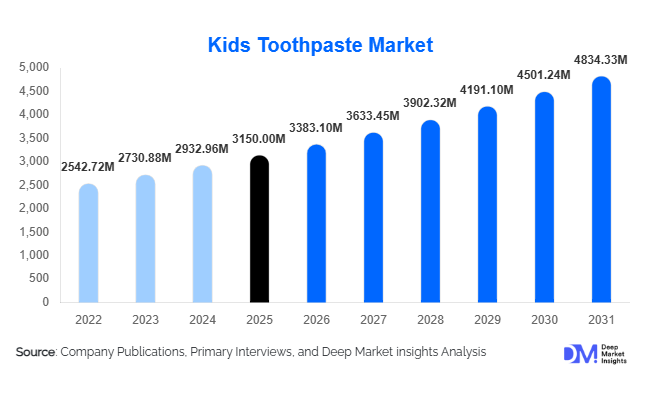
According to Deep Market Insights, the global kids toothpaste market size was valued at USD 3,150 million in 2025 and is projected to grow from USD 3,383.10 million in 2026 to reach USD 4,834.33 million by 2031, expanding at a CAGR of 7.4% during the forecast period (2026–2031). The market growth is primarily driven by increasing awareness of pediatric oral hygiene, rising demand for child-specific formulations, and growing parental preference for safe, flavored, and engaging oral care products. The expansion of organized retail and e-commerce channels, along with innovations in natural and fluoride-free formulations, is further accelerating market penetration across both developed and emerging economies.
Key Market Insights
- Natural and fluoride-free formulations are gaining strong traction, driven by increasing parental concerns regarding chemical exposure in children’s products.
- Flavor innovation and child-friendly packaging are key differentiators, enhancing product appeal and improving brushing compliance among children.
- Asia-Pacific dominates the global market, supported by a large population base, rising incomes, and increasing oral care awareness.
- E-commerce is the fastest-growing distribution channel, enabling direct-to-consumer engagement and wider product accessibility.
- Mid-range products account for the largest share, balancing affordability and perceived quality, particularly in emerging markets.
- Digital engagement tools, such as gamified brushing apps and smart packaging, are reshaping consumer interaction and brand loyalty.
What are the latest trends in the kids toothpaste market?
Shift Toward Natural and Clean-Label Products
The market is witnessing a significant transition toward herbal, organic, and clean-label toothpaste formulations. Parents are increasingly scrutinizing ingredient lists and opting for products free from parabens, SLS, artificial colors, and excessive fluoride. This has led to a surge in demand for plant-based ingredients such as neem, aloe vera, and xylitol. Manufacturers are responding by introducing certified organic products and transparent labeling practices. This trend is particularly prominent in North America and Europe, where regulatory frameworks and consumer awareness are more advanced, positioning natural toothpaste as a premium yet fast-growing segment.
Interactive and Technology-Enabled Oral Care
Technological innovation is transforming how children engage with oral hygiene. Brands are integrating QR codes, augmented reality experiences, and mobile apps that gamify brushing routines. These tools encourage consistent brushing habits by rewarding children through digital incentives and interactive content. Smart toothbrush integration and personalized recommendations based on brushing patterns are also emerging. This trend not only enhances user engagement but also strengthens brand loyalty by creating a connected oral care ecosystem for children and parents alike.
What are the key drivers in the kids toothpaste market?
Rising Awareness of Pediatric Oral Health
The growing incidence of dental caries among children has increased awareness regarding early oral care. Governments, dental associations, and healthcare providers are actively promoting preventive dental practices, leading to higher adoption of kids-specific toothpaste products. School-based dental programs and pediatric dentists' recommendations are further reinforcing this trend globally.
Product Innovation and Differentiation
Continuous innovation in flavors, textures, and packaging is a major driver of market growth. Manufacturers are introducing appealing variants such as bubblegum, chocolate, and fruit flavors, along with colorful gels and character-themed packaging. These innovations enhance the overall brushing experience for children, making oral hygiene more engaging and increasing product usage frequency.
What are the restraints for the global market?
Concerns Over Fluoride Usage
Debates regarding the safety of fluoride in children’s toothpaste have created uncertainty among parents. While fluoride is effective in preventing cavities, excessive use can lead to dental fluorosis. This has led to hesitation in product selection and increased demand for alternative formulations, posing a challenge for manufacturers to balance efficacy and safety.
Price Sensitivity in Emerging Markets
Despite growing demand, affordability remains a key constraint in developing regions. Premium and specialized products often face limited adoption due to higher price points. Manufacturers must focus on cost-effective solutions and smaller packaging formats to cater to price-sensitive consumers while maintaining product quality.
What are the key opportunities in the kids toothpaste industry?
Expansion in Emerging Economies
Rapid urbanization and increasing disposable incomes in countries such as India, China, and Brazil present significant growth opportunities. Low market penetration combined with rising awareness creates a favorable environment for both global and regional players. Localization strategies, including affordable pricing and culturally relevant flavors, can unlock substantial demand in these markets.
Digital Engagement and Smart Packaging
The integration of digital technologies into product packaging offers new avenues for consumer engagement. Interactive packaging featuring QR codes and gamified experiences can encourage regular brushing habits while enhancing brand recall. Companies investing in digital ecosystems and partnerships with educational platforms can create long-term customer relationships and differentiate themselves in a competitive market.
Report Scope
| Report Metric | Details |
|---|---|
| Market Size in 2025 | USD 3150 Million |
| Market Size in 2026 | USD 3383.10 Million |
| Market Size in 2031 | USD 4834.33 Million |
| CAGR | 7.4% (2026-2031) |
| Base Year for Estimation | 2025 |
| Historical Data | 2022-2024 |
| Forecast Period | 2026-2031 |
| Report Coverage | Revenue Forecast, Competitive Landscape, Supply Chain Disruption, Growth Factors, Environment & Regulatory Landscape and Trends |
| Geographies Covered | North America, Europe, APAC, Middle East and Africa, LATAM |
| Countries Covered | U.S., Canada, U.K., Germany, France, Spain, Italy, Russia, Nordic, Benelux, Rest of Europe, China, Korea, Japan, India, Australia, Singapore, Taiwan, South East Asia, Rest of Asia-Pacific, UAE, Turky, Saudi Arabia, South Africa, Egypt, Nigeria, Rest of MEA, Brazil, Mexico, Argentina, Chile, Colombia, Rest of LATAM |
Explore more data points, trends and opportunities Download Free Sample Report
Product Type Insights
Fluoride toothpaste continues to dominate the global kids toothpaste market, accounting for approximately 48% of total market share in 2025. This leadership is primarily driven by strong clinical endorsement from dental associations worldwide, which emphasize fluoride’s effectiveness in preventing dental caries among children. Governments and public health bodies also actively promote fluoride-based oral care through school dental programs and awareness campaigns, further reinforcing its adoption. However, the segment is witnessing gradual competition from non-fluoride and herbal alternatives. These variants are gaining traction, particularly among health-conscious parents concerned about excessive fluoride ingestion and chemical exposure in young children. The herbal/natural segment is emerging as the fastest-growing category, supported by rising demand for clean-label products and plant-based ingredients such as neem, aloe vera, and xylitol. Meanwhile, medicated toothpaste remains a niche but important segment, driven by increasing cases of pediatric dental issues such as sensitivity and enamel erosion, with higher penetration in developed regions where specialized oral care is more prevalent.
Application Insights
From an application perspective, children aged 5–8 years account for the largest share, contributing nearly 34% of the global market in 2025. This segment leads due to a critical behavioral transition phase where children begin brushing independently, resulting in higher product usage frequency and brand engagement. Parents are also more likely to invest in flavored and attractive toothpaste variants for this age group to encourage consistent oral hygiene habits. Toddlers and infants represent a smaller but essential segment, requiring low-fluoride or fluoride-free formulations designed for safe ingestion, thereby driving innovation in gentle and safe product formulations. The pre-teen segment (9–12 years) is witnessing growing demand for advanced formulations such as enamel protection and whitening, as children gradually transition toward adult oral care products. This evolving demand across age groups is encouraging manufacturers to create highly targeted product portfolios and age-specific marketing strategies.
Distribution Channel Insights
Supermarkets and hypermarkets dominate the distribution landscape, accounting for approximately 40% of total sales in 2025. Their leadership is driven by strong shelf visibility, availability of multiple brands, and consumer preference for one-stop shopping experiences. Additionally, promotional activities, discounts, and in-store marketing campaigns significantly influence purchasing decisions in this channel. Pharmacies and drug stores hold a critical share, particularly for clinically recommended and medicated toothpaste, as parents often rely on pharmacist and dentist recommendations. Notably, e-commerce is the fastest-growing distribution channel, fueled by increasing digital adoption, convenience, and access to a broader range of products, including niche and premium brands. Subscription-based models and direct-to-consumer (D2C) platforms are further enhancing customer retention by offering personalized recommendations and recurring delivery options, thereby reshaping the competitive landscape.
Price Segment Insights
The mid-range segment leads the global market with approximately 50% share in 2025, driven by its ability to balance affordability with quality. This segment appeals strongly to middle-income households, particularly in emerging markets, where consumers seek trusted brands without paying premium prices. The premium segment is gaining momentum in developed regions such as North America and Europe, supported by rising demand for organic, fluoride-free, and clinically advanced formulations. Premium products often command 30–50% higher prices due to their perceived safety, superior ingredients, and brand positioning. On the other hand, economy products continue to play a crucial role in driving volume sales in price-sensitive markets across Asia, Africa, and Latin America. Manufacturers are increasingly offering smaller pack sizes and value-based pricing strategies to cater to this segment, ensuring broader market penetration.
Explore more data points, trends and opportunities Download Free Sample Report
Kids Toothpaste Market Segmentations
By Product Type
- Fluoride Toothpaste
- Non-Fluoride Toothpaste
- Herbal/Natural Toothpaste
- Medicated Toothpaste
By Application (Age Group)
- Infants (0–2 years)
- Toddlers (2–4 years)
- Children (5–8 years)
- Pre-teens (9–12 years)
By Distribution Channel
- Supermarkets & Hypermarkets
- Pharmacies & Drug Stores
- Online/E-commerce
- Convenience Stores
- Dental Clinics
By Price Segment
- Premium
- Mid-range
- Economy
Regional Insights
Asia-Pacific
Asia-Pacific dominates the global kids toothpaste market, accounting for approximately 38% of the total market share in 2025. The region’s leadership is driven by its large pediatric population, increasing urbanization, and rising disposable incomes. China contributes nearly 18% of global demand, supported by a well-established retail network, strong domestic manufacturing capabilities, and growing consumer awareness regarding oral hygiene. India is the fastest-growing country in the region, with growth driven by government-led oral health initiatives, expanding rural penetration, and increasing adoption of branded personal care products. Additionally, the rise of e-commerce platforms and local herbal brands is accelerating market expansion. The region’s growth is further supported by favorable demographics and increasing investments in healthcare infrastructure.
North America
North America holds approximately 26% of the global market share, with the United States as the primary contributor. The region’s growth is driven by high consumer awareness, strong purchasing power, and widespread adoption of premium and specialized oral care products. Increasing preference for natural, organic, and fluoride-free toothpaste is a key driver, supported by stringent regulatory standards and transparency in product labeling. Additionally, strong recommendations from pediatric dentists and the presence of leading global brands contribute to consistent demand. Technological advancements, including smart oral care products and digital engagement tools, further enhance market growth in this region.
Europe
Europe accounts for approximately 22% of the global market, with major contributions from Germany, the UK, and France. The region’s growth is primarily driven by stringent regulatory frameworks ensuring product safety and quality, along with a strong consumer preference for organic and eco-friendly products. Increasing environmental awareness has led to rising demand for sustainable packaging and natural formulations. Government-supported healthcare systems and school-based dental programs also play a crucial role in promoting early oral hygiene habits among children. The premiumization trend is particularly strong in Western Europe, where consumers are willing to pay higher prices for certified and clinically tested products.
Latin America
Latin America represents around 8% of the global market, led by Brazil and Mexico. The region’s growth is driven by improving economic conditions, an expanding middle-class population, and increasing awareness of oral hygiene. Government initiatives and public health campaigns are playing a significant role in educating consumers about preventive dental care. Additionally, the expansion of organized retail and e-commerce platforms is improving product accessibility. However, price sensitivity remains a key factor, encouraging demand for mid-range and economy products.
Middle East & Africa
The Middle East & Africa region accounts for nearly 6% of the global market share. Growth in this region is driven by rapid urbanization, increasing healthcare awareness, and rising disposable incomes in countries such as the UAE and Saudi Arabia. South Africa serves as a key market due to its relatively advanced retail infrastructure and healthcare system. Government initiatives aimed at improving oral health, along with increasing penetration of international brands, are supporting market expansion. Additionally, a growing young population and rising demand for affordable personal care products are expected to drive long-term growth in the region.
Key Players in the Kids Toothpaste Market
- Colgate-Palmolive
- Procter & Gamble
- Unilever
- GlaxoSmithKline
- Johnson & Johnson
- Lion Corporation
- Dabur
- Himalaya Wellness
- Church & Dwight
- Tom’s of Maine
- Amway
- Pigeon Corporation
- Sunstar Group
- LG Household & Health Care
- Kao Corporation