Kids Swimwear Market Size
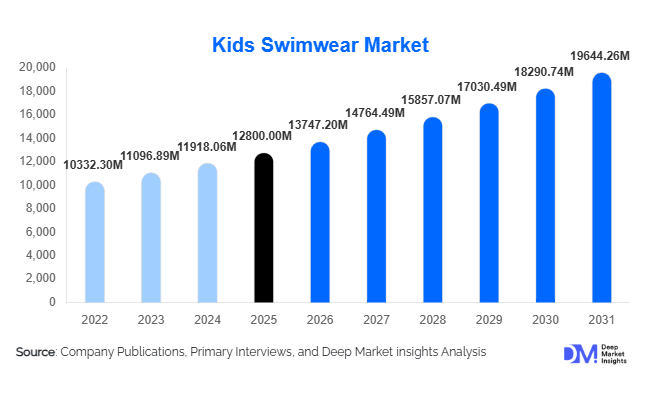
According to Deep Market Insights, the global kids swimwear market size was valued at USD 12,800 million in 2025 and is projected to grow from USD 13,747.20 million in 2026 to reach USD 19,644.26 million by 2031, expanding at a CAGR of 7.4% during the forecast period (2026–2031). The kids’ swimwear market growth is primarily driven by increasing participation in recreational and competitive swimming, rising disposable incomes, and growing awareness regarding UV-protective clothing for children. The expansion of global tourism, especially beach and resort-based travel, along with the proliferation of indoor swimming facilities, is further supporting year-round demand. Additionally, technological advancements in fabrics such as quick-dry materials, chlorine resistance, and sustainable textiles are transforming the market landscape.
Key Market Insights
- Growing awareness of UV protection and child safety is accelerating demand for functional and performance swimwear.
- Mid-range swimwear dominates the market, balancing affordability with durability and brand value.
- North America leads the global market, supported by a strong swimming culture and high consumer spending.
- Asia-Pacific is the fastest-growing region, driven by rising middle-class income and increasing urbanization.
- E-commerce channels are rapidly expanding, enabling global reach and personalized product offerings.
- Sustainability trends are encouraging the adoption of recycled fabrics and eco-friendly production methods.
What are the latest trends in the kids swimwear market?
Rising Demand for Sustainable Swimwear
Sustainability has become a defining trend in the kids’ swimwear market, with increasing adoption of recycled materials such as regenerated polyester derived from ocean plastics. Brands are investing in eco-friendly production processes and transparent supply chains to meet consumer demand for sustainable products. Parents, particularly millennials, are prioritizing environmentally responsible purchases, driving premiumization in this segment. Companies are also introducing biodegradable packaging and reducing water usage in manufacturing, aligning with global sustainability goals and regulatory pressures.
Growth of Functional and UV-Protective Apparel
Functional swimwear with built-in UV protection (UPF-rated fabrics) is gaining widespread popularity. Parents are becoming more conscious of the risks of sun exposure, leading to higher adoption of rash guards, swim shirts, and full-coverage swim sets. This trend is particularly strong in regions with high UV exposure, such as Australia and North America. Innovations in fabric technology, including moisture-wicking, anti-chlorine, and stretch-enhancing features, are further enhancing product performance and expanding their use beyond recreational swimming into sports and training applications.
What are the key drivers in the kids’ swimwear market?
Increasing Participation in Swimming and Water Activities
Swimming is increasingly promoted as a life skill and a core fitness activity for children, leading to higher enrollment in swimming classes and sports programs globally. This has created consistent demand for durable and high-performance swimwear. The growth of water parks, recreational centers, and school-level swimming programs further supports this trend, ensuring steady market expansion across regions.
Rising Disposable Income and Lifestyle Changes
Improving economic conditions and rising disposable income levels are enabling families to spend more on leisure activities and premium apparel for children. The growing popularity of family vacations, beach tourism, and resort stays is significantly boosting seasonal demand for kids’ swimwear. Additionally, urbanization and changing lifestyles are encouraging increased participation in organized sports and recreational activities.
Innovation in Fabric and Design Technology
Technological advancements in textile manufacturing have led to the development of high-performance swimwear materials that offer durability, comfort, and enhanced protection. Features such as chlorine resistance, quick-dry capabilities, and UV protection are becoming standard, allowing brands to differentiate their offerings and command higher price points. These innovations are also extending product lifespan, improving value for consumers.
What are the restraints for the global market?
Seasonal Demand Fluctuations
The kids’ swimwear market is highly seasonal, with peak demand occurring during the summer months in most regions. This creates challenges in inventory management, production planning, and revenue stability for manufacturers and retailers. Although indoor swimming facilities and year-round tourism are mitigating this issue, seasonality remains a significant constraint in many markets.
Price Sensitivity in Emerging Economies
In price-sensitive markets, particularly in developing regions, consumers often prefer low-cost, unbranded swimwear options. This limits the penetration of premium and technologically advanced products, affecting profit margins for global brands. Companies must balance affordability with quality to capture a broader consumer base in these regions.
What are the key opportunities in the kids swimwear industry?
Expansion of UV-Protective and Performance Swimwear
The growing emphasis on sun safety presents a significant opportunity for manufacturers to develop advanced UV-protective swimwear. Governments and health organizations are actively promoting awareness about skin protection, creating a favorable environment for innovation. Brands that invest in high-performance materials and certifications can capture premium market segments and strengthen brand loyalty.
Growth of E-commerce and Direct-to-Consumer Channels
The rapid expansion of online retail is transforming the distribution landscape. E-commerce platforms enable brands to reach global consumers, offer personalized recommendations, and reduce dependency on physical retail infrastructure. Direct-to-consumer strategies, supported by digital marketing and influencer collaborations, are opening new revenue streams and enhancing customer engagement.
Untapped Potential in Emerging Markets
Emerging economies such as India, Indonesia, and Brazil offer significant growth opportunities due to rising disposable incomes, urbanization, and increasing awareness of swimming as a recreational and safety activity. Expansion of water parks, swimming facilities, and tourism infrastructure in these regions is further driving demand, making them key focus areas for market participants.
Report Scope
| Report Metric | Details |
|---|---|
| Market Size in 2025 | USD 12800 Million |
| Market Size in 2026 | USD 13747.20 Million |
| Market Size in 2031 | USD 19644.26 Million |
| CAGR | 7.4% (2026-2031) |
| Base Year for Estimation | 2025 |
| Historical Data | 2022-2024 |
| Forecast Period | 2026-2031 |
| Report Coverage | Revenue Forecast, Competitive Landscape, Supply Chain Disruption, Growth Factors, Environment & Regulatory Landscape and Trends |
| Geographies Covered | North America, Europe, APAC, Middle East and Africa, LATAM |
| Countries Covered | U.S., Canada, U.K., Germany, France, Spain, Italy, Russia, Nordic, Benelux, Rest of Europe, China, Korea, Japan, India, Australia, Singapore, Taiwan, South East Asia, Rest of Asia-Pacific, UAE, Turky, Saudi Arabia, South Africa, Egypt, Nigeria, Rest of MEA, Brazil, Mexico, Argentina, Chile, Colombia, Rest of LATAM |
Explore more data points, trends and opportunities Download Free Sample Report
Product Type Insights
Swim it isontinue to dominate the kids’ swimwear market, accounting for approximately 28% of the global market share in 2025. This leadership position is primarily driven by its multi-functional utility, as it is widely used not only for swimming but also as casual summer wear, particularly among boys. Their durability, ease of wear, and broader acceptance across age groups make them a preferred choice for parents seeking value-for-money products. In addition, frequent product replacements due to wear-and-tear further support consistent demand in this segment.
One-piece swimsuits and two-piece options for girls collectively represent a substantial share, driven by fashion-oriented purchasing behavior and frequent style updates. The increasing influence of social media, character licensing, and branded designs is fueling demand in this category. Meanwhile, rash guards and swim shirts are among the fastest-growing sub-segments, supported by rising awareness regarding UV protection and skin safety. These products are increasingly being positioned as essential protective gear rather than optional apparel, particularly in high UV exposure regions. Swim sets and swim diapers serve niche but important segments, especially among infants and toddlers. Their growth is driven by increasing participation of younger children in water-based activities and the expansion of baby-friendly swimming programs. Overall, product diversification and functionality-driven innovation remain key drivers shaping this segment.
Application Insights
Recreational swimming remains the largest application segment, accounting for the majority of market demand. This dominance is driven by increasing family-oriented leisure activities, rising tourism, and the growing popularity of beach vacations and water parks. The expansion of hospitality infrastructure and resort-based experiences continues to reinforce this segment’s leadership globally. Competitive swimming is emerging as a significant growth area, supported by increasing participation in school-level, club, and professional sports programs. Governments and educational institutions are actively promoting swimming as a core physical activity, leading to higher demand for durable and performance-oriented swimwear among children.
The training and fitness segment is also expanding steadily, particularly in urban areas where indoor swimming facilities are becoming more accessible. This trend is driving demand for high-performance swimwear with enhanced durability and flexibility. Additionally, specialized applications such as UV-protective swimwear for outdoor use and branded merchandise for resorts and cruise operators are contributing to incremental market growth, diversifying application areas beyond traditional usage.
Distribution Channel Insights
Offline retail channels continue to lead the market, accounting for approximately 58% of the global share in 2025. The dominance of this segment is primarily attributed to the importance of physical product evaluation, including size, fit, and fabric quality, which are critical factors in children’s apparel purchasing decisions. Supermarkets, specialty stores, and department stores benefit from strong footfall, especially during peak summer seasons, and offer immediate product availability.
However, online retail is the fastest-growing distribution channel, driven by increasing internet penetration, smartphone usage, and evolving consumer preferences toward convenience. E-commerce platforms and brand-owned websites are leveraging advanced technologies such as AI-driven recommendations, virtual sizing tools, and personalized marketing to enhance customer experience. The availability of a wider product assortment, competitive pricing, and easy return policies further support the rapid growth of online channels. The integration of omnichannel strategies, where consumers browse online and purchase offline (or vice versa), is also becoming increasingly prominent, enabling brands to optimize customer engagement and expand their reach.
Age Group Insights
The 6–10-year age group dominates the market, accounting for approximately 32% of the global share in 2025. This segment’s leadership is driven by high participation rates in swimming lessons, school activities, and recreational programs. Children in this age group also require frequent product replacements due to growth and increased activity levels, contributing to sustained demand. Toddlers and infants represent a significant and steadily growing segment, particularly in categories such as swim diapers and protective swimwear. The rise of early childhood swimming programs and parental focus on water safety is supporting growth in this segment. Additionally, increasing awareness regarding hygiene and comfort is driving demand for specialized products tailored to younger children.
Pre-teens (11–14 years) are emerging as a high-potential segment, with growing demand for fashionable, branded, and performance-oriented swimwear. This group is increasingly influenced by peer trends, social media, and sports participation, leading to higher adoption of premium and specialized products.
Explore more data points, trends and opportunities Download Free Sample Report
Kids Swimwear Market Segmentations
By Product Type
- One-piece swimsuits
- Two-piece swimsuits
- Swim trunks
- Rash guards/swim shirts
- Swim sets
- Swim diapers
By Application
- Recreational swimming
- Competitive swimming
- Training and fitness
- UV-protective and outdoor use
By Distribution Channel
- Online retail
- Supermarkets & hypermarkets
- Specialty stores
- Department stores
- Brand-owned stores
By Age Group
- Infants (0–2 years)
- Toddlers (3–5 years)
- Children (6–10 years)
- Pre-teens (11–14 years)
Regional Insights
North America
North America holds approximately 30% of the global kids’ swimwear market share, with the United States accounting for the majority of regional demand. The region’s leadership is driven by high participation in swimming as both a recreational and competitive activity, supported by widespread access to swimming pools, sports clubs, and training facilities. Additionally, strong disposable income levels and a well-developed retail ecosystem enable higher spending on premium and branded swimwear. Another key growth driver is the increasing awareness of sun safety and UV protection, which has led to strong demand for rash guards and UPF-rated swimwear. The presence of major global brands and continuous product innovation further strengthens market growth in this region.
Europe
Europe accounts for around 25% of the global market, with key contributions from countries such as the UK, Germany, France, and Italy. The region benefits from strong tourism activity, particularly in Mediterranean coastal areas, which drives seasonal demand for kids’ swimwear. A major growth driver in Europe is the increasing preference for sustainable and ethically produced apparel. Consumers are highly conscious of environmental impact, leading to strong demand for eco-friendly swimwear made from recycled materials. Additionally, government regulations promoting sustainable manufacturing practices and product safety standards are further shaping market dynamics.
Asia-Pacific
Asia-Pacific represents approximately 28% of the global market and is the fastest-growing region, with a CAGR exceeding 9%. Countries such as China, India, Japan, and Australia are driving growth due to rapid urbanization, rising middle-class income, and increasing awareness of swimming as a life skill. The expansion of water parks, recreational centers, and school-level swimming programs is significantly boosting demand. Additionally, the rapid growth of e-commerce platforms in the region is enhancing product accessibility and affordability. Government initiatives promoting sports participation and health awareness are further supporting market expansion.
Latin America
Latin America accounts for approximately 10% of the global market, with Brazil and Mexico being the key contributors. The region’s growth is driven by its strong beach culture, favorable climate, and increasing participation in outdoor recreational activities. Tourism development, particularly in coastal destinations, is a major driver of demand. Additionally, improving economic conditions and rising disposable incomes are enabling greater spending on children’s apparel. The growing penetration of international brands and expansion of retail networks are further supporting market growth in this region.
Middle East & Africa
The Middle East & Africa region is experiencing steady growth, supported by expanding tourism and luxury hospitality sectors. Key markets such as the UAE and South Africa are witnessing increased demand due to investments in water parks, resorts, and recreational infrastructure. Another important growth driver is the rising expatriate population and increasing adoption of Western lifestyle trends, which are influencing consumer preferences toward branded swimwear. Additionally, high temperatures and year-round outdoor activity potential in several Middle Eastern countries are supporting consistent demand for kids’ swimwear. Government investments in tourism diversification and leisure infrastructure are expected to further accelerate growth in this region.