Kids Marker Market Size
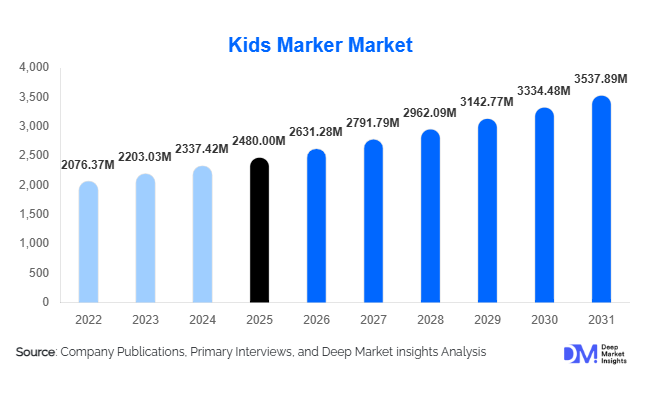
According to Deep Market Insights, the global kids marker market size was valued at USD 2,480 million in 2025 and is projected to grow from USD 2631.28 million in 2026 to reach USD 3537.89 million by 2031, expanding at a CAGR of 6.1% during the forecast period (2026–2031). The market growth is primarily driven by rising demand for creative learning tools in schools and homes, increasing adoption of non-toxic and eco-friendly markers, and the expansion of premium and specialty marker offerings catering to children of various age groups globally.
Key Market Insights
- Washable and non-toxic markers are becoming the preferred choice among parents and educational institutions, ensuring safety and ease of cleaning while encouraging creative learning.
- Emerging markets in the Asia Pacific and Latin America are driving rapid growth, fueled by rising school enrollment, growing middle-class incomes, and increased awareness of early childhood education programs.
- Water-based ink markers dominate the market, offering low-odor, eco-friendly, and child-safe alternatives, particularly for classroom and home use.
- Online retail channels are expanding market reach, with e-commerce platforms providing easy access to a wider range of products, customized kits, and bundled packs.
- Product innovation, including glitter, metallic, scented, jumbo, and dual-tip markers, is reshaping consumer preferences and driving premium pricing in global markets.
- Integration with creative learning programs and STEAM education is supporting institutional demand and creating recurring bulk orders from schools and daycare centers.
What are the latest trends in the kids marker market?
Eco-Friendly and Sustainable Marker Adoption
Manufacturers are increasingly offering markers made with biodegradable plastics, plant-based inks, and recyclable packaging to align with growing environmental awareness. Parents and schools are favoring sustainable products that reduce chemical exposure and environmental impact. Refillable markers and low-VOC inks are gaining traction, particularly in North America and Europe, allowing brands to differentiate through safety and environmental credentials. Some manufacturers have also started labeling products with eco-certifications to appeal to environmentally conscious consumers, further reinforcing sustainable marker adoption as a major market trend.
Integration with Educational and Creative Learning Programs
Markers are becoming integral to STEAM (Science, Technology, Engineering, Arts, and Mathematics) education, creative learning kits, and early childhood programs. Customized marker sets are being bundled with activity books, worksheets, and DIY craft projects to support classroom and home learning. Partnerships with schools and educational institutions are generating recurring institutional demand, providing manufacturers with opportunities to secure long-term contracts. Activity-based learning programs are also encouraging the use of specialty markers such as dual-tip, glitter, and jumbo markers for skill development in children aged 4–10 years.
What are the key drivers in the kids marker market?
Rising Early Childhood Education Enrollment
Rapid expansion of preschool, kindergarten, and primary school programs worldwide is driving consistent demand for markers. Institutions use markers extensively for teaching, coloring, and art-based learning, generating bulk procurement opportunities. Governments and private educational institutions are investing in creative learning supplies, creating a stable and growing market for kids markers. Expanding daycare and enrichment programs further reinforce demand in this segment.
Growing Popularity of Creative and DIY Art Activities
At-home art and craft activities are increasingly popular, encouraged by social media trends, DIY tutorials, and parental focus on cognitive and motor skill development. Children are engaging with coloring, journaling, and craft-based projects, increasing retail sales of markers. Specialty markers such as scented, glitter, or metallic variants are increasingly sought after for their fun, experiential value.
Product Innovation and Safety Enhancements
Non-toxic, washable, low-odor markers are becoming standard, particularly in North America and Europe. Ergonomic designs for toddlers, anti-dry nib technologies, and vibrant water-based ink formulations have improved usability and safety. Compliance with ASTM, CPSIA, and EN71 standards ensures trust among parents and educational institutions, supporting premium pricing and wider adoption.
What are the restraints for the global market?
Digital Alternatives for Creative Learning
The rise of tablets, drawing apps, and educational software offers a digital alternative to physical markers. While traditional markers remain widely used in schools, the increasing use of digital creativity platforms can limit growth in some developed regions. Children may opt for interactive drawing apps instead of conventional art supplies, impacting retail consumption patterns.
Raw Material Price Volatility
Markers require plastics, pigments, and solvents, which are susceptible to fluctuating commodity prices. Rising costs of petroleum-based plastics can squeeze profit margins, particularly for smaller manufacturers. Maintaining competitive pricing while ensuring non-toxic, eco-friendly formulations remains a challenge for producers.
What are the key opportunities in the kids marker industry?
Premium and Specialty Marker Products
Luxury and specialty markers, including glitter, metallic, scented, and dual-tip variants, offer higher margins and attract parents and schools seeking differentiated products. These innovative products support both creative learning and recreational art activities, creating opportunities to expand market share in developed and emerging economies.
Emerging Market Expansion
Countries in Asia Pacific, Latin America, and Africa are witnessing growing demand due to expanding school enrollments, rising disposable incomes, and urban middle-class growth. China, India, Brazil, and Vietnam are particularly attractive for market entry and expansion. International brands leveraging local distribution networks and e-commerce platforms can capitalize on this growth potential.
Report Scope
| Report Metric | Details |
|---|---|
| Market Size in 2025 | USD 2480 Million |
| Market Size in 2026 | USD 2631.28 Million |
| Market Size in 2031 | USD 3537.89 Million |
| CAGR | 6.1% (2026-2031) |
| Base Year for Estimation | 2025 |
| Historical Data | 2022-2024 |
| Forecast Period | 2026-2031 |
| Report Coverage | Revenue Forecast, Competitive Landscape, Supply Chain Disruption, Growth Factors, Environment & Regulatory Landscape and Trends |
| Geographies Covered | North America, Europe, APAC, Middle East and Africa, LATAM |
| Countries Covered | U.S., Canada, U.K., Germany, France, Spain, Italy, Russia, Nordic, Benelux, Rest of Europe, China, Korea, Japan, India, Australia, Singapore, Taiwan, South East Asia, Rest of Asia-Pacific, UAE, Turky, Saudi Arabia, South Africa, Egypt, Nigeria, Rest of MEA, Brazil, Mexico, Argentina, Chile, Colombia, Rest of LATAM |
Explore more data points, trends and opportunities Download Free Sample Report
Product Type Insights
Washable markers dominate the global kids marker market, accounting for approximately 42% of total sales in 2025. Their leading position is primarily driven by growing parental and institutional preference for products that are safe, easy to clean, and suitable for young children. Washable markers are specifically formulated to allow ink removal from skin, clothing, and household surfaces, making them particularly attractive for classrooms, daycare centers, and home learning environments. The increasing emphasis on child-safe art materials and compliance with international safety standards such as ASTM and EN71 has further strengthened the adoption of washable markers across developed markets. The segment’s dominance is also supported by large-scale procurement by educational institutions, where washable markers reduce maintenance costs associated with accidental stains during classroom activities. In addition, manufacturers are introducing improved washable ink technologies that maintain vibrant color quality while ensuring easy removal, making them more appealing to both parents and teachers.
Specialty markers, including scented, glitter, neon, and metallic variants, represent one of the fastest-growing product segments. These products are gaining traction as creative learning tools in STEAM-based education programs and craft activities. Specialty markers enhance engagement by offering unique sensory and visual experiences, encouraging artistic exploration among children. The rising popularity of creative hobby kits and DIY craft sets is further accelerating demand for these differentiated products. From an ink formulation perspective, water-based markers lead the market with approximately 63% share. Their dominance is driven by low toxicity, low odor, and environmentally friendly properties. Water-based inks comply with strict child-safety regulations and are widely preferred by schools and parents seeking non-toxic art supplies. The increasing global focus on sustainable consumer products is also encouraging manufacturers to invest in plant-derived pigments and eco-friendly ink formulations, further reinforcing the leadership of water-based markers in the global market.
Application Insights
Markers are extensively used in classrooms and early childhood education programs, making the education sector the largest application segment in the global kids marker market. Drawing, coloring, visual storytelling, and interactive learning activities are widely integrated into preschool and primary education curricula, making markers an essential classroom supply. As education systems increasingly adopt activity-based and creative learning methodologies, the demand for markers continues to grow. Educational institutions often procure markers in bulk for art classes, group learning activities, and project-based assignments, creating recurring demand for manufacturers. Government initiatives to improve early childhood education infrastructure, particularly in developing economies, are also boosting demand for classroom art supplies.
The home-use segment is experiencing rapid growth due to the increasing popularity of DIY craft activities, homeschooling programs, and creative hobbies among children. Parents are encouraging art-based learning at home to enhance cognitive development, motor skills, and creativity. Marker kits designed specifically for home learning, often bundled with coloring books and activity guides, are gaining popularity across retail channels. Emerging applications are also being observed in creative therapy and developmental learning programs. Pediatric therapy centers and child development institutions use art tools such as markers to support emotional expression and skill development in children. Additionally, export-driven production from countries like China, Germany, and Japan supports global supply chains, particularly for North American and European markets where branded markers are widely consumed.
Distribution Channel Insights
Offline retail channels continue to dominate the kids marker market, accounting for approximately 65% of global sales. Traditional retail outlets such as stationery stores, supermarkets, toy stores, and educational supply shops remain the primary purchasing points for parents and educational institutions. Back-to-school shopping seasons significantly boost sales through these physical retail channels, as consumers prefer to purchase school supplies in bundled shopping trips. Stationery retailers and educational supply distributors play an important role in supplying bulk marker packs to schools and daycare centers, reinforcing the importance of offline channels in institutional sales.
However, online distribution channels are rapidly expanding and are expected to gain significant market share during the forecast period. E-commerce platforms provide consumers with access to a wide variety of marker products, including premium and specialty sets that may not be widely available in physical stores. Online marketplaces also allow brands to offer subscription-based art kits, customized bundles, and limited-edition creative sets. Direct-to-consumer (D2C) strategies are becoming increasingly important for major stationery brands, enabling them to strengthen customer engagement through personalized marketing, loyalty programs, and digital product launches. Social media promotions, influencer partnerships, and digital tutorials are also influencing purchasing decisions, particularly among younger parents seeking educational and creative products for their children.
Age Group Insights
Children aged 4–6 years represent the largest consumer segment, accounting for approximately 36% of total market demand. This age group corresponds to preschool and kindergarten students who actively engage in drawing, coloring, and basic writing exercises as part of early childhood education programs. Markers designed for this segment often feature ergonomic designs, vibrant colors, and washable inks to ensure safety and ease of use. The dominance of this segment is also supported by the growing emphasis on early childhood cognitive development, where creative activities are widely used to improve motor skills, hand-eye coordination, and visual learning capabilities.
Children aged 7–10 years represent the second-largest segment, as students at this stage participate in school projects, craft assignments, and artistic activities that require a wider variety of colors and marker styles. Marker packs with larger color assortments are particularly popular among this age group. The toddler segment (1–3 years) is characterized by markers designed with enhanced safety features such as jumbo sizes, non-toxic inks, and anti-roll shapes. These markers are specifically developed to prevent choking hazards and to accommodate small hands. Pre-teens aged 11–12 years are increasingly adopting specialty markers, including brush-tip and dual-tip variants, for creative expression and school assignments. This segment is also influenced by artistic hobbies such as sketching, lettering, and journaling, which require more advanced marker designs.
Explore more data points, trends and opportunities Download Free Sample Report
Kids Marker Market Segmentations
By Product Type
- Washable Markers
- Permanent Markers for Kids
- Dry-Erase Markers
- Dual-Tip Markers
- Jumbo / Chunky Markers
- Specialty Markers
By Application
- School / Classroom Use
- Home / Personal Use
- Art & Craft Activities
- Daycare & Educational Centers
- Creative Therapy & Child Development Programs
By Distribution Channel
- Offline Retail
- Online Retail
By Age Group
- Toddlers
- Early Childhood
- Primary School Kids
- Pre-Teens
Regional Insights
North America
North America accounts for approximately 26% of the global kids marker market, with the United States representing the largest contributor, followed by Canada. The region benefits from a well-established educational infrastructure, high spending on school supplies, and strong consumer awareness of product safety standards. Parents and schools in North America prioritize non-toxic, washable markers that comply with strict regulatory guidelines such as ASTM D4236 and CPSIA.
The growth of creative learning programs and STEAM education initiatives across U.S. schools is further supporting demand for art supplies including markers. Additionally, the presence of major global stationery brands and well-developed retail networks contributes to strong product availability. The increasing popularity of specialty markers and premium art kits is also driving market expansion in the region.
Europe
Europe holds approximately 22% of the global market share, with Germany, the United Kingdom, France, and Italy representing key demand centers. The region’s growth is strongly influenced by consumer preference for eco-friendly and sustainably produced stationery products. European parents and educational institutions prioritize markers made from non-toxic inks, recyclable plastics, and environmentally responsible materials.
Government policies promoting environmentally friendly products and strict toy safety regulations have encouraged manufacturers to develop water-based and plant-derived ink formulations. The region also benefits from a strong culture of art education and creative learning programs in schools, further supporting steady demand for markers.
Asia-Pacific
Asia Pacific dominates the global kids marker market, accounting for approximately 38% of total demand. China, India, Japan, and South Korea are the major markets in the region. Large student populations, expanding school enrollment rates, and increasing household spending on education-related products are major drivers of regional growth. China plays a dual role as both a major consumer and the largest global manufacturer of stationery products, enabling strong export capabilities. India is experiencing rapid market growth due to increasing urbanization, expanding middle-class income levels, and government investments in educational infrastructure. The region also benefits from rising demand for affordable stationery products and strong domestic production capabilities, making Asia Pacific both the largest and the fastest-growing market with a projected CAGR exceeding 7.5%.
Latin America
Latin America accounts for approximately 8% of global demand, with Brazil and Mexico serving as the primary markets. Growing investments in education, expanding school enrollment rates, and improving access to basic stationery supplies are key drivers of market growth in the region. Urbanization and the expansion of retail networks are also improving product availability across Latin American countries. While price-sensitive consumers dominate the market, there is a gradual shift toward higher-quality and branded marker products, particularly among urban middle-class families.
Middle East & Africa
The Middle East and Africa collectively represent approximately 6% of the global market. Growth in this region is primarily driven by increasing investments in education infrastructure and rising demand for premium school supplies in affluent Middle Eastern countries such as the UAE and Saudi Arabia. In Africa, expanding school enrollment programs and international educational initiatives are gradually improving access to basic stationery products. South Africa remains one of the largest markets in the region due to its well-developed education system and retail infrastructure. Additionally, high-income consumers in Gulf countries are increasingly purchasing premium marker sets and international brands for educational and recreational use, contributing to steady market growth across the Middle East.
Key Players in the Kids Marker Market
- Crayola LLC
- Newell Brands (Sharpie, Paper Mate)
- Faber-Castell AG
- BIC Group
- Staedtler Mars GmbH
- Pilot Corporation
- Zebra Co., Ltd.
- Mitsubishi Pencil Co.
- Tombow Pencil Co.
- Kokuyo Co., Ltd.
- Maped Group
- Pentel Co., Ltd.
- Carioca S.p.A.
- Schneider Schreibgeräte GmbH
- Deli Group