Kid’s Hair Products Market Size
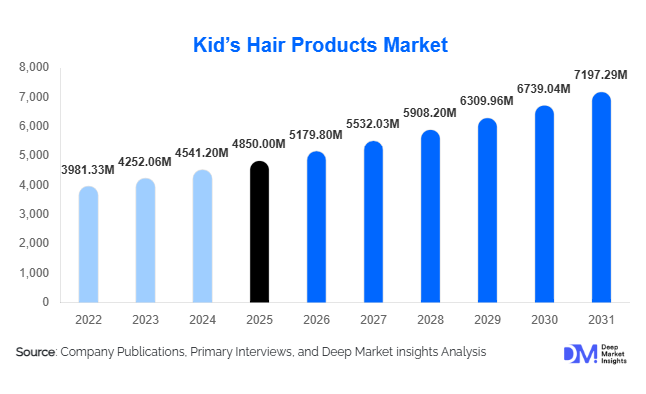
According to Deep Market Insights, the global kids’ hair products market size was valued at USD 4,850 million in 2025 and is projected to grow from USD 5,179.80 million in 2026 to reach USD 7,197.29 million by 2031, expanding at a CAGR of 6.8% during the forecast period (2026–2031). The market growth is primarily driven by increasing parental awareness regarding child-specific personal care, rising demand for safe and chemical-free formulations, and the rapid expansion of e-commerce platforms enabling wider product accessibility.
Key Market Insights
- Rising preference for natural and organic formulations is transforming product development, with parents increasingly avoiding harsh chemicals such as sulfates and parabens.
- Shampoo remains the dominant product category, accounting for nearly 38% of total market demand due to its essential role in daily hygiene.
- Asia-Pacific dominates the global market, supported by a high population, rising birth rates, and growing middle-class income levels.
- Online distribution channels are the fastest-growing, driven by convenience, wider product availability, and increasing digital adoption.
- Premiumization trends are accelerating, with consumers willing to pay more for dermatologically tested and hypoallergenic products.
- Sustainable packaging and clean-label products are becoming key differentiators among leading brands.
What are the latest trends in the kid’s hair products market?
Shift Toward Natural and Clean-Label Products
The market is witnessing a strong shift toward natural, organic, and clean-label formulations. Parents are increasingly concerned about the long-term effects of synthetic chemicals on children’s health, leading to higher demand for plant-based ingredients and dermatologically tested products. Manufacturers are responding by reformulating products with mild surfactants, botanical extracts, and allergen-free fragrances. Certifications such as organic, cruelty-free, and hypoallergenic are becoming key purchase drivers. This trend is particularly strong in North America and Europe, where regulatory frameworks support transparency and safety standards.
Digitalization and E-commerce Expansion
E-commerce platforms are rapidly transforming the market landscape. Online retail enables consumers to compare products, read reviews, and access niche brands that may not be available in physical stores. Direct-to-consumer (DTC) models are gaining traction, allowing brands to build stronger relationships with customers through personalized marketing and subscription services. Social media and influencer marketing are also playing a critical role in shaping consumer preferences, especially among millennial and Gen Z parents.
What are the key drivers in the kid’s hair products market?
Increasing Awareness of Child-Specific Grooming Needs
Parents are becoming more aware of the importance of using specialized hair care products designed for children’s sensitive scalp and hair. This has led to a decline in the use of adult products for children and a rise in demand for mild, tear-free formulations. Educational campaigns and pediatric recommendations are further supporting this trend, driving consistent market growth.
Growth in Disposable Income and Urbanization
Rising disposable incomes, particularly in emerging economies, are enabling consumers to spend more on premium and specialized personal care products. Urbanization is also contributing to increased awareness and accessibility of branded products. As middle-class populations expand, demand for mid-range and premium kid’s hair care products continues to grow.
Expansion of Modern Retail and E-commerce
The growth of supermarkets, hypermarkets, and online platforms has significantly improved product availability. E-commerce, in particular, has expanded market reach to rural and semi-urban areas, enabling consumers to access a wide range of products. This has been a major driver of market penetration and growth.
What are the restraints for the global market?
High Cost of Premium and Organic Products
Natural and organic formulations often involve higher production costs, resulting in premium pricing. This limits adoption among price-sensitive consumers, particularly in developing regions. Despite growing awareness, affordability remains a key barrier to widespread adoption.
Regulatory and Compliance Challenges
The market is subject to stringent safety and quality regulations, particularly in developed regions. Compliance with varying international standards increases operational complexity and costs for manufacturers. This can delay product launches and limit market expansion.
What are the key opportunities in the kid’s hair products industry?
Expansion of Organic and Sustainable Product Lines
The growing demand for eco-friendly and chemical-free products presents a significant opportunity for manufacturers. Companies investing in sustainable packaging, biodegradable ingredients, and certified organic formulations can capture a rapidly expanding consumer base. This trend is expected to drive innovation and differentiation in the market.
Growth in Emerging Markets
Emerging economies in Asia-Pacific, Latin America, and Africa offer substantial growth potential due to rising birth rates, increasing disposable incomes, and improving retail infrastructure. Companies that introduce affordable product variants and localized offerings can gain a competitive advantage in these regions.
Development of Climate-Specific and Customized Products
Hair care needs vary based on climatic conditions, creating opportunities for region-specific product development. Anti-frizz products for humid climates and moisturizing formulations for dry regions are gaining popularity. Customization based on local preferences can enhance market penetration and brand loyalty.
Report Scope
| Report Metric | Details |
|---|---|
| Market Size in 2025 | USD 4850 Million |
| Market Size in 2026 | USD 5179.80 Million |
| Market Size in 2031 | USD 7197.29 Million |
| CAGR | 6.8% (2026-2031) |
| Base Year for Estimation | 2025 |
| Historical Data | 2022-2024 |
| Forecast Period | 2026-2031 |
| Report Coverage | Revenue Forecast, Competitive Landscape, Supply Chain Disruption, Growth Factors, Environment & Regulatory Landscape and Trends |
| Geographies Covered | North America, Europe, APAC, Middle East and Africa, LATAM |
| Countries Covered | U.S., Canada, U.K., Germany, France, Spain, Italy, Russia, Nordic, Benelux, Rest of Europe, China, Korea, Japan, India, Australia, Singapore, Taiwan, South East Asia, Rest of Asia-Pacific, UAE, Turky, Saudi Arabia, South Africa, Egypt, Nigeria, Rest of MEA, Brazil, Mexico, Argentina, Chile, Colombia, Rest of LATAM |
Explore more data points, trends and opportunities Download Free Sample Report
Product Type Insights
Shampoo continues to dominate the kid’s hair products market, accounting for approximately 38% of the total market share in 2025, primarily due to its essential role in routine hygiene and frequent usage across all age groups. The leading driver for this segment is the increasing preference for tear-free, sulfate-free, and dermatologically tested formulations, which address parental concerns regarding scalp sensitivity and eye irritation. Manufacturers are also introducing multifunctional variants such as 2-in-1 shampoo-conditioners, enhancing convenience and strengthening category leadership. In addition, frequent product innovation, including organic and plant-based shampoos, is further accelerating growth in this segment.
Hair oils and conditioners collectively account for a significant portion of the market, particularly in Asia-Pacific and Middle Eastern regions, where traditional hair care practices emphasize nourishment, scalp hydration, and hair strengthening. The growth driver for these segments is the rising demand for natural oils such as coconut, almond, and argan, which are perceived as safer and more effective for long-term hair health. Meanwhile, styling and treatment products, though smaller in share, are the fastest-growing categories, driven by increasing grooming awareness among older children and teenagers, as well as the rising incidence of scalp-related issues such as lice and dandruff.
Application Insights
Daily hygiene applications dominate the market, contributing the largest share due to the regular use of shampoos and conditioners in children’s grooming routines. The primary driver for this segment is the growing awareness among parents regarding hygiene and preventive healthcare, particularly in urban and semi-urban populations. Frequent usage patterns and the necessity of mild formulations ensure consistent demand across all regions. Treatment applications, including anti-lice solutions and medicated scalp care products, are witnessing steady growth. This segment is driven by increasing awareness of scalp health issues and school-related hygiene concerns, especially in densely populated regions. Governments and educational institutions promoting hygiene standards are also indirectly boosting demand for treatment products.
Styling applications are emerging as a high-growth segment, particularly among children aged 10 years and above. The key driver here is the influence of social media, peer trends, and increasing focus on personal appearance. Additionally, the introduction of mild, non-toxic styling gels and creams specifically designed for children is expanding this segment. Multifunctional products, such as 2-in-1 and all-in-one grooming solutions, are further enhancing convenience and adoption across all application categories.
Distribution Channel Insights
Offline retail channels dominate the kid’s hair products market, accounting for approximately 62% of total sales in 2025. The leading driver for this segment is consumer trust and immediate product accessibility, particularly in supermarkets, hypermarkets, and pharmacies. Parents often prefer physical stores to verify product labels, ingredients, and authenticity before purchase, especially for child-specific products. In addition, strong retail networks in emerging economies continue to support offline dominance.
However, online channels are the fastest-growing segment, driven by increasing internet penetration, smartphone usage, and convenience-driven purchasing behavior. E-commerce platforms offer a wider product assortment, competitive pricing, and access to niche and premium brands that may not be available offline. Brand-owned websites are also playing a crucial role in launching new products, offering subscription models, and building direct consumer engagement. The integration of digital marketing, influencer promotions, and customer reviews is further accelerating online channel growth.
Age Group Insights
Children aged 6–12 years account for the largest share of approximately 34% in 2025, driven by their broader usage of multiple product categories, including shampoos, conditioners, and styling products. The primary growth driver for this segment is the increasing focus on grooming and hygiene among school-going children, combined with parental willingness to invest in specialized products. Infants and toddlers (0–5 years) primarily drive demand for hypoallergenic, tear-free, and ultra-mild formulations. The key driver here is heightened parental concern regarding product safety and skin sensitivity, leading to strong demand for premium and organic products in this category.
The teenage segment (13–18 years) is the fastest growing, supported by rising self-awareness, social influence, and demand for styling and treatment products. This group is more experimental and brand-conscious, encouraging companies to introduce targeted solutions such as anti-dandruff shampoos and styling creams. The increasing segmentation by age group is enabling manufacturers to develop highly customized products, enhancing overall market growth.
Explore more data points, trends and opportunities Download Free Sample Report
Kid’s Hair Products Market Segmentations
By Product Type
- Shampoo
- Conditioner
- Hair Oil
- Hair Styling Products
- Hair Treatment Products
- 2-in-1 Products
By Application
- Daily Hygiene
- Treatment
- Styling
By Distribution Channel
- Online Retail
- Supermarkets/Hypermarkets
- Pharmacies/Drugstores
- Specialty Baby Stores
- Brand-Owned Stores/Websites
By Age Group
- Infants
- Toddlers
- Children
- Teenagers
Regional Insights
Asia-Pacific
Asia-Pacific leads the global kid’s hair products market, accounting for approximately 38% of the total market share in 2025. China and India are the largest contributors, supported by high population density and rising birth rates. The key drivers for regional growth include increasing disposable incomes, rapid urbanization, and growing awareness of child hygiene. Additionally, strong cultural emphasis on hair care, particularly the use of oils and natural ingredients, is boosting demand. Expanding e-commerce penetration and government initiatives supporting domestic manufacturing are further accelerating market growth in this region.
North America
North America holds around 25% of the global market share, with the United States dominating regional demand. The primary growth drivers include high consumer awareness, strong preference for premium and organic products, and stringent regulatory standards that ensure product safety. The region also benefits from a well-established retail and e-commerce infrastructure, enabling easy access to a wide range of products. Increasing demand for clean-label and dermatologically tested formulations is further driving market expansion.
Europe
Europe accounts for approximately 22% of the market, with Germany, the UK, and France as key contributors. The region’s growth is primarily driven by strong regulatory frameworks, high adoption of sustainable and organic products, and increasing environmental consciousness among consumers. Premiumization is a major trend, with parents willing to invest in high-quality, eco-friendly products. The presence of established global brands and continuous product innovation is also supporting market growth.
Latin America
Latin America represents around 8% of the global market, led by Brazil and Mexico. The key growth drivers include improving economic conditions, rising urbanization, and expanding retail infrastructure. Increasing awareness of branded and specialized child care products is shifting consumer preference away from traditional alternatives. Additionally, the growth of modern trade and e-commerce platforms is enhancing product accessibility and driving market expansion.
Middle East & Africa
The Middle East & Africa region accounts for approximately 7% of the market, with the UAE and South Africa as major contributors. Growth in this region is driven by rising disposable incomes, increasing awareness of personal care, and the expansion of modern retail formats. In the Middle East, premium and imported products are gaining popularity due to high purchasing power, while in Africa, improving distribution networks and urbanization are supporting demand. Additionally, climatic conditions such as heat and dryness are increasing the need for moisturizing and protective hair care products, further driving market growth.
Key Players in the Kid’s Hair Products Market
- Johnson & Johnson
- Procter & Gamble
- Unilever
- L’Oréal
- Kimberly-Clark
- Beiersdorf
- Chicco
- Mustela
- Himalaya Wellness
- Dabur
- California Baby
- The Honest Company
- Burt’s Bees
- Sebapharma
- Mothercare