Instant Cold Packs Market Size
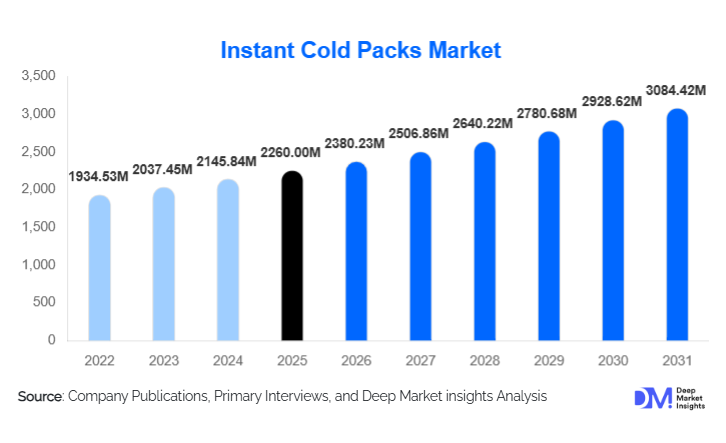
According to Deep Market Insights, the global instant cold packs market size was valued at USD 2,260.00 million in 2025 and is projected to grow from USD 2,380.23 million in 2026 to reach USD 3,084.42 million by 2031, expanding at a CAGR of 5.32% during the forecast period (2026–2031). The instant cold packs market growth is primarily driven by rising sports participation, increasing demand for non-pharmaceutical pain management, and expanding healthcare and emergency preparedness initiatives across developed and emerging markets.
Key Market Insights
- Disposable instant cold packs dominate the market, offering rapid, hygienic, and convenient solutions for acute injuries, sports trauma, and emergency first aid.
- Ammonium nitrate-based packs lead in chemical composition, due to their rapid cooling capabilities, accounting for a significant share of total market revenue.
- Sports injury applications remain the primary driver, reflecting global growth in organized athletics, outdoor recreation, and professional training programs.
- North America holds the largest regional market share, supported by advanced healthcare infrastructure, institutional safety regulations, and high sports participation rates.
- Asia-Pacific is the fastest-growing region, fueled by rising healthcare expenditure, expanding e-commerce penetration, and growing sports and recreational activities.
- Online retail channels are increasingly critical, providing direct-to-consumer access, bulk purchasing options, and subscription-based sales models that expand market reach.
What are the latest trends in the instant cold packs market?
Eco-Friendly and Sustainable Cold Packs
Manufacturers are increasingly focusing on eco-friendly instant cold packs, including biodegradable and recyclable materials, to address environmental and chemical disposal concerns. This trend is gaining traction among both healthcare institutions and eco-conscious consumers, enabling brands to differentiate their offerings while meeting regulatory standards. Sustainable packs also provide a competitive edge in markets with stringent chemical safety regulations and growing demand for “green” medical supplies.
Integration with Digital Distribution and E-Commerce
The growth of online platforms is reshaping the purchase behavior for instant cold packs. Consumers, sports organizations, and healthcare facilities are increasingly buying through e-commerce channels, enabling easy bulk procurement and subscription models. Direct-to-consumer sales allow manufacturers to capture real-time feedback, enhance customer engagement, and scale efficiently in both developed and emerging markets. Digital marketing, social media campaigns, and targeted online sales are driving product awareness and accelerating adoption globally.
What are the key drivers in the instant cold packs market?
Rising Sports Participation and Recreational Activities
Global participation in organized sports, outdoor activities, and fitness programs is growing steadily. Instant cold packs are widely used for on-the-go treatment of acute injuries, sprains, and muscle trauma, making sports teams, gyms, and athletic trainers a key consumer base. Increasing awareness of injury prevention and recovery protocols in sports further accelerates adoption, particularly in North America and Europe.
Non-Pharmaceutical Pain Management Awareness
Consumers and healthcare professionals are seeking drug-free solutions for pain and inflammation management. Instant cold packs provide convenient, safe, and immediate cooling therapy, aligning with this trend. Hospitals, clinics, and outpatient care facilities are increasingly integrating cold packs into treatment protocols, enhancing the product’s relevance and consistent demand.
Institutional Mandates and First Aid Preparedness
Workplaces, schools, sports organizations, and emergency response units are increasingly mandated to maintain first-aid kits that include instant cold packs. Compliance with safety regulations and occupational health standards supports recurring institutional demand, ensuring a steady market base for manufacturers.
What are the restraints for the global market?
Competition from Alternative Cold Therapy Solutions
Advanced cold therapy technologies such as reusable gel packs, cryotherapy devices, and ice machines provide longer-duration or customizable cooling, which can limit reliance on instant cold packs. Specialized rehabilitation centers and professional sports facilities often prefer controlled cooling systems for optimized therapeutic outcomes, restricting market growth in certain segments.
Environmental and Chemical Disposal Concerns
Traditional instant cold packs use chemical compositions that may pose environmental and safety risks if not disposed of properly. Stricter chemical handling regulations and growing consumer preference for sustainable products are pressuring manufacturers to innovate, increasing compliance costs and potentially limiting the adoption of conventional formulations.
What are the key opportunities in the instant cold packs industry?
Healthcare Policy and Emergency Preparedness
Increasing government regulations on emergency preparedness in hospitals, schools, and workplaces create opportunities for bulk procurement of instant cold packs. Public safety initiatives and workplace first-aid compliance requirements offer manufacturers a stable institutional demand base that can be expanded through strategic partnerships and certifications.
Expansion into Emerging Markets
Regions such as South Asia, Southeast Asia, and Latin America are witnessing rising sports participation, growing healthcare infrastructure, and increasing consumer awareness of first-aid solutions. Manufacturers can tap these markets by offering cost-competitive disposables, localized distribution networks, and marketing campaigns focused on safety and wellness.
Innovation in Materials and Sustainability
Developing biodegradable, recyclable, or hybrid chemical packs offers a dual advantage: meeting ESG objectives and appealing to environmentally conscious healthcare institutions and consumers. Sustainable products can command a premium price and enhance brand differentiation in a competitive market landscape.
Report Scope
| Report Metric | Details |
|---|---|
| Market Size in 2025 | USD 2260 Million |
| Market Size in 2026 | USD 2380.23 Million |
| Market Size in 2031 | USD 3084.42 Million |
| CAGR | 5.32% (2026-2031) |
| Base Year for Estimation | 2025 |
| Historical Data | 2022-2024 |
| Forecast Period | 2026-2031 |
| Report Coverage | Revenue Forecast, Competitive Landscape, Supply Chain Disruption, Growth Factors, Environment & Regulatory Landscape and Trends |
| Geographies Covered | North America, Europe, APAC, Middle East and Africa, LATAM |
| Countries Covered | U.S., Canada, U.K., Germany, France, Spain, Italy, Russia, Nordic, Benelux, Rest of Europe, China, Korea, Japan, India, Australia, Singapore, Taiwan, South East Asia, Rest of Asia-Pacific, UAE, Turky, Saudi Arabia, South Africa, Egypt, Nigeria, Rest of MEA, Brazil, Mexico, Argentina, Chile, Colombia, Rest of LATAM |
Explore more data points, trends and opportunities Download Free Sample Report
Product Type Insights
Disposable instant cold packs dominate the global market, accounting for approximately 85% of total market revenue in 2024. Their leadership is driven by unmatched convenience, rapid chemical activation, single-use hygiene benefits, and minimal storage requirements. Disposable packs are widely preferred in sports fields, emergency response scenarios, workplaces, schools, and household first-aid kits where immediate cooling without refrigeration is critical. Institutional buyers, including hospitals, sports organizations, and emergency responders, favor disposable packs due to regulatory hygiene standards, low unit cost, and ease of bulk procurement.
Reusable instant cold packs represent a smaller but steadily growing segment, primarily adopted in premium applications such as clinical rehabilitation, physiotherapy centers, and professional athletic recovery programs. These packs offer longer cooling duration, controlled temperature profiles, and sustainability advantages, making them attractive in environments with repeated usage requirements. Growing environmental awareness and cost efficiency over multiple cycles are expected to support moderate growth in the reusable segment, although disposables will continue to dominate due to their widespread emergency and consumer use cases.
Application Insights
Sports injury applications remain the largest segment, accounting for approximately 43% of the total market value. The dominance of this segment is driven by rising participation in organized sports, fitness activities, and recreational athletics worldwide. Instant cold packs are a standard component of sports medicine kits for managing acute injuries such as sprains, muscle strains, and contusions, particularly in field settings where refrigeration is unavailable.
Healthcare facilities represent the second-largest application segment, with hospitals, urgent care centers, and outpatient clinics integrating instant cold packs into trauma care, postoperative recovery, and musculoskeletal treatment protocols. Household first-aid applications are growing steadily due to increased consumer awareness of self-care and injury preparedness. Emergency services, including ambulances and disaster-response units, further reinforce demand. Emerging applications in veterinary care and industrial first-aid kits highlight the versatility of instant cold packs beyond traditional human healthcare settings.
Distribution Channel Insights
Online retail is the leading distribution channel, accounting for approximately 38% of global market share. Growth in this segment is driven by expanding e-commerce penetration, direct-to-consumer sales models, subscription-based replenishment programs, and the ability to serve both individual consumers and institutional buyers efficiently. Online platforms allow manufacturers to offer bulk purchasing, customized packaging, and faster delivery while capturing valuable customer insights through digital engagement.
Hospital and retail pharmacies continue to play a critical role, particularly for healthcare-driven purchases and emergency-use cases. Supermarkets and hypermarkets support mass consumer adoption by integrating instant cold packs into first-aid and wellness aisles. Specialty health and sports stores cater to niche requirements, including professional athletic and rehabilitation needs. The growing dominance of digital channels is reshaping pricing transparency, brand competition, and customer loyalty strategies across the market.
End-User Insights
Sports teams and athletes represent the largest end-user segment, contributing approximately 37% of global demand. High injury incidence rates, preventive recovery protocols, and frequent training schedules make instant cold packs an essential consumable for both professional and amateur sports organizations. The increasing emphasis on athlete safety and rapid injury management further reinforces demand in this segment.
Healthcare facilities are the second-largest end-user group, integrating cold packs into emergency departments, outpatient services, and physical therapy programs. Household consumers form a fast-growing segment as first-aid preparedness and self-care awareness rise globally. Emergency responders and occupational safety teams rely heavily on instant cold packs for on-site injury management. Veterinary clinics and animal care facilities are emerging as niche but growing end-users, particularly in equine and companion animal treatment.
Explore more data points, trends and opportunities Download Free Sample Report
Instant Cold Packs Market Segmentations
By Product Type
- Disposable Instant Cold Packs
- Reusable Instant Cold Packs
By Application
- Sports Injuries
- Healthcare & Clinical Use
- Household First Aid
- Emergency Response & First Responders
- Veterinary & Animal Care
By Distribution Channel
- Online Retail & E-commerce Platforms
- Hospital & Retail Pharmacies
- Supermarkets & Hypermarkets
- Specialty Health & Sports Stores
- Institutional & Bulk Procurement
By End User
- Sports Teams & Athletes
- Hospitals & Healthcare Facilities
- Household Consumers
- Emergency & Occupational Safety Services
- Veterinary Clinics
Regional Insights
North America
North America dominates the global instant cold packs market with approximately 40% market share. The U.S. leads regional demand due to high participation in organized sports, strict workplace and school first-aid regulations, and advanced healthcare infrastructure. Institutional mandates requiring cold therapy solutions in emergency kits strongly support recurring demand. Canada contributes steadily through healthcare preparedness initiatives, while Mexico benefits from growing sports participation and expanding retail access. Strong e-commerce penetration and high consumer awareness further accelerate market growth across the region.
Europe
Europe accounts for approximately 25% of global market value, led by Germany, the U.K., and France. Regional growth is driven by robust healthcare systems, widespread sports participation, and increasing emphasis on sustainable medical products. Regulatory focus on safety compliance and environmental responsibility is accelerating demand for high-quality and eco-friendly instant cold packs. Eastern Europe is emerging as a growth area as healthcare access improves, sports infrastructure expands, and institutional procurement increases.
Asia-Pacific
Asia-Pacific is the fastest-growing regional market, driven primarily by China and India. Rising healthcare expenditure, rapid urbanization, expanding middle-class populations, and growing sports and fitness culture are key growth drivers. E-commerce adoption is accelerating access to instant cold packs in both urban and semi-urban areas. Japan and Australia represent mature markets with stable demand, focused on premium and professional-grade products. Government initiatives aimed at improving emergency preparedness and workplace safety further strengthen regional growth prospects.
Latin America
Latin America represents approximately 10% of global demand, with Brazil, Argentina, and Mexico leading regional consumption. Growth is driven by increasing sports participation, improving healthcare infrastructure, and expanding institutional procurement for schools and workplaces. While domestic manufacturing remains limited, rising imports of high-quality instant cold packs are meeting growing demand. Government-led healthcare modernization programs and rising awareness of injury management support continued regional expansion.
Middle East & Africa
The Middle East & Africa region contributes approximately 5% of the global market share. Growth is supported by rising healthcare investments, emergency response development, and expanding occupational safety regulations. GCC countries lead adoption due to high-income populations, modern healthcare infrastructure, and strong demand for premium medical consumables. In Africa, institutional demand from hospitals, emergency services, and humanitarian organizations drives steady growth, while intra-regional healthcare development programs improve long-term market potential.
Key Players in the Instant Cold Packs Market
- 3M
- Cardinal Health
- Dynarex
- Halyard Health
- Mueller Sports Medicine
- Medline Industries
- Rapid Aid
- Nortech Lab Corporation
- ColdStar International
- Unimed-Midwest
- Carex Health Brands
- BSN Medical
- Ice Power
- Breg, Inc.
- Medtronic (cold therapy focus)