Ink Cartridge Printer Market Size
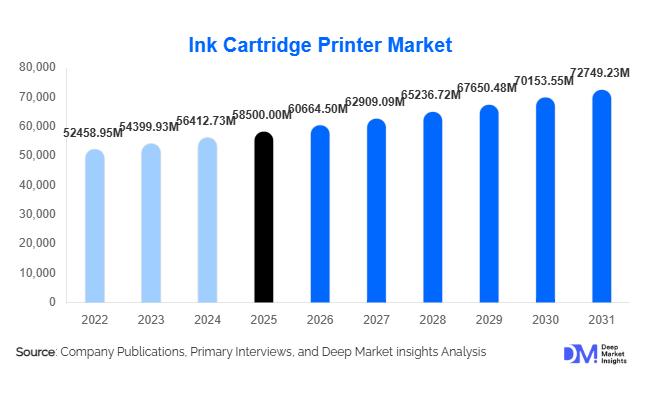
According to Deep Market Insights, the global ink cartridge printer market size was valued at USD 58,500 million in 2025 and is projected to grow from USD 60,664.50 million in 2026 to reach USD 72,749.23 million by 2031, expanding at a CAGR of 3.7% during the forecast period (2026–2031). The ink cartridge printer market growth is primarily driven by sustained demand for high-quality color printing, increasing adoption of multi-function devices, and expanding applications in industrial and textile printing.
Key Market Insights
- Multi-function inkjet printers dominate global demand, accounting for over 60% share due to cost-efficiency and versatility.
- Wireless and cloud-enabled printing solutions are rapidly expanding, driven by mobile-first work environments and remote operations.
- Asia-Pacific leads the global market, supported by strong manufacturing ecosystems and SME growth.
- Refillable and eco-friendly ink systems are gaining traction, driven by sustainability concerns and cost optimization.
- Industrial and textile printing applications are the fastest-growing segments, expanding with digital printing adoption.
- E-commerce and subscription-based ink delivery models are transforming distribution channels, enhancing recurring revenue streams.
What are the latest trends in the ink cartridge printer market?
Shift Toward Refillable and Eco-Friendly Ink Systems
The market is witnessing a strong transition toward refillable ink tank systems and environmentally sustainable cartridges. Consumers are increasingly prioritizing lower total cost of ownership and reduced environmental impact, pushing manufacturers to develop recyclable cartridges and low-VOC ink formulations. Regulatory pressure, particularly in Europe, is accelerating the adoption of sustainable printing solutions, while OEMs are introducing cartridge recycling programs and biodegradable materials. This trend is reshaping long-term consumption patterns, reducing dependency on traditional disposable cartridges.
Integration of Smart and Wireless Printing Technologies
Technological advancements are transforming the printing ecosystem through wireless connectivity, cloud printing, and mobile integration. Modern printers now support remote operation, voice-assisted printing, and seamless integration with enterprise software systems. These innovations are particularly attractive to SMEs and remote workers, enhancing productivity and convenience. Additionally, AI-enabled print management systems are emerging, optimizing ink usage, reducing waste, and enabling predictive maintenance for improved operational efficiency.
What are the key drivers in the ink cartridge printer market?
Growing Demand for High-Quality Color Printing
Industries such as marketing, packaging, and photography continue to drive demand for high-resolution color printing. Inkjet printers offer superior image quality, making them essential for applications requiring precision and vibrancy. The growth of e-commerce packaging and personalized marketing materials is further strengthening this demand globally.
Rising Adoption of Multi-Function Printers
Multi-function printers (MFPs) are increasingly preferred across residential and commercial segments due to their ability to combine printing, scanning, copying, and faxing functionalities. These devices reduce operational costs and space requirements, making them highly attractive for SMEs and home offices, thereby driving market expansion.
Expansion of Industrial and Textile Printing
Digital inkjet printing is rapidly replacing traditional printing technologies in textiles, ceramics, and packaging industries. The ability to handle short runs, reduce waste, and enable customization is driving widespread adoption, particularly in emerging markets with growing manufacturing sectors.
What are the restraints for the global market?
Increasing Shift Toward Paperless Workflows
The adoption of digital documentation and cloud-based workflows is reducing overall printing volumes, particularly in corporate environments. Enterprises are increasingly focusing on sustainability and cost reduction, limiting long-term demand for traditional printing solutions.
High Cost of OEM Cartridges
The premium pricing of original equipment manufacturer cartridges has led to the rapid growth of compatible and remanufactured alternatives. This creates pricing pressure for OEMs and impacts profit margins, while also intensifying competition within the market.
What are the key opportunities in the ink cartridge printer industry?
Growth in Industrial and Textile Printing Applications
The expansion of digital printing in textiles and packaging offers significant growth potential. Inkjet technology enables high customization, faster turnaround times, and reduced material waste, making it highly attractive for manufacturers transitioning from conventional methods.
Sustainability-Driven Product Innovation
Rising environmental concerns are creating opportunities for companies to develop eco-friendly inks, recyclable cartridges, and refillable systems. Manufacturers that align with global sustainability standards can gain a competitive advantage and tap into environmentally conscious consumer segments.
Expansion of Remote Work and Home Office Solutions
The shift toward hybrid work environments is driving demand for compact and efficient home-office printers. Integration with cloud platforms and subscription-based ink delivery models presents new revenue opportunities for both existing players and new entrants.
Report Scope
| Report Metric | Details |
|---|---|
| Market Size in 2025 | USD 58500 Million |
| Market Size in 2026 | USD 60664.50 Million |
| Market Size in 2031 | USD 72749.23 Million |
| CAGR | 3.7% (2026-2031) |
| Base Year for Estimation | 2025 |
| Historical Data | 2022-2024 |
| Forecast Period | 2026-2031 |
| Report Coverage | Revenue Forecast, Competitive Landscape, Supply Chain Disruption, Growth Factors, Environment & Regulatory Landscape and Trends |
| Geographies Covered | North America, Europe, APAC, Middle East and Africa, LATAM |
| Countries Covered | U.S., Canada, U.K., Germany, France, Spain, Italy, Russia, Nordic, Benelux, Rest of Europe, China, Korea, Japan, India, Australia, Singapore, Taiwan, South East Asia, Rest of Asia-Pacific, UAE, Turky, Saudi Arabia, South Africa, Egypt, Nigeria, Rest of MEA, Brazil, Mexico, Argentina, Chile, Colombia, Rest of LATAM |
Explore more data points, trends and opportunities Download Free Sample Report
Product Type Insights
Multi-function printers (MFPs) dominate the ink cartridge printer market, accounting for approximately 62% of global share in 2025. This leadership is primarily driven by their ability to integrate printing, scanning, copying, and faxing functionalities into a single device, significantly reducing the total cost of ownership and space requirements for users. The rapid expansion of SMEs and home offices has further accelerated adoption, as businesses seek compact and efficient solutions that enhance productivity. Additionally, continuous innovation in MFPs, including wireless connectivity, mobile printing, and cloud integration, has strengthened their value proposition. Single-function printers, while holding a smaller share, continue to serve niche industrial and high-volume printing applications where specialized performance and reliability are critical. The trend toward all-in-one solutions, combined with increasing demand for cost efficiency and operational flexibility, is expected to sustain the dominance of MFPs globally.
Application Insights
Commercial offices represent the largest end-use segment, contributing nearly 38% of the global market in 2025. This dominance is driven by consistent printing requirements across SMEs and large enterprises, including documentation, reporting, and marketing materials. The growth of small businesses globally, particularly in emerging economies, continues to reinforce demand in this segment. Residential usage is witnessing steady growth, fueled by hybrid work models and increasing need for home-office setups, especially in developed markets. Meanwhile, the textile and industrial printing segment is the fastest-growing, expanding at over 6% CAGR, driven by the adoption of digital inkjet technologies in apparel, packaging, and customized manufacturing. Education and healthcare sectors also contribute significantly, supported by administrative printing needs, student assignments, and patient documentation. The diversification of applications across both traditional and industrial use cases is strengthening overall market resilience.
Distribution Channel Insights
E-commerce platforms account for approximately 35% of total sales, emerging as the fastest-growing distribution channel. This growth is driven by increasing digital adoption, competitive pricing, and the convenience of doorstep delivery. Subscription-based ink delivery models and automated replenishment services are further enhancing customer retention and recurring revenue streams for manufacturers. Offline retail channels, including electronics stores and office supply outlets, continue to play a vital role, particularly in developing markets where physical inspection and immediate availability influence purchasing decisions. Direct OEM sales remain strong in enterprise procurement, where bulk purchasing agreements and long-term service contracts are common. The ongoing shift toward digital commerce, combined with value-added services such as subscription models, is reshaping the overall distribution landscape.
Connectivity Insights
Wireless printers dominate the market with nearly 67% share in 2025, reflecting the rapid transition toward mobile-first and cloud-enabled work environments. The increasing use of smartphones, tablets, and remote work platforms has made wireless connectivity a critical feature, enabling users to print seamlessly from multiple devices and locations. Integration with cloud storage systems and enterprise software further enhances operational efficiency. Wired printers, while still relevant in secure enterprise environments and legacy systems, are gradually losing market share due to limited flexibility. The growing emphasis on convenience, remote accessibility, and smart office ecosystems continues to drive the adoption of wireless printing solutions globally.
Explore more data points, trends and opportunities Download Free Sample Report
Ink Cartridge Printer Market Segmentations
By Product Type
- Single-Function Inkjet Printers
- Multi-Function Printers (MFPs)
By Application
- Residential/Personal
- Commercial Offices
- Education
- Healthcare
- Retail & Packaging
- Textile & Industrial Printing
By Distribution Channel
- Direct OEM Sales
- Offline Retail
- E-commerce Platforms
By Connectivity
- Wired
- Wireless
Regional Insights
Asia-Pacific
Asia-Pacific holds the largest share of approximately 42% in 2025, driven by strong demand from China, Japan, and India. China dominates both production and consumption, supported by its extensive manufacturing ecosystem, export-oriented production, and presence of leading printer manufacturers. The country’s robust electronics supply chain and cost advantages further strengthen its leadership. India is emerging as a high-growth market, supported by rapid SME expansion, increasing digital literacy, and government initiatives such as digital education programs and local manufacturing incentives. Japan contributes through advanced technological innovation and high adoption of premium printing solutions. The region’s growth is further fueled by rising disposable incomes, expanding e-commerce sectors, and increasing demand for industrial printing applications, particularly in textiles and packaging.
North America
North America accounts for around 26% of the global market, with the United States leading demand. The region benefits from strong enterprise adoption, high penetration of advanced printing technologies, and widespread use of multi-function and wireless printers. The presence of major OEMs and early adoption of subscription-based ink services are key growth drivers. Additionally, the expansion of remote work and hybrid office models has sustained demand for home-office printing solutions. Technological innovation, including AI-enabled print management and cloud integration, continues to enhance market growth. Canada also contributes steadily, supported by education and government sector demand.
Europe
Europe represents nearly 20% of the market, led by Germany, the UK, and France. A key growth driver in this region is the strong regulatory focus on sustainability and environmental compliance. Policies promoting recycling, waste reduction, and eco-friendly products are encouraging the adoption of refillable cartridges and sustainable ink solutions. Additionally, the presence of well-established corporate sectors and educational institutions supports consistent demand. Germany leads in industrial printing applications, while the UK and France contribute through service sector demand and technological adoption. The region’s emphasis on circular economy practices is shaping product innovation and long-term market trends.
Latin America
Latin America holds a smaller share of the global market but is witnessing steady growth, particularly in Brazil and Mexico. The expansion of SMEs, improving economic conditions, and increasing digital transformation initiatives are key drivers of demand. Businesses in the region are increasingly adopting cost-efficient printing solutions, including compatible and refillable cartridges, to manage operational expenses. Growth in the retail and packaging industries is also supporting demand for printing applications. Additionally, rising internet penetration is boosting e-commerce sales of printers and consumables, further strengthening market growth in the region.
Middle East & Africa
The Middle East & Africa region is among the fastest-growing, with growth exceeding 5.5% CAGR. Countries such as the UAE and South Africa are leading demand, supported by infrastructure development, expanding business ecosystems, and increasing adoption of digital technologies. Government investments in education and public sector digitization are driving demand for printers in schools and administrative offices. In the Middle East, high disposable incomes and strong corporate sectors are supporting demand for premium printing solutions. In Africa, the growth of SMEs and improving access to technology are key drivers, although cost sensitivity continues to influence purchasing decisions. The region’s long-term growth potential is supported by ongoing economic development and increasing digital integration.
Key Players in the Ink Cartridge Printer Market
- HP Inc.
- Canon Inc.
- Seiko Epson Corporation
- Brother Industries Ltd.
- Xerox Holdings Corporation
- Ricoh Company Ltd.
- Lexmark International Inc.
- Kyocera Corporation
- Konica Minolta Inc.
- Fujifilm Holdings Corporation
- Toshiba Tec Corporation
- Dell Technologies Inc.
- Sharp Corporation
- Oki Electric Industry Co., Ltd.
- Zebra Technologies Corporation