Injectable Moisturiser Market Size
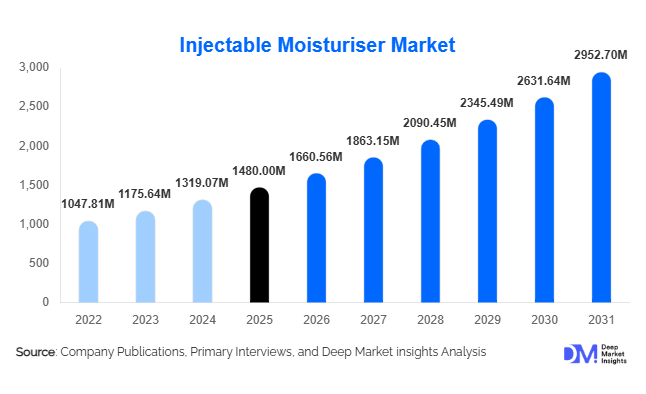
According to Deep Market Insights, the global injectable moisturiser market size was valued at USD 1,480 million in 2025 and is projected to grow from USD 1,660.56 million in 2026 to reach USD 2,952.70 million by 2031, expanding at a CAGR of 12.2% during the forecast period (2026–2031). The injectable moisturiser market growth is primarily driven by the increasing adoption of minimally invasive aesthetic procedures, rising demand for regenerative skincare treatments, and growing consumer preference for preventive anti-aging solutions that improve skin hydration, elasticity, and texture with minimal downtime.
Key Market Insights
- Injectable moisturisers are increasingly shifting toward preventive and regenerative aesthetics, attracting younger consumers seeking long-term skin quality enhancement rather than corrective cosmetic procedures.
- Hyaluronic acid-based injectable skin boosters dominate the global market, supported by strong clinical safety profiles, physician familiarity, and consistent hydration performance.
- North America dominates the global injectable moisturiser market, led by strong consumer spending on aesthetic dermatology and the rapid adoption of premium injectable skincare products in the United States.
- Asia-Pacific remains the fastest-growing regional market, driven by South Korea’s leadership in regenerative aesthetic innovation and increasing cosmetic procedure demand in China and India.
- Medical spas are emerging as the leading end-user segment, supported by increasing consumer preference for wellness-oriented cosmetic services and minimally invasive skincare procedures.
- Technological advancements, including exosome therapies, polynucleotide injectables, hybrid HA formulations, and AI-based skin diagnostics, are transforming treatment precision and personalization.
What are the latest trends in the injectable moisturiser market?
Rise of Regenerative and Bio-Stimulating Injectable Treatments
The injectable moisturiser market is rapidly evolving beyond traditional hydration-focused formulations toward regenerative and collagen-stimulating injectable therapies. Polynucleotide-based injectables, exosome therapies, peptide complexes, and hybrid hyaluronic acid formulations are increasingly gaining popularity among dermatologists and aesthetic clinics due to their ability to improve long-term skin quality and stimulate natural collagen production. Consumers are increasingly preferring treatments that provide gradual, natural-looking enhancement rather than dramatic facial alteration. South Korea and Europe remain key innovation hubs for regenerative injectable technologies, with several manufacturers expanding global exports of advanced skin booster products.
AI-Driven Personalized Aesthetic Procedures
Artificial intelligence is becoming increasingly integrated into injectable skincare treatments. Dermatology clinics and medical spas are adopting AI-based facial analysis systems to evaluate skin hydration, elasticity, pigmentation, and aging patterns before recommending customized injectable moisturiser procedures. Personalized treatment planning is improving patient outcomes and increasing procedure satisfaction. Digital monitoring tools and mobile applications are also enabling consumers to track skin improvement progress over time, supporting stronger patient engagement and repeat treatment cycles. AI-supported diagnostics are expected to become a major differentiator among premium aesthetic providers over the next few years.
What are the key drivers in the injectable moisturiser market?
Growing Demand for Minimally Invasive Aesthetic Procedures
The increasing global preference for minimally invasive cosmetic treatments remains one of the strongest growth drivers for the injectable moisturiser market. Consumers increasingly seek aesthetic procedures that deliver visible skin improvement without surgery, lengthy recovery periods, or major procedural risks. Injectable moisturisers provide enhanced hydration, smoother skin texture, and subtle rejuvenation through outpatient procedures with limited downtime. Working professionals, millennials, and younger consumers are increasingly adopting these treatments as part of preventive skincare routines, significantly expanding market demand.
Social Media Influence and Rising Beauty Awareness
Social media platforms such as Instagram, TikTok, and YouTube continue to significantly influence consumer awareness regarding injectable skincare treatments. Beauty trends focused on “glass skin,” skin radiance, and natural rejuvenation are accelerating global acceptance of aesthetic injectables. Dermatologists, influencers, and celebrities increasingly share treatment outcomes online, normalizing cosmetic procedures among younger demographics. The growing digital beauty culture is encouraging consumers to invest in long-term skin quality treatments, supporting sustained demand for injectable moisturisers globally.
What are the restraints for the global market?
High Procedure Costs and Limited Affordability
Injectable moisturiser treatments remain relatively expensive, particularly in developed markets where premium aesthetic procedures can cost several hundred dollars per session. Since optimal outcomes often require multiple treatment cycles annually, affordability remains a major challenge for middle-income consumers. High product pricing and recurring maintenance costs continue to limit broader adoption in price-sensitive regions, particularly across parts of Latin America, Africa, and Southeast Asia.
Regulatory Complexity and Safety Concerns
The injectable moisturiser market faces stringent regulatory oversight because injectable skincare products are classified under medical aesthetics and dermatological treatment categories. Regulatory approval timelines vary significantly across countries, potentially delaying product commercialization. In addition, procedures performed by unqualified practitioners can lead to adverse effects such as swelling, bruising, allergic reactions, or vascular complications, negatively impacting patient confidence and overall market perception. Maintaining procedural safety and physician training standards remains essential for long-term market sustainability.
What are the key opportunities in the injectable moisturiser industry?
Expansion of Medical Spa and Wellness Infrastructure
The rapid expansion of medical spas and premium wellness clinics globally presents significant growth opportunities for injectable moisturiser manufacturers and aesthetic providers. Consumers increasingly prefer wellness-oriented cosmetic environments over hospital-based settings for minimally invasive procedures. Luxury wellness tourism in regions such as the UAE, Thailand, South Korea, and India is further accelerating demand for injectable skin booster treatments. The integration of skincare, anti-aging medicine, and wellness services is expected to create strong long-term procedural demand.
Growth in Male Aesthetic Procedures
Male consumers are emerging as a rapidly expanding demographic within the injectable moisturiser market. Increasing awareness regarding skincare, professional appearance standards, and minimally invasive cosmetic procedures is driving male demand for subtle rejuvenation treatments. Injectable moisturisers are particularly attractive to male consumers because they improve skin hydration and texture without visibly altering facial structure. Clinics are increasingly developing gender-inclusive aesthetic protocols and targeted skincare programs for male consumers, creating new revenue opportunities within the market.
Report Scope
| Report Metric | Details |
|---|---|
| Market Size in 2025 | USD 1480 Million |
| Market Size in 2026 | USD 1660.56 Million |
| Market Size in 2031 | USD 2952.70 Million |
| CAGR | 12.2% (2026-2031) |
| Base Year for Estimation | 2025 |
| Historical Data | 2022-2024 |
| Forecast Period | 2026-2031 |
| Report Coverage | Revenue Forecast, Competitive Landscape, Supply Chain Disruption, Growth Factors, Environment & Regulatory Landscape and Trends |
| Geographies Covered | North America, Europe, APAC, Middle East and Africa, LATAM |
| Countries Covered | U.S., Canada, U.K., Germany, France, Spain, Italy, Russia, Nordic, Benelux, Rest of Europe, China, Korea, Japan, India, Australia, Singapore, Taiwan, South East Asia, Rest of Asia-Pacific, UAE, Turky, Saudi Arabia, South Africa, Egypt, Nigeria, Rest of MEA, Brazil, Mexico, Argentina, Chile, Colombia, Rest of LATAM |
Explore more data points, trends and opportunities Download Free Sample Report
Product Type Insights
Hyaluronic acid-based injectable moisturisers continue to dominate the global market, accounting for nearly 55% of total revenue in 2025, primarily due to their superior hydration capabilities, biocompatibility, strong safety profile, and broad physician acceptance across dermatology and aesthetic medicine practices., Both crosslinked and non-crosslinked hyaluronic acid formulations remain widely adopted in dermatology clinics, cosmetic surgery centers, and medical spas because they deliver immediate skin hydration, improved elasticity, and natural-looking rejuvenation outcomes with minimal downtime. Increasing consumer preference for preventive aesthetics and repeat maintenance procedures further supports the dominance of HA-based injectable moisturisers globally. Polynucleotide (PN/PDRN)-based injectable moisturisers represent the fastest-growing product segment within the market, driven by rising interest in regenerative skincare, tissue repair, and collagen stimulation technologies. These formulations are witnessing especially strong demand in South Korea, Japan, and Europe, where regenerative aesthetics and skin healing therapies are rapidly gaining popularity. The increasing adoption of “skin quality enhancement” procedures over traditional volumizing fillers is accelerating demand for PN-based injectables among younger and middle-aged consumers seeking long-term skin improvement.
Amino acid and vitamin complex injectable moisturisers are also expanding steadily, particularly among consumers aged 25–40 years focused on preventive anti-aging skincare and skin radiance enhancement. These formulations are commonly integrated into mesotherapy procedures and wellness-oriented aesthetic treatments. In addition, advanced bio-stimulatory injectable formulations such as polycaprolactone (PCL) and poly-L-lactic acid (PLLA)-based moisturisers are increasingly penetrating premium aesthetic clinics due to their ability to stimulate long-term collagen production and deliver prolonged rejuvenation effects. The growing popularity of combination therapies integrating hydration, collagen stimulation, and regenerative skincare is expected to further diversify product innovation across the injectable moisturiser market.
Application Insights
Facial injectable moisturisation procedures account for approximately 68% of total global market demand, making facial treatments the dominant application segment in 2025. The segment’s leadership is primarily driven by rising consumer focus on facial aesthetics, skin radiance, hydration enhancement, and preventive anti-aging treatments. Consumers increasingly prioritize visible improvements in highly exposed facial regions such as cheeks, under-eyes, lips, forehead, and jawline areas, where injectable moisturisers can improve skin texture, elasticity, and natural glow without altering facial structure. Social media-driven beauty trends such as “glass skin” and natural radiance aesthetics continue to accelerate demand for facial skin booster procedures globally. Under-eye rejuvenation and cheek hydration procedures are among the fastest-growing facial applications due to increasing concerns regarding skin fatigue, dehydration, and early aging signs among urban consumers and working professionals. In addition, injectable lip hydration procedures are gaining traction among younger demographics seeking subtle enhancement and smoother skin texture rather than excessive volumization.
Neck, décolletage, and hand rejuvenation treatments are emerging as important secondary application segments, particularly among aging populations in North America, Europe, and Japan, where consumers increasingly seek comprehensive anti-aging procedures beyond facial treatments. Scalp hydration therapies and regenerative hair-support injectables are also witnessing increasing adoption as aesthetic dermatology integrates hair wellness and skin rejuvenation into holistic aesthetic treatment programs. The growing demand for full-body skin rejuvenation and personalized aesthetic treatment protocols is expected to further expand application diversity within the market.
Distribution Channel Insights
Direct institutional sales dominate the injectable moisturiser market because manufacturers increasingly prefer establishing direct commercial relationships with dermatology clinics, hospitals, aesthetic medicine chains, and medical spas. This distribution model enables companies to strengthen physician education programs, maintain product authenticity, support procedural training, and reinforce premium brand positioning. Direct institutional sales also allow manufacturers to improve customer retention through injector certification programs and long-term clinic partnerships. Distributor-based clinical supply networks continue to play a crucial role in emerging economies where local regulatory expertise, cold-chain logistics capabilities, and regional market access remain essential. Distributors help global injectable manufacturers penetrate smaller aesthetic clinics and underserved urban markets, particularly across Southeast Asia, Latin America, and the Middle East.
Online professional procurement platforms are gradually gaining traction among independent dermatology clinics and aesthetic practitioners seeking flexible inventory management, transparent pricing, and faster procurement cycles. The digitalization of professional medical supply chains is improving product accessibility for smaller clinics while supporting procurement efficiency. Pharmaceutical and medical device retail networks also remain important in highly regulated markets such as Europe and parts of the Asia-Pacific, where injectable aesthetic products often require certified medical distribution frameworks. Increasing investments in digital procurement systems, physician training ecosystems, and clinic-focused supply partnerships are expected to reshape competitive dynamics across the injectable moisturiser distribution landscape over the coming years.
End-User Insights
Medical spas account for approximately 38% of global injectable moisturiser demand and remain the leading end-user segment due to rising consumer preference for wellness-oriented aesthetic procedures delivered in luxury and minimally clinical environments. The strong growth of medical spas is supported by increasing consumer spending on self-care, anti-aging treatments, and preventive skincare services. Medical spas also benefit from shorter appointment cycles, personalized treatment programs, and the growing popularity of combination aesthetic therapies integrating skin boosters, lasers, fillers, and wellness treatments. Dermatology clinics continue to maintain strong market relevance because of physician expertise, advanced diagnostic capabilities, and patient trust in medically supervised procedures. These clinics remain particularly important for premium injectable moisturiser treatments and regenerative skincare therapies requiring advanced procedural precision and customized treatment planning.
Cosmetic surgery centers are increasingly incorporating injectable moisturisers into broader facial rejuvenation protocols alongside dermal fillers, laser resurfacing, microneedling, and anti-aging treatments. Combination aesthetic procedures are becoming increasingly common among consumers seeking comprehensive skin rejuvenation with natural-looking outcomes. Wellness and longevity clinics are emerging as a rapidly expanding end-user category integrating regenerative injectables into broader healthy aging, hormone optimization, and preventive healthcare programs. The convergence of wellness medicine and aesthetic dermatology is expected to create substantial long-term opportunities for injectable moisturiser providers globally.
Age Group Insights
Consumers aged 31–45 years account for nearly 42% of global injectable moisturiser demand, making this age group the largest demographic segment within the market. The dominance of this segment is primarily driven by high disposable income levels, increasing beauty consciousness, and strong interest in preventive anti-aging treatments. Consumers within this age group increasingly seek minimally invasive procedures that improve skin hydration, elasticity, and radiance while delaying visible aging signs. Repeat treatment behavior and strong brand awareness also contribute significantly to the segment’s leadership.
Younger consumers aged 18–30 years are emerging as one of the fastest-growing demographics due to increasing social media influence, preventive skincare adoption, and rising awareness regarding long-term skin maintenance. This segment strongly favors skin booster procedures focused on hydration enhancement, acne scar reduction, and skin radiance improvement. Millennials and Gen Z consumers are also more likely to adopt early-stage aesthetic procedures as part of regular skincare routines. Consumers aged above 45 years continue to contribute significantly to premium injectable treatment demand, particularly for regenerative formulations focused on collagen stimulation, skin tightening, and age-related skin rejuvenation. Older demographics increasingly prefer injectable moisturisers as non-surgical alternatives to invasive cosmetic procedures, especially in North America, Europe, Japan, and South Korea, where aging populations continue to expand.
Explore more data points, trends and opportunities Download Free Sample Report
Injectable Moisturiser Market Segmentations
By Product Type
- Hyaluronic Acid-Based Injectable Moisturisers
- Polynucleotide (PN/PDRN)-Based Injectable Moisturisers
- Amino Acid & Vitamin Complex Injectable Moisturisers
- Polycaprolactone (PCL)-Based Injectable Moisturisers
- Poly-L-Lactic Acid (PLLA)-Based Injectable Moisturisers
- Exosome & Regenerative Injectable Moisturisers
By Application
- Facial Skin Hydration & Rejuvenation
- Under-Eye Rejuvenation
- Lip Hydration Treatments
- Neck & Décolletage Rejuvenation
- Hand Rejuvenation
- Scalp Hydration & Hair Support Therapy
By Distribution Channel
- Direct Institutional Sales
- Distributor-Based Clinical Supply
- Online Professional Procurement Platforms
- Pharmaceutical Distribution Networks
- Medical Device & Aesthetic Supply Retailers
By End User
- Medical Spas
- Dermatology Clinics
- Cosmetic Surgery Centers
- Hospitals & Specialty Clinics
- Wellness & Longevity Clinics
By Age Group
- 18–30 Years
- 31–45 Years
- 46–60 Years
- Above 60 Years
Regional Insights
North America
North America accounted for approximately 31% of the global injectable moisturiser market in 2025, making it the largest regional market globally. The United States dominates regional demand due to high consumer spending on cosmetic dermatology, strong awareness regarding minimally invasive aesthetic procedures, and increasing FDA approvals for injectable skin booster products. The region benefits from a highly developed medical spa ecosystem, strong physician expertise, and high adoption of premium aesthetic procedures among middle-aged and younger consumers.
One of the primary drivers supporting regional growth is the increasing consumer preference for natural-looking aesthetic enhancement rather than aggressive cosmetic alteration. Preventive anti-aging treatments are increasingly becoming mainstream among millennials and working professionals across the United States and Canada. In addition, rising disposable incomes, growing social media influence, and continuous innovation in regenerative skincare technologies are accelerating procedural demand. Canada is also witnessing steady growth due to expanding dermatology clinic infrastructure, increasing consumer awareness regarding skin health, and growing adoption of wellness-oriented cosmetic procedures. Strong regulatory oversight and high physician training standards continue to support consumer confidence across the North American market.
Europe
Europe represented nearly 28% of the global injectable moisturiser market revenue in 2025, supported by mature aesthetic medicine industries in France, Germany, Italy, Spain, and the United Kingdom. European consumers strongly favor subtle and natural-looking cosmetic enhancement, which aligns closely with the benefits offered by injectable moisturisers and skin booster procedures. The region’s growth is primarily driven by increasing adoption of preventive skincare treatments, rising aging populations, and strong consumer demand for regenerative aesthetic procedures. France and Italy remain major manufacturing and innovation hubs for premium injectable skincare products, while Germany and the UK continue to witness increasing demand for minimally invasive anti-aging treatments.
Europe also benefits from advanced physician expertise, strong medical aesthetics infrastructure, and well-established regulatory frameworks supporting product quality and procedural safety. The growing popularity of combination aesthetic treatments integrating lasers, injectables, and regenerative therapies is further supporting regional market expansion. In addition, wellness-focused cosmetic tourism across countries such as Turkey, Spain, and Italy is contributing to growing procedural volumes.
Asia-Pacific
Asia-Pacific is the fastest-growing regional market for injectable moisturisers and is projected to register the highest CAGR during the forecast period. The region’s rapid growth is driven by expanding middle-class populations, rising beauty consciousness, increasing social media influence, and strong adoption of advanced aesthetic technologies across South Korea, China, India, and Japan. South Korea remains the global innovation leader in regenerative injectable skincare, particularly in polynucleotide, exosome, and hybrid hyaluronic acid technologies. Korean beauty trends continue to strongly influence global demand for skin hydration and “glass skin” aesthetics. China is witnessing substantial market expansion due to rising disposable incomes, rapid urbanization, and increasing acceptance of cosmetic dermatology procedures among younger consumers.
India is emerging as one of the fastest-growing country markets due to expanding medical spa chains, growing middle-class healthcare expenditure, and increasing awareness regarding preventive skincare treatments. Japan continues to maintain a strong demand for anti-aging injectables among its aging population, while Southeast Asian countries are benefiting from medical tourism growth and rising luxury wellness investments.
Latin America
Latin America is witnessing steady growth in injectable moisturiser demand, particularly in Brazil, Mexico, and Argentina, where cosmetic dermatology procedures are becoming increasingly mainstream. Brazil remains the largest regional market due to its strong cosmetic surgery culture, high consumer acceptance of aesthetic procedures, and growing medical spa infrastructure.
Regional growth is primarily driven by increasing urbanization, rising disposable incomes among middle-class consumers, and expanding aesthetic clinic networks across major metropolitan areas. Medical tourism is also supporting market expansion, particularly in Brazil and Mexico, where cosmetic procedures are often offered at comparatively lower costs than in North America and Europe. Social media influence and growing awareness regarding non-surgical anti-aging treatments are further contributing to the rising demand for injectable moisturisers throughout Latin America. However, economic volatility and uneven access to premium aesthetic treatments continue to present moderate market challenges in some countries.
Middle East & Africa
The Middle East & Africa region is emerging as a rapidly growing luxury aesthetics market led by the UAE and Saudi Arabia. High-income populations, strong luxury beauty spending, and expanding wellness tourism infrastructure are supporting strong demand for injectable moisturiser procedures across the region. Dubai has increasingly positioned itself as a major regional hub for premium aesthetic medicine and medical tourism, attracting consumers seeking advanced skincare and anti-aging treatments. Saudi Arabia is also witnessing rising demand due to increasing beauty awareness, growing female workforce participation, and substantial investments in private healthcare infrastructure.
Regional market growth is further supported by increasing adoption of minimally invasive cosmetic procedures among younger consumers and expatriate populations. South Africa remains one of the most developed aesthetic markets within Africa due to improving dermatology infrastructure and rising urban consumer awareness regarding skin rejuvenation procedures. Expanding luxury wellness resorts and aesthetic clinics are expected to continue driving regional growth over the forecast period.
Key Players in the Injectable Moisturiser Market
- Galderma
- AbbVie (Allergan Aesthetics)
- Merz Pharma
- Teoxane
- Sinclair Pharma
- IBSA Group
- Bloomage Biotech
- Hugel Inc.
- PharmaResearch Products
- Medytox
- REVANCE Therapeutics
- Croma-Pharma
- Vivacy Laboratories
- Prollenium Medical Technologies
- Caregen