Industrial Mixer Market Size
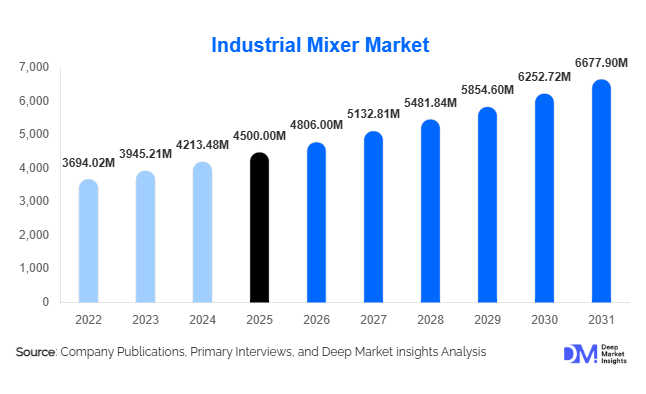
According to Deep Market Insights, the global industrial mixer market size was valued at USD 4,500 million in 2025 and is projected to grow from USD 4,806.00 million in 2026 to reach USD 6,677.90 million by 2031, expanding at a CAGR of 6.8% during the forecast period (2026–2031). The mixer market growth is primarily driven by the increasing expansion of process industries, rising demand for automation in manufacturing facilities, and the growing need for efficient blending technologies in sectors such as food processing, chemicals, pharmaceuticals, and wastewater treatment. Industrial mixers are essential equipment in manufacturing environments where materials must be blended, emulsified, homogenized, or suspended to achieve consistent product quality. Modern industrial mixers incorporate advanced engineering designs, improved impeller configurations, and automation capabilities that allow manufacturers to achieve precise mixing performance while minimizing energy consumption. These systems are widely used across industries where uniform composition is critical to product integrity and process efficiency.
The demand for industrial mixers has increased significantly as manufacturing industries continue to modernize their operations and adopt digital technologies. Automated mixing systems equipped with sensors and real-time monitoring capabilities enable better process control and improved product consistency. In addition, manufacturers are investing in high-capacity mixers capable of handling complex formulations and viscous materials, particularly in chemical and pharmaceutical production. Rapid industrialization across emerging economies, especially in the Asia-Pacific region, is further accelerating demand for industrial mixers. The expansion of food processing plants, pharmaceutical production facilities, and chemical manufacturing units is creating a strong requirement for advanced mixing technologies. As industries prioritize efficiency, sustainability, and automation, the industrial mixer market is expected to witness steady growth throughout the forecast period.
Key Market Insights
- Industrial mixers are becoming increasingly automated, with smart sensors and digital monitoring systems improving process efficiency and reducing operational downtime.
- The food and beverage processing industry accounts for the largest share of demand, driven by rising global consumption of processed and packaged foods.
- Asia-Pacific dominates the global mixer market, supported by strong manufacturing expansion in China, India, and Southeast Asia.
- Continuous mixing technologies are gaining traction, offering higher throughput and energy efficiency compared with traditional batch mixing systems.
- Demand for customized mixing solutions is rising, particularly in pharmaceutical, chemical, and cosmetics manufacturing, where precise formulations are required.
- Environmental and wastewater treatment infrastructure expansion is generating new demand for heavy-duty industrial mixers and agitators.
What are the latest trends in the Industrial mixer market?
Adoption of Smart and Automated Mixing Systems
Industrial manufacturing facilities are increasingly integrating automation technologies into their production processes, and mixers are no exception. Smart mixers equipped with sensors, programmable logic controllers (PLCs), and real-time monitoring systems are gaining popularity across industries such as pharmaceuticals, chemicals, and food processing. These systems enable precise control of mixing parameters, including speed, torque, and temperature, ensuring consistent product quality across batches. Predictive maintenance technologies are also being integrated into modern mixers, allowing operators to detect potential mechanical issues before failures occur. By reducing downtime and improving operational efficiency, smart mixers are becoming a critical component of digitally connected manufacturing environments.
Growing Preference for Continuous Mixing Technology
Continuous mixing systems are increasingly being adopted in industrial production facilities due to their ability to provide higher efficiency and productivity compared with traditional batch mixing. Continuous mixers allow raw materials to be blended continuously during the production process, eliminating the need for repeated batch cycles. This approach reduces energy consumption, increases throughput, and improves overall process efficiency. Industries such as chemicals, plastics, and food processing are rapidly adopting continuous mixing technology as they seek to optimize production operations and reduce manufacturing costs. As global manufacturing output continues to increase, demand for continuous mixers is expected to expand significantly.
What are the key drivers in the Industrial mixer market?
Expansion of the Global Food Processing Industry
The rapid growth of the global food and beverage industry is one of the most important drivers of the mixer market. Food manufacturing processes require precise blending and homogenization of ingredients to maintain product consistency and quality. Industrial mixers are widely used for producing sauces, dairy products, beverages, baked goods, and processed food formulations. Rising consumer demand for ready-to-eat foods, packaged meals, and functional food products is encouraging food manufacturers to invest in advanced mixing equipment. As food processing facilities expand worldwide, the demand for industrial mixers is expected to grow steadily.
Increasing Automation in Industrial Manufacturing
Automation has become a key strategy for manufacturers seeking to enhance efficiency and reduce operational costs. Automated mixing systems allow precise control of production processes, minimizing human error and improving batch consistency. Industries such as pharmaceuticals and chemicals require strict process control, making automated mixers an essential component of their production lines. Additionally, the integration of digital control systems enables manufacturers to optimize mixing operations and reduce energy consumption.
What are the restraints for the global market?
High Initial Investment Costs
Advanced industrial mixers equipped with automation features, specialized impellers, and corrosion-resistant materials often involve high upfront costs. For small and medium-sized manufacturers, the capital required to install such equipment may represent a significant financial barrier. These high investment requirements can slow adoption, particularly in emerging markets where industrial modernization budgets are limited.
Maintenance and Operational Complexity
Industrial mixers operate in demanding environments involving high temperatures, abrasive materials, and corrosive chemicals. Maintaining optimal performance requires regular servicing and replacement of mechanical components such as bearings and seals. Complex maintenance requirements may increase operational costs for manufacturers, which can discourage some companies from upgrading to advanced mixing systems.
What are the key opportunities in the mixer industry?
Integration of Industry 4.0 Technologies
The digital transformation of manufacturing operations is creating opportunities for mixer manufacturers to develop intelligent equipment integrated with Industry 4.0 technologies. IoT-enabled mixers can collect real-time operational data, enabling predictive maintenance, remote monitoring, and automated process optimization. These capabilities improve equipment reliability and reduce operational downtime, making smart mixers highly attractive to large industrial facilities.
Growing Demand from Emerging Manufacturing Economies
Rapid industrial expansion in emerging economies such as India, Vietnam, Indonesia, and Brazil is creating strong demand for industrial mixers. Governments in these countries are encouraging domestic manufacturing through industrial development programs and infrastructure investments. As new factories are built across sectors such as chemicals, food processing, and pharmaceuticals, the need for advanced mixing equipment is expected to increase significantly.
Report Scope
| Report Metric | Details |
|---|---|
| Market Size in 2025 | USD 4500 Million |
| Market Size in 2026 | USD 4806 Million |
| Market Size in 2031 | USD 6677.90 Million |
| CAGR | 6.8% (2026-2031) |
| Base Year for Estimation | 2025 |
| Historical Data | 2022-2024 |
| Forecast Period | 2026-2031 |
| Report Coverage | Revenue Forecast, Competitive Landscape, Supply Chain Disruption, Growth Factors, Environment & Regulatory Landscape and Trends |
| Geographies Covered | North America, Europe, APAC, Middle East and Africa, LATAM |
| Countries Covered | U.S., Canada, U.K., Germany, France, Spain, Italy, Russia, Nordic, Benelux, Rest of Europe, China, Korea, Japan, India, Australia, Singapore, Taiwan, South East Asia, Rest of Asia-Pacific, UAE, Turky, Saudi Arabia, South Africa, Egypt, Nigeria, Rest of MEA, Brazil, Mexico, Argentina, Chile, Colombia, Rest of LATAM |
Explore more data points, trends and opportunities Download Free Sample Report
Product Type Insights
Dynamic mixers dominate the industrial mixer market due to their versatility and ability to handle a wide range of mixing applications. These mixers are widely used across industries, including chemicals, pharmaceuticals, food processing, and cosmetics manufacturing. Dynamic mixers are capable of processing materials with varying viscosities, making them suitable for complex industrial formulations. High-shear mixers represent a rapidly growing segment within this category, as they provide efficient dispersion and homogenization capabilities required for pharmaceutical formulations and specialty chemical production. Static mixers, on the other hand, are commonly used in pipeline systems where continuous blending of liquids is required, particularly in chemical processing and water treatment applications.
Application Insights
Industrial mixers are used in a wide range of applications across manufacturing industries. Solid-liquid mixing applications represent one of the largest segments, particularly in chemical processing, where powders and solids must be dispersed into liquid solutions. Liquid-liquid mixing is widely used in food and beverage production for emulsification processes, such as blending oils, dairy products, and beverages. Solid-solid mixing is commonly used in pharmaceuticals, plastics, and powder-based industries where dry materials must be blended uniformly before processing. Gas-liquid mixing applications are also growing, especially in wastewater treatment facilities where aeration processes require efficient agitation to ensure effective oxygen transfer.
Distribution Channel Insights
Industrial mixers are primarily distributed through direct OEM sales, engineering procurement and construction (EPC) project contractors, and industrial equipment distributors. Large manufacturing companies typically procure mixers directly from equipment manufacturers as part of integrated production line installations. EPC contractors also play a significant role in the distribution of industrial mixers, particularly in large infrastructure and industrial projects such as chemical plants and wastewater treatment facilities. Aftermarket services and replacement equipment represent an important revenue stream for mixer manufacturers, as existing facilities frequently upgrade or replace mixing equipment to improve operational efficiency.
End-Use Industry Insights
The food and beverage industry represents the largest end-use segment for industrial mixers, accounting for a significant share of global demand. Food manufacturers rely heavily on mixing equipment to ensure consistent product quality and efficient production processes. The chemical and petrochemical industry is another major end-user, requiring mixers for chemical reactions, dispersion processes, and blending of raw materials. The pharmaceutical industry is experiencing strong growth in mixer demand due to expanding drug manufacturing capacity and increasing requirements for precise formulation processes. Additional demand is also emerging from wastewater treatment facilities, mining operations, cosmetics manufacturing, and plastics processing industries.
Explore more data points, trends and opportunities Download Free Sample Report
Industrial Mixer Market Segmentations
By Product Type
- Static Mixers
- High-Shear Mixers
- Low-Shear / Agitator Mixers
- Ribbon Blenders
- Paddle Mixers
- Planetary Mixers
- Screw / Conical Mixers
- Submersible Mixers
- Jet Mixers
- Double Cone Blenders
By Mixing Technology
- Batch Mixing Systems
- Continuous Mixing Systems
By Material Phase Mixed
- Solid–Solid Mixing
- Solid–Liquid Mixing
- Liquid–Liquid Mixing
- Liquid–Gas Mixing
By Automation Level
- Manual Mixers
- Semi-Automatic Mixers
- Fully Automated Mixers
By End-Use Industry
- Food & Beverage Processing
- Chemicals & Petrochemicals
- Pharmaceuticals & Biotechnology
- Cosmetics & Personal Care
- Paints, Coatings & Adhesives
- Water & Wastewater Treatment
- Minerals & Mining Processing
- Plastics & Polymer Processing
- Pulp & Paper
- Energy & Oil & Gas
Regional Insights
Asia-Pacific
Asia-Pacific represents the largest regional market for industrial mixers, accounting for approximately 35% of global demand in 2025. Rapid industrialization across China, India, and Southeast Asian countries is driving the expansion of manufacturing facilities that require advanced mixing equipment. China remains the largest market in the region due to its extensive chemical manufacturing industry and large-scale food processing sector. India is also emerging as a key growth market as pharmaceutical production and food manufacturing capacity expand rapidly.
North America
North America holds a significant share of the global mixer market, supported by advanced manufacturing infrastructure and high adoption of automation technologies. The United States represents the largest market in the region, with strong demand from chemical processing, food manufacturing, and wastewater treatment industries. Continuous investments in industrial modernization and process automation are further supporting demand for advanced mixing equipment.
Europe
Europe is another major market for industrial mixers, driven by its well-established chemical and pharmaceutical industries. Countries such as Germany, France, and the United Kingdom are leading adopters of advanced mixing technologies. Strict regulatory standards for food and pharmaceutical manufacturing are encouraging companies to invest in high-performance mixing equipment to maintain compliance and product quality.
Latin America
Latin America is experiencing moderate growth in mixer demand, particularly in Brazil and Mexico, where food processing and mining industries are expanding. Increasing investment in industrial manufacturing and infrastructure development is expected to create new opportunities for mixer manufacturers in this region.
Middle East & Africa
The Middle East and Africa region is witnessing steady growth in mixer demand, driven by expansion in oil and gas processing, desalination plants, and wastewater treatment infrastructure. Countries such as Saudi Arabia, the UAE, and South Africa are investing heavily in industrial development projects, which is expected to support future growth in the mixer market.
Key Players in the Industrial Mixer Market
- SPX FLOW Inc.
- Alfa Laval AB
- GEA Group AG
- EKATO Holding GmbH
- Charles Ross & Son Company
- Silverson Machines Ltd
- NETZSCH Group
- IKA-Werke GmbH
- Sulzer Ltd
- Admix Inc.
- Philadelphia Mixing Solutions
- Xylem Inc.
- Krones AG
- Primix B.V.
- Amixon GmbH