Indoor Furniture Market Size
According to Deep Market Insights, the global indoor furniture market size was valued at USD 535 billion in 2025 and is projected to grow from USD 562.29 billion in 2026 to reach USD 721.06 billion by 2031, expanding at a CAGR of 5.1% during the forecast period (2026–2031). The indoor furniture market growth is primarily driven by rapid urbanization, increasing residential construction, rising disposable incomes, and evolving consumer preferences toward multifunctional and aesthetically appealing furniture. The growing influence of e-commerce and digital retail platforms has further accelerated product accessibility and price competitiveness across regions.
Key Market Insights
- Residential demand dominates the market, accounting for nearly 70% of total revenue, driven by housing expansion and renovation trends globally.
- Wood-based furniture leads material demand, contributing approximately 45% of the market due to durability and premium appeal.
- Asia-Pacific dominates the global market, holding around 40% share, supported by strong urbanization in China and India.
- Online furniture retail is rapidly expanding, contributing over 25% of total sales, driven by convenience and wider product availability.
- The mid-range furniture segment leads pricing categories, capturing nearly 50% of the market due to affordability and quality balance.
- Smart and multifunctional furniture adoption is increasing, particularly in urban markets with limited living space.
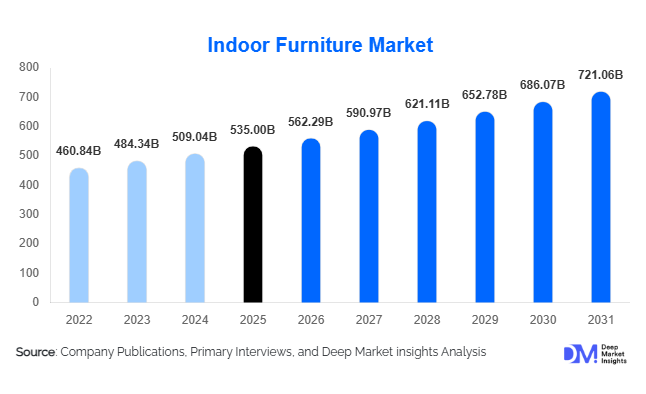
What are the latest trends in the indoor furniture market?
Rising Demand for Multifunctional and Space-Saving Furniture
Urban living spaces are becoming increasingly compact, especially in metropolitan cities across Asia and Europe. This has driven demand for multifunctional furniture such as sofa beds, foldable desks, and modular storage units. Consumers are prioritizing flexibility and efficiency, leading manufacturers to focus on innovative designs that maximize utility without compromising aesthetics. The trend is particularly strong among younger demographics and urban households, where space optimization is a critical purchasing factor. Additionally, rental housing and co-living spaces are further boosting demand for adaptable and easy-to-move furniture solutions.
Shift Toward Sustainable and Eco-Friendly Materials
Sustainability is becoming a key purchasing criterion in the indoor furniture market. Consumers are increasingly opting for products made from certified wood, recycled materials, and low-emission finishes. Manufacturers are adopting environmentally responsible practices, including sustainable sourcing and circular production models. The demand for eco-friendly furniture is especially strong in Europe and North America, where regulatory frameworks and consumer awareness are more advanced. This trend is also encouraging companies to innovate in biodegradable materials and reduce carbon footprints across supply chains.
What are the key drivers in the indoor furniture market?
Growth in Residential Construction and Renovation Activities
The expansion of residential construction globally is a primary driver of furniture demand. With the global housing market exceeding USD 5 trillion, new housing projects and renovation activities are significantly contributing to furniture purchases. Urban migration and government housing initiatives in emerging economies are further strengthening this trend, creating sustained demand for indoor furniture products.
Expansion of E-commerce and Omnichannel Retail
The rapid growth of online retail platforms has transformed the indoor furniture market. Consumers now have access to a wide range of products, competitive pricing, and convenient delivery options. Digital tools such as augmented reality (AR) for product visualization and AI-based recommendations are enhancing the online shopping experience. This has led to increased adoption of online channels, particularly among younger consumers and urban populations.
What are the restraints for the global market?
Volatility in Raw Material Prices
The indoor furniture industry is highly dependent on raw materials such as wood, metal, and foam. Fluctuations in these material costs directly impact production expenses and profit margins. Supply chain disruptions and environmental regulations affecting timber availability further intensify cost pressures for manufacturers.
High Logistics and Transportation Costs
Furniture products are bulky and expensive to transport, leading to higher logistics costs. This challenge is particularly significant for international trade and e-commerce deliveries. Increased fuel prices and supply chain inefficiencies further contribute to rising operational costs, limiting profitability for market participants.
What are the key opportunities in the indoor furniture industry?
Integration of Smart Furniture Technologies
The incorporation of technology into furniture design presents significant growth opportunities. Smart furniture, including adjustable desks, IoT-enabled storage systems, and connected home solutions, is gaining traction among tech-savvy consumers. These innovations enhance functionality and convenience, enabling companies to target premium segments and differentiate their offerings in a competitive market.
Expansion in Emerging Markets
Rapid urbanization and rising middle-class populations in emerging economies such as India, Indonesia, and Vietnam offer substantial growth potential. Increasing disposable incomes and changing lifestyles are driving demand for modern furniture solutions. Companies can leverage localized production and cost-effective distribution strategies to tap into these high-growth markets.
Report Scope
| Report Metric | Details |
|---|---|
| Market Size in 2025 | USD 535 Billion |
| Market Size in 2026 | USD 562.29 Billion |
| Market Size in 2031 | USD 721.06 Billion |
| CAGR | 5.1% (2026-2031) |
| Base Year for Estimation | 2025 |
| Historical Data | 2022-2024 |
| Forecast Period | 2026-2031 |
| Report Coverage | Revenue Forecast, Competitive Landscape, Supply Chain Disruption, Growth Factors, Environment & Regulatory Landscape and Trends |
| Geographies Covered | North America, Europe, APAC, Middle East and Africa, LATAM |
| Countries Covered | U.S., Canada, U.K., Germany, France, Spain, Italy, Russia, Nordic, Benelux, Rest of Europe, China, Korea, Japan, India, Australia, Singapore, Taiwan, South East Asia, Rest of Asia-Pacific, UAE, Turky, Saudi Arabia, South Africa, Egypt, Nigeria, Rest of MEA, Brazil, Mexico, Argentina, Chile, Colombia, Rest of LATAM |
Explore more data points, trends and opportunities Download Free Sample Report
Product Type Insights
Living room furniture dominates the indoor furniture market, accounting for approximately 32% of total revenue in 2025. The leadership of this segment is primarily driven by its central role in household functionality and aesthetics, as it serves as the primary social and recreational space in homes. High replacement cycles, frequent redesign trends, and growing consumer focus on interior décor further reinforce demand. Additionally, rising adoption of modular sofas, recliners, and entertainment units is supporting growth, particularly in urban households. Bedroom furniture follows closely, supported by essential demand for beds, wardrobes, and storage solutions, with replacement demand and real estate expansion acting as key drivers. Dining room furniture maintains steady demand, especially in mid-range and premium segments where consumers emphasize coordinated interior themes. Meanwhile, home office furniture is emerging as the fastest-growing category, driven by the global shift toward remote and hybrid work models, increasing demand for ergonomic chairs, adjustable desks, and compact workspace solutions.
Application Insights
Residential applications dominate the indoor furniture market, contributing nearly 70% of total demand in 2025. This dominance is driven by rising home ownership rates, rapid urbanization, and increasing consumer spending on home improvement and interior aesthetics. The growing trend of home personalization and lifestyle upgrades has further accelerated demand across living room and bedroom furniture categories. On the other hand, commercial applications are witnessing faster growth, expanding at a CAGR of approximately 6–7%. Key drivers include the recovery of the hospitality sector, the expansion of corporate office spaces, and the rise of co-working environments. Retail infrastructure development is also contributing to furniture demand in commercial spaces. Emerging applications such as co-living spaces, student housing, and rental accommodations are creating incremental demand, particularly for cost-effective, durable, and modular furniture solutions tailored to high-usage environments.
Distribution Channel Insights
Offline retail continues to dominate the indoor furniture market, accounting for approximately 60% of total market share in 2025. The leading position of offline channels is driven by consumer preference for physical product evaluation, including comfort, material quality, and design aesthetics before purchase. Specialty furniture stores and large-format retail outlets also provide personalized services, customization options, and immediate product availability, further strengthening this channel. However, online distribution is the fastest-growing segment, supported by increasing internet penetration, digital adoption, and the convenience of home delivery. E-commerce platforms are enhancing customer experience through augmented reality (AR)-based visualization tools, easy returns, and competitive pricing strategies. Direct-to-consumer (D2C) brands are gaining momentum by eliminating intermediaries, improving margins, and offering customized products. The rise of omnichannel retail strategies is enabling seamless integration between online browsing and offline purchasing, significantly improving customer engagement and conversion rates.
End-User Insights
The residential segment remains the largest end-user category, supported by strong demand from homeowners, renters, and renovation activities. Increasing disposable incomes and evolving lifestyle preferences are encouraging consumers to invest in aesthetically appealing and functional furniture. The commercial segment, particularly hospitality and office spaces, is witnessing faster growth due to rising investments in infrastructure development and workspace modernization. The expansion of hotels, resorts, and corporate offices is generating consistent demand for high-quality and durable furniture. Institutional demand from sectors such as education and healthcare is also contributing to steady growth, driven by the need for standardized and functional furniture solutions. Additionally, export-driven demand plays a crucial role in market expansion, with major manufacturing hubs such as China and Vietnam supplying cost-competitive furniture to global markets, particularly North America and Europe.
Explore more data points, trends and opportunities Download Free Sample Report
Indoor Furniture Market Segmentations
By Product Type
- Living Room Furniture
- Bedroom Furniture
- Dining Room Furniture
- Kitchen Furniture
- Home Office Furniture
- Bathroom Furniture
By Material
- Wood
- Metal
- Plastic & Polymer
- Glass
- Upholstered
- Composite Materials
By Distribution Channel
- Offline Retail Stores
- Online/E-commerce Platforms
- Direct-to-Consumer (D2C)
By End-Use
- Residential
- Commercial
- Institutional
Regional Insights
Asia-Pacific
Asia-Pacific leads the indoor furniture market with approximately 40% share in 2025, making it the largest regional market globally. The region’s dominance is driven by rapid urbanization, population growth, and strong expansion in residential construction. China alone contributes nearly 25% of global demand, supported by its large-scale manufacturing base, cost-efficient production capabilities, and strong domestic consumption. India is the fastest-growing market in the region, with a CAGR of around 7%, driven by rising middle-class incomes, government housing initiatives, and increasing urban migration. Southeast Asian countries such as Vietnam and Indonesia are emerging as key production hubs due to low labor costs, favorable trade policies, and increasing foreign investments. Additionally, the growth of e-commerce and the rising demand for affordable furniture are further accelerating regional market expansion.
North America
North America accounts for approximately 25% of the global indoor furniture market, with the United States being the dominant contributor. The region’s growth is primarily driven by high consumer spending power, a well-established housing market, and strong demand for premium and customized furniture. Frequent home renovation activities and rising adoption of smart and ergonomic furniture solutions are further supporting market growth. The increasing trend of remote working has significantly boosted demand for home office furniture across the region. Additionally, the presence of established brands and advanced retail infrastructure, including both offline and e-commerce channels, contributes to sustained demand growth.
Europe
Europe holds around 20% of the global market share, with major demand coming from countries such as Germany, Italy, and France. The region is characterized by a strong emphasis on sustainability, high-quality craftsmanship, and innovative design. Strict environmental regulations and consumer awareness are driving demand for eco-friendly and certified furniture products. The growth of the renovation market, particularly in Western Europe, is a key driver of furniture demand. Additionally, the increasing popularity of minimalist and modular furniture designs is shaping consumer preferences. The presence of premium furniture manufacturers and design-focused brands further strengthens the region’s position in the global market.
Middle East & Africa
The Middle East & Africa region is witnessing steady growth in the indoor furniture market, driven by large-scale real estate development and infrastructure investments. Countries such as the UAE and Saudi Arabia are leading demand due to rapid urbanization, increasing construction of residential and commercial properties, and government-led development initiatives such as smart cities and tourism projects. The hospitality sector, particularly luxury hotels and resorts, is a major driver of furniture demand in this region. Additionally, rising disposable incomes and changing lifestyle preferences are encouraging consumers to invest in modern and premium furniture solutions.
Latin America
Latin America, led by Brazil and Mexico, represents a moderate but steadily growing market, with an expected CAGR of around 4–5% during the forecast period. Economic stabilization, urban development, and gradual growth in middle-class populations are key drivers of furniture demand in the region. Increasing residential construction and renovation activities are supporting market growth. Additionally, the expansion of retail infrastructure and e-commerce platforms is improving product accessibility and driving sales. However, economic fluctuations and pricing sensitivity among consumers remain key challenges for market expansion.
Key Players in the Indoor Furniture Market
- IKEA
- Ashley Furniture Industries
- Steelcase
- Herman Miller
- Haworth
- HNI Corporation
- Okamura Corporation
- Kimball International
- La-Z-Boy
- Natuzzi
- Godrej Interio
- Nilkamal Limited
- Kinnarps
- Inter IKEA Systems
- Williams-Sonoma