Hygienic Paper Market Size
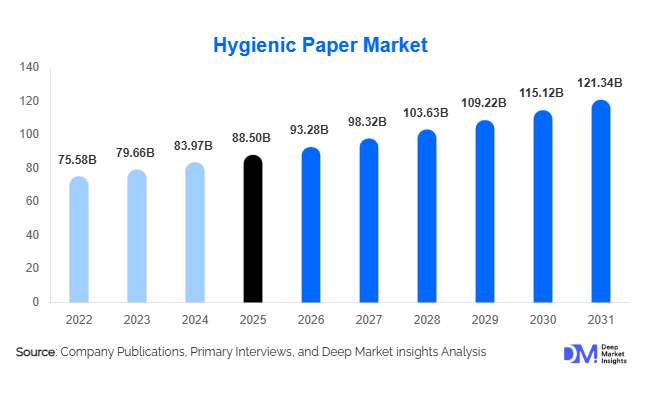
According to Deep Market Insights, the global hygienic paper market size was valued at USD 88.5 billion in 2025 and is projected to grow from USD 93.28 billion in 2026 to reach USD 121.34 billion by 2031, expanding at a CAGR of 5.4% during the forecast period (2026–2031). The hygienic paper market growth is primarily driven by rising global hygiene awareness, expanding urban populations, and increasing consumption of disposable sanitation products across residential and institutional settings. Products such as toilet paper, facial tissues, paper towels, and napkins have become essential everyday commodities in households, commercial establishments, and healthcare facilities worldwide.
The market has experienced steady expansion due to increasing public health awareness and the growing emphasis on sanitation in both developed and emerging economies. Urbanization and rising disposable income levels have increased per-capita consumption of tissue products, particularly in Asia-Pacific and Latin America. Additionally, the expansion of hospitality infrastructure, healthcare facilities, and foodservice establishments is generating significant demand for hygienic paper products.
Technological innovations in tissue manufacturing, including softer multilayer tissues, antibacterial coatings, and eco-friendly fiber sources such as bamboo and recycled pulp, are further reshaping the competitive landscape. Sustainability concerns are encouraging manufacturers to adopt responsibly sourced pulp and recyclable packaging solutions. As governments continue investing in sanitation infrastructure and hygiene education programs, the hygienic paper market is expected to maintain stable long-term growth globally.
Key Market Insights
- Toilet paper dominates the hygienic paper market, accounting for nearly 45% of global product demand due to its universal daily usage.
- Asia-Pacific leads global consumption, supported by large population bases and expanding urban middle-class households.
- Household applications account for nearly three-quarters of total demand, reflecting the essential nature of tissue products in everyday hygiene practices.
- Sustainable tissue products made from recycled and alternative fibers such as bamboo and bagasse are gaining significant traction.
- Offline retail channels dominate distribution, particularly supermarkets and hypermarkets that drive bulk household purchases.
- E-commerce platforms and subscription-based tissue deliveries are emerging as fast-growing distribution channels.
What are the latest trends in the hygienic paper market?
Sustainable and Eco-Friendly Tissue Production
Sustainability has become a major trend shaping the hygienic paper industry. Consumers and governments are increasingly concerned about deforestation and the environmental impacts associated with pulp production. As a result, manufacturers are adopting alternative fiber sources such as bamboo, bagasse, and recycled pulp to reduce dependence on virgin wood fiber. Eco-certifications and responsibly sourced pulp are becoming key differentiators for brands competing in developed markets. Many companies are also introducing biodegradable packaging and energy-efficient production technologies to reduce carbon footprints. These sustainability initiatives not only address environmental concerns but also enable companies to capture premium segments of environmentally conscious consumers who are willing to pay higher prices for eco-friendly hygiene products.
Premiumization and Product Innovation
Premium hygienic paper products are gaining popularity globally as consumers seek enhanced comfort, softness, and convenience. Manufacturers are introducing multi-ply tissues, lotion-infused toilet papers, antibacterial facial tissues, and highly absorbent kitchen towels. Premium tissue products command higher price points and deliver improved margins for manufacturers. Product innovation is particularly strong in developed markets where consumers are willing to pay for enhanced softness and durability. In addition, brands are experimenting with fragrances, skin-care additives, and hypoallergenic formulations to differentiate their offerings. These innovations are also supported by advances in tissue machine technology that enable the production of ultra-soft and high-strength tissue products.
What are the key drivers in the hygienic paper market?
Rising Global Hygiene Awareness
One of the most significant drivers of the hygienic paper market is the increasing emphasis on hygiene and sanitation across households and commercial establishments. Public health campaigns, infection prevention initiatives, and growing awareness regarding disease transmission have encouraged consumers to adopt disposable hygiene products. Tissue products such as paper towels and facial tissues play a crucial role in maintaining personal hygiene and preventing cross-contamination. Following the COVID-19 pandemic, both consumers and institutions have prioritized hygiene standards, resulting in higher consumption of disposable paper products.
Expansion of Urban Population and Middle-Class Consumption
Rapid urbanization in developing economies is significantly increasing the demand for hygienic paper products. Urban households tend to adopt packaged hygiene products rather than reusable cloth alternatives due to convenience and improved living standards. Rising disposable incomes and expanding retail infrastructure have also increased accessibility to tissue products in emerging markets. Countries such as China, India, Indonesia, and Brazil are witnessing rapid growth in tissue consumption as middle-class populations expand and modern retail chains grow.
What are the restraints for the global market?
Volatility in Raw Material Prices
The hygienic paper industry is highly dependent on pulp, which is subject to significant price fluctuations due to changes in forestry regulations, supply disruptions, and energy costs. Rising pulp prices increase production costs for tissue manufacturers and may reduce profitability. Companies must often absorb these costs or pass them on to consumers through price increases, which can affect market demand in price-sensitive regions.
Environmental Regulations and Sustainability Pressures
Environmental concerns related to deforestation and paper waste have resulted in stricter regulations for pulp sourcing and waste management. Governments and environmental organizations are pushing manufacturers to adopt sustainable forestry practices and increase recycling rates. While these initiatives promote environmental responsibility, they also require substantial investments in new technologies and supply chain adjustments, which may slow market expansion in the short term.
What are the key opportunities in the hygienic paper industry?
Institutional Hygiene Infrastructure Expansion
Growing investments in sanitation infrastructure across healthcare facilities, airports, malls, schools, and commercial buildings present significant opportunities for hygienic paper manufacturers. Institutional facilities require continuous supplies of toilet tissue, hand towels, and paper wipes. As governments and private organizations expand public sanitation infrastructure and hygiene standards, demand for bulk hygienic paper products is expected to increase. Manufacturers can capitalize on this opportunity by offering high-capacity tissue dispensers and large-format tissue rolls designed specifically for institutional environments.
E-Commerce and Direct-to-Consumer Sales Channels
The rapid growth of digital retail platforms has opened new distribution channels for hygienic paper manufacturers. E-commerce platforms enable consumers to purchase household essentials conveniently and often in bulk quantities. Subscription-based delivery models are also becoming increasingly popular, allowing households to receive regular supplies of tissue products without repeated purchases. For manufacturers, these platforms provide opportunities to build direct relationships with customers and collect valuable consumer data. Digital retail is particularly expanding in North America and the Asia-Pacific region, where online grocery shopping continues to grow rapidly.
Report Scope
| Report Metric | Details |
|---|---|
| Market Size in 2025 | USD 88.5 Billion |
| Market Size in 2026 | USD 93.28 Billion |
| Market Size in 2031 | USD 121.34 Billion |
| CAGR | 5.4% (2026-2031) |
| Base Year for Estimation | 2025 |
| Historical Data | 2022-2024 |
| Forecast Period | 2026-2031 |
| Report Coverage | Revenue Forecast, Competitive Landscape, Supply Chain Disruption, Growth Factors, Environment & Regulatory Landscape and Trends |
| Geographies Covered | North America, Europe, APAC, Middle East and Africa, LATAM |
| Countries Covered | U.S., Canada, U.K., Germany, France, Spain, Italy, Russia, Nordic, Benelux, Rest of Europe, China, Korea, Japan, India, Australia, Singapore, Taiwan, South East Asia, Rest of Asia-Pacific, UAE, Turky, Saudi Arabia, South Africa, Egypt, Nigeria, Rest of MEA, Brazil, Mexico, Argentina, Chile, Colombia, Rest of LATAM |
Explore more data points, trends and opportunities Download Free Sample Report
Product Type Insights
Toilet paper remains the dominant product category within the hygienic paper market, accounting for approximately 45% of global demand. Its leading position is attributed to its universal daily usage across households and commercial establishments. Facial tissues represent another significant segment due to their widespread use for personal hygiene and respiratory care. Paper towels are increasingly popular in kitchens and commercial food preparation environments due to their strong absorbency and convenience. Napkins and folded hand towels are widely used across the hospitality and foodservice industries, particularly in restaurants, cafes, and hotels. The growth of disposable wipes and specialized hygienic paper products for medical and industrial applications is also expanding the overall product portfolio within the market.
Application Insights
Household consumption accounts for the largest share of the hygienic paper market, representing nearly 75–77% of total demand globally. Everyday hygiene practices, including personal cleaning and kitchen usage, drive consistent demand from residential consumers. Commercial establishments such as offices, malls, and educational institutions represent another important application segment, where large volumes of paper towels and toilet tissue are required for public sanitation. The healthcare industry is a growing application area, as hospitals and clinics rely on disposable paper products to maintain sterile environments and prevent infection transmission. In addition, the foodservice industry continues to drive demand for paper napkins and hand towels due to strict hygiene standards in restaurants and catering services.
Distribution Channel Insights
Offline retail channels dominate the hygienic paper market, accounting for more than 80% of global sales. Supermarkets and hypermarkets remain the primary purchase points for consumers due to convenience and the availability of bulk packaging options. Convenience stores and wholesale distributors also contribute significantly to tissue sales in urban markets. However, online retail channels are gaining momentum as consumers increasingly purchase household essentials through e-commerce platforms. Direct-to-consumer websites and subscription services are enabling manufacturers to expand their reach and build stronger brand loyalty. Digital retail platforms are particularly influential in markets with high internet penetration and advanced logistics infrastructure.
End-Use Industry Insights
The hygienic paper market is closely linked to the growth of several end-use industries, including hospitality, healthcare, foodservice, and corporate infrastructure. The hospitality sector is one of the fastest-growing consumers of hygienic paper products due to the expansion of global tourism and hotel construction projects. Healthcare institutions represent another key growth driver, as hospitals require high volumes of disposable tissue products to maintain infection control standards. Foodservice establishments such as restaurants and cafes generate consistent demand for napkins and paper towels. Export-driven demand is also increasing, particularly from countries with large-scale tissue manufacturing capacities such as China and Indonesia, which supply tissue products to developing regions where domestic production is limited.
Explore more data points, trends and opportunities Download Free Sample Report
Hygienic Paper Market Segmentations
By Product Type
- Toilet Paper
- Facial Tissue
- Paper Towels
- Napkins
- Hand Towels
- Other Hygienic Paper Products
By Raw Material Type
- Virgin Pulp
- Recycled Fiber
- Alternative Fiber Sources
By Ply Structure
- Single-Ply Tissue
- Two-Ply Tissue
- Three-Ply Tissue
- Four-Ply & Premium Multilayer Tissue
By Distribution Channel
- Offline Retail
- Online Retail
By End-Use Application
- Household / Residential
- Healthcare & Medical Facilities
- Hospitality & Tourism
- Foodservice (Restaurants & Cafes)
- Corporate Offices & Institutions
- Industrial Cleaning Applications
Regional Insights
North America
North America represents one of the most mature hygienic paper markets globally, accounting for nearly 30–36% of global demand. The United States dominates regional consumption due to high per-capita tissue usage and strong consumer purchasing power. Commercial establishments such as offices, hotels, and healthcare facilities generate significant demand for hygienic paper products. Canada also exhibits strong consumption patterns supported by advanced sanitation standards and developed retail infrastructure.
Europe
Europe accounts for approximately 25–30% of the global hygienic paper market, with major demand centers including Germany, the United Kingdom, France, and Italy. European consumers demonstrate strong preferences for eco-friendly and recycled tissue products. Government regulations promoting sustainable forestry and recycling have accelerated the adoption of environmentally responsible hygienic paper products across the region.
Asia-Pacific
Asia-Pacific is the largest and fastest-growing regional market, representing approximately 34–44% of global demand. China leads the region due to its large population and extensive pulp manufacturing capacity. India is emerging as one of the fastest-growing markets as urbanization increases and modern retail expands. Japan and South Korea maintain high per-capita consumption levels supported by strong hygiene standards and advanced consumer markets.
Latin America
Latin America accounts for around 6–8% of the global hygienic paper market. Brazil and Mexico are the primary consumption hubs due to their large populations and growing middle-class consumers. Economic development and expanding retail networks are gradually increasing tissue product penetration across the region.
Middle East & Africa
The Middle East and Africa region represents an emerging market for hygienic paper products. Countries such as the United Arab Emirates, Saudi Arabia, and South Africa are witnessing strong demand driven by expanding hospitality infrastructure and improving sanitation standards. Increasing urbanization and tourism development across the region are expected to accelerate market growth in the coming years.
Key Players in the Hygienic Paper Market
- Kimberly-Clark Corporation
- Procter & Gamble
- Essity AB
- Georgia-Pacific
- Sofidel Group
- Svenska Cellulosa Aktiebolaget (SCA)
- Hengan International Group
- Vinda International Holdings
- Asia Pulp & Paper
- CMPC Tissue
- Metsä Tissue
- Kruger Products
- WEPA Group
- Cascades Inc.
- First Quality Enterprises