Household Cleaning Tools & Supplies Market Size
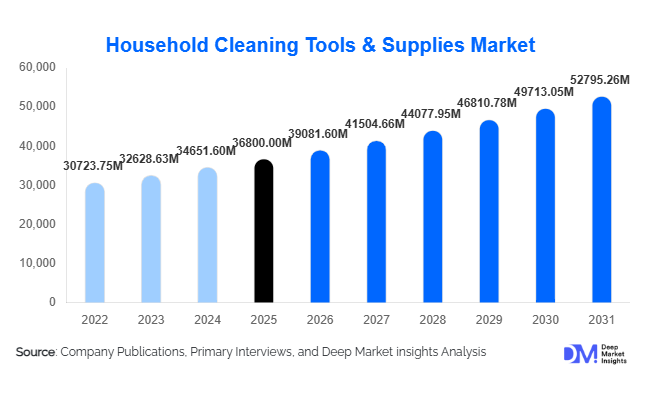
According to Deep Market Insights, the global household cleaning tools & supplies market size was valued at USD 36,800 million in 2025 and is projected to grow from USD 39,081.60 million in 2026 to reach USD 52,795.26 million by 2031, expanding at a CAGR of 6.2% during the forecast period (2026–2031). The household cleaning tools & supplies market growth is primarily driven by rising global hygiene awareness, increasing urbanization, and the expansion of organized retail and e-commerce channels offering a wide range of cleaning tools. Demand for efficient, ergonomic, and environmentally sustainable cleaning products has increased significantly across both residential and institutional environments.
Key Market Insights
- Floor cleaning tools such as mops and brooms dominate the market, accounting for the largest share due to frequent replacement cycles and universal household usage.
- Sustainability-focused cleaning products are gaining traction, with consumers increasingly opting for biodegradable brushes, bamboo-based tools, and reusable microfiber cloths.
- North America remains the largest regional market, supported by high consumer spending on household products and strong retail distribution networks.
- Asia-Pacific is the fastest-growing region, driven by rapid urbanization, rising middle-class populations, and government sanitation initiatives.
- E-commerce platforms are transforming distribution, enabling manufacturers to reach global consumers and launch specialized cleaning products.
- Technological innovations such as electric scrubbers and robotic cleaning devices are expanding the premium segment of the market.
What are the latest trends in the household cleaning tools & supplies market?
Growing Demand for Eco-Friendly Cleaning Tools
Sustainability has emerged as one of the most influential trends in the household cleaning tools market. Consumers are increasingly seeking environmentally responsible alternatives to conventional plastic-based cleaning tools. Manufacturers are responding by introducing products made from biodegradable materials, recycled plastics, and natural fibers such as bamboo, coconut husk, and plant-based bristles. Reusable microfiber cloths and refillable mop systems are also gaining popularity as they reduce waste and long-term cleaning costs.
Retailers and governments in several regions are supporting this trend by encouraging the adoption of eco-friendly products through sustainability labeling and waste reduction initiatives. Companies are also investing in recyclable packaging and low-emission manufacturing processes. As sustainability becomes a key purchase criterion, brands that align their product portfolios with environmental values are gaining competitive advantages in both developed and emerging markets.
Integration of Smart and Automated Cleaning Solutions
Technological innovation is gradually transforming traditional cleaning tools into smart and automated devices. Electric spin scrubbers, battery-powered cleaning brushes, and robotic floor cleaning systems are gaining traction among consumers seeking convenience and efficiency. These solutions are particularly appealing to urban households where time-saving products are highly valued.
Advancements in smart home technologies are also influencing product development. Cleaning tools with rechargeable batteries, ergonomic automation features, and app connectivity are being introduced by leading manufacturers. As consumers increasingly adopt connected home ecosystems, the integration of automated cleaning devices is expected to expand further, creating new opportunities in the premium segment of the household cleaning tools market.
What are the key drivers in the household cleaning tools & supplies market?
Increasing Global Hygiene Awareness
Growing awareness of hygiene and sanitation has significantly boosted demand for household cleaning tools worldwide. The COVID-19 pandemic accelerated this trend, encouraging households to adopt regular cleaning practices and invest in efficient cleaning solutions. Consumers are now prioritizing tools that enable quick and thorough cleaning of floors, surfaces, bathrooms, and kitchens.
Government health campaigns and sanitation programs have also reinforced the importance of maintaining clean living environments. As hygiene continues to be a critical component of public health strategies, the demand for cleaning tools is expected to remain strong across residential and commercial sectors.
Urbanization and Housing Development
Rapid urbanization and expanding residential construction are major contributors to market growth. As urban populations increase, the number of households requiring cleaning tools continues to rise. Newly built apartments, condominiums, and residential complexes create continuous demand for essential cleaning supplies such as mops, brooms, brushes, and dusters.
Urban lifestyles also influence product preferences, with consumers seeking compact, multi-purpose, and ergonomic cleaning tools that simplify household chores. Manufacturers are therefore designing innovative products tailored to modern living spaces, which further drives market expansion.
What are the restraints for the global market?
Volatility in Raw Material Prices
Household cleaning tools rely heavily on materials such as plastics, metals, and synthetic fibers. Fluctuations in raw material prices can significantly impact manufacturing costs and profit margins. Sudden increases in polymer prices or metal costs often force manufacturers to adjust product pricing or reduce production volumes, which can affect market competitiveness.
Additionally, global supply chain disruptions may lead to shortages of essential materials, further complicating production planning. Companies are increasingly exploring alternative materials and localized supply chains to mitigate these risks.
High Competition and Price Sensitivity
The household cleaning tools market is highly fragmented, with numerous local and international manufacturers competing across price segments. In many developing economies, low-cost unbranded products dominate sales due to strong price sensitivity among consumers.
This competitive landscape makes it challenging for premium brands to expand market share without significant investments in marketing and product differentiation. Companies must continuously innovate and enhance product value to maintain profitability in such a competitive environment.
What are the key opportunities in the household cleaning tools industry?
Expansion in Emerging Markets
Emerging economies such as India, Indonesia, Brazil, and several African nations represent significant growth opportunities for cleaning tools manufacturers. Rising middle-class incomes, rapid urbanization, and growing awareness of hygiene practices are increasing the demand for standardized cleaning products.
Government sanitation initiatives and infrastructure development programs are also promoting the use of cleaning supplies in both residential and public spaces. Companies that develop affordable, durable products tailored to the needs of these markets can capture substantial long-term growth opportunities.
Innovation in Ergonomic and Multi-Purpose Cleaning Tools
Consumers increasingly prefer cleaning tools that reduce physical effort and save time. Ergonomic designs, lightweight materials, and multi-functional products are becoming popular among households worldwide. Products such as extendable dusters, rotating mop systems, and adjustable cleaning brushes are gaining strong market acceptance.
Manufacturers are investing heavily in product design innovations to improve user comfort and efficiency. The development of modular cleaning systems and interchangeable attachments is also expanding product versatility, which is expected to create new revenue streams for market participants.
Report Scope
| Report Metric | Details |
|---|---|
| Market Size in 2025 | USD 36800 Million |
| Market Size in 2026 | USD 39081.60 Million |
| Market Size in 2031 | USD 52795.26 Million |
| CAGR | 6.2% (2026-2031) |
| Base Year for Estimation | 2025 |
| Historical Data | 2022-2024 |
| Forecast Period | 2026-2031 |
| Report Coverage | Revenue Forecast, Competitive Landscape, Supply Chain Disruption, Growth Factors, Environment & Regulatory Landscape and Trends |
| Geographies Covered | North America, Europe, APAC, Middle East and Africa, LATAM |
| Countries Covered | U.S., Canada, U.K., Germany, France, Spain, Italy, Russia, Nordic, Benelux, Rest of Europe, China, Korea, Japan, India, Australia, Singapore, Taiwan, South East Asia, Rest of Asia-Pacific, UAE, Turky, Saudi Arabia, South Africa, Egypt, Nigeria, Rest of MEA, Brazil, Mexico, Argentina, Chile, Colombia, Rest of LATAM |
Explore more data points, trends and opportunities Download Free Sample Report
Product Type Insights
Floor cleaning tools remain the leading product segment in the household cleaning tools & supplies market, accounting for approximately 38% of total revenue in 2025. This segment includes essential products such as brooms, mops, floor scrubbers, and squeegees, which are widely used across both residential and commercial environments. The dominant share of this category is largely driven by the universal requirement for floor cleaning in households and institutions, along with the high replacement frequency of these tools due to wear and tear. Continuous product innovation has further strengthened the segment’s leadership position. Advanced solutions such as spin mops, spray mops, flat microfiber mops, and steam cleaning systems are gaining strong consumer adoption because they offer improved cleaning efficiency, reduced water consumption, and ergonomic ease of use. Growing urban lifestyles, where consumers prioritize time-saving and convenient cleaning solutions, are further accelerating demand for technologically enhanced floor cleaning tools.
Surface cleaning tools represent another significant category within the market. Products such as sponges, microfiber cloths, scouring pads, and cleaning wipes are extensively used for kitchen, furniture, and appliance cleaning. Among these, microfiber cloths have gained exceptional popularity due to their superior ability to trap dust, remove bacteria, and clean surfaces effectively without requiring chemical cleaning agents. This capability aligns with the growing consumer preference for chemical-free and environmentally friendly cleaning solutions. In addition, specialty cleaning tools such as window cleaning kits, upholstery brushes, bottle cleaners, and extendable dusters are expanding the scope of the market by addressing specific cleaning needs in modern households. The increasing complexity of household interiors, including glass panels, modular kitchens, and delicate furnishings, is further driving demand for specialized cleaning solutions.
Application Insights
Residential households represent the dominant application segment in the household cleaning tools & supplies market, accounting for nearly 72% of total market demand in 2025. Cleaning tools are considered essential everyday household products with relatively short replacement cycles, ensuring steady and recurring demand globally. Increasing awareness of hygiene, cleanliness, and health safety has significantly strengthened product adoption within this segment. Furthermore, rising urbanization and rapid residential construction activities across emerging economies are expanding the global consumer base for household cleaning tools. Consumers are also increasingly investing in higher-quality and ergonomic cleaning tools that improve efficiency and reduce physical effort, which further supports market growth.
Commercial cleaning services represent one of the fastest-growing application segments. Professional cleaning companies require durable, high-performance cleaning tools to maintain large commercial spaces such as offices, retail outlets, residential complexes, and industrial facilities. The expansion of outsourcing in facility management services has significantly increased demand for commercial-grade cleaning tools. In addition, sectors such as hospitality and healthcare are increasing their consumption of specialized cleaning tools to maintain strict hygiene and sanitation standards. Hospitals, clinics, and hotels require frequent cleaning and disinfection of floors, surfaces, and high-contact areas, which contributes to strong and sustained demand from these industries.
Distribution Channel Insights
Supermarkets and hypermarkets remain the dominant distribution channels for household cleaning tools & supplies, accounting for approximately 45% of global sales in 2025. These retail outlets provide consumers with convenient access to a wide range of cleaning products, allowing them to compare brands, product features, and pricing in a single location. Large retail chains also play a crucial role in driving product visibility through promotional displays, seasonal campaigns, and bundled offers. Their ability to maintain consistent inventory levels and offer competitive pricing has made them the preferred purchasing channel for a large share of consumers worldwide.
Online retail platforms are emerging as one of the fastest-growing distribution channels in the market. The rapid growth of e-commerce has enabled consumers to access a wider variety of cleaning tools, including specialized and premium products that may not be available in traditional retail outlets. Online platforms allow consumers to compare prices, read product reviews, and make informed purchasing decisions. Manufacturers are increasingly leveraging digital marketing strategies, social media advertising, and direct-to-consumer websites to strengthen brand engagement and expand their global reach. Subscription-based household supply services and bulk purchasing options offered by online platforms are also encouraging repeat purchases and customer loyalty.
End-Use Insights
Household consumers represent the largest end-use segment, primarily driven by the need for routine cleaning in residential environments. Rising housing construction and urban residential development are continuously expanding the global consumer base for cleaning tools. In addition, growing consumer awareness regarding hygiene and sanitation is encouraging households to maintain higher cleaning standards, which results in frequent replacement and purchase of cleaning supplies. The increasing adoption of modern household products and lifestyle upgrades, particularly in emerging economies, is also contributing to rising demand within this segment.
Institutional users such as hospitals, schools, corporate offices, and government facilities represent an important and steadily expanding end-use category. Healthcare facilities require specialized cleaning tools to maintain infection control standards and prevent cross-contamination. Similarly, educational institutions and office complexes require regular cleaning to maintain safe and hygienic environments for occupants. The expansion of these sectors, combined with stricter hygiene regulations and sanitation protocols, is expected to drive consistent demand for professional-grade cleaning tools in institutional settings.
Explore more data points, trends and opportunities Download Free Sample Report
Household Cleaning Tools & Supplies Market Segmentations
By Product Type
- Floor Cleaning Tools
- Surface Cleaning Tools
- Bathroom Cleaning Tools
- Kitchen Cleaning Tools
- Dusting Tools
- Specialty Cleaning Tools
- Smart & Automated Cleaning Tools
By Application
- Residential Households
- Commercial Cleaning Services
- Hospitality Industry
- Healthcare Facilities
- Institutional Users
By Distribution Channel
- Supermarkets & Hypermarkets
- Convenience Stores
- Online Retail / E-Commerce
- Wholesale Distributors
- Direct Sales
Regional Insights
North America
North America represents the largest regional market for household cleaning tools & supplies, accounting for approximately 34% of global demand in 2025. The United States dominates regional consumption due to high household spending on consumer goods, well-established retail distribution networks, and strong brand presence from leading manufacturers. Consumers in this region demonstrate a strong preference for technologically advanced and premium cleaning tools that improve convenience and efficiency. The increasing adoption of automated cleaning solutions such as electric scrubbers and robotic floor cleaners is further strengthening market growth. In addition, growing demand for eco-friendly and sustainable cleaning products is influencing purchasing behavior, encouraging manufacturers to introduce biodegradable materials and recyclable packaging. Canada also contributes significantly to regional demand due to high disposable incomes and rising consumer awareness of environmentally responsible cleaning solutions.
Europe
Europe accounts for nearly 27% of the global household cleaning tools market, with strong demand from countries such as Germany, the United Kingdom, France, and Italy. One of the primary drivers of regional growth is the strong emphasis on sustainability and environmental responsibility among European consumers. Governments across the region have introduced strict regulations related to plastic usage, waste management, and product sustainability, which has accelerated the adoption of eco-friendly cleaning tools made from biodegradable materials and natural fibers. Additionally, Europe’s mature retail infrastructure and high consumer purchasing power enable widespread adoption of premium and specialized cleaning tools. The growing popularity of reusable microfiber cleaning cloths and ergonomic cleaning products is also contributing to the region’s steady market expansion.
Asia-Pacific
Asia-Pacific is the fastest-growing regional market for household cleaning tools & supplies, supported by rapid urbanization, expanding middle-class populations, and rising hygiene awareness. China and India represent the largest markets in the region due to their large populations and increasing consumer spending on household products. Government sanitation programs, urban housing development, and improving living standards are significantly boosting demand for cleaning tools across residential households. Additionally, the rapid growth of e-commerce platforms and organized retail networks in countries such as China, India, Indonesia, and Vietnam is improving product accessibility and market penetration. The presence of large-scale manufacturing hubs in China and Southeast Asia also supports regional market growth by enabling cost-efficient production and global exports.
Latin America
Latin America accounts for approximately 8–10% of the global market, with Brazil and Mexico serving as the largest regional markets. Market growth in this region is driven by rising urbanization, increasing disposable incomes, and growing consumer awareness of hygiene and sanitation. The expansion of modern retail formats such as supermarkets and hypermarkets is improving product availability and consumer access to branded cleaning tools. Additionally, the increasing adoption of professional cleaning services in commercial spaces such as shopping malls, office complexes, and hospitality establishments is contributing to regional demand. Governments in several Latin American countries are also promoting sanitation and public hygiene initiatives, which indirectly support market growth.
Middle East & Africa
The Middle East & Africa region is experiencing steady growth in the household cleaning tools & supplies market, supported by rising urban infrastructure development and expanding tourism and hospitality sectors. Countries such as Saudi Arabia, the United Arab Emirates, and South Africa are key markets where demand is driven by both residential households and commercial establishments such as hotels, shopping malls, and office complexes. Rapid urbanization and infrastructure investments in Gulf countries are creating significant demand for professional cleaning services and associated cleaning tools. Additionally, increasing awareness of hygiene standards in public and residential spaces is encouraging consumers to adopt modern cleaning products. Growing retail penetration and the expansion of international supermarket chains across the region are also improving product accessibility and driving market growth.
Key Players in the Household Cleaning Tools & Supplies Market
- Procter & Gamble
- Unilever
- Reckitt
- SC Johnson
- Clorox
- Henkel
- Kao Corporation
- Bissell
- Church & Dwight
- Newell Brands
- Kimberly-Clark
- Ecolab
- Diversey Holdings
- Godrej Consumer Products
- Libman Company