Hot Tub Market Size
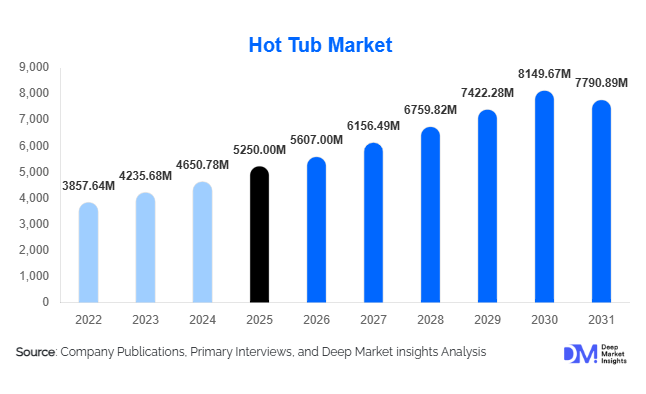
According to Deep Market Insights, the global hot tub market size was valued at USD 5,250 million in 2025 and is projected to grow from USD 5,607.00 million in 2026 to reach USD 7790.89 million by 2031, expanding at a CAGR of 6.8% during the forecast period (2026–2031). The hot tub market growth is primarily driven by rising consumer interest in home-based wellness solutions, increasing investments in outdoor living spaces, and growing adoption across hospitality and commercial wellness sectors. The shift toward hydrotherapy for stress relief and physical recovery has further accelerated demand, particularly in developed economies.
Key Market Insights
- Residential demand dominates the market, driven by home renovation trends and increased focus on personal wellness and relaxation.
- Portable and inflatable hot tubs are gaining traction, offering cost-effective and flexible installation options for a broader consumer base.
- North America leads the global market, supported by high disposable incomes and a strong culture of outdoor leisure.
- Asia-Pacific is the fastest-growing region, fueled by urbanization and rising middle-class spending in China and India.
- Smart hot tubs with IoT integration are emerging as a key trend, offering remote control, energy monitoring, and enhanced user experience.
- Sustainability and energy efficiency are becoming critical purchasing factors, influencing product design and innovation.
What are the latest trends in the hot tub market?
Smart and Connected Hot Tubs Gaining Momentum
The integration of smart technologies is transforming the hot tub market. Modern hot tubs are increasingly equipped with IoT-enabled features such as app-based temperature control, automated maintenance alerts, and energy consumption tracking. These capabilities enhance user convenience while reducing operational costs. Integration with smart home ecosystems is also becoming more common, allowing users to control hot tubs through voice assistants and centralized home automation systems. This trend is particularly appealing to tech-savvy consumers and premium buyers seeking convenience and personalization.
Eco-Friendly and Energy-Efficient Designs
Environmental sustainability is emerging as a key trend in the hot tub market. Manufacturers are focusing on energy-efficient insulation, advanced heating systems, and water-saving filtration technologies. Solar-compatible hot tubs and eco-friendly materials are gaining popularity among environmentally conscious consumers. Regulatory frameworks in Europe and North America are also encouraging energy-efficient product development, pushing manufacturers to innovate. This trend not only reduces environmental impact but also addresses rising energy costs, making hot tubs more accessible to a wider audience.
What are the key drivers in the hot tub market?
Growing Wellness and Hydrotherapy Demand
Increasing awareness of health and wellness benefits associated with hydrotherapy is a major driver for the hot tub market. Hot tubs are widely used for muscle relaxation, pain relief, improved circulation, and stress reduction. The rising prevalence of lifestyle-related health issues and mental stress is encouraging consumers to invest in wellness solutions at home. This trend is further supported by healthcare professionals recommending hydrotherapy for recovery and relaxation, strengthening demand across residential and commercial segments.
Expansion of Home Improvement and Outdoor Living Trends
The surge in home improvement activities, particularly in developed markets, is significantly boosting hot tub adoption. Consumers are increasingly investing in outdoor living spaces such as patios, decks, and gardens, where hot tubs serve as a central feature. The trend gained momentum during the pandemic and continues to drive demand. High disposable income levels and favorable financing options are enabling consumers to invest in premium home amenities, further supporting market growth.
What are the restraints for the global market?
High Initial and Maintenance Costs
The cost of purchasing and installing a hot tub remains a major barrier for many consumers. In addition to the upfront cost, ongoing expenses related to electricity, water usage, and maintenance can be significant. These factors limit adoption in price-sensitive markets and among middle-income consumers, particularly in developing regions.
Space Constraints and Regulatory Limitations
Urbanization and limited residential space pose challenges for hot tub installation, especially in densely populated cities. Additionally, regulatory requirements related to water usage, electrical safety, and zoning laws can restrict installations. Compliance with these regulations increases complexity and cost, acting as a restraint to market growth.
What are the key opportunities in the hot tub industry?
Expansion in Emerging Markets
Emerging economies such as China, India, and Brazil present significant growth opportunities for the hot tub market. Rising disposable incomes, increasing urbanization, and growing awareness of wellness products are driving demand. Manufacturers can capitalize on these opportunities by offering affordable and localized product variants, along with expanding distribution networks in these regions.
Integration with Wellness Tourism and Hospitality
The rapid growth of wellness tourism is creating new opportunities for hot tub manufacturers. Hotels, resorts, and wellness centers are increasingly incorporating hot tubs as part of their premium offerings. Customized solutions for commercial applications, including large-capacity and energy-efficient models, are gaining traction. This trend is expected to drive sustained demand from the hospitality sector.
Report Scope
| Report Metric | Details |
|---|---|
| Market Size in 2025 | USD 5250 Million |
| Market Size in 2026 | USD 5607.00 Million |
| Market Size in 2031 | USD 7790.89 Million |
| CAGR | 9.8% (2026-2031) |
| Base Year for Estimation | 2025 |
| Historical Data | 2022-2024 |
| Forecast Period | 2026-2031 |
| Report Coverage | Revenue Forecast, Competitive Landscape, Supply Chain Disruption, Growth Factors, Environment & Regulatory Landscape and Trends |
| Geographies Covered | North America, Europe, APAC, Middle East and Africa, LATAM |
| Countries Covered | U.S., Canada, U.K., Germany, France, Spain, Italy, Russia, Nordic, Benelux, Rest of Europe, China, Korea, Japan, India, Australia, Singapore, Taiwan, South East Asia, Rest of Asia-Pacific, UAE, Turky, Saudi Arabia, South Africa, Egypt, Nigeria, Rest of MEA, Brazil, Mexico, Argentina, Chile, Colombia, Rest of LATAM |
Explore more data points, trends and opportunities Download Free Sample Report
Product Type Insights
Portable hot tubs dominate the global market, accounting for approximately 52% of the total market share in 2025. The leadership of this segment is primarily driven by its affordability, ease of installation, and minimal infrastructure requirements, making it highly attractive for residential users. Unlike in-ground alternatives, portable units do not require permanent structural modifications, enabling quicker adoption across both owned and rented properties. Additionally, advancements in plug-and-play systems, improved insulation, and energy-efficient heating technologies have further strengthened their appeal.
Inflatable hot tubs are emerging as a high-growth sub-segment within portable units, particularly among budget-conscious and first-time buyers. Their low upfront cost and ease of storage make them popular in urban households with space constraints. On the other hand, in-ground hot tubs cater to the premium segment, driven by increasing demand for luxury outdoor living spaces and high-end real estate developments. This segment benefits from customization capabilities, aesthetic integration with landscapes, and long-term durability, making it a preferred choice for affluent consumers and hospitality applications.
Application Insights
The residential segment holds the largest share of approximately 64% of the global market in 2025, driven by rising homeownership, increasing disposable income, and growing consumer awareness of wellness and hydrotherapy benefits. The post-pandemic shift toward home-centric lifestyles has accelerated investments in home improvement and outdoor leisure infrastructure, positioning hot tubs as a key element of modern residential design. The trend toward backyard transformations and personal wellness spaces continues to support strong demand in this segment.
The commercial segment, while smaller in share, is witnessing faster growth and is expected to expand at a higher CAGR over the forecast period. Demand is primarily driven by the hospitality industry, including hotels, resorts, and wellness retreats, where hot tubs are increasingly considered a standard luxury amenity. Additionally, fitness centers and spas are incorporating hydrotherapy solutions to enhance service offerings. The expansion of global wellness tourism and rising investments in premium hospitality infrastructure are key growth drivers for this segment.
Distribution Channel Insights
Offline distribution channels dominate the hot tub market, accounting for approximately 68% of total sales in 2025. The dominance of this segment is attributed to the high-value nature of the product, where consumers prefer physical inspection, product demonstrations, and expert consultation before making purchasing decisions. Specialty retailers and authorized dealers play a critical role in influencing buying behavior by offering installation services, after-sales support, and customization options.
However, online channels are rapidly gaining traction, driven by the expansion of e-commerce platforms and increasing digital adoption among consumers. Competitive pricing, convenience, and access to a wider product range are key factors supporting online growth. Manufacturers are also investing in direct-to-consumer (D2C) models, leveraging digital marketing and virtual product visualization tools to enhance customer engagement. The integration of augmented reality (AR) and virtual showrooms is further expected to bridge the gap between online and offline experiences.
Technology Insights
Conventional hot tubs continue to dominate the market, accounting for approximately 70% of the global share in 2025, primarily due to their affordability and widespread availability. However, the market is undergoing a significant technological shift with the rapid adoption of smart hot tubs, which represent the fastest-growing segment. The growth of smart hot tubs is driven by increasing consumer preference for connected and automated home solutions. Features such as IoT-enabled controls, mobile app integration, energy consumption monitoring, and predictive maintenance are enhancing user convenience and operational efficiency. Additionally, advancements in energy-efficient heating systems, smart filtration technologies, and automated water treatment solutions are reducing maintenance costs and environmental impact. These innovations are particularly appealing to tech-savvy consumers and premium buyers, positioning smart hot tubs as a key future growth driver.
Explore more data points, trends and opportunities Download Free Sample Report
Hot Tub Market Segmentations
By Product Type
- Portable Hot Tubs
- In-ground Hot Tubs
- Inflatable Hot Tubs
By Material
- Acrylic
- Fiberglass
- Rotomolded Plastic
- Wooden
By Application
- Residential
- Commercial
By Distribution Channel
- Offline Retail
- Online Retail
By Technology
- Conventional Hot Tubs
- Smart Hot Tubs
Regional Insights
North America
North America remains the largest market for hot tubs, accounting for approximately 38% of the global market share in 2025, with the United States contributing over 30% of total demand. The region’s dominance is driven by high disposable income levels, a strong culture of outdoor living, and widespread adoption of home wellness solutions. The presence of leading manufacturers and well-established distribution networks further supports market growth. Additionally, climatic conditions in many parts of the U.S. and Canada encourage year-round hot tub usage, while increasing investments in home renovation and backyard leisure infrastructure continue to drive demand.
Europe
Europe holds approximately 27% of the global market share, with major demand centers in Germany, the UK, and France. Growth in this region is primarily driven by the increasing popularity of wellness tourism and a strong consumer preference for sustainable and energy-efficient products. Stringent regulatory standards related to energy consumption and environmental impact are pushing manufacturers to innovate and develop eco-friendly solutions. Additionally, the rising adoption of spa and wellness facilities across both residential and hospitality sectors is supporting steady market expansion.
Asia-Pacific
Asia-Pacific is the fastest-growing region in the hot tub market, expected to expand at a CAGR exceeding 8.2%. China accounts for nearly 12% of global demand, driven by rapid urbanization, increasing disposable incomes, and a growing middle-class population. In India and Southeast Asia, rising awareness of wellness products and increasing penetration of luxury residential projects are key growth drivers. Japan and Australia represent mature markets with stable demand, supported by a strong wellness culture and high consumer spending. The expansion of hospitality infrastructure and increasing investments in premium real estate developments are further accelerating regional growth.
Latin America
Latin America is experiencing moderate but steady growth, led by Brazil and Mexico. The market is driven by rising disposable incomes, urbanization, and increasing consumer interest in lifestyle and luxury home products. Growth in the hospitality sector, particularly in resort destinations, is also contributing to demand. However, price sensitivity and economic volatility remain key challenges in the region, limiting widespread adoption.
Middle East & Africa
The Middle East and Africa region is witnessing steady growth, particularly in the UAE and Saudi Arabia, where luxury hospitality and real estate developments are key demand drivers. High-end hotels, resorts, and residential projects are increasingly incorporating hot tubs as part of premium amenities. Government initiatives aimed at boosting tourism, such as large-scale infrastructure and hospitality investments, are further supporting market growth. In Africa, adoption remains limited but is gradually increasing in urban centers and luxury resorts, driven by growing tourism and rising disposable income among affluent consumers.
Key Players in the Hot Tub Market
- Jacuzzi Brands LLC
- Watkins Wellness
- Sundance Spas
- Bullfrog Spas
- Artesian Spas
- Master Spas
- Cal Spas
- Marquis Corp
- Coast Spas
- Dimension One Spas
- Canadian Spa Company
- ThermoSpas
- PDC Spas
- Strong Spas
- Viking Spas