Home Painting Service Market Size
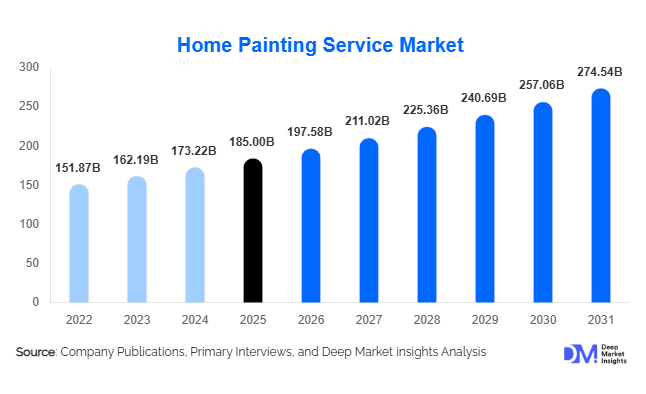
According to Deep Market Insights, the global home painting service market size was valued at USD 185 billion in 2025 and is projected to grow from USD 197.58 billion in 2026 to reach USD 274.54 billion by 2031, expanding at a CAGR of 6.8% during the forecast period (2026–2031). The market growth is primarily driven by rising urbanization, increasing residential construction, and growing consumer preference for professional, hassle-free home improvement services. Additionally, the shift from unorganized contractors to branded and technology-enabled service providers is accelerating market expansion globally.
Key Market Insights
- The market is transitioning toward organized and branded service providers, offering standardized pricing, warranties, and quality assurance.
- Interior painting services dominate demand, driven by frequent repainting cycles and evolving interior décor trends.
- Asia-Pacific leads the global market, supported by rapid urbanization and housing demand in countries like China and India.
- Eco-friendly and low-VOC paints are gaining traction, driven by environmental regulations and consumer awareness.
- Digital platforms and app-based booking models are expanding rapidly, improving customer experience and service transparency.
- The mid-range pricing segment holds the largest share, balancing affordability with quality for mass-market consumers.
What are the latest trends in the home painting service market?
Shift Toward Organized and Branded Services
The home painting service industry is witnessing a significant shift from unorganized local contractors to branded service providers offering end-to-end solutions. Consumers increasingly prefer companies that provide transparent pricing, trained professionals, project timelines, and post-service warranties. This trend is particularly prominent in urban areas, where time constraints and quality expectations are high. Organized players are also leveraging standardized processes, digital tools, and centralized procurement to enhance operational efficiency and customer satisfaction.
Adoption of Eco-Friendly and Smart Coatings
Growing environmental concerns and regulatory pressure are accelerating the adoption of eco-friendly, low-VOC, and non-toxic paints. Service providers are incorporating sustainable solutions such as anti-bacterial coatings, heat-reflective paints, and waterproofing technologies. These innovations not only improve indoor air quality but also enhance durability and energy efficiency. Premium customers are particularly inclined toward such advanced solutions, enabling companies to offer differentiated and higher-margin services.
What are the key drivers in the home painting service market?
Rapid Urbanization and Housing Growth
The expansion of urban populations, especially in emerging economies, is driving strong demand for new residential construction and associated painting services. Government housing initiatives and infrastructure development are further contributing to sustained market growth. As cities expand, the need for both new painting and repainting services continues to rise.
Increasing Renovation and Repainting Frequency
In developed markets, repainting cycles have shortened due to changing consumer preferences, lifestyle upgrades, and increasing focus on aesthetics. Homeowners are now repainting every 5–7 years compared to longer cycles previously, creating recurring demand for professional painting services. This trend is also emerging in developing markets with rising disposable incomes.
What are the restraints for the global market?
Highly Fragmented Market Structure
A significant portion of the home painting service market remains unorganized, dominated by small, local contractors. This fragmentation leads to inconsistent service quality, price undercutting, and limited scalability for organized players. The lack of standardization also affects customer trust in certain regions.
Volatility in Raw Materials and Labor Costs
Fluctuations in paint prices due to raw material cost variations, coupled with rising labor costs, pose challenges for service providers. These factors impact pricing strategies and profit margins, particularly for companies operating in competitive and price-sensitive markets.
What are the key opportunities in the home painting service industry?
Digital Transformation and Platform-Based Services
The integration of digital platforms for booking, pricing, and service tracking presents a major opportunity. Companies offering AI-based color visualization, instant quotations, and app-based scheduling can significantly enhance customer experience and scale operations efficiently. This transformation is expected to formalize the market and reduce reliance on unorganized contractors.
Expansion in Emerging Housing Markets
Emerging economies in the Asia-Pacific, the Middle East, and Africa offer significant growth potential due to rapid urbanization and increasing housing demand. New entrants can capitalize on these markets by establishing localized networks and partnering with real estate developers for large-scale projects.
Report Scope
| Report Metric | Details |
|---|---|
| Market Size in 2025 | USD 185 Billion |
| Market Size in 2026 | USD 197.58 Billion |
| Market Size in 2031 | USD 274.54 Billion |
| CAGR | 6.8% (2026-2031) |
| Base Year for Estimation | 2025 |
| Historical Data | 2022-2024 |
| Forecast Period | 2026-2031 |
| Report Coverage | Revenue Forecast, Competitive Landscape, Supply Chain Disruption, Growth Factors, Environment & Regulatory Landscape and Trends |
| Geographies Covered | North America, Europe, APAC, Middle East and Africa, LATAM |
| Countries Covered | U.S., Canada, U.K., Germany, France, Spain, Italy, Russia, Nordic, Benelux, Rest of Europe, China, Korea, Japan, India, Australia, Singapore, Taiwan, South East Asia, Rest of Asia-Pacific, UAE, Turky, Saudi Arabia, South Africa, Egypt, Nigeria, Rest of MEA, Brazil, Mexico, Argentina, Chile, Colombia, Rest of LATAM |
Explore more data points, trends and opportunities Download Free Sample Report
Service Type Insights
Within the global home painting service market, interior painting services dominate with approximately 38% share in 2025. This leadership is driven by frequent repainting cycles, growing consumer focus on home aesthetics, and rising demand for decorative finishes such as textures, designer walls, and accent panels. Interior painting remains a recurring service requirement, creating a steady revenue stream for providers. Exterior painting services follow closely, fueled by structural maintenance needs, weatherproofing requirements, and government-mandated building standards in urban and suburban developments. Specialty coatings, including waterproofing, anti-microbial, and fire-retardant solutions, are emerging as high-growth sub-segments due to their functional advantages, regulatory compliance benefits, and ability to command premium pricing. Among these, interior decorative finishes are the primary driver, particularly in urban centers and high-income residential areas where consumer expectations for aesthetics are high.
Property Type Insights
The residential segment leads the market with nearly 52% share in 2025, primarily driven by increasing homeownership, rapid urban housing developments, and strong renovation trends. Within residential properties, apartments account for the largest share, reflecting high-density urban construction and multi-family housing projects. Commercial properties, including offices, retail spaces, and hospitality establishments, are growing steadily, supported by corporate branding initiatives, workspace modernization, and increased investments in premium finishes. Institutional properties such as schools, hospitals, and government buildings maintain stable demand, primarily for periodic maintenance and compliance with functional and aesthetic standards. The residential segment’s dominance is reinforced by frequent repainting cycles and the growing willingness of homeowners to invest in professional services rather than DIY solutions.
Customer Type Insights
Individual homeowners represent the largest customer base, contributing around 45% of total demand. This is driven by convenience, quality assurance, and rising awareness of professional painting services over DIY approaches. Real estate developers and corporate clients also constitute a significant share of the market, particularly for large-scale residential or commercial projects. Developers often contract organized painting service providers to ensure consistent quality across multiple units, while corporates increasingly seek premium finishes and advanced coatings to enhance brand image and meet sustainability standards.
Paint Type Insights
Water-based paints dominate with approximately 60% market share, primarily due to environmental compliance, low VOC emissions, quick drying time, and ease of maintenance. Eco-friendly paints are gaining rapid traction, especially in developed markets such as North America and Europe, where sustainability regulations are stringent. Premium designer finishes are expanding within the luxury segment, catering to high-income consumers seeking decorative, long-lasting, and visually distinctive coatings. Functional coatings such as anti-microbial, heat-reflective, and waterproof paints are emerging as growth drivers, particularly for high-rise buildings and commercial facilities.
Service Delivery Model Insights
While unorganized contractors continue to hold around 55% share, especially in price-sensitive developing regions, organized and branded service providers are growing rapidly. Growth is driven by increasing consumer trust, the adoption of digital booking platforms, app-based scheduling, and quality assurance programs. Organized service providers benefit from standardized operations, bulk procurement of premium paints, and structured project management, which enhances efficiency and profitability.
Pricing Tier Insights
The mid-range segment leads with nearly 50% share, offering an optimal balance between affordability and service quality. Premium services are expanding rapidly in urban, high-income markets due to rising consumer willingness to invest in designer finishes, specialty coatings, and complete project management solutions. Economy services continue to serve highly price-sensitive regions and rural markets, sustaining demand in cost-conscious segments.
Explore more data points, trends and opportunities Download Free Sample Report
Home Painting Service Market Segmentations
By Service Type
- Interior Painting Services
- Exterior Painting Services
- Specialty Coatings
By Property Type
- Residential
- Commercial
- Institutional
By Customer Type
- Individual Homeowners
- Real Estate Developers
- Corporate Clients
By Paint Type
- Water-Based Paints
- Eco-Friendly/Low VOC Paints
- Premium Designer Finishes
By Service Delivery Model
- Organized Service Providers
- Unorganized Contractors
Regional Insights
Asia-Pacific
Asia-Pacific dominates the global home painting service market with approximately 42% share in 2025. Key countries such as China and India are the largest contributors, supported by rapid urbanization, rising middle-class homeownership, and government-backed housing initiatives. The growth is further fueled by the proliferation of apartment complexes and the increasing popularity of premium decorative interiors among urban consumers. India is one of the fastest-growing markets with a CAGR of around 8–9%, driven by large-scale government housing projects, increasing penetration of organized painting service providers, and rising consumer preference for eco-friendly coatings. China’s market growth is primarily driven by the combination of urban redevelopment, growing demand for interior design aesthetics, and strong commercial construction activity.
North America
North America accounts for around 25% market share, led by the United States, which represents nearly 80% of the regional demand. Market expansion is driven by frequent repainting cycles, high disposable incomes, and a strong preference for professional, branded service providers. The trend toward eco-friendly paints and premium interior finishes, particularly in urban residential and commercial properties, further supports growth. Repainting for renovations and aesthetic upgrades in mid-to-high-end residential neighborhoods is a significant driver of market demand.
Europe
Europe contributes approximately 18% share of the global market, with Germany, the UK, and France being the key countries. Renovation and refurbishment projects are major growth drivers, particularly in aging residential and commercial infrastructures. Additionally, stringent environmental regulations regarding VOC emissions and increasing demand for sustainable and eco-friendly paints propel the adoption of water-based and low-VOC coatings. The rise in premium finishes for commercial offices and luxury apartments is also positively impacting market growth.
Middle East & Africa
This region holds about 8% share, driven primarily by infrastructure expansion, rapid urbanization, and real estate development in countries such as the UAE and Saudi Arabia. Luxury residential and commercial projects, combined with demand for weather-resistant exterior coatings, are key growth drivers. The adoption of premium and specialized coatings, such as heat-reflective and anti-microbial paints, is rising in the region, particularly in the commercial and hospitality sectors.
Latin America
Latin America represents around 7% share, led by Brazil and Mexico. Growth is moderate but steady, supported by urban housing developments and renovation of older residential properties. The expansion of organized service providers, coupled with increasing awareness of interior décor and decorative finishes, is driving growth in urban centers. Demand for water-based and eco-friendly paints is growing as environmental awareness increases across key markets.
Key Players in the Home Painting Service Market
- Asian Paints Ltd.
- Berger Paints India Ltd.
- Nippon Paint Holdings
- Sherwin-Williams Company
- PPG Industries Inc.
- Akzo Nobel N.V.
- Kansai Paint Co., Ltd.
- Jotun Group
- DuluxGroup Ltd.
- RPM International Inc.
- Tikkurila Oyj
- DAW SE
- Benjamin Moore & Co.
- Masco Corporation
- Cloverdale Paint Inc.