Highlighters Marker Market Size
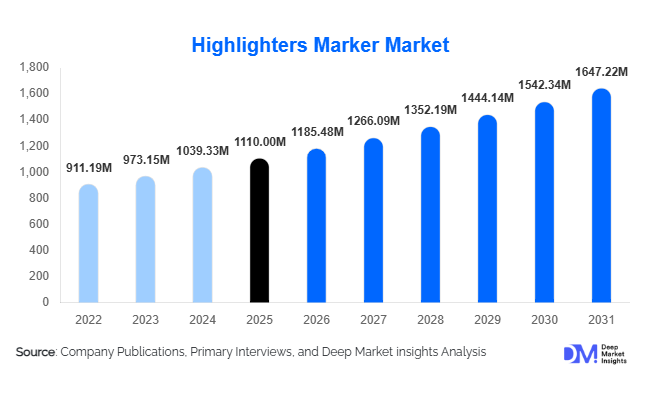
According to Deep Market Insights, the global highlighters marker market size was valued at USD 1,110 million in 2025 and is projected to grow from USD 1,185.48 million in 2026 to reach USD 1,647.22 million by 2031, expanding at a CAGR of 6.8% during the forecast period (2026–2031). The market growth is primarily driven by expanding global education enrollment, sustained office documentation requirements, and increasing consumer preference for color-coded productivity tools. Despite growing digitalization, physical highlighting tools continue to play an essential role in academic learning, corporate workflows, and creative applications. Product innovation through pastel shades, ergonomic designs, and eco-friendly ink technologies is transforming highlighters from basic stationery products into lifestyle and productivity accessories, supporting consistent long-term market expansion.
Key Market Insights
- Student-driven demand remains the backbone of global consumption, accounting for more than half of total highlighter usage worldwide.
- Pastel and aesthetic highlighters are driving premiumization, supported by journaling, note-taking, and study culture trends.
- Asia-Pacific dominates global demand due to large education systems and strong manufacturing capacity.
- Online retail is the fastest-growing distribution channel, enabling niche and premium brands to scale globally.
- Eco-friendly and non-toxic ink formulations are becoming procurement standards across schools and offices.
- Hybrid work environments continue to sustain office stationery consumption despite digital transformation.
What are the latest trends in the highlighters marker market?
Rise of Aesthetic and Pastel Highlighters
Consumer preferences are shifting from traditional fluorescent colors toward pastel and soft-tone highlighters designed for visual comfort and creative expression. The growth of digital study communities, productivity influencers, and bullet journaling trends has significantly influenced product design innovation. Manufacturers are introducing muted color palettes, ergonomic grips, and minimalistic packaging to attract younger consumers. These products are increasingly positioned as lifestyle accessories rather than purely functional stationery items, enabling brands to command premium pricing and enhance customer loyalty. The demand for visually pleasing study tools is particularly strong among students and creative professionals who prioritize organization and personalization in note-taking.
Sustainability and Non-Toxic Ink Adoption
Sustainability initiatives are reshaping product development across the stationery industry. Manufacturers are investing in recyclable plastics, refillable systems, and water-based inks compliant with global safety regulations. Educational institutions and corporate procurement programs increasingly prioritize eco-certified products, accelerating adoption of environmentally responsible highlighters. Companies are also reducing packaging waste and adopting biodegradable materials to align with regulatory requirements and consumer expectations. This transition toward sustainable production practices is expected to become a long-term competitive differentiator in mature markets such as Europe and North America.
What are the key drivers in the highlighters marker market?
Expansion of Global Education Systems
Rising student populations across emerging economies continue to drive consistent demand for writing and marking instruments. Government investments in literacy programs, school infrastructure, and higher education expansion have strengthened institutional procurement volumes. Highlighters remain essential tools for learning methodologies involving annotation, summarization, and exam preparation. Annual academic cycles create recurring purchasing patterns, ensuring stable baseline demand globally.
Hybrid Work and Documentation Practices
Although digital tools are widely used, printed documentation remains critical in industries such as education, law, healthcare, and administration. Professionals rely on highlighters for document review, research analysis, and workflow organization. The growth of remote and hybrid work models has shifted purchasing behavior toward individual retail purchases, increasing demand across both online and offline channels.
What are the restraints for the global market?
Digital Annotation Alternatives
The increasing adoption of tablets, e-readers, and digital note-taking platforms presents a long-term substitution risk. Digital highlighting tools offer convenience and cloud-based accessibility, reducing reliance on physical stationery in certain professional environments. While coexistence between digital and physical tools persists, gradual digital migration may moderate long-term growth rates.
Raw Material Price Volatility
Fluctuations in plastic resin and ink chemical prices impact production costs and profit margins. Smaller manufacturers face challenges maintaining price stability during raw material cost increases, intensifying competition in economy product segments. Supply chain disruptions and logistics costs also contribute to pricing pressures across global markets.
What are the key opportunities in the highlighters marker industry?
Eco-Friendly Product Innovation
The transition toward sustainable stationery represents one of the strongest growth opportunities. Governments and institutions increasingly mandate safe, recyclable, and environmentally compliant supplies. Companies investing in refillable designs and biodegradable materials can secure long-term institutional contracts and differentiate themselves within premium segments.
Emerging Market Education Expansion
Rapid growth in education spending across Asia, Africa, and Latin America is creating large-scale procurement opportunities. Expanding student populations and literacy initiatives generate demand for bulk highlighter packs, enabling manufacturers to scale production and penetrate high-volume institutional markets. Affordable yet durable product lines are particularly well-positioned for success in these regions.
Product Type Insights
The global highlighters market is segmented by product type into liquid ink, gel, dry, dual-tip, and specialty highlighters, each addressing evolving consumer preferences and usage environments. Liquid ink highlighters dominate the market, accounting for approximately 48% of global demand due to their smooth ink flow, affordability, and widespread adoption across educational institutions and office environments. The leading driver supporting this segment is the strong balance between cost efficiency and consistent performance, which makes liquid highlighters highly suitable for bulk institutional procurement and daily academic usage. Manufacturers continue to enhance ink formulations to improve longevity and color brightness, reinforcing their position as the standard highlighting solution worldwide.Gel and dry highlighters are gaining popularity among students and professionals seeking smudge-resistant performance and paper protection, particularly for thin textbooks, printed notes, and delicate documents. Growth in this segment is primarily driven by increasing consumer awareness of paper preservation and improved writing ergonomics, especially among heavy note-takers.
Dual-tip highlighters are emerging as a fast-growing segment by combining highlighting and fine writing functions within a single product, appealing to productivity-focused consumers who value multifunctional stationery solutions. The rising demand for compact and versatile tools supporting hybrid learning and remote work environments continues to accelerate adoption.Specialty and pastel highlighters are expanding rapidly within premium product categories, supported by aesthetic-driven purchasing behavior and creative applications such as journaling, design work, and visual planning. Social media influence and personalization trends have significantly increased demand for visually distinctive stationery products, encouraging manufacturers to introduce curated color palettes, ergonomic designs, and premium packaging formats that enhance brand differentiation and consumer engagement.
Application Insights
Based on application, the highlighters market is categorized into academic, office and administrative, creative, and government or institutional usage. Academic applications represent the largest usage segment, driven by annotation-based learning practices, exam preparation methods, and increasing global student enrollment. The primary growth driver for this segment is the continued reliance on physical study materials and active reading techniques that improve comprehension and retention, ensuring recurring consumption cycles aligned with academic calendars. Educational reforms promoting structured learning and standardized testing further reinforce consistent demand.Office and administrative applications form the second-largest category, where professionals rely on highlighters for reviewing contracts, reports, compliance documents, and operational workflows.
Demand in this segment is supported by documentation-heavy industries such as finance, consulting, healthcare administration, and legal services, where visual emphasis remains essential for efficient information processing despite ongoing digital transformation.Creative applications, including journaling, scrapbooking, visual planning, and artistic note-taking, are growing at a faster pace than traditional segments due to social media influence and personalization trends. The increasing popularity of productivity systems, bullet journaling, and aesthetic organization methods has expanded the role of highlighters beyond functional tools into lifestyle accessories. Government and institutional documentation also contributes steady demand, particularly in public administration, examination authorities, and educational governance structures where printed workflows remain operationally necessary.
Distribution Channel Insights
The distribution landscape of the highlighters market reflects a balance between traditional retail dominance and accelerating digital commerce adoption. Offline retail channels continue to dominate global sales, accounting for nearly 62% of purchases, supported by the strong presence of stationery stores, bookstores, and school supply outlets. The leading driver for offline channel dominance is consumer preference for immediate product availability and the ability to evaluate color quality and writing performance physically before purchase. Supermarkets and office supply chains also play a critical role during back-to-school seasons and institutional procurement cycles, generating significant seasonal revenue spikes.
Online retail platforms represent the fastest-growing distribution channel as consumers increasingly compare product variants, color assortments, pricing structures, and brand reviews digitally. Expansion of e-commerce infrastructure and improved last-mile delivery networks are accelerating adoption across both developed and emerging markets. Direct-to-consumer brand websites are expanding through subscription models, curated stationery bundles, and personalized product offerings, strengthening brand loyalty and recurring revenue streams. Influencer marketing, digital demonstrations, and social commerce platforms are increasingly shaping purchasing decisions among younger demographics, transforming stationery buying behavior into a discovery-driven experience.
End-Use Insights
By end use, the highlighters market is segmented into students, corporate offices, educational institutions, and creative professionals or hobbyists. Students remain the largest end-use segment, contributing approximately 58% of global consumption due to recurring academic demand cycles and continuous enrollment growth worldwide. The leading driver supporting this segment is the repetitive nature of academic usage, where highlighting remains an essential learning technique for note organization, revision, and knowledge retention. Educational institutions further strengthen demand through bulk procurement programs that ensure stable annual consumption volumes.
Corporate offices represent a significant secondary segment, particularly within documentation-intensive industries such as finance, consulting, insurance, and legal services. Despite increasing digitization, printed documentation continues to require manual review processes, sustaining steady product utilization. Creative professionals and hobbyists represent the fastest-growing user group, driven by rising interest in visual organization, productivity methodologies, and artistic expression. The expansion of content creation communities and design-focused hobbies has broadened highlighter usage beyond traditional educational purposes. Export-driven demand also supports market expansion, as large-scale manufacturing hubs supply developed markets with cost-efficient stationery products while maintaining consistent global distribution networks.
| By Product Type | By Application | By Distribution Channel |
|---|---|---|
|
|
|
Regional Insights
North America
North America accounts for approximately 24% of global market share, led by the United States and Canada. Regional growth is driven by high per-capita stationery spending, strong adoption of premium and ergonomic products, and widespread integration of creative organization practices among students and professionals. Increasing consumer preference for eco-certified and recyclable stationery products is encouraging innovation in sustainable ink formulations and biodegradable materials. Additionally, the expansion of journaling communities, productivity-focused lifestyles, and premium retail channels continues to stimulate demand for specialty and aesthetically differentiated highlighters across the region.
Europe
Europe holds nearly 20% of global demand, with Germany, the United Kingdom, and France representing key markets. Regional growth is primarily supported by strict environmental regulations that encourage adoption of recyclable, refillable, and non-toxic stationery products. Sustainability-focused procurement policies within educational institutions and corporate organizations are accelerating product innovation and driving premiumization trends. Consumer awareness regarding environmental responsibility and product safety standards further promotes adoption of eco-friendly highlighters, while established stationery brands maintain strong distribution networks across both physical and online retail channels.
Asia-Pacific
Asia-Pacific dominates the global market with roughly 41% share in 2025, driven by major economies including China, India, Japan, and South Korea. The region’s growth is fueled by large student populations, expanding education systems, and increasing literacy initiatives that generate strong baseline consumption. Rapid urbanization, rising disposable incomes, and growth of organized retail networks further support market expansion. India represents one of the fastest-growing markets due to government-led education initiatives, expanding school infrastructure investments, and increasing adoption of affordable stationery products. Additionally, the presence of large manufacturing bases enables competitive pricing and strong export capabilities, reinforcing Asia-Pacific’s leadership position.
Latin America
Latin America contributes around 8% of global demand, led by Brazil and Mexico. Regional growth is supported by improving retail penetration, rising education expenditure, and gradual expansion of middle-class consumer spending. Urbanization trends and increasing access to organized retail formats are enhancing product availability, while government initiatives focused on improving educational access continue to stimulate stationery consumption. The growth of e-commerce platforms is also enabling wider distribution reach across previously underserved regions.
Middle East & Africa
The Middle East & Africa region accounts for nearly 7% of market share, with the United Arab Emirates, Saudi Arabia, and South Africa emerging as key growth markets. Market expansion is driven by increasing investments in education infrastructure, diversification of regional economies, and growth of corporate office environments. Expanding private education sectors and rising student enrollment rates are contributing to steady demand growth. Improvements in retail modernization and cross-border trade networks are further enhancing product accessibility, supporting gradual but consistent market development across the region.
| North America | Europe | APAC | Middle East and Africa | LATAM |
|---|---|---|---|---|
|
|
|
|
|
Key Players in the Highlighters Marker Market
- Newell Brands (Sharpie)
- Société BIC
- Stabilo International GmbH
- Faber-Castell AG
- Kokuyo Co., Ltd.
- Pilot Corporation
- Zebra Co., Ltd.
- Mitsubishi Pencil Co., Ltd.
- Pentel Co., Ltd.
- Maped Group
- Staedtler Mars GmbH
- Crayola LLC
- Monami Co., Ltd.
- Deli Group Co., Ltd.
- Schneider Schreibgeräte GmbH