Helmet Market Size
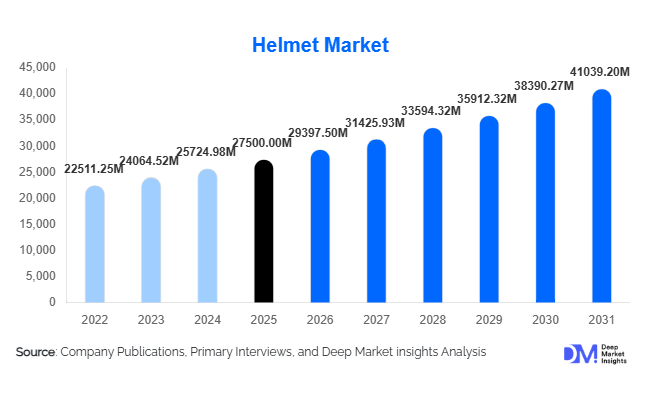
According to Deep Market Insights, the global helmet market size was valued at USD 27,500 million in 2025 and is projected to grow from USD 29,397.50 million in 2026 to reach USD 41,039.20 million by 2031, expanding at a CAGR of 6.9% during the forecast period (2026–2031). The helmet market is experiencing growth primarily driven by rising road safety awareness, increasing two-wheeler ownership globally, and stringent government regulations mandating protective headgear across the transportation and industrial sectors.
Key Market Insights
- Motorcycle helmets dominate global demand, accounting for over half of the total market share due to high two-wheeler penetration in Asia-Pacific and Latin America.
- Safety regulations and enforcement are strengthening globally, particularly in emerging economies, significantly boosting certified helmet adoption.
- Asia-Pacific leads the market, driven by large consumer bases in India, China, and Southeast Asia.
- Premiumization is accelerating in developed markets, with rising demand for lightweight, carbon fiber, and technologically advanced helmets.
- Industrial safety helmets are witnessing strong growth, supported by infrastructure expansion and stricter workplace safety norms.
- Technological integration, including smart helmets with IoT, communication systems, and augmented reality, is transforming product innovation.
What are the latest trends in the helmet market?
Shift Toward Smart and Connected Helmets
Smart helmets are gaining traction as manufacturers integrate advanced technologies such as Bluetooth connectivity, heads-up displays, navigation assistance, and accident detection sensors. These features are particularly appealing to premium motorcycle users, logistics operators, and defense personnel. The adoption of IoT-enabled helmets is also increasing in industrial environments, where real-time monitoring and worker safety analytics are becoming critical. This trend is redefining product differentiation, allowing companies to command higher price points while enhancing safety and user convenience.
Rising Demand for Lightweight and High-Performance Materials
Consumers are increasingly preferring helmets made from advanced materials such as carbon fiber and composite blends due to their superior strength-to-weight ratio. Lightweight helmets improve comfort during prolonged usage, making them particularly popular among long-distance riders and professional athletes. Additionally, manufacturers are investing in aerodynamic designs and enhanced ventilation systems to improve user experience. This trend is contributing to the growth of the premium segment, especially in North America and Europe, where consumers prioritize performance and design alongside safety compliance.
What are the key drivers in the helmet market?
Expansion of the Global Two-Wheeler Market
The rapid growth of the two-wheeler market, particularly in Asia-Pacific, is a major driver for helmet demand. Motorcycles and scooters are widely used for daily commuting in countries such as India, Indonesia, and Vietnam. This has created a large and consistent demand base for motorcycle helmets. Increasing urbanization and rising disposable incomes are further accelerating vehicle ownership, directly contributing to helmet sales growth.
Stringent Safety Regulations and Enforcement
Governments worldwide are implementing stricter safety regulations to reduce road fatalities and workplace injuries. Mandatory helmet laws, certification standards such as DOT, ECE, and ISI, and enforcement measures are significantly increasing the adoption of certified helmets. Public awareness campaigns and penalties for non-compliance are also playing a crucial role in driving market growth.
What are the restraints for the global market?
Price Sensitivity in Emerging Economies
In many developing regions, consumers prioritize affordability over safety certifications, leading to the widespread use of low-cost helmets. This limits the penetration of premium and certified products, posing a challenge for manufacturers aiming to expand their margins and market share.
Proliferation of Counterfeit and Non-Certified Products
The presence of counterfeit helmets and non-compliant products in informal markets undermines the growth of organized players. These products are often sold at significantly lower prices, creating unfair competition while also posing safety risks to users. Regulatory enforcement gaps further exacerbate this issue in several regions.
What are the key opportunities in the helmet industry?
Integration of Smart Technologies
The growing demand for connected devices presents a significant opportunity for helmet manufacturers to innovate. Smart helmets with integrated communication systems, navigation features, and safety alerts are gaining popularity among premium consumers and industrial users. Companies investing in AI-enabled safety features and IoT connectivity can capture higher-value segments and differentiate themselves in a competitive market.
Regulatory Expansion in Emerging Markets
Emerging economies are witnessing increased enforcement of helmet laws, creating new growth opportunities. Countries such as India and Brazil are implementing stricter compliance measures, driving demand for certified helmets. This trend provides opportunities for both local and international players to expand their presence with cost-effective, regulation-compliant products.
Report Scope
| Report Metric | Details |
|---|---|
| Market Size in 2025 | USD 27500 Million |
| Market Size in 2026 | USD 29397.50 Million |
| Market Size in 2031 | USD 41039.20 Million |
| CAGR | 6.9% (2026-2031) |
| Base Year for Estimation | 2025 |
| Historical Data | 2022-2024 |
| Forecast Period | 2026-2031 |
| Report Coverage | Revenue Forecast, Competitive Landscape, Supply Chain Disruption, Growth Factors, Environment & Regulatory Landscape and Trends |
| Geographies Covered | North America, Europe, APAC, Middle East and Africa, LATAM |
| Countries Covered | U.S., Canada, U.K., Germany, France, Spain, Italy, Russia, Nordic, Benelux, Rest of Europe, China, Korea, Japan, India, Australia, Singapore, Taiwan, South East Asia, Rest of Asia-Pacific, UAE, Turky, Saudi Arabia, South Africa, Egypt, Nigeria, Rest of MEA, Brazil, Mexico, Argentina, Chile, Colombia, Rest of LATAM |
Explore more data points, trends and opportunities Download Free Sample Report
Product Type Insights
Motorcycle helmets continue to dominate the global helmet market, accounting for approximately 52% of total revenue in 2025. This leadership is primarily driven by the rapid expansion of the two-wheeler parc across emerging economies, where motorcycles and scooters serve as primary modes of daily transportation. Stringent government regulations mandating helmet usage, combined with increasing enforcement and rising road safety awareness, are key drivers sustaining this segment’s dominance. Additionally, frequent product innovation in terms of aerodynamics, ventilation, and integrated smart features is further strengthening demand in both premium and mid-range categories.
Bicycle helmets are gaining significant traction, particularly in North America and Europe, due to rising fitness awareness, urban congestion, and the growing adoption of cycling as a sustainable mode of transport. Government initiatives promoting cycling infrastructure and eco-friendly mobility are acting as strong demand catalysts. Industrial safety helmets are witnessing steady growth, supported by global infrastructure development, expansion in construction and mining sectors, and stricter occupational health and safety regulations. Meanwhile, sports helmets represent a niche but expanding segment, driven by increasing participation in organized sports, rising investments in sports infrastructure, and heightened awareness regarding athlete safety across both amateur and professional levels.
Material Type Insights
Polycarbonate helmets lead the material segment with an estimated 38% market share, owing to their optimal balance between cost, durability, and impact resistance. Their widespread use across mid-range helmet categories makes them particularly popular in price-sensitive markets, where affordability remains a key purchase determinant. The scalability of polycarbonate manufacturing and its compatibility with mass production techniques further reinforce its market leadership. ABS helmets are predominantly used in the economy segment, offering cost-effective solutions for entry-level consumers, especially in developing regions. However, as consumer awareness around safety and comfort increases, demand is gradually shifting toward higher-performance materials. Fiberglass and composite helmets are gaining momentum in mid-range and premium segments due to their improved strength-to-weight ratio and enhanced shock absorption capabilities.
Carbon fiber helmets, although representing a smaller share, are the fastest-growing material segment. Their ultra-lightweight properties, superior structural integrity, and enhanced comfort make them highly preferred among professional riders, motorsport participants, and premium consumers. The growing trend of premiumization and willingness to pay for high-performance safety gear are key drivers accelerating the adoption of advanced composite materials globally.
Distribution Channel Insights
Offline retail channels dominate the helmet market, accounting for approximately 62% of total sales in 2025. The preference for physical retail is largely driven by the need for proper fitting, comfort assessment, and product verification before purchase. Specialty stores and multi-brand outlets play a critical role in influencing consumer decisions by offering personalized assistance and a wide product range.
However, online distribution channels are experiencing rapid growth, driven by increasing internet penetration, smartphone usage, and the convenience of home delivery. E-commerce platforms are enabling consumers to access a broader range of products, competitive pricing, and customer reviews, which significantly influence purchase behavior. Additionally, brand-owned digital platforms are gaining prominence as manufacturers focus on direct-to-consumer (D2C) strategies to improve margins and strengthen customer engagement. The growing influence of digital marketing, social media, and influencer endorsements is further accelerating online sales growth, particularly among younger demographics.
End-User Insights
Individual consumers dominate the helmet market, contributing approximately 68% of total demand. This dominance is driven by widespread personal mobility needs, particularly in regions with high two-wheeler usage, as well as increasing participation in recreational and sports activities. Rising awareness regarding personal safety and compliance with traffic regulations are key factors supporting sustained demand from this segment.
Commercial and industrial buyers represent a significant and steadily growing segment, driven by increasing investments in construction, manufacturing, mining, and energy sectors. The enforcement of workplace safety regulations and corporate compliance standards is compelling organizations to invest in certified protective equipment, including helmets. Government and defense agencies also contribute to demand through the procurement of specialized helmets for military, law enforcement, and emergency response applications. This segment is characterized by bulk procurement, long-term contracts, and a growing preference for technologically advanced and high-performance protective gear.
Explore more data points, trends and opportunities Download Free Sample Report
Helmet Market Segmentations
By Product Type
- Motorcycle Helmets
- Bicycle Helmets
- Industrial Safety Helmets
- Sports Helmets
- Defense & Law Enforcement Helmets
By Material Type
- Polycarbonate Helmets
- ABS Helmets
- Fiberglass Helmets
- Carbon Fiber Helmets
- Composite Material Helmets
By Distribution Channel
- Offline Retail
- Online Retail
By End-User
- Individual Consumers
- Commercial & Industrial Buyers
- Government & Defense Agencies
Regional Insights
Asia-Pacific
Asia-Pacific dominates the global helmet market with approximately 48% share in 2025, making it the largest and fastest-growing regional market. The region’s growth is primarily driven by high two-wheeler penetration in countries such as China, India, Indonesia, and Vietnam, where motorcycles are a primary mode of transportation. Strong regulatory enforcement, including mandatory helmet laws and increasing penalties for non-compliance, is significantly boosting demand. India is witnessing accelerated growth due to rising road safety awareness, government campaigns, and expanding urban populations. China continues to play a dual role as both the largest manufacturing hub and a major consumer market, benefiting from economies of scale and export-oriented production. Additionally, rising disposable incomes and increasing adoption of premium helmets are further strengthening regional growth.
North America
North America accounts for approximately 18% of the global market, with the United States leading regional demand. Growth in this region is driven by strong consumer purchasing power, high awareness of safety standards, and widespread adoption of premium and sports helmets. The increasing popularity of recreational activities such as cycling, skiing, and motorcycling is significantly contributing to demand. Furthermore, the region is at the forefront of technological innovation, with growing adoption of smart helmets featuring integrated communication systems and advanced safety features. Strict regulatory frameworks and certification requirements also ensure consistent demand for high-quality, compliant products.
Europe
Europe holds around 16% market share, with key contributions from Germany, France, Italy, and the UK. The region is characterized by stringent safety regulations and high compliance with certification standards such as ECE, which drive demand for premium helmets. Increasing environmental awareness and the promotion of cycling as a sustainable mode of transport are key growth drivers, particularly in urban areas. Additionally, strong participation in motorsports and winter sports supports demand for specialized helmets. The presence of established premium manufacturers and a consumer preference for high-quality, technologically advanced products further strengthen the European market.
Middle East & Africa
The Middle East and Africa region is experiencing steady growth, driven primarily by large-scale infrastructure development and increasing industrial activities. Countries such as the UAE and Saudi Arabia are investing heavily in construction, oil & gas, and transportation projects, leading to rising demand for industrial safety helmets. Additionally, growing urbanization and improving economic conditions are contributing to increased adoption of motorcycle helmets in certain African countries. Government initiatives aimed at improving workplace safety standards are also supporting market expansion in this region.
Latin America
Latin America is witnessing moderate but consistent growth, led by Brazil and Mexico. The region’s demand is largely driven by increasing motorcycle ownership, particularly for cost-effective urban commuting and delivery services. Strengthening enforcement of helmet laws and rising awareness of road safety are key factors supporting market growth. Additionally, the expansion of e-commerce and last-mile delivery services is indirectly boosting helmet demand among gig economy workers. The region presents significant opportunities for mid-range and affordable helmet products, given the price-sensitive nature of consumers and the growing need for compliant safety gear.
Key Players in the Helmet Market
- Shoei Co., Ltd.
- Arai Helmet Ltd.
- HJC Helmets
- Studds Accessories Ltd.
- Steelbird Hi-Tech India Ltd.
- Vega Auto Accessories
- Schuberth GmbH
- Bell Helmets
- LS2 Helmets
- Nolan Helmets
- AGV (Dainese Group)
- Shark Helmets
- Troy Lee Designs
- Alpinestars
- Fox Racing