Handheld Marijuana Vaporizer Market Size
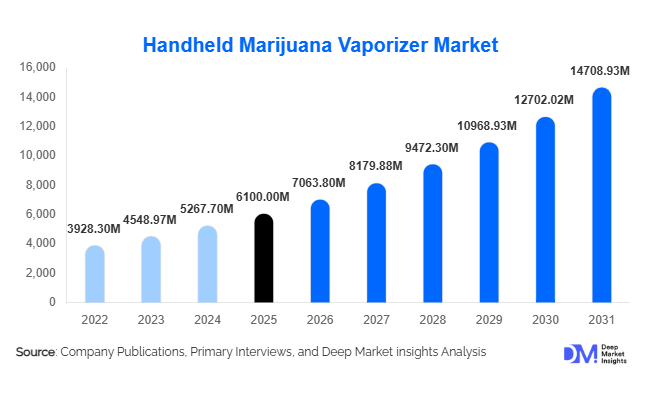
According to Deep Market Insights, the global handheld marijuana vaporizer market size was valued at USD 6,100 million in 2025 and is projected to grow from USD 7,063.80 million in 2026 to reach USD 14,708.93 million by 2031, expanding at a CAGR of 15.8% during the forecast period (2026–2031). The handheld marijuana vaporizer market growth is primarily driven by the global expansion of legal cannabis markets, rising consumer preference for smoke-free cannabis consumption methods, and continuous technological innovation in portable vaporization devices.
Handheld vaporizers are portable electronic devices designed to heat cannabis flower, oil, or concentrates at controlled temperatures to release cannabinoids and terpenes without combustion. Compared with traditional smoking methods, vaporization significantly reduces exposure to harmful toxins and provides a more controlled, discreet, and flavor-preserving cannabis experience. These advantages have contributed to the growing adoption of vaporizers among both recreational users and medical cannabis patients.
The increasing legalization of cannabis across North America, Europe, and parts of Latin America has significantly expanded the addressable market for vaporizer devices. Consumers are shifting toward technologically advanced devices that offer features such as precision temperature control, smartphone connectivity, and enhanced battery performance. Manufacturers are also introducing premium materials, modular components, and improved airflow systems to enhance product performance and differentiate their brands in a highly competitive landscape. North America currently dominates the global market due to widespread cannabis legalization, strong retail infrastructure, and high consumer awareness. However, emerging cannabis markets in Europe and Asia-Pacific are expected to witness rapid growth as regulatory frameworks evolve and demand for medical cannabis therapies expands. The handheld marijuana vaporizer industry is increasingly positioned at the intersection of cannabis consumption technology and consumer electronics innovation.
Key Market Insights
- Growing cannabis legalization worldwide is significantly expanding the consumer base for handheld vaporizers.
- Health-conscious consumers are increasingly shifting toward vaporization as a cleaner alternative to smoking cannabis.
- North America dominates the global market, supported by mature recreational cannabis industries in the United States and Canada.
- Europe is emerging as the fastest-growing regional market, driven by expanding medical cannabis adoption.
- Technological innovations such as smartphone-controlled vaporizers, precision heating systems, and smart dosage tracking are reshaping the industry.
- Premiumization trends are driving strong demand for high-end vaporizer devices with advanced design and performance capabilities.
What are the latest trends in the handheld marijuana vaporizer market?
Smart and App-Connected Vaporizers
One of the most significant technological trends in the handheld marijuana vaporizer industry is the integration of smart connectivity features. Manufacturers are introducing devices that connect to smartphones through dedicated mobile applications, allowing users to control temperature settings, monitor battery performance, and track usage patterns. These features enable consumers to personalize their vaporization experience while also improving safety and device efficiency.
App-enabled vaporizers also allow users to store custom temperature profiles for different cannabis strains, optimizing flavor and cannabinoid release. Some manufacturers are exploring integration with digital wellness platforms that monitor dosage and consumption frequency, particularly for medical cannabis patients who require consistent therapeutic dosing. This convergence of cannabis technology and digital health solutions is expected to drive innovation and create new consumer engagement opportunities.
Growth of Multi-Compatibility Vaporizers
Another important trend shaping the market is the rising popularity of vaporizers that support multiple cannabis formats. Devices capable of vaporizing dry herbs, cannabis oils, and concentrates are gaining strong consumer interest due to their versatility and convenience. Dual-use vaporizers eliminate the need for separate devices, making them particularly attractive for experienced cannabis users.
Manufacturers are investing in advanced heating chamber designs that can efficiently handle different material consistencies. Improved airflow control, ceramic heating elements, and temperature precision allow these devices to deliver consistent vapor quality regardless of the cannabis format used. As cannabis product diversity continues to expand globally, demand for multi-compatibility vaporizers is expected to grow significantly.
What are the key drivers in the handheld marijuana vaporizer market?
Expanding Cannabis Legalization
The ongoing legalization of cannabis across multiple regions is one of the primary drivers of the handheld marijuana vaporizer market. Countries and states that legalize medical or recreational cannabis create regulated supply chains that encourage the adoption of safer consumption methods. Vaporizers are widely viewed as a healthier alternative to smoking, making them highly attractive in regulated cannabis markets.
North America has been at the forefront of this trend, with the United States and Canada establishing mature cannabis industries. European countries such as Germany, the Netherlands, and Portugal are also expanding medical cannabis programs, which is expected to stimulate vaporizer demand across the region. As regulatory frameworks become clearer, more companies are entering the vaporizer market to capture growing consumer demand.
Rising Health Awareness Among Cannabis Consumers
Increasing awareness of the health risks associated with smoking is driving consumers toward alternative cannabis consumption methods. Vaporization heats cannabis at lower temperatures, releasing cannabinoids without burning plant material. This process significantly reduces exposure to harmful toxins such as tar and carbon monoxide.
Medical cannabis patients, in particular, are increasingly choosing vaporizers due to their ability to deliver controlled doses of cannabinoids while minimizing respiratory irritation. Healthcare professionals and cannabis clinics often recommend vaporization devices as a safer inhalation method for therapeutic cannabis use.
What are the restraints for the global market?
Regulatory Uncertainty in Emerging Markets
Despite growing legalization trends, regulatory uncertainty remains a major challenge for vaporizer manufacturers. Many countries maintain strict restrictions on cannabis products and related consumption devices, limiting market expansion opportunities. Regulatory inconsistencies across jurisdictions also create compliance complexities for companies attempting to distribute products globally.
Manufacturers must navigate varying rules regarding device certification, marketing restrictions, and product compatibility with cannabis products. These regulatory hurdles can delay product launches and increase operational costs.
Safety Concerns and Counterfeit Devices
The proliferation of low-quality and counterfeit vaporizer devices in certain markets has raised safety concerns among consumers. Poorly manufactured devices can experience battery malfunctions, overheating, or contamination risks. These issues can damage brand reputation and reduce consumer confidence in vaporization products.
To address these challenges, leading manufacturers are investing heavily in product safety certifications, quality control processes, and consumer education initiatives. Regulatory authorities are also increasingly implementing standards to ensure device safety and reliability.
What are the key opportunities in the handheld marijuana vaporizer industry?
Premium Cannabis Lifestyle Products
The cannabis industry is evolving into a lifestyle-driven consumer market, creating opportunities for premium vaporizer products. High-end vaporizers featuring aerospace-grade materials, ceramic heating chambers, and sleek industrial designs are attracting affluent consumers who view cannabis consumption as part of a broader lifestyle experience.
Premium devices also allow manufacturers to maintain higher profit margins compared with entry-level vaporizers. Limited-edition product launches, collaborations with lifestyle brands, and customizable accessories are further expanding revenue opportunities within the premium segment.
Integration with Medical Cannabis Ecosystems
The expanding global medical cannabis industry presents another significant growth opportunity for vaporizer manufacturers. Vaporizers are increasingly used in medical settings because they provide precise dosing and controlled cannabinoid delivery.
Companies are developing devices specifically tailored for medical cannabis patients, featuring advanced temperature calibration and dosage monitoring capabilities. Integration with digital healthcare platforms could enable physicians to monitor patient consumption patterns and adjust treatment plans accordingly. As medical cannabis regulations expand globally, demand for specialized vaporization devices is expected to increase substantially.
Report Scope
| Report Metric | Details |
|---|---|
| Market Size in 2025 | USD 6100 Million |
| Market Size in 2026 | USD 7063.80 Million |
| Market Size in 2031 | USD 14708.93 Million |
| CAGR | 15.8% (2026-2031) |
| Base Year for Estimation | 2025 |
| Historical Data | 2022-2024 |
| Forecast Period | 2026-2031 |
| Report Coverage | Revenue Forecast, Competitive Landscape, Supply Chain Disruption, Growth Factors, Environment & Regulatory Landscape and Trends |
| Geographies Covered | North America, Europe, APAC, Middle East and Africa, LATAM |
| Countries Covered | U.S., Canada, U.K., Germany, France, Spain, Italy, Russia, Nordic, Benelux, Rest of Europe, China, Korea, Japan, India, Australia, Singapore, Taiwan, South East Asia, Rest of Asia-Pacific, UAE, Turky, Saudi Arabia, South Africa, Egypt, Nigeria, Rest of MEA, Brazil, Mexico, Argentina, Chile, Colombia, Rest of LATAM |
Explore more data points, trends and opportunities Download Free Sample Report
Product Type Insights
Dry herb vaporizers dominate the handheld marijuana vaporizer market, accounting for approximately 46% of global revenue in 2025. These devices are widely preferred by consumers who favor natural cannabis flower products and seek a traditional consumption experience without combustion. Dry herb vaporizers are generally more affordable than oil or concentrate vaporizers, which contributes to their widespread adoption among both recreational users and first-time cannabis consumers.
Cannabis oil vaporizers represent another significant segment, particularly in markets where pre-filled cartridges are widely available through licensed dispensaries. Concentrate vaporizers, designed for wax and dab products, are gaining popularity among experienced cannabis users seeking higher potency and stronger flavor profiles. Dual-use vaporizers capable of handling both herbs and concentrates are emerging as a fast-growing category due to their versatility and convenience.
Application Insights
Recreational cannabis consumption represents the largest application segment in the handheld marijuana vaporizer market, accounting for nearly 63% of global demand in 2025. The expansion of recreational cannabis legalization in North America has significantly increased demand for convenient and discreet consumption devices.
The medical cannabis segment is experiencing the fastest growth due to rising acceptance of cannabis-based therapies for chronic pain, neurological disorders, and anxiety conditions. Vaporizers are often recommended for medical cannabis consumption because they enable precise temperature control and reduce harmful byproducts associated with smoking. Increasing adoption of medical cannabis in Europe and Latin America is expected to drive substantial demand for vaporizer devices in the coming years.
Distribution Channel Insights
Online retail channels dominate handheld marijuana vaporizer sales, accounting for approximately 55% of global distribution. Direct-to-consumer brand websites and e-commerce marketplaces allow consumers to compare product specifications, read reviews, and access competitive pricing. Online platforms also enable manufacturers to expand their reach into international markets where physical retail presence may be limited.
Cannabis dispensaries remain a critical offline distribution channel, particularly in North America where licensed retail stores often sell vaporizer devices alongside cannabis products. Vape specialty stores and consumer electronics retailers also contribute to sales, particularly in regions where cannabis consumption devices are marketed primarily as vaporization hardware rather than cannabis accessories.
Explore more data points, trends and opportunities Download Free Sample Report
Handheld Marijuana Vaporizer Market Segmentations
By Product Type
- Dry Herb Vaporizers
- Cannabis Oil Vaporizers
- Concentrate Vaporizers (Wax/Dabs)
- Dual-Use Vaporizers (Herb + Concentrate)
By Application
- Recreational Cannabis Consumption
- Medical Cannabis Consumption
By Distribution Channel
- Online Retail
- Cannabis Dispensaries
- Vape Specialty Stores
- Consumer Electronics Retailers
Regional Insights
North America
North America is the largest market for handheld marijuana vaporizers, accounting for approximately 48% of global revenue in 2025. The United States represents the largest national market, supported by a rapidly expanding legal cannabis industry across multiple states. Consumer awareness, strong retail networks, and widespread availability of cannabis products have significantly contributed to vaporizer adoption. Canada also represents a mature market due to nationwide legalization of recreational cannabis. Canadian consumers have shown strong interest in premium vaporizers with advanced heating technologies and customizable features.
Europe
Europe accounts for approximately 24% of global market share, with growing demand driven by expanding medical cannabis programs. Germany is the largest European market due to its well-established medical cannabis prescription system. The United Kingdom, the Netherlands, and Switzerland are also experiencing rising adoption of cannabis vaporization devices. European consumers often prefer high-quality devices with strict safety certifications, which has encouraged manufacturers to introduce premium vaporizers tailored to regulatory standards.
Asia-Pacific
The Asia-Pacific region currently represents around 13% of the global market but is expected to experience the fastest growth through 2031. China plays a crucial role as a manufacturing hub for vaporizer components, while emerging cannabis regulations in countries such as Thailand are gradually opening new market opportunities. Australia and South Korea are witnessing increasing medical cannabis adoption, which is contributing to growing demand for controlled vaporization devices.
Latin America
Latin America holds approximately 8% of the global market, with Uruguay, Colombia, and Mexico leading regional cannabis reforms. Uruguay’s early legalization of recreational cannabis has created a small but stable market for vaporizer devices. Growing medical cannabis programs in Colombia and Brazil are expected to generate additional demand for vaporization technology in therapeutic applications.
Middle East & Africa
The Middle East and Africa account for roughly 7% of the global handheld marijuana vaporizer market. Israel is a key market due to its advanced medical cannabis research and patient programs. South Africa has also emerged as an early adopter following the legalization of private cannabis use. While regulatory restrictions remain in many countries within the region, gradual policy shifts could unlock new opportunities for vaporizer manufacturers over the next decade.
Key Players in the Handheld Marijuana Vaporizer Market
- Pax Labs
- Storz & Bickel
- Grenco Science
- Arizer
- DaVinci Vaporizer
- Dynavap
- Linx Vapor
- Boundless Technology
- Dr. Dabber
- KandyPens
- Mig Vapor
- Focus V
- Vuber Technologies
- AtmosRx
- Vivant