Haircare Products Market Size
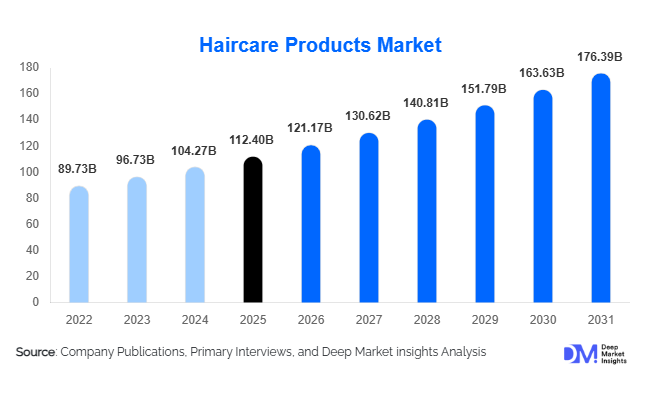
According to Deep Market Insights, the global haircare products market size was valued at USD 112.4 billion in 2025 and is projected to grow from USD 121.17 billion in 2026 to reach USD 176.39 billion by 2031, expanding at a CAGR of 7.8% during the forecast period (2026–2031). The haircare products market growth is primarily driven by increasing consumer focus on scalp health, rising demand for premium and clean-label formulations, growing urbanization, and expanding adoption of personalized beauty routines. The market is also benefiting from strong digital retail penetration, rising salon services demand, and innovation in biotechnology-based hair treatments and scalp-care solutions.
Key Market Insights
- Scalp-health-focused haircare products are rapidly gaining popularity, with consumers increasingly adopting treatment-oriented solutions such as microbiome-balancing shampoos, anti-hair-loss serums, and exfoliating scalp products.
- Premium and clean-label haircare categories are expanding globally, supported by rising demand for sulfate-free, paraben-free, vegan, and organic formulations.
- Asia-Pacific dominates the global haircare products market, led by strong demand from China, India, Japan, and South Korea.
- E-commerce and direct-to-consumer platforms are becoming major distribution channels, enabling brands to improve consumer engagement and personalization capabilities.
- Men’s grooming and specialized hair treatment categories are witnessing accelerated growth, particularly within anti-hair-fall and scalp therapy segments.
- Technology integration, including AI-powered scalp diagnostics, personalized formulations, and smart beauty recommendations, is reshaping product innovation and customer engagement.
Haircare Products Market Trends
Skinification of Haircare Driving Product Innovation
The “skinification” trend is significantly transforming the global haircare products market, with consumers increasingly treating scalp care similarly to skincare routines. Brands are introducing formulations infused with peptides, niacinamide, probiotics, ceramides, hyaluronic acid, and microbiome-friendly ingredients to address scalp sensitivity, hair thinning, and dryness. Scalp serums, exfoliators, overnight treatments, and dermatologically tested formulations are becoming mainstream across premium and professional categories. This trend is particularly strong in North America, Japan, and South Korea, where consumers are highly focused on ingredient efficacy and clinical performance. Companies are also investing heavily in scalp-health education campaigns and dermatologist partnerships to strengthen premium positioning.
Rise of Sustainable and Clean-Label Haircare
Sustainability and ingredient transparency are becoming central purchasing factors across the haircare products market. Consumers increasingly prefer products free from sulfates, parabens, silicones, and artificial fragrances, while demand for vegan, cruelty-free, and organically certified products continues to accelerate. Brands are adopting recyclable packaging, refill systems, biodegradable ingredients, and water-efficient manufacturing processes to align with evolving environmental expectations. Natural and herbal haircare products, particularly Ayurvedic and botanical formulations, are experiencing strong growth in India, Southeast Asia, and Europe. Digital platforms and social media influencers are further amplifying consumer awareness regarding clean beauty standards and ethical sourcing practices.
Haircare Products Market Drivers
Growing Consumer Focus on Personal Grooming and Hair Wellness
Rising awareness regarding personal appearance, scalp health, and self-care routines is significantly driving demand within the haircare products market. Consumers are increasingly investing in multifunctional products offering nourishment, damage repair, anti-hair-fall benefits, hydration, and heat protection. The growing influence of beauty influencers, social media platforms, and celebrity endorsements has accelerated awareness regarding advanced haircare regimens. Urban consumers, particularly millennials and Gen Z populations, are adopting premium treatment systems and customized routines, driving strong growth in specialized product categories.
Expansion of Premium and Specialized Haircare Products
The premiumization trend is becoming one of the strongest growth drivers across the global market. Consumers are increasingly willing to spend more on products addressing specific concerns such as scalp sensitivity, chemically damaged hair, dandruff, hair thinning, and color protection. Premium salon-quality products, keratin systems, bond-repair treatments, and sulfate-free formulations are witnessing rapid adoption globally. The introduction of clinically validated and dermatologically tested products has also strengthened consumer confidence in high-value haircare solutions. Premium brands continue to achieve higher profit margins while expanding through digital-first retail strategies.
Haircare Products Market Restraints
Volatility in Raw Material and Packaging Costs
The haircare products market faces ongoing challenges due to fluctuations in raw material prices, including specialty chemicals, surfactants, fragrances, essential oils, and packaging materials. Climate-related disruptions impacting natural ingredient supplies, combined with petrochemical price volatility, continue to pressure manufacturing costs. Rising transportation and logistics expenses also affect profitability, particularly within mass-market product categories where pricing flexibility remains limited.
Intense Market Competition and Product Saturation
The global haircare industry is highly competitive, with multinational corporations, regional manufacturers, salon-exclusive brands, and digital-native startups aggressively competing across multiple price categories. Consumer loyalty remains relatively fragmented, forcing companies to invest heavily in advertising, influencer partnerships, packaging differentiation, and continuous product innovation. Regulatory scrutiny regarding sustainability claims, ingredient transparency, and chemical safety standards is also increasing operational complexity and compliance costs for manufacturers operating internationally.
Haircare Products Market Opportunities
Personalized and AI-Driven Haircare Solutions
The growing adoption of artificial intelligence and digital beauty technologies presents significant opportunities within the haircare products market. Companies are increasingly introducing AI-powered scalp diagnostics, personalized product recommendations, and subscription-based customized formulations tailored to individual hair types and environmental exposure. These technologies enhance customer engagement, improve treatment effectiveness, and strengthen recurring revenue opportunities through direct-to-consumer channels. Younger consumers, particularly Gen Z and millennials, are highly receptive to digitally personalized beauty experiences.
Growth of Natural and Herbal Haircare Products
The rising preference for clean-label and plant-based beauty products is creating strong opportunities for natural and herbal haircare manufacturers globally. Ayurvedic formulations, botanical oils, organic shampoos, and chemical-free treatment systems are experiencing accelerating demand across Asia-Pacific, Europe, and North America. Companies focusing on ethically sourced ingredients, sustainable production, and cruelty-free certifications are successfully differentiating themselves within premium categories. Increasing export demand for herbal haircare products from India and South Korea is also expanding international growth opportunities for manufacturers.
Report Scope
| Report Metric | Details |
|---|---|
| Market Size in 2025 | USD 112.4 Billion |
| Market Size in 2026 | USD 121.17 Billion |
| Market Size in 2031 | USD 176.39 Billion |
| CAGR | 7.8% (2026-2031) |
| Base Year for Estimation | 2025 |
| Historical Data | 2022-2024 |
| Forecast Period | 2026-2031 |
| Report Coverage | Revenue Forecast, Competitive Landscape, Supply Chain Disruption, Growth Factors, Environment & Regulatory Landscape and Trends |
| Geographies Covered | North America, Europe, APAC, Middle East and Africa, LATAM |
| Countries Covered | U.S., Canada, U.K., Germany, France, Spain, Italy, Russia, Nordic, Benelux, Rest of Europe, China, Korea, Japan, India, Australia, Singapore, Taiwan, South East Asia, Rest of Asia-Pacific, UAE, Turky, Saudi Arabia, South Africa, Egypt, Nigeria, Rest of MEA, Brazil, Mexico, Argentina, Chile, Colombia, Rest of LATAM |
Explore more data points, trends and opportunities Download Free Sample Report
Product Type Insights
Shampoo remains the dominant product segment within the global haircare products market, accounting for the largest share due to universal usage frequency, strong household penetration, and continuous innovation in anti-dandruff, anti-hair-fall, sulfate-free, and scalp-care formulations. Conditioner and hair mask categories are expanding steadily as consumers increasingly adopt complete haircare routines focused on hydration, repair, and frizz control. Hair oils and serums continue to witness strong demand in Asia-Pacific and Middle Eastern markets, particularly within herbal and Ayurvedic categories. Hair treatment products such as keratin systems, bond-repair treatments, and scalp therapies are among the fastest-growing segments globally due to rising use of hair coloring, bleaching, and heat styling. Premium salon-exclusive products are also gaining traction as consumers increasingly seek professional-grade results at home.
Ingredient Type Insights
Conventional chemical-based formulations continue to dominate the market due to affordability and large-scale mass-market distribution. However, natural, organic, and vegan formulations are recording significantly faster growth rates globally. Consumers increasingly prefer products containing botanical extracts, plant oils, probiotics, proteins, and biotechnology-derived actives. Herbal formulations are particularly popular in India and Southeast Asia, while Europe remains a leading market for certified organic and cruelty-free haircare products. Biotechnology-based ingredients, including biomimetic keratin, peptides, and fermentation-derived actives, are also emerging rapidly within premium treatment categories.
Distribution Channel Insights
Supermarkets and hypermarkets remain the leading distribution channels globally due to strong product accessibility and promotional pricing strategies. However, e-commerce platforms represent the fastest-growing sales channel within the haircare products market. Online retail enables consumers to compare products, access reviews, receive personalized recommendations, and engage directly with brands through digital content. Direct-to-consumer models are strengthening customer retention while improving manufacturer margins. Specialty beauty retailers and salon-exclusive distribution channels continue to perform strongly within premium product categories. Social commerce and influencer-driven beauty marketing are also playing an increasingly important role in shaping purchasing decisions among younger consumers.
Consumer Group Insights
Women continue to account for the largest share of global haircare product consumption due to higher spending on styling, conditioning, coloring, and treatment products. Female consumers are increasingly adopting multi-step routines involving serums, masks, scalp treatments, and premium shampoos. Men’s grooming represents one of the fastest-growing consumer segments, supported by rising awareness regarding hair loss prevention, scalp health, and appearance-focused grooming routines. Products targeting children and sensitive-scalp consumers are also expanding steadily, particularly within dermatologically tested and clean-label categories. Gender-neutral and inclusive haircare brands are further broadening consumer accessibility and market diversification.
Pricing Category Insights
Mass-market products continue to dominate global haircare sales due to affordability and extensive retail availability, particularly across emerging economies. However, premium and luxury haircare categories are witnessing substantially faster growth as consumers increasingly prioritize ingredient quality, treatment efficacy, and salon-grade performance. Premiumization trends are especially strong in China, the United States, Japan, South Korea, and GCC countries, where affluent consumers are adopting luxury haircare routines. High-end products incorporating advanced biotechnology ingredients, scalp-care systems, and sustainable packaging continue to command strong pricing power and higher profit margins.
Explore more data points, trends and opportunities Download Free Sample Report
Haircare Products Market Segmentations
By Product Type
- Shampoo
- Conditioner
- Hair Oil & Serums
- Hair Styling Products
- Hair Colorants
- Hair Treatment Products
- Salon & Professional Haircare Products
By Ingredient Type
- Conventional/Chemical-based
- Natural & Botanical
- Organic Certified
- Vegan & Cruelty-free
- Biotechnology-based Actives
- Ayurvedic & Herbal Formulations
By Consumer Group
- Women
- Men’s Grooming
- Children & Infants
- Unisex Consumers
- Aging Population
By Distribution Channel
- Supermarkets & Hypermarkets
- Pharmacies & Drugstores
- Specialty Beauty Stores
- Salon & Professional Stores
- E-commerce Platforms
- Direct-to-Consumer (DTC) Channels
Regional Insights
North America
North America accounts for a substantial share of the global haircare products market, led primarily by the United States. Strong consumer spending on premium personal care products, widespread adoption of clean-label formulations, and advanced retail infrastructure continue to support regional growth. Consumers increasingly prefer sulfate-free shampoos, scalp-treatment products, and dermatologist-backed formulations. Canada is also witnessing growing demand for sustainable and cruelty-free haircare products. E-commerce and direct-to-consumer brands remain major growth contributors across the region.
Europe
Europe represents one of the world’s largest premium haircare markets, with Germany, France, the United Kingdom, and Italy serving as major demand centers. European consumers demonstrate strong preference for sustainable, organic, and ethically sourced products. France remains a major global beauty manufacturing hub, while Germany leads demand for sensitive-scalp and dermatological formulations. Regulatory emphasis on ingredient transparency and sustainability standards is encouraging continued innovation across premium and clean-label product categories.
Asia-Pacific
Asia-Pacific dominates the global haircare products market, supported by large population bases, rising disposable incomes, and rapidly expanding beauty awareness. China remains the largest regional market due to premiumization trends and strong digital retail penetration. India is among the fastest-growing markets globally, driven by urbanization, salon expansion, and strong demand for herbal and Ayurvedic products. Japan and South Korea continue to lead in innovation, particularly within scalp-health-focused and biotechnology-based haircare formulations. Southeast Asia is also emerging as an important growth hub due to increasing middle-class consumption and social media-driven beauty adoption.
Latin America
Latin America is led by Brazil, one of the world’s largest haircare-consuming countries due to strong beauty culture and high salon penetration. Brazilian consumers demonstrate strong demand for smoothing systems, hair oils, and styling products. Mexico and Colombia are also experiencing rising consumption of affordable mass-market and mid-premium products. Growing salon infrastructure and increasing social media beauty engagement continue supporting regional growth.
Middle East & Africa
The Middle East & Africa region is witnessing steady expansion within premium and salon-exclusive haircare categories. GCC countries, particularly the UAE and Saudi Arabia, are experiencing rising demand for luxury haircare products due to high disposable incomes and strong beauty-conscious consumer bases. South Africa remains a key African market supported by urbanization and retail expansion. Demand for hair oils, scalp treatments, and textured-hair-specific products continues to rise across multiple African markets.
Key Players in the Haircare Products Market
- L’Oréal Group
- Procter & Gamble
- Unilever
- Henkel AG & Co. KGaA
- Kao Corporation
- Shiseido Company Limited
- Amorepacific Corporation
- Natura & Co.
- Coty Inc.
- Revlon Inc.
- Johnson & Johnson
- Beiersdorf AG
- Estée Lauder Companies
- Church & Dwight Co. Inc.
- Oriflame Holding AG