Hair Wigs and Extensions Market Size
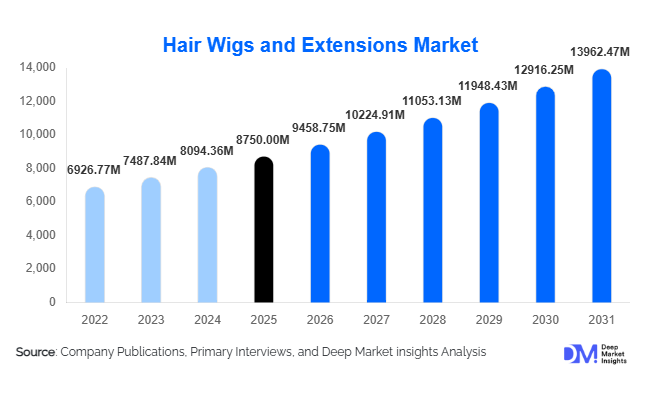
According to Deep Market Insights, the global hair wigs and extensions market size was valued at USD 8,750 million in 2025 and is projected to grow from USD 9,458.75 million in 2026 to reach USD 13,962.47 million by 2031, expanding at a CAGR of 8.1% during the forecast period (2026–2031). The market growth is primarily driven by increasing beauty consciousness, rising incidences of hair loss conditions such as alopecia and chemotherapy-related hair loss, and the growing influence of fashion trends fueled by social media and celebrity endorsements.
Key Market Insights
- Hair extensions dominate the product segment, accounting for over 50% of the market due to affordability, ease of use, and styling flexibility.
- Human hair products lead the market, capturing nearly 65% share owing to superior quality, natural appearance, and durability.
- Online retail channels are rapidly expanding, contributing close to half of global sales through direct-to-consumer models.
- Asia-Pacific is the largest regional market, supported by strong manufacturing bases and growing domestic consumption.
- Medical applications are gaining traction, particularly in oncology and alopecia treatment segments.
- Technological advancements in synthetic fibers and lace technologies are improving product realism and comfort.
What are the latest trends in the hair wigs and extensions market?
Customization and Premiumization Trends
The market is witnessing a strong shift toward customization, with consumers increasingly demanding personalized solutions such as color matching, scalp simulation, and texture customization. Premium products, especially Remy human hair wigs, are gaining popularity among affluent consumers who prioritize quality and longevity. Brands are leveraging AI and virtual try-on technologies to offer tailored experiences, enhancing customer satisfaction and driving higher margins. This trend is particularly evident in developed markets where consumers are willing to pay a premium for bespoke products that closely replicate natural hair aesthetics.
Rise of Sustainable and Ethical Sourcing
Sustainability is becoming a critical factor in purchasing decisions, particularly in North America and Europe. Consumers are demanding transparency in sourcing human hair and are increasingly favoring ethically sourced and environmentally friendly products. Companies are responding by adopting traceable supply chains, biodegradable materials, and eco-friendly packaging. This shift not only enhances brand reputation but also aligns with global sustainability goals, positioning companies for long-term growth in environmentally conscious markets.
What are the key drivers in the hair wigs and extensions market?
Growing Prevalence of Hair Loss Conditions
The increasing incidence of hair loss due to medical conditions such as alopecia, cancer treatments, and hormonal disorders is a major growth driver. The medical segment provides stable demand, with hospitals and clinics increasingly recommending wigs and extensions as part of patient care. Rising awareness and availability of customized medical wigs are further boosting this segment.
Influence of Fashion and Social Media
Social media platforms and celebrity endorsements have transformed wigs and extensions into mainstream fashion accessories. Consumers, particularly younger demographics, are embracing these products for quick style changes without permanent alterations. Influencer marketing and digital content have significantly expanded the market’s reach and appeal.
Advancements in Product Technology
Technological innovations in synthetic fibers and lace construction have improved product quality, making wigs and extensions more realistic, comfortable, and durable. Heat-resistant synthetic hair and advanced scalp simulation technologies are attracting first-time users and expanding the customer base.
What are the restraints for the global market?
High Cost of Premium Human Hair
Premium human hair products, particularly Remy hair, are expensive due to limited supply and ethical sourcing challenges. This restricts accessibility for price-sensitive consumers and limits market penetration in developing regions.
Quality Inconsistency and Counterfeit Products
The presence of low-quality and counterfeit products, especially in online marketplaces, undermines consumer trust. Inconsistent product quality can lead to dissatisfaction and hinder repeat purchases, posing a challenge for market growth.
What are the key opportunities in the hair wigs and extensions industry?
Expansion in Emerging Markets
Emerging economies in Asia-Pacific, Africa, and Latin America present significant growth opportunities due to rising disposable incomes and strong cultural acceptance of hair extensions. Countries such as India, China, and Nigeria are witnessing increasing demand, supported by urbanization and growing beauty awareness. Local manufacturing initiatives and export potential further enhance market opportunities in these regions.
Technology Integration in Retail
The integration of augmented reality (AR) and artificial intelligence (AI) in retail platforms is transforming the consumer buying experience. Virtual try-ons, personalized recommendations, and digital consultations are enhancing customer engagement and boosting online sales. Companies investing in digital transformation are likely to gain a competitive edge in the evolving market landscape.
Growth in Medical Applications
The medical segment, particularly in oncology and dermatology, offers substantial growth potential. Increasing collaborations between healthcare providers and manufacturers are enabling the development of customized medical wigs, improving patient comfort and quality of life. This segment is expected to grow steadily, driven by rising healthcare awareness and treatment rates.
Report Scope
| Report Metric | Details |
|---|---|
| Market Size in 2025 | USD 8750 Million |
| Market Size in 2026 | USD 9458.75 Million |
| Market Size in 2031 | USD 13962.47 Million |
| CAGR | 8.1% (2026-2031) |
| Base Year for Estimation | 2025 |
| Historical Data | 2022-2024 |
| Forecast Period | 2026-2031 |
| Report Coverage | Revenue Forecast, Competitive Landscape, Supply Chain Disruption, Growth Factors, Environment & Regulatory Landscape and Trends |
| Geographies Covered | North America, Europe, APAC, Middle East and Africa, LATAM |
| Countries Covered | U.S., Canada, U.K., Germany, France, Spain, Italy, Russia, Nordic, Benelux, Rest of Europe, China, Korea, Japan, India, Australia, Singapore, Taiwan, South East Asia, Rest of Asia-Pacific, UAE, Turky, Saudi Arabia, South Africa, Egypt, Nigeria, Rest of MEA, Brazil, Mexico, Argentina, Chile, Colombia, Rest of LATAM |
Explore more data points, trends and opportunities Download Free Sample Report
Product Type Insights
Hair extensions continue to dominate the global market, accounting for approximately 52% of the total market share in 2025. The leadership of this segment is primarily driven by its versatility, affordability, and ease of application compared to full wigs. Consumers increasingly prefer extensions for their ability to provide instant length, volume, and styling flexibility without long-term commitment. Among sub-types, clip-in and tape-in extensions are witnessing particularly strong demand due to their convenience, reusability, and alignment with the growing trend of temporary styling solutions. Additionally, the rise of DIY beauty routines and influencer-led tutorials has significantly boosted the adoption of these easy-to-use formats.
Full wigs, especially lace front and full lace variants, are gaining traction within the premium segment due to their superior realism, breathability, and comfort. These products are increasingly adopted by both fashion-conscious consumers and individuals with medical hair loss conditions. Meanwhile, hairpieces and toppers serve niche but steadily growing segments, particularly among consumers experiencing partial hair thinning. Their targeted functionality, combined with lower price points compared to full wigs, is supporting incremental market expansion. Overall, innovation in product design, improved fiber quality, and increasing customization options are reinforcing the dominance of the hair extensions segment globally.
Application Insights
Fashion and aesthetic applications dominate the market, contributing the largest share due to the growing emphasis on personal grooming, self-expression, and appearance enhancement. Consumers, particularly millennials and Gen Z, are increasingly using wigs and extensions as fashion accessories to experiment with different hairstyles, colors, and textures without permanent changes. Social media platforms and celebrity endorsements have played a critical role in normalizing frequent hairstyle changes, thereby driving consistent demand in this segment.
The medical application segment is emerging as a stable and steadily growing contributor, supported by rising incidences of alopecia, chemotherapy-induced hair loss, and other dermatological conditions. Increasing awareness among patients and healthcare providers, along with the availability of customized medical-grade wigs, is enhancing adoption rates. The entertainment industry, although niche, represents a high-value segment where demand is driven by film, television, theater, and fashion shows requiring high-quality, realistic wigs. Additionally, emerging applications in beauty education, cosmetology training, and professional styling are expanding the scope of the market, further diversifying revenue streams.
Distribution Channel Insights
Online retail channels account for approximately 48% of global sales, making them the leading distribution segment. The dominance of online platforms is driven by convenience, access to a wide product range, competitive pricing, and the ability to compare products and reviews. Direct-to-consumer (D2C) models through brand-owned websites are gaining traction, allowing manufacturers to improve margins and build stronger customer relationships. The integration of advanced technologies such as virtual try-ons, AI-based recommendations, and personalized styling tools is further enhancing the online shopping experience.
Offline channels, including salons, specialty stores, and beauty supply outlets, continue to play a critical role, particularly in the premium segment where personalized consultation and product trials are essential. Professional salons remain key touchpoints for high-end products and semi-permanent extensions. Increasingly, offline retailers are adopting digital tools such as in-store virtual mirrors and digital catalogs to bridge the gap between physical and online shopping experiences. This omnichannel approach is expected to further strengthen distribution efficiency and customer engagement.
End-User Insights
Individual consumers dominate the market, accounting for nearly 70% of total demand. This segment’s leadership is driven by the widespread adoption of wigs and extensions for daily fashion use, special occasions, and personal styling. The increasing acceptance of these products as mainstream beauty accessories, coupled with rising disposable incomes and social media influence, continues to fuel growth in this segment.
The medical end-user segment is expanding steadily, supported by growing demand from patients undergoing hair loss treatments. Hospitals and clinics are increasingly recommending wigs as part of patient care, leading to higher adoption of specialized medical products. Institutional buyers, including beauty academies and training institutes, represent a smaller but consistent demand segment. These institutions utilize wigs and extensions for educational purposes, contributing to stable long-term demand across regions.
Explore more data points, trends and opportunities Download Free Sample Report
Hair Wigs and Extensions Market Segmentations
By Product Type
- Full Wigs
- Hair Extensions
- Hairpieces & Toppers
By Application
- Fashion & Aesthetic Use
- Medical Applications
- Entertainment & Media
- Beauty Education & Training
By Distribution Channel
- Online Retail
- Offline Retail
By End-User
- Individual Consumers
- Medical Institutions
- Institutional Buyers
By Application Duration
- Temporary
- Semi-permanent
- Permanent
Regional Insights
Asia-Pacific
Asia-Pacific leads the global market with approximately 38% share in 2025, driven by a combination of strong manufacturing capabilities and rising domestic consumption. China and India are the primary contributors, with China’s market exceeding USD 1,500 million due to its dominance in the production and export of human hair products. India is emerging as a major exporter, supported by abundant raw material availability and cost advantages. Key growth drivers in this region include increasing urbanization, rising disposable incomes, cultural acceptance of hair extensions, and expanding e-commerce penetration. Additionally, government initiatives promoting manufacturing and exports are further strengthening the region’s market position.
North America
North America accounts for around 32% of the global market, led by the United States, with demand exceeding USD 2,200 million. The region’s growth is driven by high consumer spending, strong adoption of premium and customized products, and a well-established retail infrastructure. The increasing prevalence of medical hair loss conditions and growing awareness of available solutions are also significant drivers. Furthermore, the influence of celebrity culture, social media trends, and demand for high-quality, natural-looking products continues to support market expansion in this region.
Europe
Europe holds approximately 18% market share, with key markets including the UK, Germany, and France. Growth in this region is driven by strong fashion consciousness, increasing demand for premium and ethically sourced products, and rising awareness of medical applications. Consumers in Europe are particularly inclined toward sustainable and responsibly sourced products, prompting manufacturers to adopt transparent supply chains. Additionally, the region’s well-developed salon industry and professional styling services contribute to steady demand growth.
Middle East & Africa
The Middle East & Africa region is the fastest-growing, with a CAGR exceeding 9%. Countries such as Nigeria and South Africa exhibit strong cultural demand for hair extensions and wigs, making them key markets. Growth drivers include increasing urbanization, rising disposable incomes, and a strong preference for hair enhancement products as part of daily grooming. In the Middle East, high purchasing power and demand for luxury beauty products are supporting premium segment growth. Expanding retail networks and increasing penetration of international brands are further accelerating market development in this region.
Latin America
Latin America accounts for around 7% of the market, led by Brazil and Mexico. The region is witnessing growing demand due to rising beauty consciousness, expanding middle-class populations, and increasing influence of global fashion trends. Brazil, in particular, has a strong beauty and personal care culture, which is driving the adoption of wigs and extensions. Additional growth drivers include improving retail infrastructure, increasing online sales, and greater availability of affordable products catering to a wider consumer base.
Key Players in the Hair Wigs and Extensions Market
- Great Lengths
- Balmain Hair
- Hairdreams
- Easihair Pro
- Donna Bella Hair
- Cinderella Hair
- Evergreen Products Group
- Godrej Consumer Products
- Klix Hair Extensions
- Shake-N-Go Fashion
- Janet Collection
- Outre Hair
- Aderans Co.
- Artnature Inc.
- Rebecca Hair Products