Hair Scarves Market Size
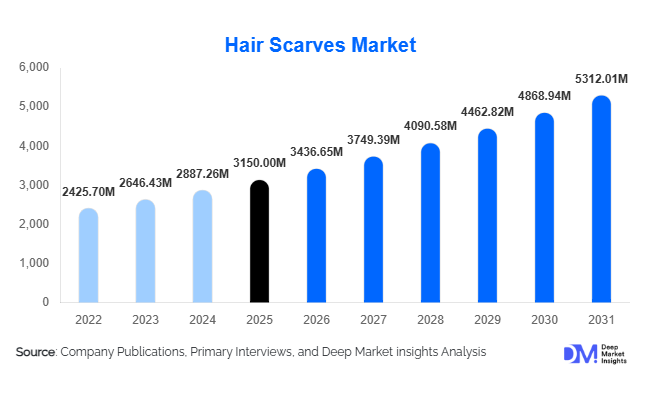
According to Deep Market Insights, the global hair scarves market size was valued at USD 3,150 million in 2025 and is projected to grow from USD 3,436.65 million in 2026 to reach USD 5,312.01 million by 2031, expanding at a CAGR of 9.1% during the forecast period (2026–2031). The hair scarves market growth is primarily driven by rising fashion personalization trends, increasing adoption of protective haircare accessories, and the expanding influence of social media–driven styling culture worldwide. Growing consumer awareness regarding hair health, combined with demand for multifunctional fashion accessories, is transforming hair scarves from occasional styling products into everyday lifestyle essentials across global markets.
Key Market Insights
- Hair scarves are evolving from fashion accessories into protective haircare products, particularly driven by demand for silk and satin fabrics that reduce hair damage.
- E-commerce channels dominate global sales growth, enabling direct-to-consumer brands and niche fashion labels to scale internationally.
- Asia-Pacific is the fastest-growing regional market, supported by rising disposable incomes and strong cultural adoption of headwear.
- Premiumization trends are accelerating, with luxury fashion houses expanding designer scarf collections and limited-edition collaborations.
- Sustainable and organic fabric adoption is increasing, as consumers prioritize ethical sourcing and eco-friendly textile production.
- Healthcare and oncology applications are emerging, positioning hair scarves as comfort-oriented products for medical hair loss support.
What are the latest trends in the hair scarves market?
Protective Haircare Integration Driving Product Innovation
Hair scarves are increasingly positioned as functional haircare tools rather than purely decorative accessories. Consumers are adopting silk and satin scarves to prevent hair breakage, retain moisture, and reduce friction during sleep or outdoor exposure. Dermatologists and beauty influencers frequently recommend protective styling methods, accelerating product adoption across global markets. Brands are responding by developing breathable fabrics, anti-frizz linings, and adjustable wrapping designs suited for different hair textures. The convergence of beauty and fashion industries has also resulted in bundled offerings where scarves are marketed alongside hair oils, bonnets, and wellness kits, strengthening cross-category growth opportunities.
Digital Fashion and Influencer-Led Styling Culture
Social media platforms are reshaping how consumers discover and purchase hair accessories. Styling tutorials, short-form video content, and influencer collaborations have transformed hair scarves into trend-driven fashion statements. Limited-edition collections launched through digital campaigns generate rapid consumer engagement and impulse purchases. Brands increasingly rely on data analytics to identify trending prints, colors, and tying styles, enabling faster product development cycles. Social commerce integrations allow users to purchase products directly from content platforms, reducing purchase friction and accelerating market expansion among younger consumers.
What are the key drivers in the hair scarves market?
Growing Demand for Multifunctional Fashion Accessories
Consumers increasingly prefer accessories that serve both aesthetic and functional purposes. Hair scarves offer styling versatility, seasonal adaptability, and practical benefits such as sun protection and hair maintenance. This multifunctionality supports frequent usage and repeat purchasing behavior. Fashion brands are expanding accessory portfolios because scarves deliver higher margins compared to core apparel categories, reinforcing their strategic importance within global fashion retail.
Expansion of Online Retail and Direct-to-Consumer Models
The rapid growth of online retail platforms has significantly improved global product accessibility. Direct-to-consumer brands leverage targeted advertising, influencer partnerships, and customization features to attract niche audiences. Digital storefronts reduce dependency on physical retail infrastructure, allowing emerging brands to compete with established fashion houses. Subscription-based fashion drops and personalized recommendations are further strengthening customer retention and lifetime value.
What are the restraints for the global market?
Raw Material Price Volatility
Premium hair scarves rely heavily on silk and natural fibers, which are subject to fluctuating agricultural output and supply chain disruptions. Price instability affects manufacturing costs and retail pricing strategies, particularly for mid-tier brands attempting to maintain affordability while preserving product quality.
Market Commoditization in Low-Cost Segments
The proliferation of low-cost synthetic products creates pricing pressure and intensifies competition. Unbranded and counterfeit products dilute brand differentiation and challenge premium positioning strategies. Companies must invest in branding, quality assurance, and innovation to sustain long-term competitive advantage.
What are the key opportunities in the hair scarves industry?
Growth of Modest Fashion and Cultural Wear Markets
Global acceptance of modest fashion is expanding demand for stylish headwear across the Middle East, Southeast Asia, and parts of Africa. Brands introducing culturally relevant designs and region-specific collections can unlock significant growth opportunities. Government initiatives supporting textile manufacturing and export promotion further enhance market entry potential in emerging economies.
Customization and Sustainable Product Development
Personalized fashion represents a major opportunity for market participants. Custom prints, monogrammed scarves, and limited-edition collaborations appeal to consumers seeking individuality. Simultaneously, sustainability initiatives such as recycled fabrics, eco-friendly dyes, and transparent sourcing practices are influencing purchasing decisions. Brands investing in ethical production models are achieving stronger customer loyalty and premium pricing potential.
Report Scope
| Report Metric | Details |
|---|---|
| Market Size in 2025 | USD 3150 Million |
| Market Size in 2026 | USD 3436.65 Million |
| Market Size in 2031 | USD 5312.01 Million |
| CAGR | 9.1% (2026-2031) |
| Base Year for Estimation | 2025 |
| Historical Data | 2022-2024 |
| Forecast Period | 2026-2031 |
| Report Coverage | Revenue Forecast, Competitive Landscape, Supply Chain Disruption, Growth Factors, Environment & Regulatory Landscape and Trends |
| Geographies Covered | North America, Europe, APAC, Middle East and Africa, LATAM |
| Countries Covered | U.S., Canada, U.K., Germany, France, Spain, Italy, Russia, Nordic, Benelux, Rest of Europe, China, Korea, Japan, India, Australia, Singapore, Taiwan, South East Asia, Rest of Asia-Pacific, UAE, Turky, Saudi Arabia, South Africa, Egypt, Nigeria, Rest of MEA, Brazil, Mexico, Argentina, Chile, Colombia, Rest of LATAM |
Explore more data points, trends and opportunities Download Free Sample Report
Product Type Insights
The global hair scarves market demonstrates strong product diversification, with square hair scarves emerging as the leading product category, accounting for nearly 34% of global revenue. Their dominance is primarily attributed to exceptional versatility across multiple styling applications, including head wraps, neck accessories, protective hair coverings, and fashion layering. Consumers increasingly prefer square formats because they accommodate both traditional cultural styling and contemporary fashion trends, enabling brands to position them as multi-functional accessories. Additionally, the growth of social media styling tutorials and influencer-driven fashion content has amplified consumer awareness regarding creative scarf usage, further strengthening demand.
Bandana-style scarves continue to maintain substantial popularity, particularly among younger demographics influenced by streetwear aesthetics and retro fashion revivals. Their compact size, bold prints, and gender-neutral appeal have enabled brands to expand into lifestyle and urban fashion segments. Pre-styled turbans are witnessing rising adoption across healthcare, convenience, and modest fashion markets, supported by growing demand from consumers seeking ready-to-wear solutions that combine comfort with style. Rectangular and oblong scarves also contribute significantly to market revenue, as they are frequently incorporated into seasonal collections and layered fashion looks, encouraging repeat purchases and frequent product refresh cycles among fashion-conscious consumers.
Material Type Insights
Material selection plays a critical role in consumer purchasing decisions, influencing comfort, durability, and perceived product value. Silk hair scarves lead the material segment with approximately 29% market share, supported by their premium positioning and strong association with hair protection benefits such as reduced friction, moisture retention, and minimized hair breakage. The increasing consumer focus on hair health and scalp care has reinforced silk’s status as a luxury yet functional material, particularly among premium and professional beauty segments.
Cotton scarves remain widely adopted for everyday wear due to breathability, softness, and affordability, making them particularly popular in warmer climates and emerging economies. Polyester and satin variants dominate mass-market sales owing to cost efficiency, easy maintenance, and durability, enabling manufacturers to offer fashionable designs at accessible price points. Meanwhile, sustainable materials such as bamboo fibers, organic cotton, and recycled textiles are gaining momentum as environmentally conscious consumers increasingly prioritize ethical sourcing and eco-friendly fashion. Brands integrating sustainability certifications and transparent supply chains are experiencing stronger engagement, especially among younger consumers seeking responsible fashion alternatives.
Distribution Channel Insights
Distribution strategies continue to evolve as digital transformation reshapes global retail dynamics. Online retail channels account for the largest share of global sales, contributing nearly 38% of total revenue. Consumers increasingly rely on e-commerce platforms for product comparison, access to international brands, customer reviews, and styling inspiration through integrated social commerce features. The rapid growth of mobile shopping and influencer collaborations has further strengthened online channel performance, allowing emerging brands to scale globally with relatively low entry barriers.
Fashion specialty stores remain essential for premium product positioning, offering curated collections and experiential retail environments that enhance brand perception. Department stores and hypermarkets continue to support high-volume sales within mid-range and value segments, particularly in urban retail centers. Direct-to-consumer brand websites are experiencing accelerated growth as companies invest in loyalty programs, personalized recommendations, limited-edition launches, and exclusive product drops. This shift toward owned digital ecosystems enables brands to strengthen customer relationships while improving margins and data-driven marketing capabilities.
Application Insights
Fashion and styling applications dominate the global hair scarves market, accounting for over 52% of total demand. Continuous fashion cycle innovation, celebrity endorsements, and social media-driven styling trends encourage frequent product adoption and seasonal purchasing behavior. Hair scarves have increasingly transitioned from functional accessories to core fashion statements, appearing across runway collections, casual wear, and luxury styling categories.
Protective haircare applications represent the fastest-growing segment, driven by rising consumer awareness regarding hair damage prevention, moisture preservation, and nighttime hair protection routines. Increased adoption among consumers with textured, curly, or chemically treated hair has significantly accelerated demand. Cultural and religious applications maintain stable and long-term consumption patterns, supporting consistent baseline demand across multiple regions. Additionally, sports and outdoor applications are expanding as lightweight scarves gain popularity for sun protection, travel convenience, and multifunctional usage, particularly among active lifestyle consumers seeking practical yet fashionable accessories.
Consumer Demographic Insights
Women aged 18–35 years represent the largest consumer demographic, accounting for approximately 46% of market demand. This segment demonstrates strong engagement with fashion experimentation, digital retail platforms, and influencer-led purchasing behavior. High social media exposure and fast-changing fashion preferences drive frequent product purchases, encouraging brands to introduce diverse color palettes, prints, and limited-edition collaborations.
Consumers aged 36–55 contribute significantly to premium segment growth, prioritizing material quality, durability, and functional benefits such as hair protection and comfort. This demographic shows greater willingness to invest in silk and sustainably sourced products. Senior consumers are increasingly adopting hair scarves for comfort, scalp protection, and medical or hair-loss-related needs, expanding the functional positioning of the product category. Meanwhile, men’s adoption is gradually increasing, supported by the expansion of gender-neutral fashion trends, streetwear influence, and lifestyle branding initiatives that reposition scarves as versatile fashion accessories rather than traditionally gender-specific items.
Explore more data points, trends and opportunities Download Free Sample Report
Hair Scarves Market Segmentations
By Product Type
- Square Hair Scarves
- Rectangular/Oblong Hair Scarves
- Triangle Hair Scarves
- Bandana-Style Hair Scarves
- Pre-Styled Hair Wraps & Turban Scarves
By Material Type
- Silk Hair Scarves
- Cotton Hair Scarves
- Polyester & Satin Hair Scarves
- Wool & Blended Fabric Scarves
- Sustainable & Organic Fabric Scarves
By Distribution Channel
- Online Retail
- Fashion Specialty Stores
- Department Stores
- Luxury Boutiques
- Hypermarkets & Mass Retail Chains
By Application
- Fashion & Styling
- Protective Hair Care
- Cultural & Religious Wear
- Sports & Outdoor Use
- Medical Hair Loss Support
Regional Insights
North America
North America accounts for nearly 28% of the global hair scarves market, led primarily by the United States and supported by high consumer spending power and advanced retail infrastructure. Regional growth is driven by strong adoption of protective haircare practices, particularly among consumers focused on maintaining hair health and reducing styling damage. The widespread influence of social media creators, celebrity fashion endorsements, and multicultural fashion integration continues to stimulate product demand. High e-commerce penetration and efficient logistics networks enable rapid product availability, while premium silk scarves and designer collaborations perform strongly due to established luxury fashion consumption patterns. Additionally, increasing demand for inclusive beauty and fashion products has encouraged brands to expand diverse styling offerings tailored to various hair types and cultural preferences.
Europe
Europe represents approximately 25% of global market share, with France, Italy, the United Kingdom, and Germany serving as key demand centers. Regional growth is strongly supported by Europe’s deep-rooted luxury fashion heritage and consumer appreciation for craftsmanship and premium materials. Increasing emphasis on sustainability and ethical sourcing has significantly influenced purchasing behavior, encouraging brands to adopt eco-friendly materials and transparent manufacturing practices. The region also benefits from strong tourism-driven retail sales, where fashion accessories such as scarves are frequently purchased as lifestyle and luxury items. Expansion of slow-fashion movements and growing consumer preference for timeless accessories further support steady long-term demand growth across European markets.
Asia-Pacific
Asia-Pacific is the fastest-growing regional market, expanding at a CAGR exceeding 11%, driven by rapid urbanization, rising disposable incomes, and expanding middle-class populations across China and India. The region’s strong growth is further supported by increasing fashion awareness among younger consumers and widespread adoption of mobile commerce platforms. Japan and South Korea contribute significantly to premium and trend-driven segments through highly innovative fashion ecosystems and strong beauty culture integration. Local manufacturers benefit from scalable production capabilities, enabling competitive pricing and rapid product launches aligned with fast-fashion cycles. Additionally, growing interest in haircare protection and modest fashion trends continues to broaden the consumer base throughout the region.
Latin America
Latin America holds close to 10% of global demand, led by Brazil and Mexico. Regional market expansion is supported by a fashion-conscious population that embraces vibrant colors, prints, and expressive styling traditions. Increasing penetration of online retail platforms has improved product accessibility beyond major metropolitan areas, enabling international brands to enter emerging markets. Rising youth populations and expanding social media engagement contribute to higher fashion experimentation, while affordability-focused product offerings drive strong adoption within mass-market segments. Cultural events and seasonal festivals also sustain consistent demand for decorative and statement accessories, reinforcing steady market growth.
Middle East & Africa
The Middle East & Africa region accounts for roughly 12% of global market share, supported by strong cultural adoption of headwear and modest fashion practices. Demand growth is particularly strong in the UAE and Saudi Arabia, where premium imports and luxury fashion consumption continue to expand alongside rising disposable incomes. The region benefits from increasing participation of global fashion brands introducing culturally aligned designs and high-quality materials. Turkey plays a strategic role as a major manufacturing and export hub, supplying products to Europe and neighboring regions through established textile production capabilities. Additionally, rising digital retail adoption and growing youth populations are accelerating fashion awareness and expanding market accessibility across emerging African economies.
Key Players in the Hair Scarves Market
- Hermès International
- LVMH (Louis Vuitton)
- Kering Group (Gucci)
- Burberry Group plc
- Chanel Limited
- Ralph Lauren Corporation
- H&M Group
- Inditex (Zara)
- Fast Retailing Co., Ltd. (Uniqlo)
- Anthropologie
- Nordstrom Inc.
- ASOS plc
- Mango Group
- Liberty London
- Ted Baker plc