Hair Mask Market Size
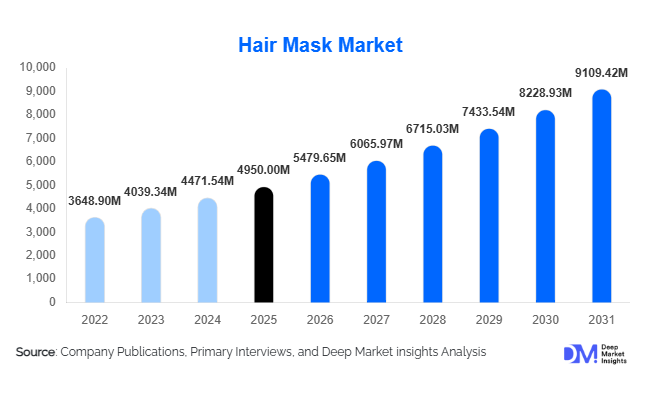
According to Deep Market Insights,the global hair mask market size was valued at USD 4,950 million in 2025 and is projected to grow from USD 5,479.65 million in 2026 to reach USD 9,109.42 million by 2031, expanding at a CAGR of 10.7% during the forecast period (2026–2031). Market growth is primarily driven by rising consumer awareness regarding hair damage repair, increasing adoption of multi-step hair care routines, and strong premiumization trends across global beauty markets. Consumers are increasingly shifting from basic conditioning products toward intensive treatment solutions that provide deep nourishment, scalp health benefits, and long-term hair restoration.
Key Market Insights
- Hair care routines are evolving toward treatment-based regimens, with weekly masking becoming a standardized global beauty practice.
- Premium and salon-grade formulations dominate revenue growth, supported by higher consumer willingness to pay for performance-driven products.
- Asia-Pacific leads global demand, fueled by expanding middle-class populations and rising beauty awareness in China and India.
- E-commerce channels are transforming distribution, enabling rapid global expansion of both multinational and indie brands.
- Clean beauty and natural ingredient preferences are accelerating innovation in botanical and hybrid formulations.
- Technological advancements in bond-repair and scalp science are reshaping product differentiation and pricing benchmarks.
What are the latest trends in the hair mask market?
Rise of Scalp-Centric Hair Care
Hair care innovation is increasingly shifting toward scalp health, positioning hair masks as therapeutic treatments rather than cosmetic conditioners. Consumers are adopting products enriched with probiotics, peptides, and microbiome-balancing ingredients designed to improve follicle health and hair strength. Dermatologist-backed formulations and trichology-inspired treatments are gaining mainstream acceptance, particularly in premium product categories. Brands are launching masks addressing dandruff, scalp sensitivity, and hair thinning, expanding the category into semi-dermatological applications. This trend aligns with growing consumer understanding that healthy hair growth originates from scalp wellness, thereby expanding usage frequency and market value.
Digital Commerce and Influencer-Led Adoption
Social media platforms and beauty influencers have significantly accelerated consumer education regarding deep-conditioning treatments. Tutorials showcasing weekly hair repair routines have normalized hair mask usage across younger demographics. E-commerce platforms allow niche brands to scale globally through direct-to-consumer strategies, reducing reliance on traditional retail channels. AI-driven product recommendations, subscription services, and personalized hair diagnostics are enhancing consumer engagement while improving repeat purchase rates. Online retail has become a major growth engine, accounting for a rapidly expanding share of total sales worldwide.
What are the key drivers in the hair mask market?
Growing Demand for Hair Damage Repair Solutions
Increasing exposure to pollution, chemical treatments, hair coloring, and heat styling has significantly increased hair damage concerns globally. Consumers are seeking restorative solutions capable of repairing structural damage and improving hair texture. Bond-repair technologies and protein-based formulations have transformed consumer perception of hair masks from optional products into essential treatment solutions. Professional salon recommendations further reinforce adoption, driving consistent growth across both developed and emerging markets.
Premiumization Across Global Beauty Markets
Consumers are increasingly investing in premium personal care products that deliver visible results. Hair masks positioned as salon-quality treatments offer higher perceived value compared to conventional conditioners. Premium brands leverage advanced ingredients, sustainable packaging, and luxury branding to command higher price points. Rising disposable incomes in Asia-Pacific and the Middle East are accelerating demand for premium hair treatments, supporting strong revenue expansion.
What are the restraints for the global market?
Price Sensitivity in Emerging Economies
Despite strong growth potential, hair masks remain relatively premium products compared to traditional hair conditioners. In price-sensitive markets, consumers may limit purchase frequency or opt for lower-cost alternatives. This creates challenges for premium brands attempting to scale penetration across developing regions where affordability remains a critical purchasing factor.
Raw Material Price Volatility
Hair mask formulations rely heavily on botanical oils, specialty proteins, and active cosmetic ingredients whose prices fluctuate due to agricultural variability and supply chain disruptions. Rising costs of argan oil, shea butter, and keratin derivatives impact manufacturing margins and pricing strategies, potentially slowing adoption if retail prices increase significantly.
What are the key opportunities in the hair mask industry?
Personalized and AI-Driven Hair Care Solutions
The integration of artificial intelligence into beauty diagnostics presents major opportunities for manufacturers. Personalized hair masks tailored to specific damage profiles, hair textures, and environmental conditions are gaining traction. Digital scalp analysis tools and subscription-based customized formulations allow companies to build long-term consumer relationships while increasing lifetime customer value. This data-driven innovation is expected to redefine product development and marketing strategies.
Expansion Across Emerging Beauty Markets
Rapid urbanization and rising disposable income levels in countries such as India, Indonesia, Brazil, and Mexico are creating new demand centers. Consumers in these regions are transitioning from basic hair cleansing products toward specialized treatments. Localization of formulations addressing humidity, pollution exposure, and textured hair types provides significant growth potential for both multinational corporations and regional brands.
Report Scope
| Report Metric | Details |
|---|---|
| Market Size in 2025 | USD 4950 Million |
| Market Size in 2026 | USD 5479.65 Million |
| Market Size in 2031 | USD 9109.42 Million |
| CAGR | 10.7% (2026-2031) |
| Base Year for Estimation | 2025 |
| Historical Data | 2022-2024 |
| Forecast Period | 2026-2031 |
| Report Coverage | Revenue Forecast, Competitive Landscape, Supply Chain Disruption, Growth Factors, Environment & Regulatory Landscape and Trends |
| Geographies Covered | North America, Europe, APAC, Middle East and Africa, LATAM |
| Countries Covered | U.S., Canada, U.K., Germany, France, Spain, Italy, Russia, Nordic, Benelux, Rest of Europe, China, Korea, Japan, India, Australia, Singapore, Taiwan, South East Asia, Rest of Asia-Pacific, UAE, Turky, Saudi Arabia, South Africa, Egypt, Nigeria, Rest of MEA, Brazil, Mexico, Argentina, Chile, Colombia, Rest of LATAM |
Explore more data points, trends and opportunities Download Free Sample Report
Product Type Insights
The global hair mask market is primarily led by deep conditioning hair masks, which account for nearly 28% of total revenue owing to their universal suitability across diverse hair textures, damage levels, and climatic conditions. The leading segment growth is strongly driven by rising consumer preference for intensive at-home treatment solutions that replicate professional salon results while addressing concerns such as dryness, breakage, and chemical damage. Increasing exposure to heat styling tools, pollution, and frequent coloring treatments has significantly elevated demand for repair and damage-control masks, positioning them as one of the fastest-expanding product categories. Hydrating masks continue to witness sustained adoption in regions characterized by dry and humid climates where moisture retention remains a key hair care challenge. Meanwhile, scalp-treatment masks are emerging as an innovation-driven niche supported by dermatological research linking scalp health to hair growth and overall hair quality. Anti-frizz and color-protection masks are also gaining strong traction among urban consumers seeking long-lasting smoothness and color preservation, reflecting the broader premiumization trend within global hair care routines.
Ingredient Type Insights
Hybrid formulations that combine natural botanical extracts with scientifically engineered active ingredients represent the dominant ingredient category, contributing approximately 41% of total market share. The leading segment expansion is driven by consumers increasingly seeking multifunctional products that deliver both clean-label appeal and clinically validated performance outcomes. Rising awareness regarding ingredient safety, sustainability, and efficacy has encouraged brands to develop formulations integrating plant-based oils, peptides, vitamins, and bond-repair technologies. Natural and organic hair masks are experiencing accelerated growth across Europe and North America, supported by regulatory emphasis on ingredient transparency and growing environmental consciousness among consumers. At the same time, protein- and keratin-based formulations maintain strong demand within professional salon channels due to their immediate strengthening and reconstruction benefits, particularly following chemical treatments such as bleaching, perming, and straightening. Continuous innovation in biotechnology-derived ingredients and personalized formulations is further enhancing product differentiation and supporting long-term category expansion.
Distribution Channel Insights
Online retail channels account for approximately 32% of global sales and represent the fastest-growing distribution segment, primarily driven by increasing digital adoption and evolving consumer purchasing behavior. The leading segment growth is supported by the convenience of home delivery, access to global brands, competitive pricing, and the influence of social media marketing and beauty influencers who accelerate product discovery and consumer trust. E-commerce platforms also enable detailed product education through reviews, tutorials, and personalized recommendations, strengthening conversion rates. Specialty beauty retailers continue to play a critical role in premium product positioning by offering curated selections and expert consultation, while supermarkets and hypermarkets remain essential for high-volume sales in mass-market categories. Professional salon distribution channels further influence purchasing decisions, as hairstylists frequently recommend post-treatment maintenance products, creating a strong link between service experiences and retail consumption.
End-User Insights
Individual consumers represent nearly 72% of total market demand, reflecting a structural shift toward at-home hair care treatments and self-care routines. The leading segment growth is driven by increasing consumer awareness regarding hair health maintenance, rising disposable income levels, and the growing availability of salon-grade formulations designed for home use. Social media tutorials and beauty education content have empowered consumers to adopt advanced hair treatment routines independently. Professional salons continue to serve as an important secondary end-user segment, incorporating hair masks into conditioning, repair, and restoration services that enhance treatment outcomes. Strategic collaborations between salons and retail brands have strengthened consumer confidence in recommended products, encouraging repeat purchases and supporting overall market penetration. The integration of professional expertise with retail accessibility continues to expand the category’s consumer base globally.
Explore more data points, trends and opportunities Download Free Sample Report
Hair Mask Market Segmentations
By Product Type
- Deep Conditioning Hair Masks
- Repair & Damage Control Masks
- Hydrating & Moisturizing Masks
- Color Protection Masks
- Anti-Frizz & Smoothing Masks
- Scalp Treatment Masks
- Strengthening & Protein Masks
- Anti-Hair Fall & Growth Masks
By Ingredient Type
- Natural & Botanical-Based Formulations
- Synthetic Active-Based Formulations
- Hybrid Formulations (Natural + Scientific Actives)
By Hair Type
- Dry & Damaged Hair
- Curly & Textured Hair
- Colored/Chemically Treated Hair
- Oily Hair
- Normal Hair
- Aging/Thinning Hair
By Distribution Channel
- Supermarkets & Hypermarkets
- Specialty Beauty Stores
- Pharmacies & Drugstores
- Online Retail
- Professional Salon Distribution
By End User
- Individual Consumers (At-Home Use)
- Professional Salons & Hair Clinics
Regional Insights
North America
North America accounts for nearly 24% of global market share, led primarily by the United States, where consumers demonstrate strong adoption of premium, bond-repair, and scientifically advanced hair treatments. Regional growth is driven by high disposable income levels, widespread salon infrastructure, and a strong culture of beauty experimentation supported by influencer marketing and digital beauty communities. Increasing demand for personalized hair care solutions and dermatologist-recommended formulations further accelerates innovation and product adoption. In Canada, market expansion is supported by growing clean beauty awareness, demand for sustainable packaging, and heightened focus on scalp health and wellness-oriented hair care routines. The presence of leading global brands and continuous product launches reinforces North America’s position as a mature yet innovation-driven market.
Europe
Europe contributes approximately 22% of global revenue, with Germany, France, the United Kingdom, and Italy serving as major demand centers. Regional growth is strongly driven by stringent sustainability regulations, increasing adoption of organic and vegan formulations, and consumer emphasis on ethical sourcing practices. European consumers prioritize ingredient transparency, product safety, and environmentally responsible packaging, prompting manufacturers to invest heavily in biodegradable materials and low-impact production processes. Additionally, the region’s established salon culture and professional hair care heritage continue to support demand for high-performance treatment masks. Rising awareness of hair health linked to lifestyle and environmental stressors further strengthens long-term market growth across both premium and mass segments.
Asia-Pacific
Asia-Pacific dominates the global hair mask market with approximately 38% share in 2025, supported by large population bases, expanding middle-class income levels, and rapid digital commerce adoption. Regional growth is driven by strong beauty consciousness, innovation-led product development, and increasing penetration of international and domestic brands. China represents the largest national market due to advanced e-commerce ecosystems and rising demand for premium beauty solutions. India is among the fastest-growing markets, fueled by strong preference for herbal and Ayurvedic ingredients, increasing urbanization, and growing awareness of specialized hair treatments. Japan and South Korea remain global innovation hubs, leading advancements in scalp-care technologies, lightweight formulations, and multifunctional beauty products that influence global product trends.
Latin America
Latin America is experiencing steady market expansion, particularly in Brazil and Mexico where hair care plays a significant cultural and aesthetic role. Regional growth is driven by high salon density, frequent chemical hair treatments, and strong consumer engagement with professional hair care routines. Climatic conditions such as humidity and sun exposure also increase demand for repair, hydration, and anti-frizz solutions. Expanding penetration of international beauty brands through online platforms and social commerce channels is improving product accessibility across urban and semi-urban populations. Rising beauty awareness among younger consumers and increasing adoption of premium hair care products further support sustained regional development.
Middle East & Africa
The Middle East & Africa region represents the fastest-growing geographic market, expanding at nearly 14% CAGR. Regional growth is primarily driven by harsh climatic conditions including heat, dryness, and water salinity, which contribute to hair damage and increase demand for intensive treatment products. Countries such as the United Arab Emirates and Saudi Arabia exhibit strong demand for premium hair care solutions supported by high beauty spending and luxury retail expansion. Increasing urbanization, rising female workforce participation, and expanding modern retail infrastructure across Gulf countries and South Africa are further accelerating market penetration. Growing awareness of hair health, combined with increasing availability of international brands and localized product offerings, continues to strengthen long-term growth prospects across the region.
Key Players in the Hair Mask Market
- L’Oréal S.A.
- Unilever PLC
- Procter & Gamble Co.
- Henkel AG & Co. KGaA
- Shiseido Company Limited
- Kao Corporation
- Estée Lauder Companies Inc.
- Coty Inc.
- Amorepacific Corporation
- Olaplex Holdings Inc.
- Moroccanoil Israel Ltd.
- Davines S.p.A.
- Oribe Hair Care LLC
- Natura & Co
- Revlon Inc.