Hair Fiber Market Size
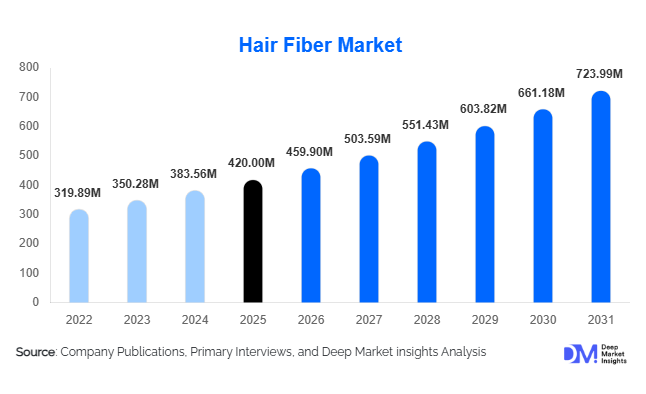
According to Deep Market Insights, the global hair fiber market size was valued at USD 420 million in 2025 and is projected to grow from USD 459.90 million in 2026 to reach USD 723.99 million by 2031, expanding at a CAGR of 9.5% during the forecast period (2026–2031). The market growth is primarily driven by the increasing prevalence of hair thinning and alopecia, rising grooming awareness among consumers, and the growing demand for instant, non-invasive cosmetic solutions. Hair fibers are gaining widespread popularity as a quick and affordable alternative to surgical treatments, offering immediate visual improvement with minimal effort.
Key Market Insights
- The rising incidence of hair loss globally is driving demand for instant cosmetic solutions such as hair fibers.
- Male consumers dominate the market, accounting for nearly 65% of total demand due to the higher prevalence of pattern baldness.
- Online retail channels lead distribution, contributing over 55% of global sales, driven by e-commerce expansion.
- Keratin-based natural fibers hold the largest share, with approximately 52% of the global market.
- Asia-Pacific is the fastest-growing region, supported by rising disposable incomes and growing awareness.
- Product innovation in sweat resistance and scalp safety is enhancing consumer adoption globally.
What are the latest trends in the hair fiber market?
Shift Toward Natural and Organic Fiber Formulations
Consumers are increasingly preferring natural, keratin-based hair fibers over synthetic alternatives due to their superior blending capability and scalp compatibility. Brands are investing in organic formulations free from harmful chemicals to meet rising demand for dermatologically safe products. This trend is particularly strong in developed markets where consumers prioritize health-conscious grooming solutions. Additionally, eco-friendly packaging and sustainable sourcing of raw materials are gaining traction, aligning with global environmental concerns and influencing purchasing decisions.
Digital-First and Direct-to-Consumer Expansion
The hair fiber market is witnessing a strong shift toward digital sales channels, with brands leveraging e-commerce platforms and direct-to-consumer (D2C) models. Social media marketing, influencer endorsements, and video demonstrations showcasing before-and-after transformations are significantly boosting product visibility. Subscription-based models and personalized product recommendations using AI are also emerging, enhancing customer engagement and retention. This trend is particularly effective among younger consumers who rely heavily on digital platforms for product discovery.
What are the key drivers in the hair fiber market?
Increasing Prevalence of Hair Loss Conditions
The growing incidence of hair loss caused by stress, pollution, aging, and hormonal imbalances is a major driver of market growth. Conditions such as androgenetic alopecia are becoming more common globally, leading to higher demand for quick and effective cosmetic solutions. Hair fibers offer an immediate fix, making them highly attractive for individuals seeking non-medical alternatives.
Rising Grooming Awareness and Aesthetic Consciousness
Modern consumers are increasingly focused on personal appearance, driven by social media influence and professional lifestyle demands. This has led to a surge in demand for grooming products, including hair fibers. The trend is particularly strong among millennials and Gen Z consumers, who prioritize appearance and are more open to experimenting with cosmetic solutions.
Affordability and Ease of Application
Compared to expensive and invasive procedures like hair transplants, hair fibers are highly affordable and easy to use. This accessibility has broadened the consumer base, allowing individuals across different income groups to adopt the product. The convenience of at-home application further enhances its appeal.
What are the restraints for the global market?
Temporary Nature of the Product
Hair fibers provide only a temporary solution and require repeated application. Their susceptibility to water, sweat, and environmental conditions can limit usage in certain scenarios, reducing consumer confidence and long-term adoption.
Competition from Alternative Solutions
The market faces competition from other hair loss treatments, including topical medications, wigs, and surgical procedures. Consumers seeking permanent solutions may prefer medical treatments, which can limit the growth potential of hair fibers in the long term.
What are the key opportunities in the hair fiber industry?
Expansion in Emerging Markets
Emerging economies in Asia-Pacific, Latin America, and the Middle East present significant growth opportunities due to increasing urbanization and rising disposable incomes. Countries such as India, China, and Brazil are witnessing growing awareness of grooming products, creating a large untapped consumer base for hair fibers.
Technological Innovation in Product Formulation
Advancements in fiber technology, including sweat-resistant formulations, anti-static properties, and improved color matching, are enhancing product performance. Companies investing in R&D to develop long-lasting and scalp-friendly fibers can gain a competitive advantage and expand their market share.
Growth in Professional Salon Channels
Partnerships with salons, dermatology clinics, and trichology centers offer new revenue streams for manufacturers. Professional endorsements increase product credibility and encourage repeat usage, particularly in premium segments where consumers seek expert recommendations.
Report Scope
| Report Metric | Details |
|---|---|
| Market Size in 2025 | USD 420 Million |
| Market Size in 2026 | USD 459.90 Million |
| Market Size in 2031 | USD 723.99 Million |
| CAGR | 9.5% (2026-2031) |
| Base Year for Estimation | 2025 |
| Historical Data | 2022-2024 |
| Forecast Period | 2026-2031 |
| Report Coverage | Revenue Forecast, Competitive Landscape, Supply Chain Disruption, Growth Factors, Environment & Regulatory Landscape and Trends |
| Geographies Covered | North America, Europe, APAC, Middle East and Africa, LATAM |
| Countries Covered | U.S., Canada, U.K., Germany, France, Spain, Italy, Russia, Nordic, Benelux, Rest of Europe, China, Korea, Japan, India, Australia, Singapore, Taiwan, South East Asia, Rest of Asia-Pacific, UAE, Turky, Saudi Arabia, South Africa, Egypt, Nigeria, Rest of MEA, Brazil, Mexico, Argentina, Chile, Colombia, Rest of LATAM |
Explore more data points, trends and opportunities Download Free Sample Report
Product Type Insights
Natural keratin-based hair fibers dominate the global hair fiber market, accounting for approximately 52% of total revenue in 2025. The leading position of this segment is primarily driven by its superior ability to mimic natural hair texture, ensuring seamless blending and a more realistic appearance. Keratin, being a natural protein found in human hair, enhances fiber adhesion through static charge, improving durability and user satisfaction. Additionally, increasing consumer preference for safe, dermatologically tested, and chemical-free products has accelerated the adoption of natural fibers, particularly in developed markets such as North America and Europe.
Synthetic fibers, including rayon and nylon variants, cater to cost-sensitive consumer segments and are widely used in emerging economies due to their affordability. However, their limitations in terms of natural finish, scalp compatibility, and lower resistance to environmental factors restrict their adoption in premium markets. Hybrid fiber blends are emerging as a niche but promising category, combining the affordability of synthetic fibers with the performance benefits of keratin. Continuous innovation in fiber engineering—such as improved electrostatic properties, sweat resistance, and enhanced color matching—is expected to further differentiate product offerings and drive growth across all product segments.
Application Insights
Scalp hair thinning remains the dominant application segment, contributing nearly 78% of the total market share in 2025. The primary driver for this dominance is the high global prevalence of scalp-related hair loss conditions, including androgenetic alopecia, stress-induced hair fall, and age-related thinning. The increasing number of consumers seeking instant, non-invasive cosmetic solutions has significantly boosted demand for scalp-focused hair fibers. Moreover, the growing acceptance of grooming products among male consumers has further strengthened this segment’s leadership.
Other applications, such as beard and eyebrow enhancement, are gaining traction, particularly among younger demographics influenced by social media trends and evolving beauty standards. These segments are witnessing higher growth rates due to increasing experimentation with personal grooming products and the rising popularity of well-defined facial aesthetics. As consumer awareness expands, these niche applications are expected to contribute incrementally to overall market growth, supported by targeted product innovations and marketing strategies.
Distribution Channel Insights
Online retail channels dominate the hair fiber market, accounting for over 55% of total sales in 2025. This leadership is driven by the rapid expansion of e-commerce platforms, direct-to-consumer (D2C) strategies, and the increasing reliance on digital channels for product discovery and purchase. Consumers benefit from a wide range of product options, competitive pricing, customer reviews, and convenient home delivery, making online platforms the preferred choice globally. Additionally, influencer marketing and video demonstrations showcasing product effectiveness have significantly boosted online conversion rates.
Offline channels, including pharmacies, specialty beauty stores, and supermarkets, continue to play a crucial role in product visibility and consumer trust. These channels are particularly important in regions where consumers prefer physical product verification before purchase. Professional distribution through salons and dermatology clinics is emerging as a high-value segment, driven by expert recommendations and bundled service offerings. This channel is expected to witness strong growth, particularly in the premium segment, as consumers increasingly seek professional guidance for hair loss solutions.
End-User Insights
Individual consumers dominate the hair fiber market, accounting for approximately 70% of total demand in 2025. The ease of application, affordability, and immediate results make hair fibers highly appealing for personal use. The growing awareness of grooming and appearance, particularly among urban populations, has further accelerated adoption in this segment. Male consumers represent the majority within this category, driven by higher incidence rates of pattern baldness and increasing acceptance of cosmetic solutions.
Professional salons and clinics represent a rapidly growing segment, supported by rising consumer trust in expert recommendations and the integration of hair fibers into grooming and treatment services. This segment is expected to grow at a faster pace compared to individual consumption, driven by repeat usage, premium product offerings, and the expansion of trichology and dermatology services globally. The increasing collaboration between manufacturers and professional service providers is also enhancing market penetration and brand credibility.
Explore more data points, trends and opportunities Download Free Sample Report
Hair Fiber Market Segmentations
By Product Type
- Natural Hair Fibers
- Synthetic Hair Fibers
- Hybrid Fiber Blends
By Application
- Scalp Hair Thinning
- Beard & Mustache Enhancement
- Eyebrow Enhancement
By Distribution Channel
- Online Retail
- Pharmacies & Drug Stores
- Specialty Beauty Stores
- Supermarkets & Hypermarkets
- Professional Distribution
By End User
- Individual Consumers
- Professional Salons &
By Price Range
- Economy Segment
- Mid-Range Segment
- Premium Segment
Regional Insights
North America
North America holds the largest share of the global hair fiber market at approximately 32% in 2025, with the United States accounting for the majority of regional demand. Growth in this region is driven by high awareness of cosmetic hair solutions, strong purchasing power, and a well-established grooming culture. The presence of leading brands, advanced e-commerce infrastructure, and widespread adoption of digital marketing strategies further support market expansion. Additionally, the increasing prevalence of hair loss conditions and rising demand for premium, dermatologically tested products are key drivers. The growing influence of social media and celebrity endorsements also plays a significant role in boosting product adoption.
Europe
Europe accounts for around 25% of the global market, with major contributions from Germany, the UK, and France. Regional growth is driven by an aging population, increasing incidence of hair thinning, and strong consumer preference for high-quality, safe cosmetic products. Strict regulatory standards regarding product safety and formulation enhance consumer confidence and drive demand for premium hair fibers. Additionally, the rising trend of sustainable and organic personal care products is encouraging manufacturers to innovate, further supporting market growth. The increasing popularity of salon-based applications and professional endorsements is also contributing to regional expansion.
Asia-Pacific
Asia-Pacific is the fastest-growing region in the hair fiber market, holding approximately 28% market share in 2025 and expected to grow at a CAGR of over 11%. Key markets include China, India, Japan, and South Korea. Growth in this region is driven by rapid urbanization, rising disposable incomes, and increasing awareness of personal grooming. The large population base and high prevalence of hair loss issues provide significant growth opportunities. Additionally, the strong influence of beauty trends, particularly in countries like South Korea and Japan, is driving product adoption. Expanding e-commerce penetration and the availability of affordable product variants further accelerate market growth in emerging economies such as India and Southeast Asia.
Latin America
Latin America accounts for approximately 7% of the global market, with Brazil and Mexico leading demand. The region’s strong beauty culture and high consumer spending on personal care products are key growth drivers. Increasing urbanization, rising middle-class income levels, and growing awareness of grooming solutions are further supporting market expansion. Additionally, the influence of social media and beauty influencers is encouraging product adoption among younger consumers. The availability of cost-effective products and expanding retail networks also contributes to steady market growth in the region.
Middle East & Africa
The Middle East & Africa region holds around 8% market share, with demand concentrated in countries such as the UAE and Saudi Arabia. Growth in this region is driven by high disposable incomes, increasing focus on personal grooming, and strong demand for premium cosmetic products. The presence of a large expatriate population and growing urbanization further support market expansion. Additionally, the increasing adoption of salon-based grooming services and the rising popularity of luxury beauty products are key drivers. In Africa, gradual improvements in retail infrastructure and increasing awareness of personal care products are expected to contribute to long-term market growth.