Hair Drying Towel Market Size
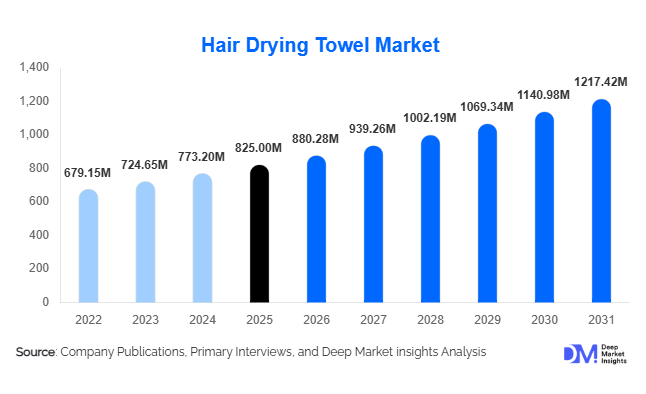
According to Deep Market Insights, the global hair drying towel market size was valued at USD 825 million in 2025 and is projected to grow from USD 880.28 million in 2026 to reach USD 1,217.42 million by 2031, expanding at a CAGR of 6.7% during the forecast period (2026–2031). Market growth is primarily driven by increasing consumer awareness regarding heat-induced hair damage, rising adoption of microfiber-based solutions, and expanding demand for sustainable and eco-friendly personal care textiles. The growing influence of social media beauty trends, combined with rapid e-commerce penetration, has significantly improved product visibility and global accessibility.
Key Market Insights
- Microfiber hair towels dominate the market, accounting for approximately 58% of total revenue in 2025 due to superior absorbency and anti-frizz performance.
- Online retail channels lead distribution, contributing nearly 52% of total global sales, driven by D2C brands and marketplace expansion.
- North America holds the largest regional share, accounting for around 32% of global demand in 2025.
- Asia-Pacific is the fastest-growing region, expanding at over 8% CAGR due to rising urbanization and middle-class spending.
- Household applications account for 68% of total demand, with growing adoption in personal grooming routines.
- Sustainable materials such as bamboo and organic cotton are gaining traction, particularly in Europe and premium product segments.
What are the latest trends in the hair-drying towel market?
Shift Toward Sustainable & Eco-Friendly Materials
Sustainability has become a defining trend within the hair-drying towel market. Consumers increasingly prefer bamboo fiber, organic cotton, and recycled polyester blends that minimize environmental impact. European markets are particularly responsive to eco-certified textiles complying with chemical safety and environmental standards. Manufacturers are investing in low-water dyeing processes, biodegradable packaging, and carbon-neutral production facilities. This shift allows brands to command premium pricing while aligning with environmentally conscious consumer values.
Growth of Influencer-Driven and D2C Sales
Social media platforms have significantly shaped product adoption patterns. Beauty influencers and dermatologists frequently promote microfiber towels as heat-free drying alternatives. Direct-to-consumer brands leverage targeted digital advertising, subscription bundles, and cross-selling with hair serums and conditioners. Online demonstrations highlighting reduced breakage and faster drying times have increased conversion rates. This digital-first strategy is particularly effective among younger demographics aged 18–35.
What are the key drivers in the hair-drying towel market?
Rising Awareness of Heat Damage
Growing education about hair breakage, frizz, and scalp damage caused by excessive blow-drying is encouraging consumers to adopt microfiber drying towels. Dermatologists and professional stylists increasingly recommend low-friction alternatives, strengthening long-term demand.
Expansion of the Global Beauty & Personal Care Industry
The expanding beauty and personal care sector continues to boost complementary product categories. As consumers invest more in shampoos, conditioners, serums, and hair masks, hair-drying towels are becoming a standard accessory within holistic haircare routines.
What are the restraints for the global market?
Availability of Substitutes
Traditional bath towels remain a low-cost alternative, particularly in price-sensitive markets. Consumer inertia and limited differentiation awareness may slow adoption in developing economies.
Raw Material Price Volatility
Fluctuations in polyester and polyamide feedstock prices impact microfiber production costs. Price instability can compress manufacturer margins and increase retail pricing volatility.
What are the key opportunities in the hair-drying towel industry?
Commercial & Institutional Expansion
Professional salons, spas, hotels, and fitness centers present strong growth opportunities. Antimicrobial and durable microfiber variants designed for repeated commercial laundering are gaining traction. The hospitality sector’s expansion is expected to increase bulk procurement demand.
Emerging Market Penetration
Countries such as India, Indonesia, Vietnam, and Brazil are witnessing rapid growth in personal grooming expenditure. Rising smartphone penetration and marketplace accessibility enable global brands to scale through cross-border e-commerce strategies.
Report Scope
| Report Metric | Details |
|---|---|
| Market Size in 2025 | USD 825 Million |
| Market Size in 2026 | USD 880.28 Million |
| Market Size in 2031 | USD 1217.42 Million |
| CAGR | 6.7% (2026-2031) |
| Base Year for Estimation | 2025 |
| Historical Data | 2022-2024 |
| Forecast Period | 2026-2031 |
| Report Coverage | Revenue Forecast, Competitive Landscape, Supply Chain Disruption, Growth Factors, Environment & Regulatory Landscape and Trends |
| Geographies Covered | North America, Europe, APAC, Middle East and Africa, LATAM |
| Countries Covered | U.S., Canada, U.K., Germany, France, Spain, Italy, Russia, Nordic, Benelux, Rest of Europe, China, Korea, Japan, India, Australia, Singapore, Taiwan, South East Asia, Rest of Asia-Pacific, UAE, Turky, Saudi Arabia, South Africa, Egypt, Nigeria, Rest of MEA, Brazil, Mexico, Argentina, Chile, Colombia, Rest of LATAM |
Explore more data points, trends and opportunities Download Free Sample Report
Material Type Insights
Microfiber towels dominate the global hair drying towel market with approximately 58% share in 2025, primarily driven by their superior absorbency rate, lightweight construction, quick-drying capability, and reduced friction benefits that minimize hair breakage and frizz. The leading driver for microfiber dominance is the growing consumer shift toward heat-free haircare routines. Dermatologists and stylists increasingly recommend microfiber over traditional terry towels due to its ability to absorb up to 7–8 times its weight in water while maintaining structural softness. Technological advancements in ultra-fine polyester-polyamide blending and high-density weaving techniques have further enhanced capillary absorption performance, making microfiber the preferred material across both household and professional segments.
Cotton-based towels account for approximately 27% of global revenue, largely concentrated in mid-range and hospitality sectors where durability and cost-effectiveness are key purchase drivers. Premium long-staple cotton variants, including Turkish and Egyptian cotton, are positioned within upscale salon and hotel environments. Meanwhile, bamboo and blended natural fibers represent the fastest-growing sub-segment within premium categories, supported by sustainability-driven consumer demand, particularly in Europe and North America. These materials appeal to environmentally conscious buyers seeking biodegradable and hypoallergenic alternatives.
Product Type Insights
Turban and wrap-style towels account for nearly 46% of global revenue, making them the leading product category. The primary growth driver for this segment is ergonomic convenience. The button-loop fastening system enables hands-free drying, which aligns with multitasking consumer lifestyles. This format is especially popular among long-haired users and working professionals who prioritize functionality and time efficiency. Social media demonstrations showcasing ease of use have further accelerated adoption.
Standard rectangular towels represent roughly 30% of the market, mainly within economy and institutional purchases, where cost sensitivity influences buying behavior. Cap-style and compact travel towels are emerging growth niches, particularly among gym users, swimmers, and frequent travelers. Rising fitness culture and mobility-driven lifestyles are contributing to incremental demand for portable, lightweight formats.
Distribution Channel Insights
Online retail leads with approximately 52% of total global revenue. The primary driver of online channel dominance is rapid e-commerce penetration combined with influencer-led marketing and direct-to-consumer brand strategies. Digital platforms allow detailed product demonstrations, customer reviews, subscription models, and bundle offers, significantly improving conversion rates. North America and the Asia-Pacific are major contributors to online growth due to high smartphone penetration and strong logistics networks.
Offline retail accounts for the remaining 48%, including supermarkets, specialty beauty stores, department stores, and salon supply chains. Europe maintains a strong brick-and-mortar presence, particularly in specialty cosmetic retailers where premium and sustainable product positioning influences purchasing decisions. Commercial bulk procurement also supports offline demand.
End-Use Insights
Household consumption dominates with a 68% market share in 2025, driven by daily personal grooming routines and increasing consumer awareness of hair damage prevention. The leading growth driver for this segment is the integration of microfiber towels into complete haircare regimens that include sulfate-free shampoos and leave-in conditioners.
Commercial applications account for approximately 32% of total demand and are expanding at a nearly 8% CAGR. Growth is primarily fueled by the expanding global salon, spa, and hospitality industries. Hotels and wellness resorts are upgrading guest amenities to include premium microfiber hair towels, while salons prefer reusable, antimicrobial variants capable of withstanding high-frequency laundering cycles.
Explore more data points, trends and opportunities Download Free Sample Report
Hair Drying Towel Market Segmentations
By Material Type
- Microfiber
- 100% Polyester Microfiber
- Cotton
- Bamboo Fiber
- Blended Natural Fibers
By Product Type
- Turban/Wrap Towels
- Standard Rectangular Towels
- Cap-Style Hair Drying Towels
- Luxury Spa-Grade Towels
- Travel/Compact Hair Towels
By Distribution Channel
- Online Retail
- Supermarkets & Hypermarkets
- Specialty Beauty Stores
- Department Stores
- Salon & Professional Supply Stores
By End-Use
- Household/Personal Use
- Salons & Spas
- Hotels & Resorts
- Fitness Centers & Swimming Clubs
Regional Insights
North America
North America holds approximately 32% of the global market share in 2025, with the United States alone accounting for nearly 26%. The primary regional growth drivers include high per capita expenditure on beauty and personal care products, widespread awareness of heat-damage prevention, and strong penetration of direct-to-consumer brands. Influencer marketing and subscription-based haircare accessory models are highly prevalent in the U.S. Canada contributes steadily, particularly in eco-friendly and organic textile categories, driven by consumer sustainability preferences and regulatory standards on textile safety.
Europe
Europe represents around 27% of global demand, led by Germany, the United Kingdom, France, and Italy. Regional growth is driven by rising demand for sustainable and ethically sourced textiles, compliance with stringent chemical safety regulations, and high adoption of premium grooming products. Germany leads in imports due to its strong retail infrastructure and eco-conscious consumer base. The UK shows strong online channel expansion, while France and Italy benefit from robust salon and luxury hospitality sectors that support commercial purchases.
Asia-Pacific
Asia-Pacific is the fastest-growing region, expanding at over 8% CAGR. China dominates both production and domestic consumption due to its advanced textile manufacturing ecosystem and growing middle-class beauty expenditure. India is the fastest-growing country in the region, supported by rapid urbanization, expanding e-commerce platforms, and increasing awareness of haircare solutions among younger consumers. Japan and South Korea represent innovation-driven markets where premium microfiber and advanced textile technologies are widely adopted. Rising disposable income and expanding digital retail channels are key regional growth drivers.
Latin America
Brazil leads regional demand, supported by a strong cultural emphasis on haircare and one of the highest salon densities globally. Growth drivers include increasing female workforce participation and expanding mid-range beauty product consumption. Mexico follows with steady expansion driven by retail modernization and rising adoption of online beauty platforms.
Middle East & Africa
The UAE and Saudi Arabia drive premium demand within hospitality and luxury retail segments, supported by high disposable incomes and growing tourism infrastructure. Government-led diversification initiatives promoting tourism and retail expansion further stimulate commercial purchases. South Africa leads Sub-Saharan demand due to established salon networks and increasing urban retail penetration. Rising wellness tourism and hotel expansion across the Gulf region are expected to continue driving growth in commercial applications.
Key Players in the Hair Drying Towel Market
- Aquis Hair
- Turbie Twist
- The Hair Repair
- DevaCurl
- Kitsch LLC
- Dock & Bay
- YoulerTex
- Evolve Beauty
- Yves Rocher
- L'Oréal
- Shiseido Company
- Miniso
- Decathlon
- Taotronics Textile
- TowelSelections