Graphic Tees Market Size
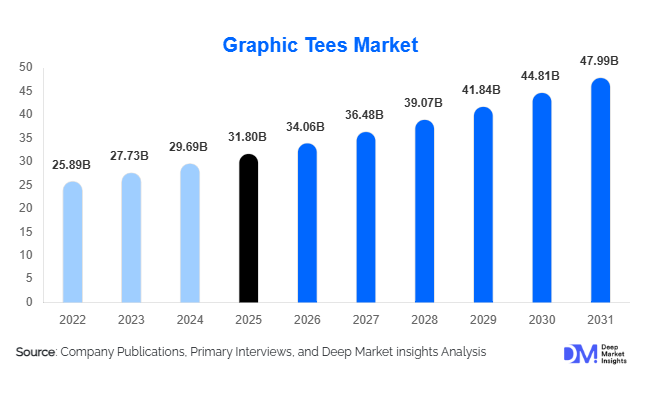
According to Deep Market Insights, the global Graphic Tees Market size was valued at USD 31.8 billion in 2025 and is projected to grow from USD 34.06 billion in 2026 to reach USD 47.99 billion by 2031, expanding at a CAGR of 7.1% during the forecast period (2026–2031). The market growth is primarily driven by the rising influence of streetwear culture, increasing demand for personalized and expressive fashion, expansion of entertainment merchandising, and rapid growth of e-commerce and print-on-demand apparel platforms globally.
Key Market Insights
- Streetwear and casual fashion dominance is driving global adoption of graphic tees as everyday wardrobe essentials across all age groups.
- Entertainment and fandom-based merchandise, including anime, gaming, music, and sports collaborations, is significantly expanding demand.
- Asia-Pacific leads global manufacturing and consumption, supported by strong textile ecosystems in China, India, and Southeast Asia.
- North America dominates premium and licensed apparel demand, especially in sports and influencer-driven fashion segments.
- Online retail and social commerce platforms are reshaping purchasing behavior through fast product discovery and influencer marketing.
- Sustainability-focused apparel demand is increasing, especially in Europe and North America, driving organic cotton and eco-print adoption.
What are the latest trends in the Graphic Tees Market?
Rise of Streetwear and Oversized Fashion Culture
The global graphic tees market is being strongly influenced by the expansion of streetwear and oversized fashion trends. Consumers, particularly Gen Z, are increasingly adopting loose-fit, vintage-inspired, and expressive graphic apparel as a core fashion identity. Collaborations between luxury brands and streetwear labels are further elevating graphic tees into premium fashion segments. Limited-edition drops, resale culture, and influencer-led fashion cycles are intensifying demand and shortening product lifecycles, making agility a key competitive factor for brands.
Expansion of Print-on-Demand and Digital Customization
Print-on-demand (POD) business models and AI-driven design tools are transforming the production landscape of graphic tees. Brands and independent creators can now launch customized designs without maintaining large inventories, reducing financial risk and increasing market accessibility. This trend is enabling micro-brands and digital creators to monetize niche communities such as gaming, anime, fitness, and meme culture. Real-time trend tracking and automated design generation are further accelerating product innovation cycles and enhancing personalization capabilities.
What are the key drivers in the Graphic Tees Market?
Growing Influence of Entertainment and Pop Culture
The increasing dominance of pop culture, gaming, anime, sports leagues, and music fandoms is a major growth driver for the graphic tees market. Licensed merchandise and collaborative collections are generating high consumer engagement, especially among younger demographics. Streaming platforms and esports ecosystems are significantly expanding demand for themed apparel, turning graphic tees into identity-based fashion products rather than simple clothing items.
Expansion of E-Commerce and Social Commerce Ecosystems
The rapid growth of online retail platforms, influencer marketing, and social commerce is significantly boosting graphic tee sales globally. Consumers increasingly rely on Instagram Shops, TikTok Shops, and e-commerce marketplaces for fashion discovery and purchasing. Direct-to-consumer brands benefit from lower distribution costs and global reach, while algorithm-driven recommendations improve conversion rates. This digital shift has lowered entry barriers for new brands and intensified global competition.
What are the restraints for the global market?
Intense Market Fragmentation and Price Competition
The graphic tees market is highly fragmented, with thousands of small and medium brands competing globally. Low entry barriers and widespread online marketplaces have resulted in price wars and reduced brand loyalty. Frequent trend changes force companies to continuously launch new designs, increasing operational pressure and limiting long-term product stability. Many small players struggle with profitability due to aggressive discounting strategies.
Raw Material Price Volatility and Supply Chain Risks
Fluctuations in cotton prices, logistics costs, and textile supply chain disruptions present significant challenges for manufacturers. Rising energy costs and geopolitical uncertainties in textile-producing regions further impact production economics. Smaller manufacturers with limited sourcing diversification are particularly vulnerable to cost fluctuations, which can compress margins and affect pricing stability in the market.
What are the key opportunities in the Graphic Tees Industry?
Sustainable and Ethical Fashion Expansion
Rising environmental awareness is creating strong opportunities for sustainable graphic tees made from organic cotton, recycled fabrics, and eco-friendly dyes. Consumers are increasingly willing to pay premium prices for ethically sourced apparel. Brands that invest in transparent supply chains, carbon reduction initiatives, and circular fashion models are gaining a strong competitive advantage, particularly in Europe and North America.
Entertainment Licensing and Creator Economy Growth
The expansion of creator-driven economies and entertainment licensing is opening significant revenue opportunities. Collaborations between apparel brands and influencers, musicians, esports teams, and streaming platforms are driving high-margin product launches. Limited-edition merchandise drops and fan-driven apparel ecosystems are becoming a major monetization channel, particularly in digital-first retail environments.
Report Scope
| Report Metric | Details |
|---|---|
| Market Size in 2025 | USD 31.8 Billion |
| Market Size in 2026 | USD 34.06 Billion |
| Market Size in 2031 | USD 47.99 Billion |
| CAGR | 7.1% (2026-2031) |
| Base Year for Estimation | 2025 |
| Historical Data | 2022-2024 |
| Forecast Period | 2026-2031 |
| Report Coverage | Revenue Forecast, Competitive Landscape, Supply Chain Disruption, Growth Factors, Environment & Regulatory Landscape and Trends |
| Geographies Covered | North America, Europe, APAC, Middle East and Africa, LATAM |
| Countries Covered | U.S., Canada, U.K., Germany, France, Spain, Italy, Russia, Nordic, Benelux, Rest of Europe, China, Korea, Japan, India, Australia, Singapore, Taiwan, South East Asia, Rest of Asia-Pacific, UAE, Turky, Saudi Arabia, South Africa, Egypt, Nigeria, Rest of MEA, Brazil, Mexico, Argentina, Chile, Colombia, Rest of LATAM |
Explore more data points, trends and opportunities Download Free Sample Report
Product Type Insights
Printed graphic tees continue to dominate the global graphic tees market, accounting for the largest share of total industry revenue due to their affordability, scalability, and strong alignment with rapidly evolving fashion trends. The segment benefits from high consumer demand for visually expressive apparel influenced by pop culture, gaming, anime, music, and social media-driven aesthetics. Printed graphic tees are widely adopted across both mass-market and premium fashion categories because they enable brands to quickly respond to changing consumer preferences through frequent design refresh cycles and limited-edition collections. The increasing popularity of licensed entertainment merchandise and creator-led collaborations is further accelerating growth within this segment. Cotton-based graphic tees remain the leading fabric category globally owing to their comfort, breathability, softness, and durability. Consumers increasingly prefer ring-spun and combed cotton fabrics for enhanced wearability, while organic cotton demand is rapidly increasing in Europe and North America due to rising sustainability awareness. The growth of eco-conscious fashion is encouraging manufacturers to integrate recycled cotton blends, low-impact dyes, and sustainable sourcing certifications into their product offerings. Cotton-polyester blends are also gaining traction in sports-inspired and athleisure-oriented graphic tees because of their improved moisture management and durability.
Oversized graphic tees represent the fastest-growing fit category, supported by the continued global influence of streetwear culture, Korean fashion trends, and gender-neutral apparel movements. Younger consumers, particularly Gen Z, increasingly favor relaxed silhouettes that combine comfort with fashion versatility. Social media influencers and celebrity endorsements are significantly accelerating the adoption of oversized fits across both luxury and fast-fashion segments. In contrast, slim-fit and regular-fit graphic tees continue to maintain strong demand within mainstream casualwear categories. From a production perspective, screen printing remains the dominant printing technology due to its cost efficiency, vibrant color output, and suitability for large-scale production runs. However, direct-to-garment (DTG) printing is witnessing substantial growth because of rising demand for customized apparel, short-run production, and print-on-demand business models. DTG technology allows brands to produce highly detailed graphics with faster turnaround times and lower inventory risk, making it increasingly attractive for independent creators, small apparel brands, and digital-first fashion companies.
Application Insights
Casual wear continues to be the largest application segment within the global graphic tees market, accounting for a significant share of overall demand as consumers increasingly prioritize comfort-driven everyday fashion. Graphic tees have evolved into wardrobe staples across all age groups due to their affordability, styling flexibility, and ability to reflect personal identity and cultural interests. The growing acceptance of casual dressing in workplaces, educational institutions, and social settings has further strengthened long-term demand for graphic apparel globally. Entertainment and fandom merchandise is currently the fastest-growing application segment, driven by expanding consumer engagement with gaming franchises, anime series, sports leagues, streaming platforms, music artists, and influencer communities. Graphic tees linked to entertainment properties are increasingly viewed as collectible lifestyle products rather than conventional apparel items. Limited-edition merchandise drops, celebrity collaborations, esports partnerships, and anime-inspired fashion trends are significantly boosting market growth within this category. The increasing integration of entertainment commerce into social media ecosystems is also accelerating global merchandise sales.
Corporate branding and promotional merchandise continue to represent an important commercial application area for graphic tees. Businesses, startups, educational institutions, event organizers, and non-profit organizations increasingly use customized graphic apparel for brand visibility, employee engagement, product launches, and promotional campaigns. The rise of entrepreneurship and creator economies has further expanded demand for custom-branded apparel solutions. Additionally, niche applications such as eco-volunteering, cause-driven fashion, experiential tourism merchandise, and sustainability-focused apparel are gaining visibility among environmentally conscious consumers. Social messaging, activism-oriented graphics, and community-focused designs are becoming increasingly popular, especially among younger demographics seeking purpose-driven fashion consumption.
Distribution Channel Insights
Online retail channels dominate the global graphic tees market and continue to gain market share due to convenience, broad product availability, competitive pricing, and rapid trend discovery. Consumers increasingly rely on e-commerce marketplaces, brand-owned websites, and mobile shopping applications to access a wider range of graphic designs and personalized apparel options. The rise of digital-first fashion brands and direct-to-consumer (DTC) business models has significantly transformed global apparel retail dynamics. Social commerce platforms are emerging as one of the fastest-growing distribution channels, particularly among Gen Z and millennial consumers. Platforms such as Instagram Shops, TikTok Shop, Pinterest, and creator-led storefronts are enabling highly targeted product discovery through influencer marketing, short-form video content, and live-stream shopping experiences. Viral fashion trends and algorithm-driven recommendations are accelerating consumer engagement and impulse purchases within the graphic tees category.
Brand-owned websites and direct-to-consumer platforms are also witnessing strong expansion as apparel companies increasingly prioritize customer data ownership, higher profit margins, and personalized shopping experiences. Features such as AI-driven product recommendations, customization tools, virtual try-ons, and limited-edition drops are enhancing consumer engagement and strengthening brand loyalty. Print-on-demand integration further allows brands to launch niche collections without maintaining high inventory levels. Despite rapid digitalization, offline retail remains an important distribution channel, particularly for premium streetwear, luxury collaborations, and experiential shopping formats. Branded flagship stores, department stores, and fashion boutiques continue to attract consumers seeking product quality assessment, exclusive collections, and immersive retail experiences. Pop-up stores and limited-release retail events are also becoming increasingly common within premium and hype-driven streetwear categories.
Explore more data points, trends and opportunities Download Free Sample Report
Graphic Tees Market Segmentations
By Product Type
- Printed Graphic Tees
- Embroidered Graphic Tees
- Vintage & Retro Graphic Tees
- Anime & Gaming Graphic Tees
- Sports & Entertainment Graphic Tees
- Streetwear Graphic Tees
- Sustainable & Organic Graphic Tees
By Fabric Type
- Cotton Graphic Tees
- Polyester Graphic Tees
- Cotton-Polyester Blend Graphic Tees
- Organic & Recycled Fabric Graphic Tees
- Performance Fabric Graphic Tees
By Printing Technology
- Screen Printing
- Direct-to-Garment (DTG) Printing
- Heat Transfer Printing
- Sublimation Printing
- Digital Printing
By Application
- Casual Wear
- Sports & Athleisure
- Entertainment & Fan Merchandise
- Corporate Branding & Promotional Merchandise
- Event Merchandise
- Fashion & Luxury Collaborations
By Distribution Channel
- Online Retail
- Brand-Owned Websites
- E-commerce Marketplaces
- Specialty Fashion Stores
- Department Stores
- Streetwear Boutiques
- Social Commerce Platforms
Regional Insights
North America
North America remains one of the most influential and high-value regions within the global graphic tees market, accounting for a substantial share of premium apparel consumption. The region’s market growth is primarily driven by strong demand for licensed sports merchandise, entertainment-inspired apparel, and premium streetwear fashion. The United States dominates regional consumption due to high disposable incomes, mature fashion retail infrastructure, and the significant influence of Hollywood, music culture, gaming, and professional sports leagues on consumer purchasing behavior.
The rapid expansion of influencer-led fashion trends, celebrity collaborations, and creator-driven merchandise ecosystems is significantly accelerating graphic tee sales across online channels. Additionally, the growing popularity of nostalgia-based fashion, vintage graphics, and oversized silhouettes is strengthening demand among Gen Z and millennial consumers. North America is also witnessing increasing demand for sustainable graphic apparel, with consumers showing greater preference for organic cotton, ethical sourcing, and eco-friendly printing technologies.
Europe
Europe represents a major market for sustainable and fashion-forward graphic apparel, with strong demand concentrated in Germany, the United Kingdom, France, Italy, and Spain. Regional growth is being driven by increasing consumer preference for ethically sourced products, premium-quality fabrics, and environmentally responsible fashion brands. European consumers are highly responsive to sustainability certifications, circular fashion initiatives, and transparent supply chain practices, making eco-friendly graphic tees a rapidly expanding category.
The region is also benefiting from the growing popularity of minimalist graphics, retro-inspired fashion, and artistic streetwear aesthetics. Established fashion retail infrastructure and strong penetration of both luxury and fast-fashion brands continue to support market expansion. Additionally, increasing digital fashion adoption and strong e-commerce penetration across Western Europe are enabling smaller apparel brands and independent designers to scale rapidly within the region.
Asia-Pacific
Asia-Pacific dominates the global graphic tees market in both manufacturing and consumption, supported by large-scale textile production ecosystems, expanding urban populations, and rapidly rising fashion awareness. China remains the largest regional market and manufacturing hub due to its vertically integrated textile supply chain, advanced printing infrastructure, and strong domestic demand for streetwear and entertainment-inspired fashion.
India is emerging as one of the fastest-growing graphic tees markets globally due to increasing disposable income, rapid urbanization, growing internet penetration, and strong youth demographics. The expansion of social commerce platforms and affordable fast-fashion retail is accelerating demand among younger consumers. Japan and South Korea continue to influence global streetwear trends through anime culture, K-fashion, gaming communities, and premium urban fashion labels. Additionally, Southeast Asian countries such as Vietnam, Indonesia, and Thailand are strengthening their positions as important apparel manufacturing and export hubs due to lower labor costs and increasing investments in textile production infrastructure. Rising smartphone usage and social media engagement across the region are also significantly influencing graphic apparel purchasing behavior.
Latin America
Latin America is witnessing steady growth in graphic tee demand, particularly in Brazil, Mexico, Argentina, and Chile. The region’s market expansion is primarily driven by a growing youth population, increasing urbanization, and rising digital retail adoption. Social media-driven fashion trends and the influence of Western pop culture are significantly boosting consumer interest in graphic apparel across urban markets.
Brazil remains the largest regional market due to its large consumer base and strong fashion retail sector, while Mexico benefits from expanding apparel manufacturing capabilities and increasing e-commerce penetration. Consumers within the region increasingly prefer affordable casualwear and entertainment-inspired designs, particularly sports-themed and music-related graphics. Growing smartphone penetration and the rapid adoption of online marketplaces are further supporting regional market growth.
Middle East & Africa
The Middle East & Africa region is emerging as a high-growth market for graphic tees, supported by rising disposable incomes, westernization of fashion preferences, and expanding retail infrastructure. GCC countries, including the UAE and Saudi Arabia, are witnessing strong demand for premium streetwear, luxury collaborations, and international fashion brands due to high consumer spending capacity and strong youth-driven fashion culture. Increasing tourism activity, rapid mall expansion, and the growing influence of global fashion trends through digital media are accelerating graphic apparel adoption across the Middle East. In Africa, countries such as South Africa, Egypt, and Nigeria are experiencing rising demand for affordable casualwear due to increasing urbanization and expanding middle-class populations.
The region also benefits from strengthening textile and garment manufacturing investments, particularly in North African production hubs and export-oriented economies. The expansion of online retail platforms and mobile commerce is improving product accessibility across emerging African markets, creating long-term growth opportunities for both regional and international apparel brands.