Golf Clubs & Equipment Market Size
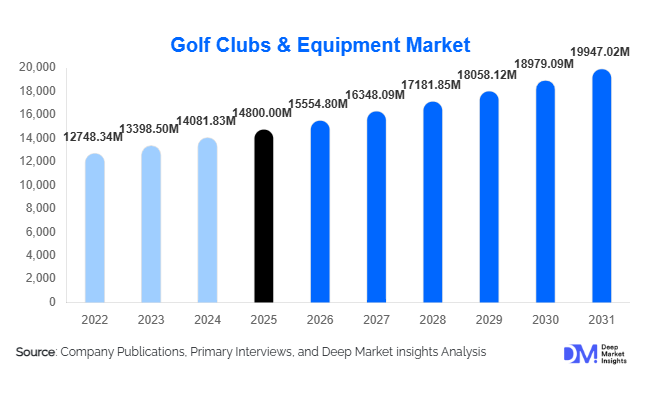
According to Deep Market Insights, the global golf clubs & equipment market size was valued at USD 14,800 million in 2025 and is projected to grow from USD 15,554.80 million in 2026 to reach USD 19,947.02 million by 2031, expanding at a CAGR of 5.1% during the forecast period (2026–2031). The market growth is primarily driven by increasing global participation in golf, rising disposable incomes, technological innovations in golf equipment, and the expansion of golf tourism and recreational facilities across both mature and emerging economies.
Key Market Insights
- Golf participation is becoming more inclusive, attracting a broader range of amateur and recreational players worldwide, expanding the base for equipment demand.
- Technological innovation in golf clubs and devices, including AI-enabled swing analysis, smart GPS devices, and composite material clubs, is enhancing performance and user engagement.
- North America dominates the market, led by the U.S., with an established golf culture, high spending capacity, and a strong presence of professional and amateur golfers.
- Asia-Pacific is the fastest-growing region, driven by rising disposable incomes, golf infrastructure investments in China, India, and Japan, and growing awareness of golf as a lifestyle sport.
- Europe remains a significant market, with the UK, Germany, and France leading demand, particularly in premium and mid-range segments.
- Online and e-commerce channels are reshaping distribution, providing customization, convenience, and direct-to-consumer engagement, increasingly influencing purchase decisions.
What are the latest trends in the golf clubs & equipment market?
Technologically Enhanced Equipment
Golf equipment is increasingly integrating advanced technologies, such as lightweight carbon fiber composites, smart sensors in clubs, and mobile-connected swing analysis tools. These innovations are enhancing performance, attracting tech-savvy amateur golfers, and enabling professional players to fine-tune their game. Custom-fitted clubs and AI-assisted training solutions are expanding, offering a high degree of personalization and engagement for players at all skill levels. Manufacturers are leveraging these trends to differentiate products, justify premium pricing, and drive frequent upgrades.
Sustainable and Eco-Friendly Equipment
With rising environmental awareness, golf equipment manufacturers are adopting eco-friendly materials, such as recyclable golf balls, biodegradable tees, and sustainably sourced composites. Refurbished and resale markets are also gaining traction, particularly among beginners and recreational players, promoting circular economy practices. Sustainability is increasingly becoming a key differentiator for both premium and mid-range product lines, supported by consumer demand and regulatory encouragement in regions such as Europe and North America.
What are the key drivers in the golf clubs & equipment market?
Rising Global Participation in Golf
Golf is expanding beyond traditional strongholds, with increased participation among women, younger players, and amateurs. Initiatives by golf associations and federations are promoting the sport in schools, universities, and community programs. This has created a growing base of recreational golfers who drive consistent demand for clubs, balls, and accessories. Emerging markets in Asia-Pacific and the Middle East are witnessing rapid adoption, fueled by rising incomes, lifestyle awareness, and investments in golf infrastructure.
Innovation in Club and Ball Design
Technological advancements in club materials, aerodynamics, and swing mechanics are enhancing player performance, encouraging frequent equipment upgrades. Multi-layered golf balls, hybrid clubs, and AI-enabled rangefinders are becoming standard, attracting both professional and recreational players. Premium products in these segments also yield higher margins, incentivizing manufacturers to invest heavily in R&D for performance optimization and customization.
Expansion of Golf Tourism and Resort Infrastructure
Golf tourism, especially in regions like the UAE, Japan, and Europe, is driving demand for premium equipment and apparel. Golf resorts and courses are increasingly offering club memberships and retail facilities, directly influencing equipment consumption. International tournaments and corporate golf events also contribute to premium segment growth, strengthening the overall market.
What are the restraints for the global market?
High Equipment Costs
Premium golf clubs, balls, and accessories carry high price points, limiting adoption among beginners and price-sensitive players. Mid-range segments help bridge this gap, but affordability remains a barrier in emerging economies.
Shifting Recreational Preferences
Urban youth are increasingly exploring alternative sports and digital entertainment, reducing the time and attention dedicated to golf. Mature markets must continually innovate and engage new players to sustain growth amid these changing preferences.
What are the key opportunities in the golf clubs & equipment industry?
Emerging Market Expansion
Regions like Asia-Pacific and the Middle East offer untapped potential. Investments in golf courses, resorts, and training academies are expanding the player base. Localized production, affordable lines, and tailored marketing strategies can help new entrants capture market share in these regions.
Technology Integration and Smart Equipment
Smart clubs, GPS-enabled rangefinders, and AI-assisted swing analysis are creating new product categories. Integrating mobile apps and data analytics into equipment offerings can generate recurring revenue and enhance consumer loyalty. Partnerships with sports tech and wearable device companies also present growth avenues.
Sustainability and Circular Economy Initiatives
Eco-conscious consumers are driving demand for recyclable golf balls, sustainable bags, and carbon-neutral production practices. Refurbishment and resale models are also emerging, creating a secondary market for beginner and recreational golfers. Sustainability aligns with both consumer values and regulatory trends, providing a competitive advantage.
Report Scope
| Report Metric | Details |
|---|---|
| Market Size in 2025 | USD 14800 Million |
| Market Size in 2026 | USD 15554.80 Million |
| Market Size in 2031 | USD 19947.02 Million |
| CAGR | 5.1% (2026-2031) |
| Base Year for Estimation | 2025 |
| Historical Data | 2022-2024 |
| Forecast Period | 2026-2031 |
| Report Coverage | Revenue Forecast, Competitive Landscape, Supply Chain Disruption, Growth Factors, Environment & Regulatory Landscape and Trends |
| Geographies Covered | North America, Europe, APAC, Middle East and Africa, LATAM |
| Countries Covered | U.S., Canada, U.K., Germany, France, Spain, Italy, Russia, Nordic, Benelux, Rest of Europe, China, Korea, Japan, India, Australia, Singapore, Taiwan, South East Asia, Rest of Asia-Pacific, UAE, Turky, Saudi Arabia, South Africa, Egypt, Nigeria, Rest of MEA, Brazil, Mexico, Argentina, Chile, Colombia, Rest of LATAM |
Explore more data points, trends and opportunities Download Free Sample Report
Product Type Insights
Golf clubs continue to dominate the global golf clubs & equipment market, accounting for approximately 45% of the 2025 market share. This leadership is primarily driven by continuous product innovation, shorter replacement cycles, and strong consumer preference for performance-enhancing equipment. Advanced materials such as carbon fiber and multi-material composites are increasingly being used to reduce club weight while improving swing speed, accuracy, and distance. The growing popularity of custom-fitted clubs and AI-assisted design is further accelerating demand in this segment, particularly among serious amateur and professional players. Additionally, frequent product launches by leading manufacturers, combined with aggressive marketing and athlete endorsements, are reinforcing the dominance of golf clubs.
Golf balls, bags, and accessories collectively represent a significant portion of the market, with steady demand driven by replacement purchases and entry-level adoption. Premium golf balls with multi-layer construction are gaining traction due to improved spin control and durability. Meanwhile, the demand for technologically integrated accessories such as GPS rangefinders and smart wearables is increasing rapidly. The rise of mid-range and premium product offerings is supporting higher average selling prices across categories. Notably, online retail accounts for nearly 30% of total distribution, enabling consumers to access a wide product range, compare specifications, and opt for personalized configurations, further boosting product category growth.
Application Insights
Recreational and amateur golfers dominate the application landscape, contributing nearly 60% of global demand. This segment is expanding rapidly due to increased accessibility of golf as a leisure activity, supported by urban golf facilities, driving ranges, and beginner-friendly programs. The shift of golf from an elite sport to a more inclusive recreational activity has significantly broadened the consumer base, particularly in emerging economies. Golf tourism and resort-based applications are becoming major growth drivers, especially in regions such as the Middle East, Southeast Asia, and Southern Europe. Luxury golf resorts and destination courses are investing heavily in premium equipment procurement, driving demand for high-end clubs, balls, and apparel. Furthermore, training academies and professional coaching centers are emerging as key consumers of advanced equipment, particularly those integrated with swing analysis and performance tracking technologies.
New technology-driven applications, including indoor golf simulators, virtual reality training environments, and AI-powered coaching platforms, are further expanding the market scope. These applications are particularly gaining traction in urban centers across North America, Europe, and the Asia-Pacific, where space constraints and digital adoption are high. This diversification of applications is expected to sustain long-term market growth.
Distribution Channel Insights
Traditional distribution channels such as specialty sports stores, pro shops located within golf courses, and departmental retail outlets continue to play a vital role, particularly for high-value purchases where consumers prefer physical evaluation and expert guidance. These channels are especially relevant in mature markets like North America and Europe, where brand loyalty and in-store experience remain important purchasing factors. However, the market is undergoing a significant transformation with the rapid expansion of online and direct-to-consumer (D2C) channels. E-commerce platforms are increasingly dominant due to their ability to offer product variety, competitive pricing, and customization options. Consumers can now personalize club specifications, compare performance metrics, and access user reviews, making online platforms a preferred choice for both beginners and experienced players.
Manufacturers are leveraging digital platforms to bypass intermediaries, improve margins, and strengthen customer relationships through data-driven insights. Subscription models, online fitting tools, and virtual consultations are further enhancing the buying experience. The growing penetration of smartphones and digital payment systems in emerging markets is also accelerating online channel adoption globally.
Explore more data points, trends and opportunities Download Free Sample Report
Golf Clubs & Equipment Market Segmentations
By Product Type
- Golf Clubs
- Golf Balls
- Golf Bags
- Golf Accessories
- Golf Apparel & Footwear
By Application
- Professional Golfers
- Amateur/Recreational Players
- Institutional Buyers
By Distribution Channel
- Online Retail
- Specialty Sports Stores
- Pro Shops
- Department Stores
Regional Insights
North America
North America remains the largest market, accounting for approximately 40% of the global share in 2025, with the United States representing the dominant contributor. The region’s leadership is driven by a deeply entrenched golf culture, a large base of professional and recreational players, and high disposable income levels that support premium equipment purchases. The presence of leading manufacturers, extensive golf course infrastructure, and strong participation in tournaments further reinforces market demand.
Additionally, the rapid adoption of technologically advanced equipment, including smart clubs and swing analysis tools, is a key growth driver. The increasing popularity of indoor golf simulators and year-round playing facilities is also expanding participation, particularly among younger demographics. Canada contributes steadily, supported by recreational golfing trends and growing interest in mid-range equipment. Overall, innovation, high spending capacity, and mature infrastructure continue to drive regional growth.
Europe
Europe accounts for approximately 25% of the global market, with key demand originating from the United Kingdom, Germany, and France. The region’s growth is strongly influenced by its focus on sustainability and high-performance equipment. European consumers are increasingly opting for eco-friendly golf products, including recyclable balls and sustainably manufactured clubs, aligning with broader environmental regulations and preferences.
Golf tourism is a major growth driver, particularly in Spain and Portugal, which are among the world’s leading golf destinations. Seasonal tourism and international tournaments generate consistent demand for equipment, especially in premium and rental segments. Additionally, government support for sports participation and increasing interest among younger players are contributing to steady market expansion. The combination of sustainability trends, tourism-driven demand, and technological adoption is shaping the European market landscape.
Asia-Pacific
Asia-Pacific is the fastest-growing region, exhibiting a CAGR exceeding 7%, and currently accounts for approximately 20% of the global market. Countries such as China, Japan, South Korea, and India are at the forefront of this growth. Japan remains a mature and technologically advanced market with high demand for premium equipment, while South Korea shows strong participation rates and innovation adoption.
China and India are emerging as high-growth markets due to rising middle-class incomes, urbanization, and increasing exposure to international sports. Significant investments in golf infrastructure, including courses, driving ranges, and training academies, are creating new demand avenues. Additionally, the growing popularity of golf among corporate professionals and youth is expanding the consumer base. Digital retail expansion and affordability-focused product lines are further accelerating market penetration in this region.
Middle East & Africa
The Middle East & Africa region is emerging as a high-potential market, driven primarily by luxury golf tourism and infrastructure development. The UAE and Saudi Arabia are leading markets, supported by government initiatives to diversify economies through tourism and sports investments. High-income populations and the presence of world-class golf courses are fueling demand for premium equipment.
South Africa remains a key market within Africa, benefiting from a well-established golfing culture and international tournaments. The region’s growth is further supported by large-scale investments in luxury resorts and golf-centric real estate projects. Additionally, favorable climatic conditions enabling year-round play and increasing international visitor inflows are boosting equipment demand across segments.
Latin America
Latin America represents a smaller share of approximately 5% of the global market, with Brazil, Mexico, and Argentina as the primary contributors. Growth in this region is driven by increasing interest in golf as a recreational and lifestyle activity among affluent consumers. Expanding tourism and the development of golf resorts are gradually enhancing market visibility.
While the market is still developing, rising disposable incomes, urbanization, and growing exposure to international sports are expected to drive future demand. Import reliance for high-quality equipment remains high, but increasing availability through online channels is improving accessibility. The region presents long-term growth potential, particularly as golf infrastructure continues to expand and participation rates increase.
Key Players in the Golf Clubs & Equipment Market
- Callaway Golf Company
- TaylorMade Golf Company
- Acushnet Holdings (Titleist, FootJoy)
- PING Inc.
- Cobra Golf
- Mizuno Corporation
- Bridgestone Golf
- Srixon (Sumitomo Rubber Industries)
- Wilson Sporting Goods
- PXG (Parsons Xtreme Golf)
- Honma Golf
- Cleveland Golf
- XXIO
- Yonex Co., Ltd.
- Decathlon