Glue Stick Market Size
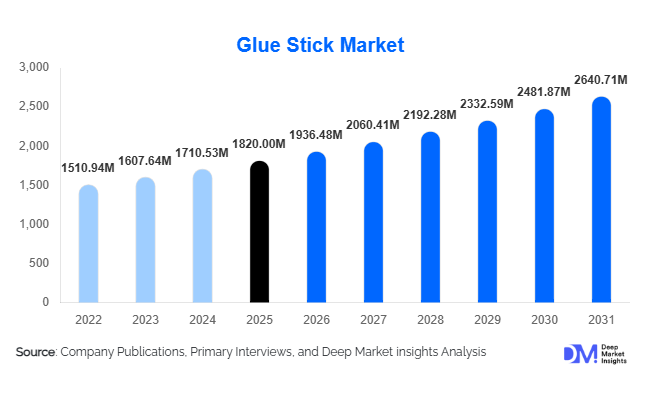
According to Deep Market Insights, the global glue stick market size was valued at USD 1,820 million in 2025 and is projected to grow from USD 1,936.48 million in 2026 to reach USD 2,640.71 million by 2031, expanding at a CAGR of 6.4% during the forecast period (2026–2031). The glue stick market growth is primarily driven by increasing demand from educational institutions, rising adoption in arts and crafts activities, and the growing preference for non-toxic, easy-to-use adhesive solutions across households and offices.
Key Market Insights
- Educational institutions remain the largest demand segment, accounting for a significant share of global glue stick consumption due to bulk procurement and consistent usage.
- Eco-friendly and non-toxic formulations are gaining traction, particularly in developed markets with strict regulatory frameworks.
- Asia-Pacific dominates the global market, driven by large student populations and expanding education infrastructure.
- DIY and craft applications are the fastest-growing segment, supported by social media trends and increasing consumer engagement in creative activities.
- Offline retail continues to lead distribution, although e-commerce is rapidly gaining share due to convenience and pricing advantages.
- Mid-range products dominate pricing segments, balancing affordability and quality for both institutional and individual buyers.
What are the latest trends in the glue stick market?
Shift Toward Sustainable Adhesive Solutions
The glue stick market is witnessing a strong transition toward environmentally friendly products. Manufacturers are increasingly developing biodegradable and plant-based adhesives using starch and natural polymers. This trend is particularly prominent in Europe and North America, where regulations and consumer awareness are driving demand for safer, eco-conscious alternatives. Packaging innovation, including recyclable containers and reduced plastic usage, is also gaining importance. Companies are positioning sustainability as a key differentiator, enhancing brand value and enabling premium pricing opportunities.
Rising Popularity of Craft and DIY Applications
The growth of DIY culture, fueled by digital platforms and creative communities, is significantly influencing glue stick demand. Colored and glitter glue sticks are gaining popularity among hobbyists, students, and artists. Social media platforms have amplified interest in creative projects, driving demand for specialty adhesive products. This segment offers higher margins and allows manufacturers to diversify their product portfolios beyond traditional applications.
What are the key drivers in the glue stick market?
Expansion of Global Education Sector
The increasing number of educational institutions and rising student enrollment globally are major drivers of glue stick demand. Governments in emerging economies are investing heavily in education infrastructure, leading to consistent bulk procurement of stationery products. Glue sticks are essential classroom supplies, ensuring stable and recurring demand across regions.
Growing Preference for Convenience and Safety
Glue sticks offer a clean, mess-free alternative to liquid adhesives, making them highly suitable for children and office use. Non-toxic formulations further enhance their appeal, particularly among parents and educational institutions. The ease of use and portability of glue sticks continue to drive their widespread adoption across multiple end-user segments.
What are the restraints for the global market?
Limited Application Scope
Glue sticks are primarily designed for lightweight bonding applications such as paper and cardboard. Their inability to provide strong adhesion for heavy-duty materials restricts their use in industrial applications, limiting overall market expansion compared to other adhesive types.
High Price Competition and Market Fragmentation
The glue stick market is highly competitive, with numerous global and regional players offering similar products. This leads to price pressures, particularly in the economy segment, resulting in thin profit margins. Commoditization of standard glue sticks further intensifies competition among manufacturers.
What are the key opportunities in the glue stick industry?
Growth in Emerging Education Markets
Developing regions such as Asia-Pacific, Africa, and Latin America present significant growth opportunities due to expanding education systems and rising literacy rates. Government initiatives aimed at improving access to education are driving demand for basic stationery products, including glue sticks. Bulk procurement by schools and institutions offers stable revenue streams for manufacturers.
Product Innovation in Specialty Segments
The increasing popularity of arts and crafts activities is creating demand for innovative products such as colored, glitter, and high-strength glue sticks. These specialty products cater to niche segments and offer higher profit margins. Manufacturers can leverage branding and packaging innovations to target creative consumers and differentiate their offerings in a competitive market.
Report Scope
| Report Metric | Details |
|---|---|
| Market Size in 2025 | USD 1820 Million |
| Market Size in 2026 | USD 1936.48 Million |
| Market Size in 2031 | USD 2640.71 Million |
| CAGR | 6.4% (2026-2031) |
| Base Year for Estimation | 2025 |
| Historical Data | 2022-2024 |
| Forecast Period | 2026-2031 |
| Report Coverage | Revenue Forecast, Competitive Landscape, Supply Chain Disruption, Growth Factors, Environment & Regulatory Landscape and Trends |
| Geographies Covered | North America, Europe, APAC, Middle East and Africa, LATAM |
| Countries Covered | U.S., Canada, U.K., Germany, France, Spain, Italy, Russia, Nordic, Benelux, Rest of Europe, China, Korea, Japan, India, Australia, Singapore, Taiwan, South East Asia, Rest of Asia-Pacific, UAE, Turky, Saudi Arabia, South Africa, Egypt, Nigeria, Rest of MEA, Brazil, Mexico, Argentina, Chile, Colombia, Rest of LATAM |
Explore more data points, trends and opportunities Download Free Sample Report
Product Type Insights
Standard PVP-based glue sticks continue to dominate the global market, accounting for approximately 48% of the total market share in 2025. This leadership position is primarily driven by its cost-effectiveness, reliable bonding performance, and widespread acceptance across educational institutions and office environments. The segment benefits from strong demand in bulk procurement cycles, particularly from schools and corporate offices, where consistency and affordability are critical purchasing factors. Additionally, well-established manufacturing processes and supply chains for PVP-based adhesives ensure stable pricing and large-scale availability, further reinforcing their dominance.
Specialty glue sticks, including colored and glitter variants, are witnessing accelerated growth, supported by the rising popularity of arts, crafts, and DIY activities. These products cater to higher-margin niche segments, particularly among students, hobbyists, and creative professionals. Meanwhile, natural and organic glue sticks are emerging as a promising segment, driven by increasing environmental awareness and stringent regulatory standards in developed markets. Although currently niche, this segment is expected to expand steadily as sustainability becomes a key purchasing criterion.
Application Insights
Educational applications represent the largest segment, contributing nearly 38% of total demand in 2025. This dominance is driven by continuous consumption in schools, colleges, and training institutions, where glue sticks are essential stationery items. Government investments in education infrastructure, particularly in emerging economies, and increasing student enrollment globally are key growth drivers for this segment. Bulk purchasing contracts and recurring demand cycles make education the most stable and predictable application area.
Office and documentation use remains a steady contributor, supported by administrative requirements across corporate environments. However, digitalization is gradually moderating growth in this segment. In contrast, craft and DIY applications are the fastest-growing segment, fueled by social media influence, online tutorials, and the rising trend of home-based creative activities. Packaging applications, though relatively small, are expanding in lightweight bonding scenarios, particularly in e-commerce packaging and temporary sealing, creating incremental growth opportunities.
Distribution Channel Insights
Offline retail channels dominate the glue stick market, accounting for approximately 62% of total sales in 2025. This dominance is driven by the strong presence of stationery stores, supermarkets, and hypermarkets, which remain the preferred purchasing points for both individual consumers and small businesses. The ability to physically evaluate products, combined with immediate availability, continues to support offline sales, particularly in developing regions.
However, e-commerce platforms are rapidly gaining traction and represent the fastest-growing distribution channel. The growth is driven by increasing internet penetration, competitive pricing, convenience, and the availability of bulk purchasing options for institutions. Institutional procurement channels also play a significant role, especially in supplying educational institutions and corporate offices through long-term contracts and bulk supply agreements, ensuring consistent demand flow.
End-User Insights
Educational institutions remain the largest end-user segment, holding around 35% of the global market share in 2025. The segment’s leadership is driven by high-volume consumption, regular procurement cycles, and the essential nature of glue sticks in classroom activities. Government-funded education programs and increasing global literacy rates further strengthen demand in this segment.
Household consumers and DIY users are emerging as key growth drivers, supported by rising interest in crafts, home projects, and creative hobbies. This segment is particularly influential in driving demand for specialty and premium glue sticks. Corporate offices continue to generate stable demand, primarily for documentation and administrative purposes. Meanwhile, light industrial and packaging users represent a smaller but growing segment, with increasing adoption in temporary bonding and lightweight packaging applications.
Explore more data points, trends and opportunities Download Free Sample Report
Glue Stick Market Segmentations
By Product Type
- Standard PVP-Based Glue Sticks
- Natural/Organic Glue Sticks
- Colored Glue Sticks
- Glitter Glue Sticks
- High-Strength Industrial Glue Sticks
By Application
- Educational Use
- Office & Documentation
- Craft & DIY Activities
- Packaging
- Paper & Cardboard Bonding
By Distribution Channel
- Offline Retail
- E-commerce Platforms
- Institutional/Bulk Procurement
Regional Insights
Asia-Pacific
Asia-Pacific dominates the glue stick market with approximately 42% share in 2025, making it the largest regional market globally. The region’s growth is primarily driven by large and expanding student populations in countries such as China and India, along with significant government investments in education infrastructure. Rapid urbanization, rising disposable incomes, and increasing awareness of educational materials further contribute to demand. Additionally, the presence of low-cost manufacturing hubs and strong export capabilities in China enhances regional supply dynamics. India is the fastest-growing market in the region, supported by initiatives to improve literacy rates and expand access to education, along with increasing penetration of organized retail and e-commerce platforms.
North America
North America accounts for around 22% of the global market share, with the United States leading regional demand. Growth in this region is driven by high per capita spending on educational and office supplies, along with a well-established education system. The strong DIY and craft culture, supported by social media and hobbyist communities, is a major driver for specialty glue sticks. Additionally, the region shows high adoption of premium and eco-friendly products, driven by consumer awareness and regulatory standards emphasizing safety and sustainability. Advanced retail infrastructure and widespread e-commerce adoption further support market expansion.
Europe
Europe holds approximately 20% market share, with key markets including Germany, France, and the United Kingdom. The region’s growth is largely driven by stringent environmental regulations and strong consumer preference for sustainable products, which are accelerating the adoption of biodegradable and non-toxic glue sticks. Well-established education systems and steady demand from office environments also contribute to market stability. Additionally, innovation in eco-friendly formulations and packaging is a key growth driver, with manufacturers focusing on reducing environmental impact to comply with regulatory requirements and meet consumer expectations.
Latin America
Latin America represents about 8% of the global market, with Brazil and Mexico serving as major demand centers. Growth in this region is driven by improving education infrastructure, increasing school enrollment rates, and rising middle-class income levels. Expanding retail networks and greater availability of affordable stationery products are also supporting market penetration. Additionally, growing awareness of arts and crafts activities among younger populations is contributing to increased demand for glue sticks, particularly in urban areas.
Middle East & Africa
The Middle East & Africa region accounts for roughly 8% market share and is among the fastest-growing regions globally. Growth is primarily driven by expanding education systems, increasing government spending on literacy programs, and rapid urbanization in countries such as South Africa, the UAE, and Nigeria. The region is also benefiting from improved retail infrastructure and rising consumer awareness of educational products. In the Middle East, high disposable incomes and strong demand for premium products are supporting market growth, while in Africa, increasing access to education and international aid programs are driving demand for basic stationery supplies, including glue sticks.
Key Players in the Glue Stick Market
- Henkel AG & Co. KGaA
- Newell Brands Inc.
- Société BIC S.A.
- 3M Company
- UHU GmbH & Co. KG
- Faber-Castell AG
- Kokuyo Co., Ltd.
- Pilot Corporation
- Tombow Pencil Co., Ltd.
- Maped Group
- Pelikan Holding AG
- ITC Limited
- Deli Group Co., Ltd.
- Staples Inc.
- Office Depot Inc.