Gift Boxes Market Size
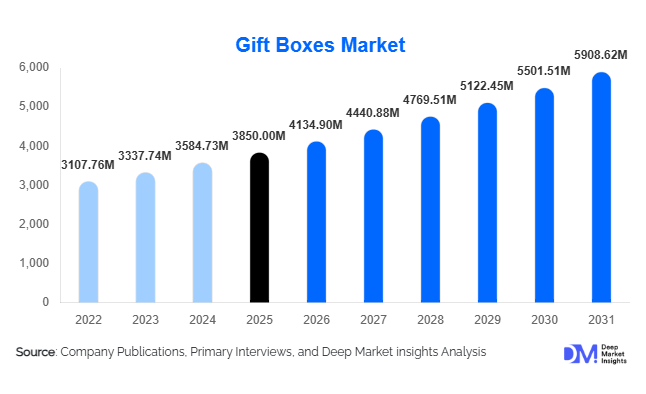
According to Deep Market Insights, the global gift boxes market size was valued at USD 3,850 million in 2025 and is projected to grow from USD 4,134.90 million in 2026 to reach USD 5,908.62 million by 2031, expanding at a CAGR of 7.4% during the forecast period (2026–2031). The market growth is primarily driven by rising global gifting culture, expansion of e-commerce, and increasing demand for premium and customized packaging solutions. Gift boxes are no longer limited to protective packaging; they play a vital role in enhancing product presentation, brand perception, and customer experience. The growing influence of social media and unboxing trends is further encouraging brands to invest in aesthetically appealing packaging. Additionally, the shift toward sustainable materials such as recyclable paperboard and biodegradable packaging is reshaping product innovation and consumer preference globally.
Key Market Insights
- Paper-based gift boxes dominate the market, accounting for over 50% share due to sustainability and cost efficiency.
- Premium and luxury packaging demand is rising rapidly, especially in cosmetics, jewelry, and corporate gifting.
- Asia-Pacific leads the market, driven by strong manufacturing capabilities and festive demand in China and India.
- E-commerce is the fastest-growing distribution channel, supported by D2C brands and subscription box models.
- Sustainable packaging is becoming a key differentiator, with increasing adoption of recyclable and reusable gift boxes.
- Customization and digital printing technologies are enabling scalable personalization for businesses of all sizes.
What are the latest trends in the gift boxes market?
Shift Toward Sustainable and Eco-Friendly Packaging
Sustainability has become a defining trend in the gift boxes market, with both consumers and regulators pushing for environmentally responsible solutions. Manufacturers are increasingly adopting recyclable paperboard, biodegradable materials, and reusable designs to replace plastic-based packaging. Brands are also redesigning packaging structures to minimize material usage while maintaining durability and visual appeal. This trend is particularly strong in Europe and North America, where regulatory frameworks and consumer awareness are driving rapid adoption. Companies are integrating sustainability certifications and eco-labeling to strengthen brand positioning and meet evolving compliance requirements.
Premiumization and Experience-Driven Packaging
The growing emphasis on product presentation and customer experience is driving demand for premium gift boxes. Features such as magnetic closures, embossed textures, foil stamping, and rigid structures are becoming standard in high-end packaging. The unboxing experience has emerged as a powerful marketing tool, particularly in e-commerce and luxury retail. Social media platforms are amplifying this trend, as visually appealing packaging enhances brand visibility and consumer engagement. As a result, companies are investing in design innovation and advanced printing technologies to deliver differentiated packaging solutions.
What are the key drivers in the gift boxes market?
Expansion of E-commerce and Direct-to-Consumer Brands
The rapid growth of e-commerce has significantly increased demand for visually appealing and durable gift packaging. Online brands rely on packaging to create memorable unboxing experiences, making gift boxes a strategic marketing asset. Subscription box services and influencer marketing kits are further contributing to this demand, driving innovation in packaging design and customization.
Growing Global Gifting Culture
Increasing consumer spending on festivals, weddings, and personal occasions is boosting demand for gift boxes worldwide. Emerging markets such as India and China are witnessing strong growth due to cultural gifting traditions and rising disposable incomes. Corporate gifting is also expanding, with companies using customized gift boxes for branding and employee engagement.
What are the restraints for the global market?
Volatility in Raw Material Prices
Fluctuations in the prices of paperboard, plastics, and specialty materials pose challenges for manufacturers. Rising pulp costs and supply chain disruptions can impact production expenses and profit margins, particularly for small and medium-sized players.
Environmental Regulations on Non-Sustainable Materials
Increasing regulatory scrutiny on plastic-based packaging is limiting growth in certain segments. Companies must invest in sustainable alternatives, which can increase production costs and require significant technological adaptation.
What are the key opportunities in the gift boxes industry?
Growth in Premium and Luxury Packaging
The premium segment presents significant opportunities, particularly in cosmetics, jewelry, and high-end food gifting. Consumers are willing to pay higher prices for aesthetically appealing packaging, enabling manufacturers to achieve higher margins. Innovations in rigid boxes and luxury finishes are expected to drive this segment’s growth.
Expansion of Sustainable Packaging Solutions
The shift toward eco-friendly packaging offers substantial growth potential. Companies investing in recyclable, biodegradable, and reusable gift boxes are likely to gain a competitive advantage. This opportunity is particularly relevant in developed markets with strict environmental regulations.
Report Scope
| Report Metric | Details |
|---|---|
| Market Size in 2025 | USD 3850 Million |
| Market Size in 2026 | USD 4134.90 Million |
| Market Size in 2031 | USD 5908.62 Million |
| CAGR | 7.4% (2026-2031) |
| Base Year for Estimation | 2025 |
| Historical Data | 2022-2024 |
| Forecast Period | 2026-2031 |
| Report Coverage | Revenue Forecast, Competitive Landscape, Supply Chain Disruption, Growth Factors, Environment & Regulatory Landscape and Trends |
| Geographies Covered | North America, Europe, APAC, Middle East and Africa, LATAM |
| Countries Covered | U.S., Canada, U.K., Germany, France, Spain, Italy, Russia, Nordic, Benelux, Rest of Europe, China, Korea, Japan, India, Australia, Singapore, Taiwan, South East Asia, Rest of Asia-Pacific, UAE, Turky, Saudi Arabia, South Africa, Egypt, Nigeria, Rest of MEA, Brazil, Mexico, Argentina, Chile, Colombia, Rest of LATAM |
Explore more data points, trends and opportunities Download Free Sample Report
Material Type Insights
Paper and paperboard dominate the global gift boxes market, accounting for approximately 52% of the total share in 2025. This leadership is primarily driven by increasing regulatory pressure on sustainable packaging, strong consumer preference for eco-friendly materials, and the cost-efficiency of paper-based solutions. The segment benefits significantly from advancements in digital printing, embossing, and coating technologies, which enable high-quality customization while maintaining recyclability. Additionally, large-scale availability of raw materials and established supply chains further strengthen its dominance across both developed and emerging markets.
Plastic-based gift boxes, while representing a smaller share, continue to serve niche applications requiring durability, moisture resistance, and transparency—particularly in electronics and specialty retail. However, growth in this segment is constrained by environmental regulations. Meanwhile, wood and metal gift boxes are positioned within the premium and luxury segments, where durability, reusability, and aesthetic appeal justify higher price points. Fabric-based and glass packaging remain niche but are witnessing increasing demand in high-end gifting categories such as jewelry and luxury hampers, driven by rising consumer inclination toward unique and reusable packaging formats.
Box Type Insights
Rigid boxes lead the market with approximately 34% share in 2025, primarily due to their superior structural integrity, premium appearance, and ability to enhance perceived product value. The growth of luxury retail, cosmetics, and high-end electronics has significantly contributed to the expansion of this segment. Rigid boxes are widely preferred for their durability and ability to support advanced finishing techniques such as magnetic closures, foil stamping, and textured laminations, making them a key driver of premiumization in the market.
Folding cartons and corrugated gift boxes continue to dominate the mass-market segment due to their cost efficiency, lightweight nature, and scalability for bulk production. These formats are widely used in food, apparel, and e-commerce packaging. Additionally, magnetic closure boxes, drawer-style boxes, and specialty structural designs are gaining traction in premium segments, as brands increasingly focus on delivering enhanced unboxing experiences. The shift toward innovative structural designs is further supported by advancements in die-cutting and automated manufacturing technologies.
Distribution Channel Insights
Offline retail remains the dominant distribution channel, accounting for nearly 48% of market share in 2025. This dominance is largely attributed to strong consumer preference for physical product inspection, particularly in emerging markets where gifting purchases are closely tied to in-store experiences. Gift shops, stationery stores, and supermarkets play a crucial role in driving volume sales, especially during festive seasons and special occasions.
However, e-commerce is the fastest-growing channel, supported by the rapid expansion of direct-to-consumer (D2C) brands and online marketplaces. The increasing importance of packaging as a branding tool in online retail has accelerated demand for customized and visually appealing gift boxes. Furthermore, direct B2B sales are gaining momentum, particularly in corporate gifting, where bulk purchasing and customization requirements are significant. Digital platforms are also enabling small and medium enterprises to access customized packaging solutions, further driving market expansion.
End-Use Industry Insights
The food and beverage industry is the largest end-use segment, contributing approximately 29% of the global market share in 2025. This dominance is driven by strong demand for confectionery packaging, festive hampers, and premium food gifting solutions. Seasonal demand during holidays and cultural festivals plays a critical role in sustaining high consumption levels within this segment.
The cosmetics and personal care segment is the fastest-growing, driven by increasing demand for premium beauty products and the influence of social media and influencer marketing. Brands in this sector are heavily investing in high-quality packaging to enhance product appeal and differentiate themselves in a competitive market. Additionally, corporate gifting is emerging as a significant growth segment, particularly in industries such as IT, BFSI, and e-commerce. Companies are increasingly using customized gift boxes for branding, employee engagement, and client retention, creating consistent bulk demand.
Explore more data points, trends and opportunities Download Free Sample Report
Gift Boxes Market Segmentations
By Material Type
- Paper & Paperboard
- Plastic
- Wood
- Metal
- Fabric-based
- Glass & Ceramic
By Box Type
- Folding Cartons
- Rigid Boxes
- Corrugated Gift Boxes
- Magnetic Closure Boxes
- Drawer/Slide Boxes
- Tube/Cylindrical Boxes
- Window Display Boxes
By Customization Level
- Standard
- Semi-Customized
- Fully Customized
By Distribution Channel
- Offline Retail
- E-commerce Platforms
- Direct B2B Sales
- Specialty Packaging Suppliers
By End-Use Industry
- Food & Beverages
- Cosmetics & Personal Care
- Apparel & Accessories
- Electronics & Gadgets
- Jewelry & Luxury Goods
- Corporate Gifting
- Seasonal & Festive Gifting
Regional Insights
North America
North America accounts for approximately 26% of the global gift boxes market, with the United States leading regional demand. Growth in this region is driven by high consumer spending on gifting, strong penetration of e-commerce platforms, and a well-established culture of corporate gifting. The presence of major retail and luxury brands further fuels demand for premium and customized packaging solutions. Additionally, increasing consumer awareness regarding sustainable packaging is encouraging manufacturers to adopt eco-friendly materials, further shaping market dynamics. Technological advancements in printing and packaging automation also contribute to regional growth.
Europe
Europe holds around 22% market share, with key countries including Germany, France, and the United Kingdom. The region’s growth is strongly driven by stringent environmental regulations and a high level of consumer awareness regarding sustainability. European manufacturers are at the forefront of adopting recyclable and biodegradable materials, making sustainability a key competitive factor. Additionally, the presence of luxury brands and strong demand for premium packaging solutions contribute significantly to market expansion. The region also benefits from advanced manufacturing infrastructure and innovation in packaging design.
Asia-Pacific
Asia-Pacific dominates the global market with approximately 38% share in 2025 and is also the fastest-growing region. China serves as both the largest producer and exporter of gift boxes, supported by its extensive manufacturing base and cost advantages. India is emerging as a high-growth market, driven by strong festive demand, increasing disposable income, and rapid expansion of organized retail. Japan contributes through innovation in premium packaging and high-quality design standards. The region’s growth is further supported by rising e-commerce penetration, expanding middle-class populations, and increasing demand for customized and affordable packaging solutions.
Latin America
Latin America accounts for approximately 7% of the global market, with Brazil and Mexico leading demand. Growth in this region is driven by increasing urbanization, rising disposable incomes, and the expansion of retail and e-commerce channels. Cultural gifting practices and seasonal demand also play a significant role in driving consumption. However, market growth is somewhat constrained by economic volatility and limited adoption of premium packaging compared to developed regions.
Middle East & Africa
The Middle East and Africa region is emerging as a promising growth market, particularly in countries such as the UAE and Saudi Arabia. The region’s growth is driven by a strong luxury gifting culture, high per capita income in Gulf countries, and increasing tourism activities. Retail expansion, particularly in luxury malls and duty-free outlets, is further boosting demand for premium gift boxes. In Africa, growth is supported by improving retail infrastructure and increasing consumer spending, although the market remains relatively nascent compared to other regions. The rising influence of corporate gifting and hospitality sectors is also contributing to regional demand.
Key Players in the Gift Boxes Market
- International Paper Company
- WestRock Company
- Smurfit Kappa Group
- DS Smith Plc
- Mondi Group
- Stora Enso
- Rengo Co., Ltd.
- Mayr-Melnhof Karton AG
- Huhtamaki Oyj
- Georgia-Pacific LLC
- Pratt Industries
- UFP Technologies
- Graphic Packaging International
- Cascades Inc.
- Packaging Corporation of America