Gemstone Market Size
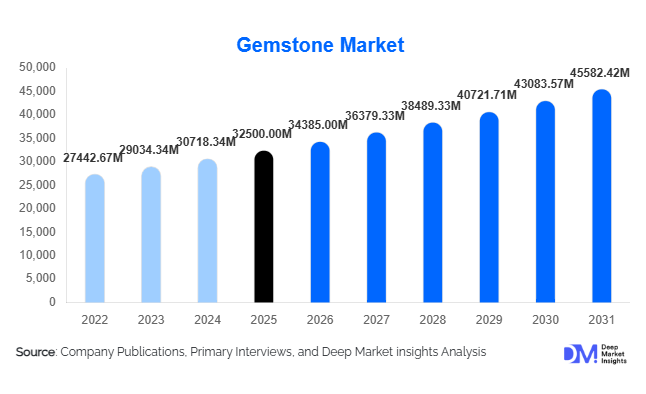
According to Deep Market Insights, the global gemstone market size was valued at USD 32,500 million in 2025 and is projected to grow from USD 34,385.00 million in 2026 to reach USD 45,582.42 million by 2031, expanding at a CAGR of 5.8% during the forecast period (2026–2031). The gemstone market growth is primarily driven by increasing global demand for luxury jewelry, rising adoption of lab-grown gemstones, and strong cultural and investment demand across emerging economies. Expanding digital retail channels and advancements in gemstone certification technologies are further supporting market expansion globally.
Key Market Insights
- Jewelry applications dominate the market, accounting for over 75% of total demand, driven by bridal and luxury consumption trends.
- Asia-Pacific leads the global market, supported by strong demand from India and China and a well-established processing ecosystem.
- Lab-grown gemstones are the fastest-growing segment, gaining traction due to affordability and sustainability advantages.
- Offline retail continues to dominate, though online platforms are expanding rapidly with increasing consumer trust.
- Mid-range gemstones hold the largest share, appealing to a broad consumer base, balancing affordability and luxury.
- Technological advancements, including blockchain-based certification and AI grading, are enhancing transparency and trust in gemstone transactions.
What are the latest trends in the gemstone market?
Rising Adoption of Lab-Grown Gemstones
Lab-grown gemstones are rapidly transforming the global market landscape. These stones offer similar physical and chemical properties as natural gemstones but at significantly lower costs, making them increasingly attractive to younger consumers. Sustainability concerns and ethical sourcing issues surrounding mining activities have further accelerated their adoption. Major industry players are investing in advanced production technologies such as Chemical Vapor Deposition (CVD), enabling scalable and high-quality production. Retailers are also actively promoting lab-grown gemstones as eco-friendly alternatives, enhancing their market penetration. This trend is expected to significantly reshape pricing dynamics and expand the overall consumer base.
Digitalization and Online Gemstone Trading
The gemstone market is undergoing a digital transformation, with online retail platforms gaining prominence. E-commerce marketplaces and direct-to-consumer brand websites are enabling global access to gemstones, reducing dependency on traditional intermediaries. Blockchain technology is increasingly being integrated to ensure transparency, traceability, and authenticity of gemstones, particularly for high-value transactions. Consumers are benefiting from improved access to certifications, pricing comparisons, and virtual visualization tools. This shift toward digital channels is particularly strong among younger demographics and international buyers, driving growth in cross-border gemstone trade.
What are the key drivers in the gemstone market?
Increasing Global Luxury Spending
The rise in disposable incomes and expanding middle-class populations, particularly in the Asia-Pacific, is driving demand for gemstone jewelry. Consumers are increasingly investing in premium and customized jewelry products, especially for weddings and special occasions. High-net-worth individuals continue to fuel demand for rare and high-value gemstones, further strengthening the luxury segment.
Cultural and Astrological Significance
Gemstones hold strong cultural and astrological importance in countries such as India, Thailand, and China. Consumers purchase gemstones for spiritual benefits, healing purposes, and horoscope alignment, ensuring consistent demand across economic cycles. This cultural relevance provides a stable demand base for the market.
What are the restraints for the global market?
Price Volatility of Natural Gemstones
The prices of natural gemstones are subject to fluctuations due to limited supply, mining challenges, and geopolitical factors. This volatility affects market stability and creates uncertainty for both buyers and investors. High-value gemstones, in particular, are impacted by supply constraints and speculative pricing.
Lack of Standardization and Certification Challenges
The gemstone market faces issues related to inconsistent grading standards and the presence of counterfeit products. Limited global standardization in certification reduces consumer trust, particularly in online transactions. Addressing these challenges is critical for sustained market growth.
What are the key opportunities in the gemstone industry?
Expansion in Emerging Markets
Emerging economies such as India, China, and Southeast Asia present significant growth opportunities due to rising disposable incomes and increasing luxury consumption. Cultural affinity toward gemstones, particularly in wedding and festive jewelry, is driving demand. Companies can expand their presence in these markets through localized product offerings and distribution networks.
Integration of Blockchain and Certification Technologies
The adoption of blockchain technology for gemstone tracking and certification is creating new opportunities for market players. Enhanced transparency and traceability improve consumer confidence, particularly for high-value purchases. Companies investing in digital authentication systems can differentiate themselves and capture premium segments.
Report Scope
| Report Metric | Details |
|---|---|
| Market Size in 2025 | USD 32500 Million |
| Market Size in 2026 | USD 34385 Million |
| Market Size in 2031 | USD 45582.42 Million |
| CAGR | 5.8% (2026-2031) |
| Base Year for Estimation | 2025 |
| Historical Data | 2022-2024 |
| Forecast Period | 2026-2031 |
| Report Coverage | Revenue Forecast, Competitive Landscape, Supply Chain Disruption, Growth Factors, Environment & Regulatory Landscape and Trends |
| Geographies Covered | North America, Europe, APAC, Middle East and Africa, LATAM |
| Countries Covered | U.S., Canada, U.K., Germany, France, Spain, Italy, Russia, Nordic, Benelux, Rest of Europe, China, Korea, Japan, India, Australia, Singapore, Taiwan, South East Asia, Rest of Asia-Pacific, UAE, Turky, Saudi Arabia, South Africa, Egypt, Nigeria, Rest of MEA, Brazil, Mexico, Argentina, Chile, Colombia, Rest of LATAM |
Explore more data points, trends and opportunities Download Free Sample Report
Product Type Insights
Precious gemstones continue to dominate the global gemstone market, accounting for approximately 62% of total market share in 2025. This dominance is primarily driven by the sustained global demand for diamonds, rubies, sapphires, and emeralds, which are widely perceived as symbols of luxury, status, and long-term value. Diamonds alone contribute a substantial portion of total revenue due to their entrenched role in engagement rings and premium jewelry, particularly in North America and Europe. The leading driver for this segment is the strong emotional and cultural association of precious stones with milestones such as weddings and anniversaries, coupled with their investment-grade appeal.
Semi-precious gemstones, including amethyst, topaz, garnet, aquamarine, and tourmaline, are witnessing accelerated growth, particularly within the mid-range and affordable segments. Their rising popularity is fueled by increasing demand for colored gemstones in contemporary and fashion jewelry, especially among younger consumers seeking personalization and uniqueness. Additionally, lower price points and wider availability are expanding accessibility, making semi-precious stones a key growth engine in emerging markets. The shift toward everyday luxury and fashion-forward jewelry designs is expected to further strengthen this segment’s contribution globally.
Application Insights
Jewelry applications remain the largest segment, contributing nearly 78% of total gemstone demand in 2025. This segment’s leadership is driven by robust demand for bridal jewelry, luxury accessories, and evolving fashion trends across both developed and emerging markets. The primary growth driver is the increasing global spending on weddings and personal adornment, particularly in countries such as India and China, where jewelry consumption is culturally significant. Additionally, the rise of branded jewelry and customization trends is further boosting gemstone usage in this segment.
Industrial applications, primarily involving diamonds used in cutting, drilling, and polishing tools, represent a smaller yet stable segment. Growth in infrastructure development, mining, and manufacturing industries is sustaining demand for industrial-grade diamonds. Decorative and collectible gemstones form a niche but high-value segment, driven by investors and collectors seeking rare stones for portfolio diversification and long-term appreciation. Increasing interest in gemstones as alternative investment assets is gradually expanding this segment’s relevance.
Distribution Channel Insights
Offline retail channels dominate the gemstone market, accounting for approximately 65% of total sales in 2025. The leading driver for this segment is consumer preference for physical verification of gemstone quality, clarity, and authenticity, particularly for high-value purchases. Jewelry stores, specialty boutiques, and auction houses continue to play a crucial role in building trust and offering personalized buying experiences.
However, online distribution channels are emerging as the fastest-growing segment, expanding at a CAGR of over 9%. Growth is driven by increasing digital adoption, improved certification transparency, and the integration of advanced technologies such as blockchain for provenance tracking. E-commerce platforms and direct-to-consumer brand websites are enabling global accessibility, price transparency, and convenience, particularly for mid-range and affordable gemstones. The growing influence of digital marketing and social media is further accelerating online sales.
End-User Insights
Individual consumers dominate the gemstone market, accounting for approximately 70% of total demand in 2025. This segment’s leadership is driven by rising disposable incomes, increasing fashion consciousness, and strong cultural affinity toward gemstone jewelry. Consumer demand is particularly high in the Asia-Pacific, where gemstones are widely used for both ornamental and astrological purposes.
Jewelry manufacturers represent a significant secondary segment, sourcing gemstones in bulk for large-scale production of rings, necklaces, and other accessories. Industrial buyers primarily utilize diamonds for cutting and drilling applications, supported by growth in the construction and manufacturing sectors. Meanwhile, investors and collectors are emerging as a niche but high-value segment, driven by increasing awareness of gemstones as tangible assets with potential for long-term appreciation. This trend is particularly strong for rare and high-quality precious stones.
Explore more data points, trends and opportunities Download Free Sample Report
Gemstone Market Segmentations
By Product Type
- Precious Gemstones
- Semi-Precious Gemstones
By Application
- Jewelry
- Industrial Applications
- Decorative & Collectibles
- Astrology & Healing
By Distribution Channel
- Offline Retail
- Online Retail
Regional Insights
Asia-Pacific
Asia-Pacific leads the global gemstone market, accounting for approximately 45% of total market share in 2025, and remains the fastest-growing region with a CAGR of around 6.5%. India holds nearly 18% share, driven by its position as the world’s largest gemstone processing hub and strong domestic demand rooted in cultural and wedding-related consumption. China accounts for approximately 14% share, supported by rapid urbanization, rising middle-class wealth, and increasing luxury spending. Key growth drivers in the region include expanding disposable incomes, strong export-oriented manufacturing ecosystems, increasing adoption of branded jewelry, and deep-rooted cultural and astrological significance of gemstones. Additionally, government initiatives supporting jewelry exports and manufacturing infrastructure are further accelerating regional growth.
North America
North America accounts for around 22% of the global gemstone market, with the United States contributing nearly 20%. The region’s growth is primarily driven by high disposable income levels, strong demand for luxury and bridal jewelry, and increasing consumer preference for ethically sourced and lab-grown gemstones. Another key driver is the rapid adoption of advanced technologies, including blockchain-based certification and AI-driven grading systems, which enhance transparency and consumer trust. The presence of established jewelry brands and a mature retail ecosystem further supports steady market expansion in this region.
Europe
Europe holds approximately 18% of the global market share, with significant demand from countries such as the UK, Germany, France, and Italy. The region is characterized by a strong presence of luxury jewelry brands and a high consumer preference for premium-quality gemstones. Key growth drivers include increasing demand for sustainably sourced and ethically certified gemstones, as well as rising interest in heritage and designer jewelry. European consumers are also highly inclined toward colored gemstones and customized jewelry, further supporting market growth. Regulatory emphasis on ethical sourcing and transparency is shaping purchasing behavior across the region.
Middle East & Africa
The Middle East & Africa region accounts for around 8% of the global gemstone market. The UAE serves as a major trading and re-export hub, driven by its strategic geographic location and advanced trade infrastructure. Growth in the Middle East is fueled by high disposable incomes, strong luxury consumption patterns, and increasing demand for premium jewelry. In Africa, the market is primarily driven by gemstone mining activities, with countries such as Botswana and South Africa contributing significantly to global supply. Increasing investments in mining infrastructure and government support for resource development are key growth drivers in this region.
Latin America
Latin America represents approximately 7% of the global gemstone market, with Brazil being a प्रमुख supplier of semi-precious gemstones such as amethyst and topaz. Regional growth is driven by expanding export activities, increasing global demand for colored gemstones, and gradual improvement in mining technologies. Domestic demand is also rising due to increasing consumer awareness and growing middle-class income levels. Government initiatives supporting mining and export sectors, along with rising participation in global gemstone trade, are expected to further strengthen market growth in this region.
Key Players in the Gemstone Market
- De Beers Group
- ALROSA
- Rio Tinto
- Gemfields Group
- Chow Tai Fook Jewellery
- Tiffany & Co.
- Signet Jewelers
- Rajesh Exports
- Titan Company Limited
- Harry Winston
- Graff Diamonds
- Petra Diamonds
- Lucara Diamond Corp
- Swarovski
- Blue Nile