Garden Decor Market Size
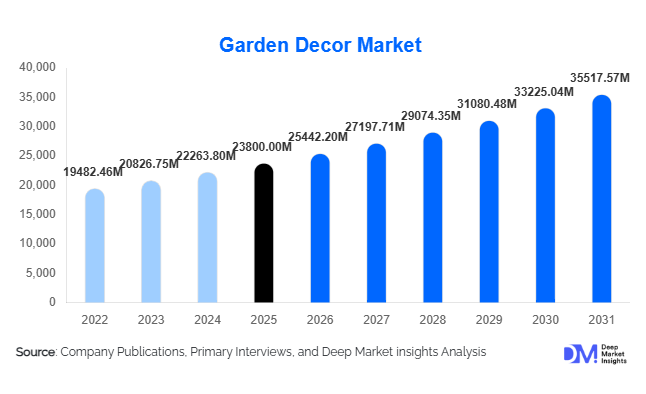
According to Deep Market Insights, the global garden decor market size was valued at USD 23,800 million in 2025 and is projected to grow from USD 25,442.20 million in 2026 to reach USD 35,517.57 million by 2031, expanding at a CAGR of 6.9% during the forecast period (2026–2031). The garden decor market growth is primarily driven by increasing consumer focus on outdoor living aesthetics, rising home improvement spending, and the expansion of urban gardening trends across both developed and emerging economies.
Key Market Insights
- Outdoor living and home beautification trends are significantly boosting demand, especially for functional decor such as furniture, lighting, and planters.
- Sustainability is reshaping product innovation, with rising demand for eco-friendly materials such as recycled plastics, bamboo, and responsibly sourced wood.
- North America dominates the global market, supported by high consumer spending and a strong outdoor lifestyle culture.
- Asia-Pacific is the fastest-growing region, driven by urbanization, rising disposable incomes, and expanding middle-class populations.
- E-commerce channels are rapidly gaining traction, enabling wider product accessibility and customization.
- Smart and solar-powered garden decor solutions are increasingly influencing purchasing decisions among environmentally conscious consumers.
What are the latest trends in the garden decor market?
Sustainable and Eco-Friendly Decor Solutions
The garden decor market is witnessing a strong shift toward sustainability, with consumers increasingly prioritizing eco-friendly materials and production processes. Manufacturers are adopting recycled plastics, reclaimed wood, and biodegradable materials to align with environmental concerns. Solar-powered lighting systems and water-efficient decorative fountains are gaining widespread popularity as they reduce energy consumption and operational costs. Additionally, brands are incorporating circular economy practices, such as recyclable packaging and modular designs that extend product lifecycles. Governments across Europe and North America are also enforcing stricter sustainability regulations, further accelerating the adoption of green garden decor products.
Rise of Smart and Modular Outdoor Decor
Technological integration is emerging as a key trend in the garden decor market. Smart outdoor lighting systems, app-controlled irrigation-integrated decor, and IoT-enabled garden accessories are enhancing user convenience and efficiency. Modular and multifunctional decor solutions are also gaining traction, especially in urban environments with limited space. Products such as foldable furniture, vertical gardens, and compact decorative units cater to apartment dwellers and small households. This trend is particularly strong in Asia-Pacific and European urban centers, where space optimization is critical. The integration of design aesthetics with smart functionality is creating premium product categories that command higher margins.
What are the key drivers in the garden decor market?
Growing Popularity of Outdoor Living Spaces
The increasing preference for outdoor living spaces as extensions of indoor environments is a major driver of the garden decor market. Consumers are investing in patios, balconies, and backyard spaces to create functional and aesthetically appealing environments for relaxation and social gatherings. This trend has been further reinforced by post-pandemic lifestyle changes, where homeowners prioritize personal outdoor areas for leisure and wellness. As a result, demand for outdoor furniture, decorative lighting, and garden accessories has surged globally.
Rising Disposable Income and Urbanization
Rapid urbanization and rising disposable incomes, particularly in emerging economies such as India and China, are significantly boosting demand for garden decor products. The expansion of the middle class has increased spending on home improvement and lifestyle products. Urban housing developments are increasingly incorporating landscaped spaces, balconies, and rooftop gardens, further driving demand for compact and affordable decor solutions. This socio-economic shift is expanding the consumer base beyond premium segments.
What are the restraints for the global market?
Seasonal Demand Fluctuations
The garden decor market is highly influenced by seasonal patterns, particularly in regions with extreme weather conditions. Demand tends to peak during spring and summer months, while colder seasons significantly reduce consumer spending on outdoor decor. This seasonality creates challenges for inventory management, production planning, and revenue stability for manufacturers and retailers.
High Material and Logistics Costs
The cost of raw materials such as wood, metal, and stone, along with rising transportation expenses, poses a significant challenge to market growth. Premium garden decor products often involve high manufacturing and shipping costs, which can limit affordability in price-sensitive markets. Additionally, fluctuations in raw material prices can impact profit margins and pricing strategies, making it difficult for companies to maintain competitiveness.
What are the key opportunities in the garden decor industry?
Expansion of Smart and Sustainable Product Lines
The integration of smart technology and sustainability presents a significant opportunity for market players. Companies can develop solar-powered lighting, automated irrigation-integrated decor, and IoT-enabled outdoor solutions to cater to environmentally conscious consumers. These products not only enhance functionality but also allow manufacturers to target premium segments with higher margins. As governments promote green infrastructure and energy efficiency, demand for such solutions is expected to rise significantly.
Urban Compact Gardening Solutions
The increasing prevalence of apartment living and smaller residential spaces has created demand for compact and modular garden decor products. Vertical gardens, foldable furniture, and space-saving decorative elements are becoming essential for urban consumers. This segment offers strong growth potential, particularly in densely populated regions such as the Asia-Pacific and Europe. Companies focusing on innovative designs tailored for small spaces can capture a rapidly expanding customer base.
Commercial Landscaping and Hospitality Demand
The commercial sector, including hospitality, retail, and corporate spaces, is increasingly investing in outdoor aesthetics to enhance customer experience and brand value. Hotels, restaurants, and office campuses are incorporating decorative lighting, water features, and themed landscaping to create visually appealing environments. This segment offers high-value contracts and bulk procurement opportunities, making it an attractive growth avenue for manufacturers and suppliers.
Report Scope
| Report Metric | Details |
|---|---|
| Market Size in 2025 | USD 23800 Million |
| Market Size in 2026 | USD 25442.20 Million |
| Market Size in 2031 | USD 35517.57 Million |
| CAGR | 6.9% (2026-2031) |
| Base Year for Estimation | 2025 |
| Historical Data | 2022-2024 |
| Forecast Period | 2026-2031 |
| Report Coverage | Revenue Forecast, Competitive Landscape, Supply Chain Disruption, Growth Factors, Environment & Regulatory Landscape and Trends |
| Geographies Covered | North America, Europe, APAC, Middle East and Africa, LATAM |
| Countries Covered | U.S., Canada, U.K., Germany, France, Spain, Italy, Russia, Nordic, Benelux, Rest of Europe, China, Korea, Japan, India, Australia, Singapore, Taiwan, South East Asia, Rest of Asia-Pacific, UAE, Turky, Saudi Arabia, South Africa, Egypt, Nigeria, Rest of MEA, Brazil, Mexico, Argentina, Chile, Colombia, Rest of LATAM |
Explore more data points, trends and opportunities Download Free Sample Report
Product Type Insights
Outdoor furniture dominates the garden decor market, accounting for approximately 28% of the total market share in 2025. This segment continues to lead due to its strong combination of functionality, durability, and aesthetic appeal, making it an essential component of modern outdoor living spaces. The growing consumer preference for extending indoor comfort to outdoor environments—such as patios, balconies, and backyards—has significantly boosted demand for weather-resistant seating, dining sets, and loungers. Additionally, innovations in materials such as UV-resistant fabrics, treated wood, and rust-proof metals have enhanced product longevity, further supporting adoption. Planters and containers represent the next significant segment, driven by the increasing popularity of home gardening, urban farming, and biophilic design trends. Consumers are integrating greenery into both indoor and outdoor spaces, leading to strong demand for decorative and functional planting solutions. Decorative lighting is another rapidly expanding category, particularly solar-powered and LED-based products, as consumers prioritize energy efficiency, sustainability, and ambiance creation. The integration of smart lighting systems and automation features is further accelerating growth in this segment.
Material Insights
Wood-based garden decor holds the largest share at approximately 26% of the market, primarily due to its natural aesthetic, versatility, and strong alignment with sustainability trends. Consumers increasingly prefer wood for its ability to blend seamlessly with outdoor environments while offering durability and a premium look. The rising availability of sustainably sourced and certified wood products has further strengthened this segment’s position. Metal-based decor products also maintain a substantial share, particularly in premium and modern designs, due to their structural strength and contemporary appeal. Meanwhile, plastic and resin materials are gaining traction in the mass market segment due to their affordability, lightweight properties, and resistance to weather conditions, making them ideal for cost-conscious consumers. The demand for mixed-material products is increasing rapidly, as manufacturers combine materials such as wood-metal or plastic-metal hybrids to enhance both aesthetics and functionality. This trend reflects a broader shift toward innovative design solutions that cater to diverse consumer preferences across price segments.
Distribution Channel Insights
Offline retail channels dominate the garden decor market, accounting for nearly 62% of total sales, as consumers prefer to physically assess product quality, dimensions, material finish, and durability before making a purchase. Large-format home improvement stores, specialty garden centers, and furniture retailers continue to play a critical role in influencing purchasing decisions through in-store displays and experiential marketing. However, online retail is emerging as the fastest-growing channel, supported by the rapid expansion of e-commerce platforms, improved logistics, and increasing digital adoption among consumers. Direct-to-consumer (D2C) models are gaining popularity as brands leverage online platforms to offer customization, competitive pricing, and a wider product assortment. Additionally, the use of augmented reality (AR) tools that allow customers to visualize products in their outdoor spaces is enhancing online conversion rates. This shift toward digital channels is expected to significantly reshape distribution dynamics over the forecast period.
End-Use Insights
The residential segment leads the garden decor market with approximately 68% share, driven by increasing home improvement activities, DIY gardening trends, and a growing emphasis on personal outdoor spaces. The post-pandemic shift toward home-centric lifestyles has further accelerated investments in garden decor, as consumers seek to create relaxing and aesthetically pleasing environments within their homes. The commercial segment, including hospitality, corporate campuses, retail spaces, and public parks, is growing at a faster pace with a CAGR exceeding 8%, supported by rising investments in outdoor aesthetics and experiential design. Businesses are increasingly leveraging well-designed outdoor spaces to enhance customer engagement, improve brand perception, and create differentiated experiences. Emerging applications such as rooftop gardens, co-working spaces, wellness retreats, and urban green zones are expanding the scope of garden decor products, creating new revenue streams for market participants. Additionally, government initiatives promoting urban greening and sustainable infrastructure are further supporting demand in both residential and commercial segments.
Explore more data points, trends and opportunities Download Free Sample Report
Garden Decor Market Segmentations
By Product Type
- Outdoor Furniture
- Planters & Containers
- Lighting & Illumination
- Water Features
- Decorative Structures
- Garden Art & Sculptures
- Outdoor Rugs & Textiles
- Fire Pits & Heating Elements
By Material
- Wood
- Metal
- Plastic & Resin
- Stone & Concrete
- Glass & Ceramics
- Mixed Materials
By Distribution Channel
- Offline Retail
- Online Retail
By End Use
- Residential
- Commercial
Regional Insights
North America
North America holds the largest share of approximately 34% of the global market in 2025, with the United States accounting for nearly 78% of regional demand. The region’s dominance is driven by high disposable income levels, strong consumer inclination toward outdoor living, and well-established suburban housing infrastructure that supports backyard and patio spaces. Seasonal outdoor activities and a culture of home improvement further stimulate demand for garden decor products. Additionally, the presence of major retail chains and advanced distribution networks ensures product accessibility and variety. The growing trend of smart homes and integration of technology into outdoor spaces is also driving demand for innovative decor solutions, including smart lighting and automated garden systems.
Europe
Europe accounts for around 27% of the global market, with key countries such as Germany, the United Kingdom, and France leading demand. The region’s growth is strongly influenced by its long-standing gardening culture and increasing emphasis on sustainability and eco-friendly living. Consumers in Europe show a high preference for environmentally responsible products, driving demand for decor made from recycled and sustainable materials. Government initiatives promoting green spaces, urban biodiversity, and energy-efficient products are further supporting market expansion. Additionally, the rise of compact urban living has increased demand for balcony and small-space garden solutions, particularly in densely populated cities.
Asia-Pacific
Asia-Pacific is the fastest-growing region in the garden decor market, with a CAGR exceeding 8.5%, and currently accounts for approximately 23% of global demand. Rapid urbanization, rising disposable incomes, and the expansion of middle-class populations in countries such as China and India are key growth drivers. Increasing awareness of home aesthetics and the growing popularity of gardening as a lifestyle activity are further boosting demand. The region is also witnessing significant growth in residential construction and real estate development, creating opportunities for garden decor integration. Additionally, the availability of low-cost manufacturing and export-oriented production in countries like China and Vietnam supports both domestic consumption and global supply.
Latin America
Latin America holds approximately 7% of the global market, with Brazil and Mexico as the leading contributors. The region’s growth is supported by increasing urbanization, improving economic conditions, and rising consumer spending on home improvement products. Cultural preferences for outdoor social gatherings and garden spaces are driving demand for functional and decorative outdoor products. However, price sensitivity remains a key factor, leading to higher demand for affordable and durable materials such as plastic and resin. The expansion of retail infrastructure and e-commerce platforms is also improving product accessibility across the region.
Middle East & Africa
The Middle East & Africa region accounts for around 9% of the global market, with demand primarily concentrated in the UAE and Saudi Arabia. Growth in this region is driven by large-scale real estate developments, luxury residential projects, and high investments in landscaping and outdoor aesthetics. The hospitality sector, particularly luxury hotels and resorts, plays a significant role in driving demand for premium garden decor products. Additionally, government initiatives focused on urban beautification and tourism development are contributing to market expansion. In Africa, emerging urban centers and increasing investments in infrastructure are gradually supporting demand, although the market remains relatively nascent compared to other regions.