Fragrance Diffuser Market Size
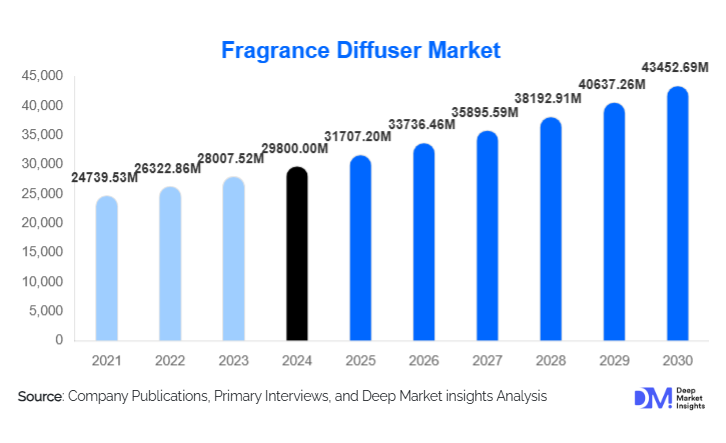
According to Deep Market Insights, the global fragrance diffuser market size was valued at USD 29,800.00 million in 2025 and is projected to grow from USD 31,707.20 million in 2026 to reach USD 43,452.69 million by 2031, expanding at a CAGR of 6.4% during the forecast period (2026–2031). The fragrance diffuser market growth is primarily driven by increasing consumer awareness about home wellness, rising adoption of smart and IoT-enabled diffusers, and expanding demand across residential, hospitality, and commercial segments globally.
Key Market Insights
- Smart and IoT-enabled diffusers are gaining prominence, offering remote control, automated scheduling, and app integration for personalized fragrance experiences.
- Residential adoption dominates, fueled by the rising interest in home aromatherapy, stress relief, and lifestyle-driven fragrance products.
- North America leads the global market, with high disposable income and a preference for smart home wellness products driving demand.
- Asia-Pacific is the fastest-growing region, driven by urbanization, rising middle-class income, and increasing interest in premium and commercial diffusers.
- Eco-friendly and sustainable diffusers are emerging as a key trend, with biodegradable materials, energy-efficient designs, and refillable fragrance pods gaining consumer acceptance.
- Commercial adoption is expanding, particularly in hotels, spas, wellness centers, and office spaces, where scent marketing enhances customer experience.
Fragrance Diffuser Market Trends
Smart and Connected Diffusers
Consumers increasingly prefer smart diffusers integrated with apps and voice assistants, enabling scheduling, intensity control, and remote monitoring. The integration of IoT technology allows for personalized fragrance experiences, subscription-based refill services, and automation in commercial spaces. The trend is particularly strong in North America and Europe, where smart home adoption is widespread. Manufacturers are focusing on multi-functional devices that combine scent diffusion with lighting or humidification, providing both aesthetic appeal and wellness benefits.
Sustainability and Eco-Friendly Designs
Eco-conscious consumers are driving demand for sustainable diffusers made from biodegradable, recyclable, or low-energy materials. Energy-efficient ultrasonic diffusers, refillable fragrance pods, and low-noise devices are becoming standard in premium and mid-range categories. Regulatory requirements in Europe for eco-labeling, alongside growing consumer awareness in APAC, are further accelerating the adoption of sustainable fragrance products. Companies investing in environmentally friendly technologies are achieving higher brand loyalty and market differentiation.
Fragrance Diffuser Market Drivers
Rising Demand for Home Wellness
The shift toward wellness and self-care is driving the global adoption of fragrance diffusers. Consumers increasingly seek aromatherapy, stress relief, and home ambiance enhancement, leading to higher residential sales. Remote working trends and urban lifestyles have further amplified the need for personalized, calming environments, boosting demand for both premium and mid-range diffusers.
Technological Advancements
Advancements such as ultrasonic and nebulizing diffusion technologies, along with IoT-enabled features, have improved efficiency, customization, and user convenience. Smart diffusers allow scheduling, intensity adjustment, and integration with home automation systems, attracting tech-savvy consumers. Continuous innovation has expanded the product portfolio and driven replacement cycles, particularly in North America and Europe.
Hospitality and Commercial Adoption
Hotels, resorts, wellness centers, and office spaces are investing in high-quality diffusers to enhance ambiance and customer experience. Premium and smart diffusers are widely used in luxury hospitality environments, contributing to the growth of the commercial segment. Corporate wellness programs are also incorporating scent-based solutions to improve employee satisfaction and productivity.
Fragrance Diffuser Market Restraints
High Initial Costs
Premium and smart diffusers remain relatively expensive, limiting adoption in price-sensitive markets. High upfront costs can deter consumers in emerging economies from purchasing feature-rich devices, slowing penetration in key growth regions.
Dependency on Fragrance Supply
Fragrance diffusers require consistent replenishment of essential oils or scent cartridges. Fluctuating prices of natural oils, supply chain disruptions, and limited availability of high-quality fragrances can restrict market expansion and affect consumer retention.
Fragrance Diffuser Market Opportunities
Integration with Smart Home Ecosystems
Fragrance diffusers can leverage IoT and home automation trends to offer app-based control, voice command functionality, and automated scent scheduling. Subscription-based models for fragrance refills and remote monitoring provide new revenue streams for manufacturers. This creates opportunities for differentiation in developed regions with high smart home adoption.
Expansion into Emerging Markets
Emerging economies such as India, China, Brazil, and Southeast Asia are witnessing rising disposable incomes, urbanization, and lifestyle-driven consumption. These markets present growth potential for mid-range and premium diffusers, both in residential and commercial applications, supported by wellness and hospitality initiatives.
Sustainable and Eco-Friendly Innovations
Manufacturers focusing on biodegradable materials, energy-efficient devices, and refillable fragrance pods can tap into environmentally conscious consumer segments. Sustainable product design not only meets regulatory standards in Europe but also provides differentiation and premium pricing potential in global markets.
Report Scope
| Report Metric | Details |
|---|---|
| Market Size in 2025 | USD 29800 Million |
| Market Size in 2026 | USD 31707.20 Million |
| Market Size in 2031 | USD 43452.69 Million |
| CAGR | 6.4% (2026-2031) |
| Base Year for Estimation | 2025 |
| Historical Data | 2022-2024 |
| Forecast Period | 2026-2031 |
| Report Coverage | Revenue Forecast, Competitive Landscape, Supply Chain Disruption, Growth Factors, Environment & Regulatory Landscape and Trends |
| Geographies Covered | North America, Europe, APAC, Middle East and Africa, LATAM |
| Countries Covered | U.S., Canada, U.K., Germany, France, Spain, Italy, Russia, Nordic, Benelux, Rest of Europe, China, Korea, Japan, India, Australia, Singapore, Taiwan, South East Asia, Rest of Asia-Pacific, UAE, Turky, Saudi Arabia, South Africa, Egypt, Nigeria, Rest of MEA, Brazil, Mexico, Argentina, Chile, Colombia, Rest of LATAM |
Explore more data points, trends and opportunities Download Free Sample Report
Product Type Insights
Ultrasonic diffusers dominate the market, accounting for 38% of global market share in 2025, due to their quiet operation, multifunctionality, and energy efficiency. Nebulizing diffusers are gaining popularity in premium and commercial settings for concentrated fragrance delivery, while heat-based and evaporative diffusers are preferred in budget segments. Consumer preference is shifting toward devices offering additional wellness and smart functionalities, supporting growth across product tiers.
Technology Insights
Smart/IoT-enabled diffusers hold the largest share of 42% in 2025, as consumers increasingly demand app-based control, automated scheduling, and remote monitoring. Non-smart diffusers maintain a stable market presence in emerging regions, but overall growth is driven by connected devices with integrated features such as humidification, lighting, and aroma customization.
Distribution Channel Insights
Online retail dominates the fragrance diffuser market, representing 45% of global sales in 2025. E-commerce platforms provide convenience, a wide product selection, and access to premium global brands. Offline retail, including department stores and specialty stores, continues to capture a significant share, particularly in emerging regions where consumer trust in physical stores remains strong. Commercial channels, such as hotels and spas, contribute to high-value recurring orders, supporting overall market growth.
End-Use Insights
Residential users represent the largest end-use segment, accounting for 50% of global demand in 2025. The hospitality sector, particularly luxury hotels and wellness resorts, is rapidly adopting premium diffusers, while office spaces and commercial facilities are integrating scent marketing as part of wellness initiatives. Emerging applications in healthcare, such as hospitals and eldercare facilities, offer untapped growth potential, particularly for therapeutic aromatherapy solutions.
Explore more data points, trends and opportunities Download Free Sample Report
Fragrance Diffuser Market Segmentations
By Product Type
- Ultrasonic Diffusers
- Nebulizing Diffusers
- Evaporative Diffusers
- Heat-Based Diffusers
By Technology
- Smart/IoT-Enabled Diffusers
- Non-Smart Diffusers
By Distribution Channel
- Online Retail
- Offline Retail
- Commercial/Professional Channels
By End-Use Industry
- Residential
- Hospitality (Hotels, Resorts, Airbnb)
- Wellness & Spa
- Healthcare & Clinical
- Commercial & Office Spaces
By Price Tier
- Premium/High-End
- Mid-Range
- Economy/Budget
Regional Insights
North America
North America holds 32% of the global market in 2025, led by the U.S. and Canada. High disposable income, smart home adoption, and consumer awareness about wellness drive demand. Premium residential and commercial applications dominate, with increasing uptake of smart and eco-friendly diffusers.
Europe
Europe accounts for 28% of the global market, led by Germany, France, and the UK. Eco-friendly and technologically advanced diffusers are preferred, with strong adoption in both residential and hospitality sectors. Regulations and sustainability trends further influence product design and consumer choices.
Asia-Pacific
APAC is the fastest-growing region, driven by China, India, Japan, and Australia. Rising urbanization, disposable income, and social media influence are fueling premium and smart diffuser adoption. China is projected to grow at a CAGR of 9% from 2026–2031, making it a critical market for both global and domestic players.
Middle East & Africa
Luxury hotels in the UAE, Saudi Arabia, and South Africa are driving regional demand. High-income populations and hospitality-focused adoption support steady growth in MEA, with increasing interest in eco-friendly and premium devices.
Latin America
Brazil and Argentina are emerging markets for fragrance diffusers. While residential adoption is growing, premium hospitality and office-based applications are still developing. Overall regional market share remains below 10% but presents potential for future expansion.