Foot Massage Machine Market Size
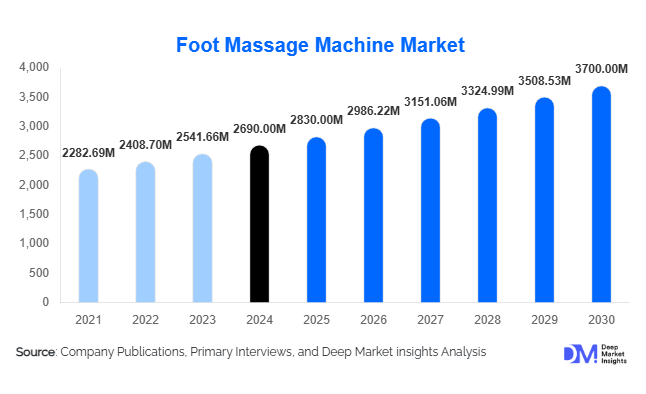
According to Deep Market Insights, the global foot massage machine market size was valued at USD 2,690 million in 2025 and is projected to grow from USD 2,830 million in 2026 to reach USD 3,700 million by 2031, expanding at a CAGR of 5.52% during the forecast period (2026–2031). The market growth is primarily driven by increasing health and wellness awareness, rising demand for home-based therapeutic devices, and technological advancements in foot massage machines offering smart, customizable features.
Key Market Insights
- Rising consumer focus on wellness and home-based therapies has fueled the adoption of foot massage machines as a convenient, therapeutic alternative to spa visits.
- Electric foot massagers dominate the product type segment, accounting for approximately 60% of the market share in 2025 due to their effectiveness, ease of use, and advanced features such as heat therapy and adjustable intensity.
- Online retail channels are emerging as the preferred distribution mode, capturing around 45% of the market in 2025, supported by convenient doorstep delivery, product reviews, and competitive pricing.
- North America holds the largest regional market share at roughly 35% in 2025, driven by high disposable incomes and strong wellness awareness.
- Asia-Pacific is the fastest-growing region, led by China and Japan, with a projected CAGR of 7.5% from 2026 to 2031 due to urbanization, rising middle-class income, and cultural emphasis on foot health.
- Technological integration, including smart IoT-enabled features and mobile app connectivity, is enhancing personalization and user engagement, driving market differentiation.
Foot Massage Machine Market Trends
Smart and IoT-Enabled Devices
Manufacturers are increasingly embedding IoT capabilities, app connectivity, and AI-driven personalization into foot massage machines. These features allow users to customize massage intensity, monitor usage patterns, and control devices remotely. Smart devices also enable integration with health tracking apps, enhancing user engagement and satisfaction. This trend is particularly popular among tech-savvy consumers seeking personalized wellness experiences at home.
Home-Based Wellness Focus
With growing awareness of health and convenience, consumers are increasingly opting for home-based foot massage solutions. The trend is fueled by the rising prevalence of foot-related health issues, such as plantar fasciitis and diabetic neuropathy, as well as the convenience of avoiding professional spa visits. Home-based wellness is also cost-effective over the long term, further boosting adoption.
Foot Massage Machine Market Drivers
Increasing Health and Wellness Awareness
Global consumers are becoming more health-conscious, seeking products that offer relaxation, pain relief, and improved circulation. Foot massage machines align perfectly with this trend, as they provide therapeutic benefits, reduce stress, and enhance overall well-being. The rising geriatric population further supports demand, as older adults require devices that alleviate chronic foot pain and improve mobility.
Technological Advancements in Products
Integration of features such as heat therapy, air compression, and customizable massage modes has transformed the user experience. Advanced products appeal to consumers looking for multifunctional devices, driving higher adoption rates across residential and commercial sectors.
Expansion in Emerging Markets
Rising disposable incomes in Asia-Pacific, Latin America, and the Middle East, coupled with a growing middle-class population, are creating new demand opportunities. Market players are targeting these regions with affordable and region-specific offerings, supporting long-term growth.
Foot Massage Machine Market Restraints
High Initial Cost
Premium foot massage machines with advanced features often carry high price tags, limiting affordability for price-sensitive consumers. This can restrict market penetration in emerging regions despite growing demand.
Lack of Awareness in Certain Regions
In less developed markets, consumer understanding of foot massage benefits remains limited. Educating potential customers about therapeutic advantages is crucial to expanding adoption.
Foot Massage Machine Market Opportunities
Smart and Connected Devices
The integration of IoT, AI, and mobile app-based control is a significant opportunity. Smart foot massage machines can track usage, provide personalized recommendations, and connect with broader wellness ecosystems, offering differentiation for manufacturers and engaging tech-savvy consumers.
Healthcare and Therapeutic Collaborations
Partnerships with healthcare providers and physiotherapists allow positioning foot massage machines as complementary therapeutic tools. These collaborations can expand the customer base and enhance credibility by promoting machines for conditions like diabetic neuropathy, poor circulation, and chronic foot pain.
Growth in Emerging Markets
The Asia-Pacific and Latin America regions present untapped growth potential due to rising urbanization, increasing disposable incomes, and the emergence of health-conscious middle-class consumers. Localized marketing, affordability, and culturally relevant features can drive adoption in these regions.
Report Scope
| Report Metric | Details |
|---|---|
| Market Size in 2025 | USD 2690 Million |
| Market Size in 2026 | USD 2830 Million |
| Market Size in 2031 | USD 3700 Million |
| CAGR | 5.52% (2026-2031) |
| Base Year for Estimation | 2025 |
| Historical Data | 2022-2024 |
| Forecast Period | 2026-2031 |
| Report Coverage | Revenue Forecast, Competitive Landscape, Supply Chain Disruption, Growth Factors, Environment & Regulatory Landscape and Trends |
| Geographies Covered | North America, Europe, APAC, Middle East and Africa, LATAM |
| Countries Covered | U.S., Canada, U.K., Germany, France, Spain, Italy, Russia, Nordic, Benelux, Rest of Europe, China, Korea, Japan, India, Australia, Singapore, Taiwan, South East Asia, Rest of Asia-Pacific, UAE, Turky, Saudi Arabia, South Africa, Egypt, Nigeria, Rest of MEA, Brazil, Mexico, Argentina, Chile, Colombia, Rest of LATAM |
Explore more data points, trends and opportunities Download Free Sample Report
Product Type Insights
Electric foot massagers lead the global market, holding approximately 60% of the 2025 market share. Their dominance is primarily driven by advancements in motor technology, quieter and more energy-efficient designs, and the growing consumer preference for automated, convenient solutions. These devices also offer advanced features such as heat therapy, adjustable intensity, and massage modes tailored to individual needs, which further enhances their appeal. Shiatsu foot massagers are gaining traction due to the rising consumer interest in traditional and holistic therapies, particularly in the Asia-Pacific region, where Shiatsu techniques are culturally popular. Air compression massagers are experiencing growth driven by demand for deep tissue massage and improved circulation, catering to consumers seeking targeted therapeutic benefits. Manual foot massagers remain niche, appealing mostly to cost-conscious buyers or those who prefer simpler, non-electric devices.
Application Insights
The residential segment dominates demand, accounting for roughly 70% of the market in 2025. Consumers increasingly prefer home use for convenience, personalized wellness routines, and cost-effectiveness compared to spa visits. Commercial adoption in spas, wellness centers, and hotels is also expanding steadily, driven by operators’ focus on enhancing customer experience and adding value through relaxation services. The combination of growing wellness awareness, rising disposable incomes, and the popularity of home-based therapeutic devices contributes to this trend across both developed and emerging markets.
Distribution Channel Insights
Online channels account for around 45% of the global market, making them the fastest-growing distribution mode. The convenience of browsing, real-time reviews, doorstep delivery, and competitive pricing drives consumer preference for e-commerce platforms. Offline retail stores remain significant in developed regions, particularly for high-end or premium devices, where consumers prefer to test products before purchase. Emerging models, such as direct-to-consumer (D2C) platforms and subscription-based offerings, are gaining traction by fostering brand loyalty, providing repeat purchase options, and offering exclusive product features or bundles.
Explore more data points, trends and opportunities Download Free Sample Report
Foot Massage Machine Market Segmentations
By Product Type
- Electric Foot Massagers
- Shiatsu Foot Massagers
- Air Compression Foot Massagers
- Manual Foot Massagers
By Application
- Residential
- Commercial (Spas, Wellness Centers, Hotels)
By Distribution Channel
- Online Retail
- Offline Retail Stores
- Direct-to-Consumer (D2C) Platforms
- Subscription and Rental Models
Regional Insights
North America
North America holds the largest share of the global market at 35% in 2025. The region’s growth is fueled by high disposable incomes, increasing wellness consciousness, and a preference for home-based therapeutic devices. Growing consumer demand for relaxation and wellness products is propelling adoption, particularly in the U.S. and Canada, where tech-savvy consumers are drawn to advanced features such as smart connectivity, heat therapy, and customizable massage modes. Online retail adoption is also strong, supported by a mature e-commerce infrastructure and the convenience of home delivery.
Europe
Europe represents a significant market with widespread adoption of high-quality wellness devices. Germany, France, and the U.K. are the leading countries in this region, driven by an aging population, rising disposable income, and growing awareness of health benefits from regular foot care and massage. Increasing consumer preference for home wellness solutions, coupled with strong online retail penetration, supports continued market growth. Technological innovation and integration of multifunctional devices further enhance consumer appeal in Europe.
Asia-Pacific
Asia-Pacific is the fastest-growing region, with a projected CAGR of 7.5% from 2026 to 2031. China and Japan lead demand due to rising disposable incomes, urbanization, and a cultural emphasis on foot health. Traditional practices like Shiatsu massage are influencing the popularity of specific foot massage techniques, driving adoption of both electric and Shiatsu-based devices. Emerging markets such as India, South Korea, and Southeast Asian countries are witnessing rising demand for affordable yet technologically advanced devices. The growth is further accelerated by increasing awareness of wellness trends, expanding e-commerce penetration, and growing interest in home-based health solutions.
Latin America
Latin America is gradually emerging, particularly in Brazil, Mexico, and Argentina. Rising middle-class income, growing wellness awareness, and increasing exposure to global lifestyle trends are driving the adoption of foot massage machines. However, adoption remains constrained by price sensitivity. As disposable income grows and e-commerce penetration improves, market expansion is expected to accelerate over the coming years.
Middle East & Africa
The Middle East, led by the UAE and Saudi Arabia, is witnessing steady growth due to high-income consumers, increasing health awareness, and rising interest in wellness products. Urban centers in Africa are slowly developing demand for therapeutic devices, driven by growing middle-class populations and rising health consciousness. Investments in healthcare infrastructure and wellness-focused lifestyle trends are expected to create new opportunities in both regions.
Key Players in the Foot Massage Machine Market
- OSIM International
- HoMedics Inc.
- Beurer GmbH
- Panasonic Corporation
- Brookstone
- Inada Co., Ltd.
- iRest
- Fujiiryoki Co., Ltd.
- Renpho
- MedMassager
- Belmint
- Johnson Health Tech
- Human Touch
- Lifepro
- SKG