Floor Covering Market Size
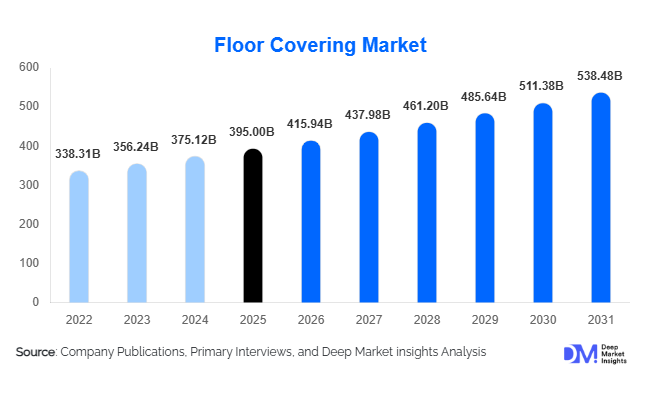
According to Deep Market Insights, the global floor covering market size was valued at USD 395.0 billion in 2025 and is projected to grow from USD 415.94 billion in 2026 to reach USD 538.48 billion by 2031, expanding at a CAGR of 5.3% during the forecast period (2026–2031). The market growth is primarily driven by rapid urbanization, rising construction activities, and increasing demand for aesthetically appealing and durable flooring solutions across residential and commercial sectors. Additionally, the growing adoption of resilient flooring materials such as luxury vinyl tiles (LVT), coupled with technological advancements in digital printing and sustainable materials, is further accelerating market expansion globally.
Key Market Insights
- Resilient flooring solutions such as vinyl and LVT are gaining significant traction due to their durability, cost-effectiveness, and water resistance.
- Asia-Pacific dominates the global market, driven by large-scale infrastructure development and urban housing demand in China and India.
- Residential applications account for the largest share, supported by increasing home renovation and remodeling activities.
- Sustainability is emerging as a key trend, with rising demand for eco-friendly materials such as cork, bamboo, and recycled flooring.
- Replacement and renovation demand is strong in developed markets, particularly in North America and Europe.
- Technological advancements, including digital printing and waterproof flooring innovations, are enhancing product offerings.
What are the latest trends in the floor covering market?
Shift Toward Sustainable and Eco-Friendly Flooring
The floor covering market is increasingly moving toward environmentally sustainable materials and production processes. Consumers and commercial buyers are prioritizing low-VOC, recyclable, and renewable materials such as bamboo, cork, and recycled vinyl. Green building certifications and regulations are encouraging manufacturers to innovate in eco-friendly product development. Companies are investing in circular economy models, including recycling programs and reduced carbon footprint manufacturing. This trend is particularly strong in Europe and North America, where environmental compliance is stringent, and sustainability-conscious consumers are driving purchasing decisions.
Rise of Luxury Vinyl Tiles (LVT) and Digital Printing Technologies
Luxury vinyl tiles (LVT) have emerged as one of the fastest-growing segments due to their ability to replicate natural materials such as wood and stone at a lower cost. Advanced digital printing technologies allow for highly realistic textures and designs, enhancing product appeal. Waterproof and scratch-resistant features further boost adoption across residential and commercial applications. This trend is reshaping consumer preferences, shifting demand away from traditional materials like hardwood and ceramic tiles toward more versatile and cost-efficient alternatives.
What are the key drivers in the floor covering market?
Growth in Construction and Real Estate Development
Rising investments in residential and commercial construction globally are a major driver of the floor covering market. Urbanization, population growth, and infrastructure development projects are fueling demand for new installations. Emerging economies, particularly in the Asia-Pacific region, are witnessing strong housing demand, while developed regions continue to benefit from commercial real estate expansion.
Increasing Renovation and Remodeling Activities
In mature markets such as North America and Europe, renovation and replacement demand accounts for a significant portion of flooring consumption. Aging infrastructure, changing interior design trends, and increased spending on home improvement are driving frequent flooring upgrades. This trend supports steady market growth even in periods of slower new construction activity.
Demand for Durable and Low-Maintenance Flooring
Consumers are increasingly prioritizing flooring solutions that offer durability, ease of maintenance, and long lifecycle performance. Products such as vinyl, laminate, and engineered wood meet these requirements, leading to higher adoption rates. Commercial sectors such as healthcare and retail also prefer low-maintenance flooring to reduce operational costs.
What are the restraints for the global market?
Volatility in Raw Material Prices
Fluctuations in raw material prices, particularly PVC, wood, and petroleum-based inputs, significantly impact production costs and pricing strategies. Manufacturers often face margin pressures due to unpredictable supply chain dynamics, which can hinder market growth.
Stringent Environmental Regulations
Compliance with environmental standards related to emissions, chemical usage, and recycling increases operational costs for manufacturers. Smaller players may struggle to meet these requirements, limiting their ability to compete in the global market.
What are the key opportunities in the floor covering industry?
Expansion in Emerging Markets
Rapid urbanization and infrastructure development in countries such as India, Indonesia, and Vietnam present significant growth opportunities. Government housing initiatives and smart city projects are driving large-scale demand for affordable and durable flooring solutions. Companies entering these markets can benefit from rising middle-class income and increasing construction activities.
Adoption of Smart and Functional Flooring
Technological advancements are enabling the development of smart flooring solutions with features such as antimicrobial coatings, acoustic insulation, and enhanced durability. These innovations are particularly attractive in healthcare, commercial, and institutional applications, creating new revenue streams for manufacturers.
Growth of Premium and Customized Flooring Solutions
Rising disposable incomes and changing consumer preferences are driving demand for premium and customized flooring products. High-end materials such as engineered wood and designer tiles are gaining popularity, especially in urban residential and luxury commercial spaces. This trend offers higher profit margins for manufacturers.
Report Scope
| Report Metric | Details |
|---|---|
| Market Size in 2025 | USD 395 Billion |
| Market Size in 2026 | USD 415.94 Billion |
| Market Size in 2031 | USD 538.48 Billion |
| CAGR | 5.3% (2026-2031) |
| Base Year for Estimation | 2025 |
| Historical Data | 2022-2024 |
| Forecast Period | 2026-2031 |
| Report Coverage | Revenue Forecast, Competitive Landscape, Supply Chain Disruption, Growth Factors, Environment & Regulatory Landscape and Trends |
| Geographies Covered | North America, Europe, APAC, Middle East and Africa, LATAM |
| Countries Covered | U.S., Canada, U.K., Germany, France, Spain, Italy, Russia, Nordic, Benelux, Rest of Europe, China, Korea, Japan, India, Australia, Singapore, Taiwan, South East Asia, Rest of Asia-Pacific, UAE, Turky, Saudi Arabia, South Africa, Egypt, Nigeria, Rest of MEA, Brazil, Mexico, Argentina, Chile, Colombia, Rest of LATAM |
Explore more data points, trends and opportunities Download Free Sample Report
Product Type Insights
Resilient flooring dominates the global floor covering market, accounting for approximately 38% of the market share in 2025. The leadership of this segment is primarily driven by the rapid adoption of vinyl-based products, particularly luxury vinyl tiles (LVT), which offer a combination of durability, water resistance, ease of installation, and cost efficiency. The ability of LVT to mimic natural materials such as wood and stone through advanced digital printing technologies has significantly increased its acceptance across both residential and commercial applications. Additionally, growing demand for low-maintenance and long-life flooring solutions in high-traffic environments such as retail stores, healthcare facilities, and offices is further accelerating the growth of resilient flooring globally.
Non-resilient flooring, including ceramic tiles, porcelain tiles, and natural stone, continues to hold a substantial share of the market, particularly in premium and high-end construction projects. This segment is driven by increasing demand for aesthetically superior and long-lasting materials, especially in luxury residential and commercial developments. Meanwhile, soft floor coverings such as carpets and rugs maintain stable demand, supported by their comfort, thermal insulation properties, and strong usage in hospitality, residential, and office environments. The segment is also benefiting from innovations in stain-resistant and eco-friendly carpet materials.
Application Insights
Indoor applications dominate the floor covering market, accounting for nearly 85% of the total demand in 2025. This dominance is driven by the extensive use of flooring materials in residential housing, commercial buildings, offices, retail outlets, and institutional infrastructure. Increasing urbanization, coupled with rising consumer preference for enhanced interior aesthetics and comfort, is further reinforcing demand for indoor flooring solutions. Additionally, the growing trend of home renovation and remodeling, particularly in developed economies, continues to boost indoor flooring replacement cycles.
Outdoor flooring applications, although representing a smaller share, are witnessing steady growth due to increasing investments in landscaping, outdoor living spaces, and commercial infrastructure such as hotels and resorts. The demand for weather-resistant, anti-slip, and durable materials such as stone, concrete-based tiles, and treated wood is driving this segment. The expansion of outdoor recreational areas and urban beautification projects is further supporting growth in outdoor flooring applications.
Distribution Channel Insights
Retail stores remain the dominant distribution channel, contributing approximately 45% of the global market share in 2025. The leadership of this segment is driven by the need for customers to physically evaluate flooring products in terms of texture, color, and finish before making purchasing decisions, especially for high-value installations. Specialty flooring stores and large home improvement chains play a critical role in influencing consumer choices through product displays and expert consultation.
However, e-commerce platforms are rapidly gaining traction, supported by increasing digital adoption, the availability of virtual visualization tools, and competitive pricing. Online platforms are particularly popular among younger consumers and for standardized products such as laminates and vinyl flooring. Direct sales channels, especially in the B2B segment, are also significant, driven by bulk procurement from contractors, real estate developers, and infrastructure companies. This channel is expanding as manufacturers increasingly establish direct relationships with large-scale buyers to improve margins and supply chain efficiency.
End-Use Industry Insights
The residential sector leads the floor covering market, accounting for approximately 52% of the total market share in 2025. This dominance is driven by strong housing demand, increasing urban population, and rising spending on home improvement and interior design. Renovation and remodeling activities, particularly in North America and Europe, are key contributors to sustained demand in this segment. The growing preference for premium and customized flooring solutions is also enhancing market value within the residential sector.
The commercial segment is the fastest-growing end-use category, supported by expanding retail spaces, hospitality infrastructure, healthcare facilities, and corporate offices. Increasing demand for durable, easy-to-maintain, and visually appealing flooring solutions is driving adoption in this segment. Industrial and institutional sectors are also contributing to market growth, particularly with the expansion of logistics hubs, warehouses, manufacturing facilities, and public infrastructure projects. These segments require specialized flooring solutions such as anti-slip, heavy-duty, and chemical-resistant materials, further diversifying product demand.
Explore more data points, trends and opportunities Download Free Sample Report
Floor Covering Market Segmentations
By Product Type
- Soft Floor Coverings
- Resilient Floor Coverings
- Non-Resilient Hard Floor Coverings
By Application
- Indoor Flooring
- Outdoor Flooring
By Distribution Channel
- Direct Sales
- Retail Stores
- E-commerce Platforms
By End-Use Industry
- Residential
- Commercial
- Industrial
- Institutional
Regional Insights
Asia-Pacific
Asia-Pacific dominates the global floor covering market, accounting for approximately 42% of the total market share in 2025. The region’s leadership is driven by rapid urbanization, large-scale infrastructure development, and strong growth in residential construction across countries such as China and India. China remains the largest market due to its massive construction industry and well-established manufacturing base for flooring materials, enabling both domestic consumption and exports. India is emerging as the fastest-growing market in the region, with a projected CAGR of around 7%, supported by government initiatives such as affordable housing schemes, smart city projects, and increasing foreign investments in real estate. Southeast Asian countries, including Indonesia, Vietnam, and Thailand, are also witnessing strong growth due to infrastructure expansion, rising middle-class income, and increasing demand for modern housing.
North America
North America holds approximately 23% of the global floor covering market, with the United States being the dominant contributor. Growth in this region is primarily driven by strong renovation and remodeling activities, supported by aging housing infrastructure and high consumer spending on home improvement. The increasing adoption of premium flooring solutions such as engineered wood and LVT is also contributing to market expansion. Commercial sector growth, particularly in office spaces, retail, and healthcare, further supports demand. Canada is also experiencing steady growth, driven by residential construction and government investments in infrastructure development.
Europe
Europe accounts for around 20% of the global market, with key demand coming from Germany, the United Kingdom, and France. The region’s growth is strongly influenced by stringent environmental regulations and a high level of consumer awareness regarding sustainability. This has led to increased adoption of eco-friendly flooring materials such as recycled vinyl, cork, and sustainably sourced wood. Additionally, renovation activities in older buildings and the modernization of commercial infrastructure are key drivers of demand. The region is also witnessing increased investments in energy-efficient and green building projects, further supporting the adoption of advanced flooring solutions.
Middle East & Africa
The Middle East & Africa region is experiencing steady growth in the floor covering market, driven by large-scale infrastructure and construction projects in countries such as the United Arab Emirates and Saudi Arabia. Mega projects, including commercial complexes, tourism infrastructure, and smart cities, are generating significant demand for high-quality flooring materials. In Africa, increasing urbanization, population growth, and rising investments in housing are supporting demand for cost-effective flooring solutions. The expansion of retail and hospitality sectors across the region is also contributing to market growth.
Latin America
Latin America is witnessing moderate growth in the floor covering market, led by countries such as Brazil and Mexico. The region’s growth is driven by improving economic conditions, increasing residential construction, and rising urban housing demand. Government initiatives aimed at boosting affordable housing and infrastructure development are supporting market expansion. Additionally, the gradual recovery of the construction sector and increasing investments in commercial real estate are contributing to steady demand for flooring materials across the region.
Key Players in the Floor Covering Market
- Mohawk Industries
- Shaw Industries Group
- Tarkett
- Armstrong Flooring
- Interface Inc.
- Forbo Holding
- Gerflor Group
- Beaulieu International Group
- Milliken & Company
- Mannington Mills
- Kajaria Ceramics
- RAK Ceramics
- Saint-Gobain
- LG Hausys
- Congoleum Corporation