Fishing Clothing Market Size
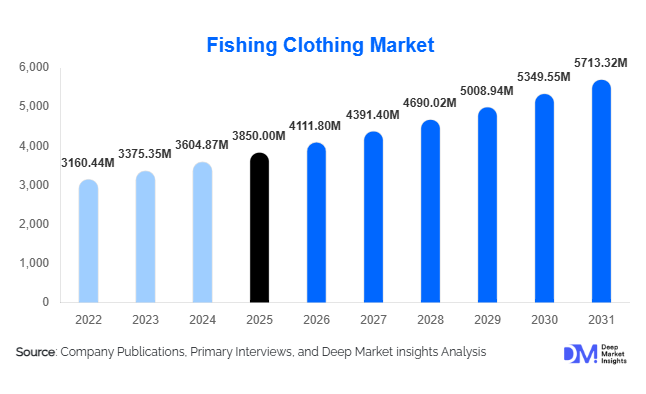
According to Deep Market Insights, the global fishing clothing market size was valued at USD 3,850 million in 2025 and is projected to grow from USD 4,111.80 million in 2026 to reach USD 5,713.32 million by 2031, expanding at a CAGR of 6.8% during the forecast period (2026–2031). The fishing clothing market growth is primarily driven by the increasing popularity of recreational fishing, rising participation in outdoor leisure activities, and advancements in performance-driven apparel technologies. Growing awareness regarding UV protection and weather-resistant gear has significantly contributed to product adoption across both amateur and professional anglers.
Key Market Insights
- Recreational fishing dominates global demand, accounting for over 60% of total consumption, supported by rising outdoor tourism trends.
- Mid-range apparel leads the market, balancing affordability and performance, with nearly 45% share of total sales.
- North America dominates the global market due to a strong fishing culture and high consumer spending.
- Asia-Pacific is the fastest-growing region, driven by increasing disposable income and expanding recreational activities.
- Polyester-based fabrics remain the most widely used material, contributing around 35% of production due to durability and moisture resistance.
- Technological innovations, including UV protection, breathable membranes, and smart textiles, are transforming product development.
What are the latest trends in the fishing clothing market?
Shift Toward Sustainable and Eco-Friendly Apparel
Manufacturers are increasingly focusing on sustainability by incorporating recycled polyester, biodegradable materials, and eco-friendly dyes into fishing clothing. Consumers are becoming more environmentally conscious, preferring brands that adopt transparent and sustainable manufacturing practices. Companies are also introducing circular economy models, including recycling programs and reduced carbon footprint production. This trend is particularly strong in North America and Europe, where environmental regulations and consumer awareness are higher. Sustainable fishing apparel is also gaining traction among premium buyers, enabling brands to command higher margins while aligning with global sustainability goals.
Integration of Advanced Fabric Technologies
The adoption of high-performance materials such as breathable membranes, moisture-wicking fabrics, and UV-resistant textiles is redefining fishing apparel. Advanced materials like Gore-Tex and neoprene are improving durability and comfort in extreme conditions. Multi-functional clothing designed for varied climates is gaining popularity, especially among professional anglers. Additionally, innovations such as anti-microbial coatings and temperature-regulating fabrics are enhancing usability. These advancements are not only improving product performance but also expanding the application of fishing clothing into broader outdoor and adventure segments.
What are the key drivers in the fishing clothing market?
Rising Participation in Recreational Fishing
The growing popularity of recreational fishing as a leisure activity is a major growth driver. Increasing urbanization and the need for outdoor experiences have led to higher participation rates globally. Governments are also promoting fishing tourism through infrastructure development, further supporting market growth. Recreational anglers drive demand for versatile and affordable apparel, particularly in North America and Europe, where participation rates are highest.
Advancements in Textile and Apparel Technology
Continuous innovation in textile technology is significantly boosting the fishing clothing market. Features such as waterproofing, breathability, UV protection, and quick-dry capabilities are becoming standard. These advancements enhance comfort and safety, encouraging consumers to invest in specialized fishing apparel. Manufacturers are also focusing on lightweight and durable materials, improving overall product appeal and expanding usage across different climates.
What are the restraints for the global market?
High Cost of Premium Fishing Apparel
Advanced fishing clothing equipped with high-performance features often comes at a premium price, limiting its accessibility to price-sensitive consumers. This is particularly evident in emerging markets where affordability remains a key concern. The cost of raw materials and advanced manufacturing processes further contributes to higher retail prices.
Seasonal Demand and Weather Dependency
The fishing clothing market is highly influenced by seasonal variations and weather conditions. Demand fluctuates based on fishing seasons, leading to inconsistent sales cycles. This creates challenges for manufacturers in terms of inventory management and production planning, potentially impacting profitability.
What are the key opportunities in the fishing clothing industry?
Expansion in Emerging Markets
Emerging economies such as China, India, and Brazil present significant growth opportunities due to increasing disposable incomes and rising interest in outdoor recreational activities. Infrastructure development in coastal and inland fishing areas is further boosting demand. Companies can leverage localized manufacturing and distribution strategies to tap into these high-growth markets.
Technological Innovation and Smart Apparel
The integration of smart textiles and wearable technology offers new growth avenues. Features such as temperature regulation, UV sensors, and enhanced durability are attracting both professional and recreational users. Companies investing in R&D for innovative apparel solutions are expected to gain a competitive edge in the market.
Report Scope
| Report Metric | Details |
|---|---|
| Market Size in 2025 | USD 3850 Million |
| Market Size in 2026 | USD 4111.80 Million |
| Market Size in 2031 | USD 5713.32 Million |
| CAGR | 6.8% (2026-2031) |
| Base Year for Estimation | 2025 |
| Historical Data | 2022-2024 |
| Forecast Period | 2026-2031 |
| Report Coverage | Revenue Forecast, Competitive Landscape, Supply Chain Disruption, Growth Factors, Environment & Regulatory Landscape and Trends |
| Geographies Covered | North America, Europe, APAC, Middle East and Africa, LATAM |
| Countries Covered | U.S., Canada, U.K., Germany, France, Spain, Italy, Russia, Nordic, Benelux, Rest of Europe, China, Korea, Japan, India, Australia, Singapore, Taiwan, South East Asia, Rest of Asia-Pacific, UAE, Turky, Saudi Arabia, South Africa, Egypt, Nigeria, Rest of MEA, Brazil, Mexico, Argentina, Chile, Colombia, Rest of LATAM |
Explore more data points, trends and opportunities Download Free Sample Report
Product Type Insights
Fishing shirts and T-shirts continue to dominate the global fishing clothing market, accounting for approximately 28% of total revenue in 2025. The leadership of this segment is primarily driven by its universal applicability across all fishing types, climates, and user categories. The increasing demand for UV-protective, lightweight, and quick-dry apparel has significantly accelerated adoption, particularly among recreational anglers who prioritize comfort during long fishing hours. Additionally, affordability and frequent replacement cycles compared to heavier gear contribute to higher volume sales. Jackets and outerwear are witnessing strong growth, especially in colder regions such as North America and Northern Europe, where demand for insulated and waterproof gear is critical. Waders and bibs remain indispensable for professional and commercial fishing activities due to their durability and ability to withstand harsh environments. Meanwhile, accessories such as gloves, caps, and headwear are gaining traction as value-added products, enhancing safety, comfort, and sun protection, thereby contributing to incremental market growth.
Application Insights
Freshwater fishing apparel leads the market with an estimated 40% share in 2025, primarily due to the widespread accessibility of freshwater fishing locations such as lakes and rivers, making it the most popular activity among recreational anglers globally. This segment benefits from lower entry barriers and higher participation rates, especially in North America and Europe. Saltwater fishing apparel follows as a significant segment, driven by coastal tourism, marine sports, and commercial fishing industries, particularly in regions such as Asia-Pacific and Latin America. Fly fishing apparel is gaining increasing popularity among enthusiasts, supported by premium product demand and specialized gear requirements, especially in developed markets. Ice fishing apparel, although niche, is experiencing steady growth driven by demand in colder climates like Canada, Scandinavia, and Russia, where insulated and weather-resistant clothing is essential. The diversification of fishing applications is expanding the overall market scope and encouraging product innovation.
Distribution Channel Insights
Offline retail channels dominate the fishing clothing market, accounting for approximately 55% of total sales in 2025. The leading position of this segment is attributed to consumer preference for physical inspection of product quality, fit, and material performance, which is particularly important for technical apparel. Specialty sporting goods stores and branded outlets continue to serve as primary sales channels, offering expert guidance and product customization. However, online retail is rapidly emerging as the fastest-growing channel, driven by increasing digital penetration, convenience, and competitive pricing. E-commerce platforms and direct-to-consumer (D2C) strategies are enabling manufacturers to expand their global reach, improve margins, and offer personalized shopping experiences. The integration of digital technologies such as virtual fitting tools and customer reviews is further enhancing online adoption, making it a critical growth driver for the future.
End-Use Insights
Recreational anglers represent the largest end-use segment, contributing over 60% of total market demand in 2025. The dominance of this segment is driven by the growing popularity of fishing as a leisure activity, supported by increasing disposable incomes and rising interest in outdoor recreation. Government initiatives promoting fishing tourism and conservation-based activities are further accelerating participation rates. The commercial fishing workforce segment, valued at approximately USD 1,200 million in 2025, remains a stable demand base, requiring highly durable, weather-resistant, and safety-focused apparel. Professional anglers, although smaller in size, play a crucial role in shaping market trends by driving demand for premium and technologically advanced clothing. Their influence through sponsorships, competitions, and media exposure significantly impacts consumer purchasing behavior, particularly in high-performance apparel segments.
Explore more data points, trends and opportunities Download Free Sample Report
Fishing Clothing Market Segmentations
By Product Type
- Fishing Jackets & Outerwear
- Fishing Shirts & T-Shirts
- Fishing Pants & Bibs
- Waders (Chest, Waist, Hip)
- Fishing Vests
- Base Layers & Thermal Wear
- Gloves & Headwear
By Application
- Freshwater Fishing Apparel
- Saltwater Fishing Apparel
- Fly Fishing Apparel
- Ice Fishing Apparel
By Distribution Channel
- Online Retail
- Specialty Sporting Goods Stores
- Brand Outlets
- Department Stores
- Outdoor & Adventure Retailers
By End-Use
- Recreational/Amateur Anglers
- Professional Anglers
- Commercial Fishing Workforce
Regional Insights
North America
North America holds the largest share of the fishing clothing market at approximately 35% in 2025, driven by a deeply rooted fishing culture and high participation rates in recreational angling. The United States dominates regional demand, supported by a large base of over 50 million anglers and strong spending capacity on premium outdoor gear. Canada also contributes significantly, particularly in cold-weather apparel such as insulated jackets and ice fishing gear. Key growth drivers in this region include advanced product adoption, high awareness of UV protection, strong retail infrastructure, and increasing demand for performance-based apparel. Additionally, the presence of leading global brands and continuous innovation in fabric technology further strengthens regional dominance.
Europe
Europe accounts for around 25% of the global market, with strong demand across the UK, Germany, France, and Nordic countries. The region benefits from both recreational and commercial fishing industries, particularly in coastal and riverine areas. A key growth driver in Europe is the increasing emphasis on sustainability and eco-friendly apparel, with consumers showing a strong preference for recycled and ethically produced clothing. Additionally, favorable government policies promoting outdoor tourism and fishing activities, along with rising participation in fly fishing, are supporting market expansion. The presence of established fishing traditions in Northern Europe further contributes to consistent demand.
Asia-Pacific
Asia-Pacific holds approximately 22% market share and is the fastest-growing region, with a CAGR exceeding 8%. China and Japan lead the market due to strong manufacturing capabilities and established fishing industries. Emerging markets such as India, Indonesia, and Thailand are witnessing rapid growth driven by rising disposable incomes, expanding middle-class populations, and increasing interest in outdoor recreational activities. Government initiatives promoting coastal tourism and marine industries are also boosting demand. Additionally, the region’s role as a global manufacturing hub enables cost-effective production and export opportunities, further accelerating market growth.
Latin America
Latin America accounts for approximately 10% of the global market, with Brazil and Mexico serving as key demand centers. Growth in this region is primarily driven by expanding fishing tourism, improving economic conditions, and increasing participation in recreational fishing. Coastal regions and inland water bodies provide ample opportunities for fishing activities, supporting steady demand for apparel. Additionally, the growing influence of international brands and the expansion of retail networks are enhancing product accessibility and driving market penetration.
Middle East & Africa
The Middle East & Africa region contributes around 8% of the global market, with growth driven by coastal fishing industries and tourism. South Africa represents a major market due to its established fishing culture and strong recreational participation. The UAE and other Gulf countries are witnessing increasing demand driven by rising disposable incomes, luxury fishing tourism, and expanding marine leisure activities. Additionally, government investments in tourism infrastructure and coastal development projects are supporting market growth. In Africa, commercial fishing activities continue to drive demand for durable and functional clothing, particularly in coastal economies.
Key Players in the Fishing Clothing Market
- Columbia Sportswear Company
- Simms Fishing Products
- Patagonia Inc.
- Grundéns
- AFTCO (American Fishing Tackle Company)
- Huk Gear
- Shimano Inc.
- Daiwa Corporation
- Rapala VMC Corporation
- Under Armour Inc.
- Nike Inc.
- Adidas AG
- Decathlon Group
- Musto
- Bass Pro Shops