Fish Finder Market Size
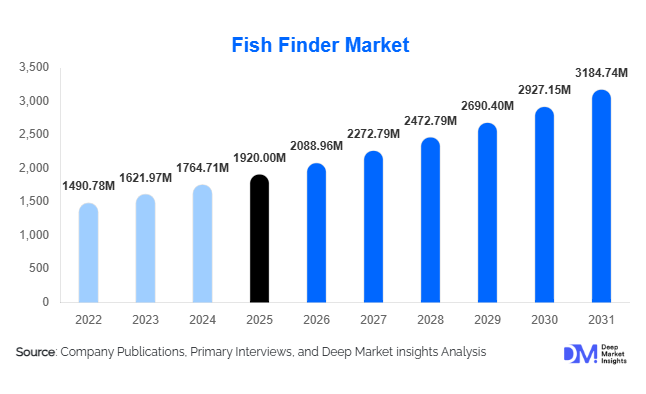
According to Deep Market Insights, the global fish finder market size was valued at USD 1,920 million in 2025 and is projected to grow from USD 2,088.96 million in 2026 to reach USD 3,184.74 million by 2031, expanding at a CAGR of 8.8% during the forecast period (2026–2031). The fish finder market growth is primarily driven by the increasing popularity of recreational fishing, advancements in sonar imaging technologies, and the growing integration of marine electronics in modern fishing boats.
Fish finders are sonar-based marine devices designed to detect underwater objects, fish schools, and seabed structures by analyzing sound wave reflections. Modern fish finders incorporate advanced technologies such as CHIRP sonar, side imaging, and GPS mapping, enabling anglers to locate fish with greater precision. Rising interest in sport fishing tournaments, expanding marine tourism, and increasing boat ownership are further strengthening market demand.
The expansion of the recreational boating industry across North America, Europe, and Asia-Pacific has significantly contributed to market growth. Additionally, commercial fishing fleets are increasingly adopting advanced fish finder systems to improve catch efficiency and reduce operational costs. Continuous innovations in wireless connectivity, high-resolution displays, and smartphone-integrated fish finders are making these devices more accessible to amateur anglers. As marine electronics ecosystems continue to evolve, fish finders are becoming an essential component of modern fishing equipment worldwide.
Key Market Insights
- Recreational fishing is the primary driver of demand, accounting for more than half of global fish finder sales due to the rising popularity of sport fishing.
- North America dominates the market, supported by a large angler population, strong recreational boating culture, and high consumer spending on marine electronics.
- CHIRP sonar technology has become the industry standard, offering improved fish detection accuracy and superior underwater imaging.
- Asia-Pacific is emerging as the fastest-growing regional market, driven by expanding fishing industries in China, Japan, and Australia.
- Portable and smartphone-connected fish finders are gaining popularity, particularly among beginner anglers and shore-based fishing enthusiasts.
- Integration with GPS navigation and multifunction displays is transforming fish finders into advanced marine electronics platforms.
What are the latest trends in the fish finder market?
Live Sonar and Real-Time Imaging Adoption
One of the most transformative trends in the fish finder market is the rapid adoption of live sonar technology. Unlike traditional sonar systems that display historical data, live sonar provides real-time visualization of fish movement and underwater structures. This technology enables anglers to observe fish behavior instantly and adjust their fishing techniques accordingly. Professional anglers and competitive fishing tournament participants have been early adopters of live sonar systems, driving significant demand for premium fish finder models. Manufacturers are investing heavily in improving sonar clarity, target separation, and range detection to enhance real-time underwater imaging capabilities.
Smart and Connected Fish Finder Systems
Connectivity is reshaping the fish finder industry as devices increasingly integrate with smartphones, tablets, and cloud-based platforms. Wi-Fi and Bluetooth-enabled fish finders allow users to monitor sonar data remotely, update navigation charts, and share fishing locations through mobile applications. This trend is particularly appealing to younger anglers who prefer digital integration and interactive fishing experiences. App-based fish finders and castable sonar devices are also expanding the market by attracting shore anglers and kayak fishers who require compact and portable solutions.
What are the key drivers in the fish finder market?
Growth of Recreational Fishing and Boating Activities
The rising popularity of recreational fishing has been one of the most influential drivers of the fish finder market. Millions of anglers worldwide participate in sport fishing activities, particularly in North America and Europe. Fishing tournaments, coastal tourism, and outdoor recreation trends are encouraging consumers to invest in advanced fishing equipment. Recreational boat owners increasingly install fish finder systems as standard navigation tools, further boosting market demand.
Technological Advancements in Sonar Imaging
Continuous improvements in sonar technology have significantly enhanced the performance and reliability of fish finders. Innovations such as CHIRP sonar, side imaging, and down imaging provide highly detailed underwater images that help anglers distinguish fish from underwater structures. High-resolution displays and 3D sonar imaging capabilities are further improving the user experience. These advancements are encouraging consumers to upgrade their devices more frequently, contributing to steady market expansion.
What are the restraints for the global market?
High Cost of Advanced Fish Finder Systems
Advanced fish finder models equipped with live sonar, multi-beam scanning, and large displays can cost several thousand dollars. These high costs limit adoption among casual anglers and small-scale fishing operators. Price sensitivity in emerging markets also restricts widespread penetration of premium fish finder technologies.
Limited Technical Expertise Among New Users
Interpreting sonar images and underwater mapping data requires technical understanding. Beginner anglers often struggle to interpret fish finder readings accurately, which may reduce the perceived value of the device. Manufacturers are addressing this challenge by developing simplified interfaces, automated fish detection algorithms, and educational tutorials to make fish finders easier to use.
What are the key opportunities in the fish finder industry?
AI-Integrated Sonar Analytics
The integration of artificial intelligence into sonar imaging represents a major opportunity for fish finder manufacturers. AI-based algorithms can analyze sonar data to identify fish species, predict fish movement patterns, and recommend optimal fishing zones. These features can significantly improve catch efficiency for both recreational and commercial anglers.
Expansion of Recreational Fishing in Emerging Economies
Recreational fishing is gaining popularity in emerging markets such as China, India, Brazil, and Southeast Asian countries. Rising disposable income, expanding marine tourism, and growing outdoor recreation culture are encouraging consumers to adopt fishing technologies. Affordable portable fish finder devices designed for beginner anglers are expected to play a key role in capturing this emerging demand.
Report Scope
| Report Metric | Details |
|---|---|
| Market Size in 2025 | USD 1920 Million |
| Market Size in 2026 | USD 2088.96 Million |
| Market Size in 2031 | USD 3184.74 Million |
| CAGR | 8.8% (2026-2031) |
| Base Year for Estimation | 2025 |
| Historical Data | 2022-2024 |
| Forecast Period | 2026-2031 |
| Report Coverage | Revenue Forecast, Competitive Landscape, Supply Chain Disruption, Growth Factors, Environment & Regulatory Landscape and Trends |
| Geographies Covered | North America, Europe, APAC, Middle East and Africa, LATAM |
| Countries Covered | U.S., Canada, U.K., Germany, France, Spain, Italy, Russia, Nordic, Benelux, Rest of Europe, China, Korea, Japan, India, Australia, Singapore, Taiwan, South East Asia, Rest of Asia-Pacific, UAE, Turky, Saudi Arabia, South Africa, Egypt, Nigeria, Rest of MEA, Brazil, Mexico, Argentina, Chile, Colombia, Rest of LATAM |
Explore more data points, trends and opportunities Download Free Sample Report
Product Type Insights
The fish finder market is segmented by product type into standalone fish finders, combo fish finders, and portable fish finders. Among these, combo fish finders represent the leading product segment due to their multifunctionality and ability to integrate sonar imaging with GPS chartplotters. These multifunction devices allow anglers to navigate waterways while simultaneously detecting fish schools, underwater terrain, and submerged structures, significantly improving fishing efficiency and safety. The growing demand for integrated marine electronics and the convenience of using a single device for both navigation and fish detection continue to drive the strong adoption of combo fish finders among recreational and professional anglers.Standalone fish finders continue to maintain a strong presence in the market, particularly among entry-level anglers and owners of small fishing vessels. These devices focus primarily on sonar-based fish detection and are widely preferred for their affordability, ease of use, and reliable performance in freshwater and nearshore fishing environments. Their simple interface and lower price points make them attractive to beginners who require basic fish detection capabilities without the complexity of advanced navigation features.Portable fish finders are also gaining significant traction in the market, driven by the rising popularity of alternative fishing formats such as kayak fishing, ice fishing, and shore fishing. These compact and lightweight devices are designed for mobility and ease of transport, making them suitable for anglers who do not operate large boats. Advances in wireless sonar technology, smartphone connectivity, and battery-powered systems have further enhanced the usability of portable fish finders, contributing to their growing adoption among casual fishing enthusiasts and outdoor hobbyists.
Application Insights
The fish finder market is segmented by application into recreational fishing, commercial fishing, and scientific research and marine monitoring. Recreational fishing remains the dominant application segment, primarily driven by the global growth in outdoor leisure activities and the increasing popularity of sport fishing. Fish finders enable anglers to significantly improve fishing success rates by accurately locating fish schools, underwater structures, and optimal fishing zones. The growing number of recreational boat owners and fishing enthusiasts worldwide continues to support strong demand for advanced fish finding technologies within this segment.The commercial fishing industry represents another important application area, where fish finders play a critical role in improving operational efficiency and reducing search time for fish populations. Commercial vessels utilize sonar-based fish detection systems to identify dense fish concentrations and optimize harvesting operations. As global demand for seafood continues to rise, commercial fishing operators are increasingly investing in advanced sonar and fish finding technologies to enhance catch productivity and reduce fuel consumption associated with long search periods.Scientific research and marine monitoring are emerging applications within the fish finder market. Oceanographic research institutions, universities, and environmental monitoring organizations are increasingly utilizing sonar technologies to study marine ecosystems, track fish migration patterns, and monitor underwater biodiversity. Government fisheries agencies are also adopting fish finder technologies as part of broader fisheries management programs to support sustainable fishing practices, monitor fish stock populations, and protect marine habitats.
Distribution Channel Insights
The fish finder market is distributed through marine equipment dealers, specialty fishing stores, online retail platforms, and direct manufacturer sales channels. Marine equipment dealers and specialty fishing retailers continue to dominate the market, as these outlets provide professional product guidance, installation services, and hands-on product demonstrations that help consumers select suitable marine electronics systems. Many boat owners prefer purchasing fish finder devices through these channels due to the availability of technical support and compatibility guidance with existing onboard navigation systems.However, e-commerce platforms are rapidly gaining market share as consumers increasingly turn to digital channels to purchase fishing equipment. Online marketplaces and specialized outdoor gear websites offer extensive product catalogs, competitive pricing, and detailed customer reviews that help anglers make informed purchasing decisions. The ability to easily compare specifications across multiple brands and models has made online retail particularly attractive for technology-oriented anglers seeking advanced sonar solutions.Direct-to-consumer sales through manufacturer websites are also growing steadily as marine electronics companies expand their digital sales strategies. By selling directly to customers, manufacturers can strengthen brand engagement, provide customized product bundles, and offer exclusive product launches. This shift toward digital commerce is expected to continue expanding as consumers become more comfortable purchasing high-value marine electronics online.
End-Use Insights
The fish finder market serves a diverse range of end users, including individual anglers, charter fishing operators, commercial fishing fleets, and marine research institutions. Individual anglers represent the largest end-user segment, driven by the rising global participation in recreational fishing and outdoor leisure activities. The increasing affordability of entry-level fish finder devices and the growing availability of portable sonar solutions have made these technologies more accessible to casual anglers and hobbyists.Charter fishing operators and professional fishing guides also represent a significant portion of market demand. These operators rely heavily on fish finder systems to improve the fishing experience for customers by locating productive fishing zones more efficiently. Advanced sonar imaging and mapping capabilities allow charter operators to deliver higher catch success rates, which directly contributes to customer satisfaction and repeat business.Commercial fishing fleets account for a substantial share of the market, particularly in countries with large commercial fishing industries such as Norway, Japan, and China. For these operators, fish finder technologies are critical tools that support efficient fishing operations, reduce fuel costs associated with fish searching, and enhance overall fleet productivity. Meanwhile, marine research institutions and government agencies are emerging as important end users as sonar technologies become increasingly valuable for marine ecosystem monitoring, fisheries stock assessment, and environmental conservation initiatives.
Explore more data points, trends and opportunities Download Free Sample Report
Fish Finder Market Segmentations
By Product Type
- Standalone Fish Finders
- Fish Finder + GPS Chartplotter Combos
- Portable / Castable Fish Finders
- Multifunction Marine Display Fish Finders
By Sonar Technology
- Traditional 2D Sonar
- CHIRP Sonar
- Down Imaging / DownScan Sonar
- Side Imaging / SideScan Sonar
- 3D and Live Sonar Systems
By Installation Type
- Transom-Mount
- Thru-Hull
- In-Hull (Shoot-Through Hull)
- Trolling Motor Mount
- Portable Systems
By Application
- Recreational Fishing
- Commercial Fishing
- Marine Research & Oceanographic Studies
- Government Fisheries Monitoring
By Distribution Channel
- Marine Equipment Dealers
- Online Retail / E-Commerce Platforms
- Specialty Fishing Stores
- OEM Boat Manufacturers
Regional Insights
North America
North America represents the largest regional market for fish finders, accounting for approximately 36% of global demand. The United States leads the region due to its large angler population, extensive inland water systems, and well-developed recreational boating industry. Canada also contributes significantly, particularly in freshwater fishing markets across provinces with large lake systems. High disposable income levels and strong consumer interest in outdoor recreational activities continue to drive market growth in the region. The presence of leading marine electronics manufacturers, rapid adoption of technologically advanced sonar systems, and increasing participation in sport fishing tournaments further support the expansion of the fish finder market across North America.
Europe
Europe holds the second-largest share of the global fish finder market, supported by its well-established marine electronics industry and long-standing fishing traditions. Countries such as Norway, the United Kingdom, Germany, and France represent major regional markets due to their active recreational fishing communities and strong maritime industries. Norway’s commercial fishing sector plays a particularly important role in regional demand, as fishing vessels rely heavily on advanced sonar technologies for efficient fish detection and navigation in deep waters. Increasing investments in marine technology innovation, growing interest in recreational boating, and expanding coastal tourism activities are additional factors driving market growth across the European region.
Asia-Pacific
Asia-Pacific is the fastest-growing region in the fish finder market, driven by the rapid expansion of both commercial and recreational fishing activities. China, Japan, South Korea, and Australia represent the key markets contributing to regional demand. China’s large commercial fishing fleet and expanding domestic seafood consumption are major drivers of fish finder adoption across the country. Japan is widely recognized for its advanced marine electronics manufacturing capabilities and early adoption of sonar-based fish detection technologies. Meanwhile, Australia’s growing recreational fishing community and increasing marine tourism activities are creating new opportunities for fish finder manufacturers across the region. Rising disposable incomes, expanding coastal economies, and technological advancements in marine navigation equipment are expected to further accelerate market growth in Asia-Pacific.
Latin America
Latin America is gradually emerging as a growing market for fish finder systems, supported by expanding marine tourism and increasing interest in sport fishing activities. Brazil, Mexico, and Chile are among the leading markets in the region due to their extensive coastlines and active fishing industries. Growing investments in coastal infrastructure, rising participation in recreational boating, and increasing demand for modern fishing equipment are contributing to the adoption of fish finder technologies across the region. Additionally, the expansion of sport fishing tournaments and charter fishing services is creating new opportunities for marine electronics suppliers in Latin American markets.
Middle East & Africa
The Middle East and Africa region represents a smaller but steadily growing market for fish finder technologies. South Africa leads regional demand due to its well-developed recreational fishing tourism industry and active coastal fishing communities. Gulf countries such as the United Arab Emirates are increasingly investing in marine leisure infrastructure, including yacht marinas and recreational boating facilities, which is expected to support long-term demand for advanced marine electronics equipment. Additionally, the gradual modernization of commercial fishing fleets and growing interest in marine sports activities across coastal regions are expected to contribute to steady market growth in the Middle East and Africa over the coming years.
Company Market Share
The fish finder market is moderately consolidated, with the top five manufacturers accounting for approximately 55% of global revenue. Leading companies compete primarily through technological innovation, product reliability, and integration with marine navigation systems. Companies are investing heavily in research and development to introduce advanced sonar technologies such as live imaging, 3D sonar mapping, and wireless connectivity. Pricing varies significantly depending on device features, with entry-level fish finders priced under USD 200 and premium multifunction sonar systems exceeding USD 3,000.
Key Players in the Fish Finder Market
- Garmin Ltd.
- Navico Group
- Humminbird (Johnson Outdoors)
- Raymarine
- Furuno Electric Co., Ltd.
- Koden Electronics Co., Ltd.
- Simrad Yachting
- Lowrance Electronics
- Deeper UAB
- HawkEye Electronics
- NorCross Marine Products
- JRC (Japan Radio Company)
- Vexilar Inc.
- Interphase Technologies
- Si-Tex Marine Electronics