Film Camera Market Size
According to Deep Market Insights, the global film camera market size was valued at USD 520 million in 2025 and is projected to grow from USD 555.36 million in 2026 to reach USD 771.67 million by 2031, expanding at a CAGR of 6.8% during the forecast period (2026–2031). The market growth is primarily driven by the resurgence of analog photography, increasing demand for artistic imaging formats, and the growing popularity of instant film cameras among younger consumers. Additionally, the revival of legacy camera brands and the expansion of film production capabilities are supporting steady market expansion.
Key Market Insights
- Analog photography revival is driving demand globally, particularly among Gen Z and millennials seeking authentic and aesthetic visual experiences.
- Instant film cameras are gaining significant traction, especially in social and casual photography applications.
- North America dominates the global market, supported by strong hobbyist communities and established creative industries.
- Asia-Pacific is the fastest-growing region, driven by rising disposable income and increasing interest in creative hobbies.
- Online retail channels are expanding rapidly, fueled by refurbished camera sales and global accessibility.
- Premiumization trends are shaping the market, with high-end cameras and limited-edition models gaining popularity.
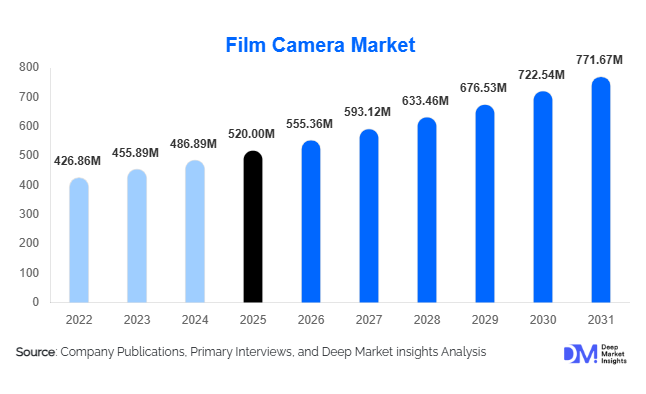
What are the latest trends in the film camera market?
Resurgence of Analog Photography Culture
The film camera market is experiencing a strong cultural revival, driven by nostalgia and the desire for tangible photography experiences. Consumers are increasingly drawn to the unique grain, color depth, and unpredictability of film photography, which digital formats cannot replicate. Social media platforms have played a significant role in popularizing analog aesthetics, encouraging users to experiment with film. This trend is particularly prominent among younger demographics, who view film photography as both an artistic expression and a lifestyle choice.
Growth of Instant Photography
Instant film cameras are rapidly gaining popularity due to their ease of use and immediate output. These cameras cater to social events, travel, and casual photography, making them highly appealing to a broad consumer base. Manufacturers are continuously innovating with compact designs, improved film quality, and creative features such as filters and smartphone integration. This segment is becoming a key growth driver within the overall film camera market.
What are the key drivers in the film camera market?
Increasing Demand for Creative and Artistic Photography
Professional photographers and creative industries are increasingly adopting film cameras for their distinctive visual output. Film photography offers a unique aesthetic that enhances storytelling in fashion, advertising, and cinematography. This growing demand for artistic differentiation is driving the adoption of premium film cameras globally.
Expansion of Hobbyist and Enthusiast Base
The rising interest in photography as a hobby is significantly contributing to market growth. Enthusiasts are exploring film photography as a creative outlet, supported by the availability of affordable entry-level cameras and online tutorials. The hobbyist segment accounts for a substantial share of market demand and continues to expand steadily.
What are the restraints for the global market?
High Cost of Film and Processing
Film photography involves recurring costs such as film rolls, development, and scanning, making it less accessible compared to digital alternatives. These costs can deter price-sensitive consumers and limit widespread adoption.
Limited Film Production Capacity
The decline in film manufacturing infrastructure has resulted in supply constraints, leading to higher prices and limited availability. This remains a key challenge for market participants aiming to scale operations.
What are the key opportunities in the film camera industry?
Emerging Demand in Developing Markets
Rapid urbanization and increasing disposable income in emerging economies such as India, China, and Brazil present significant growth opportunities. Expanding distribution networks and localized pricing strategies can help companies capture these untapped markets.
Hybrid Analog-Digital Solutions
The integration of analog photography with digital technologies, such as instant scanning and mobile app connectivity, is creating new growth avenues. These hybrid solutions enhance user convenience while preserving the traditional film experience.
Report Scope
| Report Metric | Details |
|---|---|
| Market Size in 2025 | USD 520 Million |
| Market Size in 2026 | USD 555.36 Million |
| Market Size in 2031 | USD 771.67 Million |
| CAGR | 6.8% (2026-2031) |
| Base Year for Estimation | 2025 |
| Historical Data | 2022-2024 |
| Forecast Period | 2026-2031 |
| Report Coverage | Revenue Forecast, Competitive Landscape, Supply Chain Disruption, Growth Factors, Environment & Regulatory Landscape and Trends |
| Geographies Covered | North America, Europe, APAC, Middle East and Africa, LATAM |
| Countries Covered | U.S., Canada, U.K., Germany, France, Spain, Italy, Russia, Nordic, Benelux, Rest of Europe, China, Korea, Japan, India, Australia, Singapore, Taiwan, South East Asia, Rest of Asia-Pacific, UAE, Turky, Saudi Arabia, South Africa, Egypt, Nigeria, Rest of MEA, Brazil, Mexico, Argentina, Chile, Colombia, Rest of LATAM |
Explore more data points, trends and opportunities Download Free Sample Report
Camera Type Insights
35mm film cameras dominate the global film camera market, accounting for approximately 42% of the total market share in 2025. The leadership of this segment is primarily driven by its strong balance between affordability, usability, and performance. These cameras are widely accessible in both new and refurbished markets, making them an ideal entry point for beginners while still offering sufficient manual control and compatibility with interchangeable lenses for professionals. The extensive availability of 35mm film rolls globally further reinforces their dominance, as supply chains for this format are more stable compared to niche formats.
Instant film cameras represent the fastest-growing segment, supported by rising demand for instant gratification and social sharing experiences. Their appeal lies in ease of use, portability, and immediate photo output, making them highly popular among younger demographics and event-based usage such as travel, parties, and weddings. The growth of this segment is also fueled by product innovation, including compact designs, improved film quality, and integration with smartphone ecosystems.
Medium and large format film cameras cater to niche but high-value professional segments, particularly in fine art photography, commercial shoots, and studio environments. These cameras offer superior image resolution, tonal range, and detail, making them indispensable for specialized applications. However, their high cost and complexity limit widespread adoption, keeping their market share relatively smaller but stable.
End-Use Insights
Hobbyists and enthusiasts constitute the largest end-use segment, contributing approximately 44% of the global market share in 2025. This segment is the primary growth engine of the film camera market, driven by the resurgence of analog photography as a creative hobby and lifestyle choice. Social media platforms and digital communities have significantly influenced this trend, encouraging users to explore film photography for its aesthetic appeal and authenticity. The increasing availability of entry-level cameras and affordable film options has further accelerated adoption among this group.
Professional photographers remain a critical segment, particularly in industries such as fashion, advertising, and cinematography. Film cameras are valued for their unique visual characteristics, including natural grain, color depth, and dynamic range, which enhance artistic storytelling. This segment is also benefiting from the growing demand for differentiated visual content in high-end commercial projects.
Educational institutions are emerging as a steadily growing segment, incorporating film photography into art, design, and media curricula. The use of film cameras in education is driven by their ability to teach fundamental photography principles, such as exposure, composition, and manual control, providing students with a deeper understanding of the craft.
Distribution Channel Insights
Online retail channels dominate the distribution landscape, accounting for approximately 38% of total market sales in 2025. The growth of this segment is driven by global accessibility, competitive pricing, and the expansion of refurbished and second-hand marketplaces. E-commerce platforms enable consumers to access a wide range of products, including discontinued models and rare vintage cameras, which are often unavailable through traditional retail channels.
Specialty photography stores continue to play a vital role, particularly for high-end and professional-grade equipment. These stores offer personalized services, expert guidance, and after-sales support, making them a preferred choice for serious photographers. Consumer electronics retail chains contribute significantly to entry-level camera sales, especially in urban markets where physical retail presence enhances product visibility.
The second-hand and refurbished market is one of the fastest-growing distribution segments, driven by affordability and sustainability considerations. Consumers are increasingly opting for pre-owned cameras, which provide access to high-quality products at lower price points, thereby expanding the overall market base.
Explore more data points, trends and opportunities Download Free Sample Report
Film Camera Market Segmentations
By Camera Type
- 35mm Film Cameras
- Medium Format Film Cameras
- Large Format Film Cameras
- Instant Film Cameras
- Disposable Film Cameras
By End-Use
- Professional Photographers
- Hobbyists & Enthusiasts
- Educational Institutions
- Commercial & Creative Industries
By Distribution Channel
- Online Retail
- Specialty Photography Stores
- Consumer Electronics Retail Chains
- Second-hand/Refurbished Marketplaces
Regional Insights
North America
North America holds the largest share of the film camera market, accounting for approximately 35% of global revenue in 2025. The United States dominates regional demand, supported by a strong culture of photography, a large base of hobbyists and professionals, and well-established creative industries such as fashion and entertainment. The region also benefits from a robust distribution network, including both online platforms and specialty stores, ensuring product availability. Additionally, the growing trend of analog revival among younger consumers and the presence of leading market players contribute to sustained demand growth.
Europe
Europe represents around 30% of the global market, with key contributions from Germany, the United Kingdom, and France. The region’s growth is driven by its rich photographic heritage and strong presence of premium camera manufacturers. Demand is further supported by the expansion of creative industries, including advertising and media production. Increasing consumer preference for sustainable and analog experiences is also fueling growth, as film photography aligns with the broader trend toward authenticity and craftsmanship. Government support for arts and cultural activities in several European countries further enhances market development.
Asia-Pacific
Asia-Pacific accounts for approximately 25% of the market and is the fastest-growing region, with a CAGR exceeding 8.5%. Japan plays a dual role as both a major producer and consumer, with established companies driving innovation and supply. China and India are emerging as high-growth markets due to rising disposable incomes, urbanization, and increasing interest in photography as a hobby. The rapid expansion of e-commerce platforms and social media influence in these countries is significantly boosting demand. Additionally, younger demographics in the region are embracing film photography as a form of creative expression, further accelerating market growth.
Latin America
Latin America holds a smaller share of around 5% of the global market, with Brazil and Mexico leading regional demand. Growth in this region is primarily driven by increasing accessibility to affordable cameras through online platforms and the expanding second-hand market. Rising interest in photography as a hobby, coupled with improving economic conditions in urban centers, is supporting market expansion. Additionally, the influence of global photography trends through social media is encouraging adoption among younger consumers.
Middle East & Africa
The Middle East and Africa region accounts for approximately 5% of the global market. Growth is concentrated in urban hubs such as the UAE and South Africa, where demand is supported by tourism, luxury retail, and expanding creative industries. High disposable income in the Middle East is driving demand for premium and instant film cameras, while Africa is witnessing gradual adoption driven by increasing urbanization and youth interest in creative fields. The growing presence of international retail chains and online platforms is also improving product accessibility, contributing to steady market growth in the region.
Key Players in the Film Camera Market
- Canon Inc.
- Nikon Corporation
- Fujifilm Holdings Corporation
- Leica Camera AG
- Eastman Kodak Company
- Olympus Corporation
- Ricoh Imaging (Pentax)
- Hasselblad
- Polaroid
- Lomography
- Yashica
- Zeiss
- Voigtländer
- Rollei
- Minolta (revival brands)