Face Steaming Device Market Size
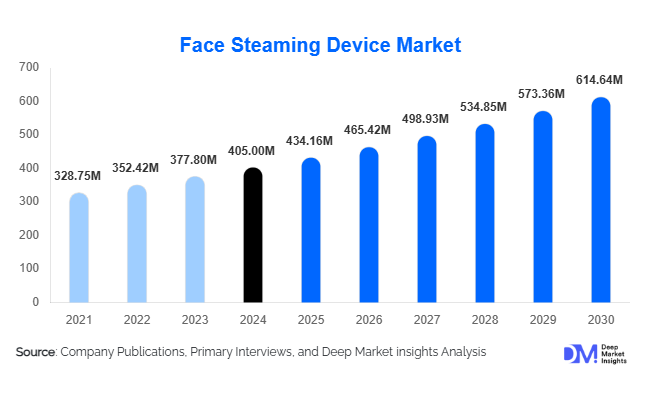
According to Deep Market Insights, the global face steaming device market size was valued at USD 405.00 million in 2025 and is projected to grow from USD 434.16 million in 2026 to reach USD 614.64 million by 2031, expanding at a CAGR of 7.2% during the forecast period (2026–2031). Growth is driven by rising at-home skincare adoption, increasing consumer emphasis on wellness-based beauty routines, and rapid integration of advanced steam technologies such as nano-ionic, ultrasonic, and smart app-connected devices.
Key Market Insights
- Shift toward at-home skincare wellness continues to drive mass-market device adoption, particularly among Millennials and Gen Z.
- Nano-ionic and ultrasonic steamers are gaining rapid traction due to superior skin penetration and hydration outcomes.
- E-commerce dominates global distribution, accounting for more than half of sales in 2025.
- Asia-Pacific is the fastest-growing region, supported by rising disposable income and beauty-tech adoption in China, India, Japan, and South Korea.
- Smart connected devices, integrated with mobile apps, customizable steam cycles, and AI-based skincare guidance, continue to reshape product innovation.
- Commercial demand from salons, spas, and dermatology clinics is steadily increasing as multifunction steamers support professional-grade therapies.
Face Steaming Device Market Trends
Technologically Advanced, Skin-Specific Steam Solutions
The market is witnessing accelerated adoption of nano-ionic, ionic, and ultrasonic micro-mist technologies, offering deeper hydration, enhanced pore cleansing, and targeted skincare benefits. Smart steamers equipped with mobile apps, adjustable intensity modes, auto shut-off mechanisms, and skin-type personalization are elevating user experience and creating premium sub-segments. These devices allow users to customize steam temperature, session duration, and aromatherapy settings. With the rise of AI-assisted beauty, next-generation steamers offer routine tracking, skin analysis, and usage optimization, appealing strongly to tech-savvy consumers.
Rapid Growth of At-Home Beauty and Wellness Ecosystems
Consumers increasingly prefer at-home facial treatments as an affordable alternative to salon or spa services. Influencer-driven skincare routines, clean beauty movements, and post-pandemic wellness habits are expanding the use of steamers for deep cleansing, hydration, product absorption, and sinus relief. Multi-function steamers that integrate LED therapy, microcurrent stimulation, aromatherapy, or mask warmers are rising in popularity, creating a comprehensive skincare ecosystem. This convergence of beauty and wellness is reshaping purchasing behavior and accelerating premium device adoption.
Face Steaming Device Market Drivers
Growing Adoption of At-Home Skincare Treatments
Consumers worldwide are prioritizing self-care and wellness-focused beauty rituals, leading to a surge in demand for DIY facial treatments. Face steamers offer an easy, effective way to cleanse pores, prepare skin for serums, and enhance hydration, making them a staple in at-home skincare routines. Increased awareness through dermatologists, beauty influencers, and product tutorials further enhances market penetration. With busy lifestyles and rising salon prices, at-home devices provide convenience, cost savings, and professional-grade outcomes, strengthening market growth.
Technological Advancements and Innovation
Advances in nano-ionic technology, smart connectivity, and micro-mist ultrasonic systems have significantly improved device efficiency and user safety. These innovations produce finer steam particles that penetrate deeper into skin layers, leading to faster and more noticeable skincare benefits. Smart steamers connected to mobile apps offer personalized routines, timers, session tracking, and adaptive steam cycles. As consumers increasingly seek high-tech, premium beauty solutions, technologically advanced devices are driving substantial product differentiation and value creation.
Increasing Beauty & Wellness Expenditure
Global wellness spending is rising, with consumers prioritizing products that enhance skin health, relaxation, and long-term beauty outcomes. The facial steaming device market benefits from this shift as buyers increasingly view skincare devices not as luxury items but as necessary lifestyle tools. Premium beauty devices, often priced above USD 150, are gaining traction among professional users and affluent households, expanding revenue potential in developed and emerging markets alike.
Face Steaming Device Market Restraints
Safety Concerns and Skin Sensitivity Risks
Despite growing popularity, face steaming devices are associated with concerns such as overheating, burns, skin irritation, and improper usage. Individuals with sensitive skin or certain dermatological conditions may experience adverse reactions, limiting adoption. Manufacturers are pressured to improve device safety standards, temperature controls, and certification compliance to build consumer trust. Misuse or inconsistent product quality among budget brands further challenges market credibility.
Market Fragmentation and Low-Cost Competition
The market features numerous low-cost manufacturers, especially in Asia, causing significant price competition. These budget devices, often sold online, create margin pressure for premium brands and make market differentiation difficult. The abundance of generic products also leads to concerns related to quality, durability, and safety compliance. Premium brands must therefore invest heavily in innovation, marketing, and certifications to maintain a competitive advantage.
Face Steaming Device Market Opportunities
Smart Connected Skincare Ecosystems
Smart device integration presents a major opportunity for manufacturers to differentiate their offerings. App-enabled face steamers can deliver real-time skin analysis, personalized steam cycles, progress tracking, and AI-driven recommendations. The convergence of IoT and beauty-tech supports subscription-based models for consumables such as aromatherapy pods and skincare boosters. This shift toward connected devices is expected to accelerate premium market growth and customer loyalty.
Expansion in Emerging Markets
Rapid urbanization, rising disposable incomes, and growing beauty awareness in China, India, Indonesia, Brazil, and the Middle East are unlocking new demand potential. As consumers in these markets increasingly adopt Western-style skincare routines, facial steamers become an affordable entry point into professional-grade beauty care. E-commerce expansion further facilitates access to global brands. Manufacturers entering these markets with localized pricing, language support, and region-specific product features can capture significant untapped value.
Report Scope
| Report Metric | Details |
|---|---|
| Market Size in 2025 | USD 405 Million |
| Market Size in 2026 | USD 434.16 Million |
| Market Size in 2031 | USD 614.64 Million |
| CAGR | 7.2% (2026-2031) |
| Base Year for Estimation | 2025 |
| Historical Data | 2022-2024 |
| Forecast Period | 2026-2031 |
| Report Coverage | Revenue Forecast, Competitive Landscape, Supply Chain Disruption, Growth Factors, Environment & Regulatory Landscape and Trends |
| Geographies Covered | North America, Europe, APAC, Middle East and Africa, LATAM |
| Countries Covered | U.S., Canada, U.K., Germany, France, Spain, Italy, Russia, Nordic, Benelux, Rest of Europe, China, Korea, Japan, India, Australia, Singapore, Taiwan, South East Asia, Rest of Asia-Pacific, UAE, Turky, Saudi Arabia, South Africa, Egypt, Nigeria, Rest of MEA, Brazil, Mexico, Argentina, Chile, Colombia, Rest of LATAM |
Explore more data points, trends and opportunities Download Free Sample Report
Product Type Insights
Facial steamers dominate the market, accounting for approximately 45% of global revenue in 2025. These devices are widely used for everyday skincare routines, offering benefits such as deep cleansing, pore opening, and hydration. Portable and tabletop steamers appeal to home users, while professional-grade steamers serve salons and dermatology clinics. Nano-ionic and ultrasonic devices are gaining traction due to superior performance and fine steam particle generation. Multifunction devices integrating LED therapy, aromatherapy, and ion technology are creating new premium sub-segments.
Application Insights
Face steaming devices are used for deep skin cleansing, hydration, blackhead removal preparation, and improved serum absorption. Residential at-home skincare remains the largest segment, representing nearly 60% of market demand. Commercial usage in salons, spas, and dermatology clinics is expanding due to increased adoption of multifunction steamers in facial treatments. New applications are emerging in respiratory wellness and sinus relief, creating additional growth pathways.
Distribution Channel Insights
E-commerce remains the dominant distribution channel, contributing over 50% of global sales. Online platforms enable customers to compare features, read reviews, and access competitive pricing. Specialty beauty stores, electronic retailers, and departmental stores collectively support offline sales, particularly for premium brands. Direct-to-consumer (D2C) websites are gaining momentum as companies invest in personalized marketing, virtual demos, and bundled skincare packages.
End-User Insights
Residential users represent the largest share of demand due to convenience, affordability, and growing adoption of at-home beauty routines. Commercial users, salons, spas, wellness centers, and dermatology clinics prefer high-end multifunction devices with enhanced durability and steam precision. The growing wellness industry, including yoga and holistic centers, is incorporating steamers for treatments, expanding the landscape of end-user applications.
Explore more data points, trends and opportunities Download Free Sample Report
Face Steaming Device Market Segmentations
By Product Type
- Tabletop Facial Steamers
- Portable / Handheld Facial Steamers
- Nano-Ionic & Ultrasonic Steamers
- Face Steam Inhalers
- Facial Saunas
- Multifunction / Combo Steam Devices
By Technology
- Conventional Steam Technology
- Nano-Ionic Steam Technology
- Ultrasonic / Micro-Mist Technology
- Smart Connected Steam Devices (App-Enabled)
By Distribution Channel
- Online Retail (E-commerce)
- Specialty Beauty & Electronics Stores
- Department Stores
- Direct Brand Stores
- Professional/Salon Supply Channels
By End User
- Residential / At-Home Users
- Beauty Salons
- Spas & Wellness Centers
- Dermatology Clinics
- Health & Wellness Facilities
By Price Category
- Low-End/Budget Devices
- Mid-Range Devices
- Premium / Professional Devices
- Smart High-End Devices
Regional Insights
North America
North America accounts for approximately 30–35% of global market share, driven by strong beauty spending, high awareness of skincare technologies, and widespread availability of premium devices. The U.S. is the leading market, with increasing adoption of nano-ionic and multifunction steamers among both home users and professional salons.
Europe
Europe holds around 20% of the market share, supported by demand in Germany, the U.K., France, and Italy. Consumers in Europe emphasize safety certifications, premium device quality, and dermatologically approved features. The region also shows a strong preference for sustainable and energy-efficient beauty devices.
Asia-Pacific
APAC is the fastest-growing region, contributing 35–38% of global demand. China leads the market, followed by Japan, South Korea, and India. Rising disposable income, beauty-tech adoption, and a flourishing e-commerce ecosystem are key growth drivers. South Korea and Japan, global leaders in skincare innovation, significantly influence product trends.
Latin America
Latin America is gradually expanding, particularly in Brazil and Mexico. Growing urban populations and rising interest in at-home beauty solutions are driving market penetration, although cost sensitivity remains high.
Middle East & Africa
MEA contributes 5–7% of global demand, with the UAE and Saudi Arabia leading due to high-income consumers and strong affinity for premium beauty technologies. Local salons and wellness centers also generate steady commercial demand.
Leading Players in the Face Steaming Device Market
- Panasonic Corporation
- Conair Corporation
- Revlon Inc.
- Pure Daily Care
- Beurer GmbH
- Kingdom Beauty
- Vanity Planet
- Dr. Dennis Gross Skincare
- OKACHI GLIYA
- AromaTools
- HoMedics
- EZBASICS
- Secura
- Zenpy
- Flynn Tech
Recent Developments
- In 2025, Panasonic introduced a new nano-ionic steamer with AI-based skin detection for personalized steam cycles.
- In 2025, Pure Daily Care expanded its multifunction device lineup, integrating LED therapy and ultrasonic misting.
- In 2025, Beurer launched a smart facial steamer connected to a proprietary skincare mobile app for enhanced personalization.