Extended Stay Hotel Market Size
According to Deep Market Insights, the global extended stay hotel market size was valued at USD 58,500.00 million in 2025 and is projected to grow from USD 62,829.00 million in 2026 to reach USD 89,780.40 million by 2031, expanding at a CAGR of 7.4% during the forecast period (2026–2031). The market growth is primarily driven by rising corporate relocations, increasing demand for serviced apartments, the expansion of midscale and luxury extended stay offerings, and evolving traveler preferences toward long-term accommodations that combine the convenience of hotels with home-like amenities.
Key Market Insights
- Corporate extended stay hotels dominate globally, driven by long-term business assignments and project-based travel that require fully equipped accommodations.
- Midscale extended stay offerings are expanding rapidly, providing a balance of affordability and amenities for families, remote workers, and business travelers.
- North America remains the largest market, with the U.S. and Canada accounting for nearly 50% of the global market due to strong corporate mobility and domestic travel.
- Asia-Pacific is the fastest-growing region, led by increasing corporate projects, urbanization, and rising middle-class affluence in China and India.
- Technology adoption, including mobile check-ins, AI-driven services, and digital booking platforms, is enhancing guest experience and operational efficiency.
- Sustainability initiatives and eco-friendly properties are increasingly shaping consumer preference, particularly in Europe and North America.
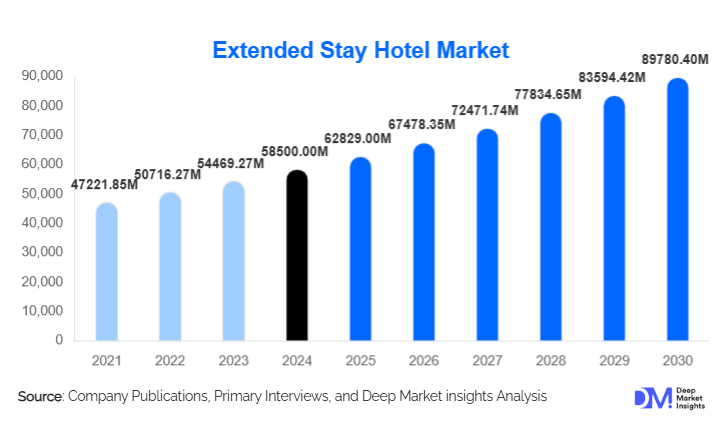
Extended Stay Hotel Market Trends
Rise of Serviced Apartments and Midscale Offerings
The trend toward serviced apartments and midscale extended stay hotels has accelerated as travelers seek a home-like environment with hotel-like services. Features such as kitchenettes, laundry facilities, living spaces, and communal lounges are becoming standard offerings. Midscale hotels provide a perfect balance for corporate travelers and families, delivering cost-effective long-term accommodations while maintaining comfort and convenience. This trend is particularly strong in urban centers and regions experiencing high workforce mobility.
Technology Integration and Smart Stays
Emerging technologies are being integrated to enhance guest experience and operational efficiency. Mobile check-ins, digital room controls, AI-powered concierge services, and predictive maintenance systems are now common in leading extended stay hotels. Online booking platforms allow for dynamic pricing, personalized offers, and real-time occupancy updates. These innovations appeal to younger, tech-savvy business travelers and remote workers seeking convenience, safety, and flexibility during long-term stays.
Extended Stay Hotel Market Drivers
Rising Corporate Relocations and Project-Based Work
Corporate travel and project-based assignments are the largest drivers of demand for extended stay hotels. Professionals working on medium- to long-term assignments prefer accommodations that offer comfort, kitchen facilities, and work-friendly environments. Partnerships between hotels and corporate clients ensure stable bookings, predictability in occupancy, and recurring revenue, particularly in North America and Europe.
Work-from-Anywhere and Remote Work Trends
The global shift toward remote and hybrid work models has fueled demand for long-term stays. Professionals now seek accommodations that provide office-friendly spaces, reliable internet connectivity, and home-like living arrangements. Extended stay hotels are increasingly targeting remote workers and “digital nomads” through specialized packages that combine workspaces, communal areas, and leisure amenities, driving occupancy outside traditional business travel periods.
Tourism Recovery and Family Travel
Leisure travel is rebounding post-pandemic, with families increasingly preferring long-term accommodations over traditional hotels. Extended stay hotels provide affordability, safety, and convenience for multi-day or week-long vacations. The trend toward domestic and regional tourism is further accelerating growth in APAC and LATAM markets.
Extended Stay Hotel Market Restraints
High Operational Costs
Extended stay hotels require significant investments in room amenities, kitchens, laundry facilities, housekeeping, and technology systems. High operational and maintenance costs can deter new entrants and limit expansion in price-sensitive markets. These expenses are particularly impactful for midscale and upscale segments, where quality expectations remain high.
Regulatory and Zoning Challenges
Compliance with local regulations, including hospitality licensing, building codes, and safety standards, can slow market entry and expansion. Stringent regulations in Europe and North America increase operational complexity and compliance costs, posing challenges to scaling operations efficiently.
Extended Stay Hotel Market Opportunities
Expansion in Emerging Markets
Emerging economies in Asia-Pacific and Latin America, particularly China, India, Brazil, and Mexico, present significant opportunities. Increasing corporate mobility, urbanization, and a growing middle class are driving demand for cost-effective midscale and premium extended stay accommodations. Operators investing in these regions can capitalize on lower construction costs, less competitive landscapes, and rising disposable incomes.
Technology and Smart Hotel Solutions
Hotels adopting smart technologies, such as AI-powered guest support, predictive maintenance, self-check-in kiosks, and mobile-based room controls, can enhance guest experience and optimize operational efficiency. These innovations attract tech-savvy travelers and enable operators to maintain competitive pricing while improving profitability.
Corporate & Relocation Partnerships
Strategic collaborations with corporates, government bodies, and relocation agencies present opportunities for stable, long-term bookings. Extended stay hotels providing fully furnished accommodations with business-oriented services are increasingly preferred over traditional hotels or rental apartments. Such partnerships can enhance occupancy rates, particularly during off-peak leisure periods.
Sustainability and Green Certifications
Hotels adopting energy-efficient operations, eco-friendly practices, and certifications such as LEED are gaining a competitive edge. Environmentally conscious travelers increasingly prefer properties that minimize ecological impact, making sustainability a differentiator in market positioning.
Report Scope
| Report Metric | Details |
|---|---|
| Market Size in 2025 | USD 58500 Million |
| Market Size in 2026 | USD 62829 Million |
| Market Size in 2031 | USD 89780.40 Million |
| CAGR | 7.4% (2026-2031) |
| Base Year for Estimation | 2025 |
| Historical Data | 2022-2024 |
| Forecast Period | 2026-2031 |
| Report Coverage | Revenue Forecast, Competitive Landscape, Supply Chain Disruption, Growth Factors, Environment & Regulatory Landscape and Trends |
| Geographies Covered | North America, Europe, APAC, Middle East and Africa, LATAM |
| Countries Covered | U.S., Canada, U.K., Germany, France, Spain, Italy, Russia, Nordic, Benelux, Rest of Europe, China, Korea, Japan, India, Australia, Singapore, Taiwan, South East Asia, Rest of Asia-Pacific, UAE, Turky, Saudi Arabia, South Africa, Egypt, Nigeria, Rest of MEA, Brazil, Mexico, Argentina, Chile, Colombia, Rest of LATAM |
Explore more data points, trends and opportunities Download Free Sample Report
Product Type Insights
Corporate extended stay hotels dominate the market, accounting for approximately 45% of the global market in 2025 due to steady demand from project-based assignments and relocations. Midscale offerings represent 38% of the market, balancing affordability with essential amenities, while upscale and luxury segments cater to premium corporate and leisure travelers seeking personalized services. Economy/budget extended stay hotels are gaining traction in emerging markets due to cost-sensitive travelers and families. The trend toward serviced apartments and multi-room suites is shaping the overall market dynamics.
Application Insights
Corporate travel and project assignments remain the largest application, contributing 44% of the global market in 2025. Relocation/temporary housing demand is rising rapidly, particularly in APAC and LATAM, driven by multinational corporate expansions. Tourism and leisure applications are expanding steadily, especially among families seeking midscale and luxury extended stay accommodations. Government and institutional stays, including long-term deployments and temporary employee housing, also contribute to consistent demand.
Distribution Channel Insights
Online travel agencies (OTAs) and direct booking platforms dominate distribution, offering transparency, dynamic pricing, and convenience. Corporate agreements and bulk bookings continue to be critical for large hotel chains, ensuring steady occupancy. Digital marketing, loyalty programs, and subscription-based models are emerging as additional channels to attract repeat customers, particularly among business travelers and remote workers.
Traveler Type Insights
Business travelers are the largest customer segment, accounting for 42% of the global market in 2025, due to frequent project assignments and long-term relocations. Families are increasingly adopting extended stay hotels for vacations and temporary housing. Remote workers and digital nomads are emerging as a key growth segment, particularly in APAC. Relocation clients, government employees, and institutional travelers contribute to steady demand across regions.
Age Group Insights
Travelers aged 31–50 years form the largest market, balancing high disposable income with the need for long-term stays. The 18–30 age group is fueling growth in budget and midscale options, leveraging technology for bookings and extended stays. Older demographics, particularly 51–65 years, are significant contributors to premium and luxury extended stay segments, prioritizing comfort, amenities, and work-leisure integration.
Explore more data points, trends and opportunities Download Free Sample Report
Extended Stay Hotel Market Segmentations
By Type
- Corporate Extended Stay Hotels
- Leisure Extended Stay Hotels
- Serviced Apartments / Residences
By Service Level
- Economy / Budget
- Midscale
- Upscale / Luxury
By Guest Type
- Business Travelers
- Families
- Relocation / Temporary Housing
- Others (Students, Medical Travelers, Project Workers)
By Application
- Corporate Travel & Project Assignments
- Tourism & Leisure
- Relocation / Temporary Residence
- Government & Institutional Stays
By Distribution Channel
- Online Travel Agencies (OTAs)
- Direct Hotel Bookings
- Corporate Contracts / Bulk Bookings
Regional Insights
North America
North America is the largest market, holding 50% of the global share in 2025 (USD 18.75 billion). The U.S. leads due to corporate relocations, domestic tourism, and the presence of major branded extended stay chains. Canada follows, driven by project-based travel and business relocations. Midscale and corporate-focused offerings dominate, supported by strong demand for predictable quality and full-service amenities.
Europe
Europe holds 22% of the global market (USD 8.25 billion), with Germany, the U.K., and France as key markets. Germany benefits from industrial relocations, the U.K. from corporate assignments, and France from tourism and long-term business stays. Regulatory standards and high operational costs pose challenges, but quality and service excellence maintain steady demand.
Asia-Pacific
APAC accounts for 18% of the market (USD 6.75 billion) and is the fastest-growing region, with China and India driving demand due to corporate mobility, urbanization, and expanding middle-class travel. Japan and Australia represent mature markets with steady demand, while Southeast Asia is emerging as a hub for midscale and serviced apartment offerings.
Latin America
Brazil and Mexico are key markets, driven by corporate relocations and inbound tourism. Demand is gradually increasing, particularly for midscale and cost-effective extended stay hotels. Latin American travelers prioritize adventure, family-friendly stays, and flexible packages.
Middle East & Africa
UAE and Saudi Arabia lead in MEA due to corporate and tourism travel. Africa’s growing business travel, energy projects, and infrastructure development support regional demand. Extended stay hotels are increasingly popular among expatriates and long-term project workers.
Leading Players in the Extended Stay Hotel Industry
- Marriott International
- Hilton Worldwide
- IHG Hotels & Resorts
- Hyatt Hotels Corporation
- AccorHotels
- Extended Stay America
- Choice Hotels
- Ascott Limited
- Sonder
- Oakwood Worldwide
- Aimbridge Hospitality
- Red Lion Hotels
- Radisson Hotel Group
- Waterford Hotel Group
- Staybridge Suites
- Wyndham Hotels & Resorts