Emerald Ring Market Size
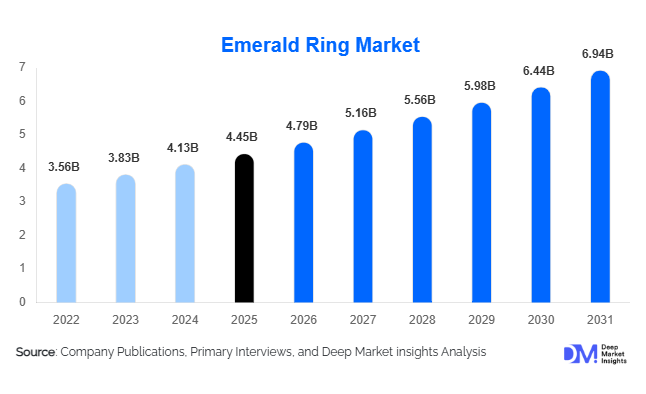
According to Deep Market Insights, the global emerald ring market size was valued at USD 4.45 billion in 2025 and is projected to grow from USD 4.79 billion in 2026 to reach USD 6.94 billion by 2031, expanding at a CAGR of 7.7% during the forecast period (2026–2031). The emerald ring market growth is primarily driven by increasing demand for colored gemstone jewelry, rising preference for personalized luxury accessories, and expanding adoption of emerald engagement rings among younger consumers seeking distinctive alternatives to traditional diamond jewelry.
Key Market Insights
- Colored gemstone jewelry is increasingly replacing traditional diamond-centric purchases, with emerald rings gaining strong traction in bridal and luxury fashion categories.
- Luxury jewelry brands are expanding sustainable sourcing initiatives, integrating ethically mined emeralds, recycled precious metals, and blockchain-based gemstone traceability.
- Asia-Pacific dominates the global emerald ring market, supported by strong bridal jewelry demand in India and rising luxury consumption in China.
- North America remains a leading premium market, driven by customization trends, online luxury jewelry sales, and growing demand for vintage-inspired emerald engagement rings.
- Lab-grown emerald rings are emerging as a fast-growing segment, enabling affordable luxury access among younger consumers and sustainability-focused buyers.
- Technological integration, including AI-assisted jewelry customization, virtual try-on solutions, and digital gemstone certification, is transforming customer engagement globally.
Emerald Ring Market Trends
Rise of Sustainable and Ethical Gemstone Jewelry
Sustainability has become one of the defining trends within the emerald ring market. Consumers increasingly prioritize ethically sourced gemstones, transparent supply chains, and environmentally responsible mining practices when purchasing luxury jewelry. Jewelry brands are strengthening partnerships with certified emerald mines in Colombia and Zambia while implementing blockchain-enabled gemstone traceability systems to verify authenticity and ethical sourcing. Recycled gold and platinum settings are also gaining popularity as buyers seek environmentally conscious luxury purchases. This trend is particularly strong among millennials and Gen Z consumers who value sustainability alongside exclusivity and craftsmanship. Luxury houses are further integrating ESG-focused branding strategies, positioning emerald rings as premium yet socially responsible investment purchases.
Technology-Driven Personalization and Digital Retail
Advanced technologies are reshaping both online and offline emerald ring retail experiences. AI-powered customization platforms, 3D ring configurators, augmented reality-based virtual try-ons, and digital gemstone visualization tools are significantly improving online jewelry purchasing confidence. Luxury retailers are increasingly offering personalized emerald ring design services that allow customers to select gemstone origin, carat size, metal type, and ring setting digitally. Omnichannel retailing strategies are enabling seamless integration between physical showrooms and online luxury platforms. Social media-driven discovery and influencer marketing are also accelerating digital jewelry sales globally. In addition, lab-grown emerald collections are benefiting from online-first retail strategies targeting younger luxury consumers seeking affordable personalization options.
Emerald Ring Market Drivers
Growing Demand for Colored Gemstone Engagement Rings
The increasing popularity of colored gemstone engagement jewelry is one of the strongest growth drivers for the emerald ring market. Consumers are shifting away from conventional diamond solitaire rings toward more personalized and visually distinctive alternatives. Emerald rings symbolize luxury, prosperity, exclusivity, and heritage, making them particularly attractive within bridal jewelry collections. Celebrity endorsements, fashion trends, and social media exposure are further accelerating acceptance of emerald engagement rings among millennials and Gen Z consumers. Vintage-inspired jewelry aesthetics and bespoke ring customization services are also contributing to higher demand for premium emerald ring designs globally.
Expansion of Global Luxury Consumption
Rising disposable incomes and increasing luxury spending across emerging economies are significantly supporting market growth. Expanding upper-middle-class populations in countries such as China, India, the UAE, and Indonesia are driving strong demand for fine gemstone jewelry. Emerald rings are increasingly purchased not only as fashion accessories but also as investment-oriented luxury assets and heirloom products. Luxury jewelry brands are expanding flagship stores, premium collections, and experiential retail strategies across major metropolitan markets. The rise of affluent younger consumers and high-net-worth individuals is further strengthening demand for premium handcrafted emerald rings and customized gemstone jewelry.
Emerald Ring Market Restraints
High Cost and Limited Availability of Natural Emeralds
The global emerald ring market faces challenges associated with the scarcity and high pricing of premium-quality natural emeralds. High-grade Colombian emeralds remain limited in supply due to mining constraints, geopolitical factors, and fluctuating gemstone production volumes. These supply limitations increase manufacturing costs and retail pricing, restricting accessibility for broader consumer groups. In addition, volatility in gold and platinum prices further affects overall ring production costs and profit margins for manufacturers and retailers.
Durability and Maintenance Concerns
Emeralds are comparatively softer and more inclusion-prone than diamonds and sapphires, making them susceptible to scratches and cracks under frequent use. This creates durability concerns among consumers seeking long-lasting bridal and everyday jewelry. The gemstone’s fragility increases maintenance requirements and insurance costs, particularly for high-value emerald rings. Counterfeit gemstones and inconsistent gemstone grading standards across online retail channels also create trust-related challenges for consumers and luxury jewelry brands.
Emerald Ring Market Opportunities
Growth of Lab-Grown Emerald Jewelry
The increasing adoption of lab-grown emeralds presents a major opportunity for market expansion. These gemstones offer visually similar aesthetics to natural emeralds while significantly reducing price barriers for younger and price-sensitive consumers. Lab-grown emerald rings are gaining popularity within entry-luxury and online retail categories due to affordability and sustainability positioning. Jewelry companies are increasingly launching dedicated lab-grown collections to target eco-conscious buyers while improving margins through lower raw material procurement costs.
Luxury Gifting and Investment Jewelry Demand
Emerald rings are increasingly being purchased as luxury gifting products and collectible investment assets. Rising wealth concentration in Asia-Pacific and the Middle East is driving demand for premium gemstone jewelry during weddings, anniversaries, milestone celebrations, and festive occasions. High-net-worth individuals increasingly view rare emerald rings as long-term wealth preservation assets due to limited gemstone supply and rising auction prices globally. Luxury jewelry brands are capitalizing on this trend by launching exclusive high-jewelry emerald collections and limited-edition gemstone pieces targeted toward affluent collectors.
Report Scope
| Report Metric | Details |
|---|---|
| Market Size in 2025 | USD 4.45 Billion |
| Market Size in 2026 | USD 4.79 Billion |
| Market Size in 2031 | USD 6.94 Billion |
| CAGR | 7.7% (2026-2031) |
| Base Year for Estimation | 2025 |
| Historical Data | 2022-2024 |
| Forecast Period | 2026-2031 |
| Report Coverage | Revenue Forecast, Competitive Landscape, Supply Chain Disruption, Growth Factors, Environment & Regulatory Landscape and Trends |
| Geographies Covered | North America, Europe, APAC, Middle East and Africa, LATAM |
| Countries Covered | U.S., Canada, U.K., Germany, France, Spain, Italy, Russia, Nordic, Benelux, Rest of Europe, China, Korea, Japan, India, Australia, Singapore, Taiwan, South East Asia, Rest of Asia-Pacific, UAE, Turky, Saudi Arabia, South Africa, Egypt, Nigeria, Rest of MEA, Brazil, Mexico, Argentina, Chile, Colombia, Rest of LATAM |
Explore more data points, trends and opportunities Download Free Sample Report
Product Type Insights
Solitaire emerald rings dominate the market, accounting for the largest revenue share due to strong demand in bridal and engagement jewelry categories. Consumers prefer solitaire designs because they emphasize gemstone visibility and timeless elegance. Halo emerald rings are also gaining popularity as they enhance perceived gemstone size and luxury appeal through surrounding diamond settings. Vintage and antique-inspired emerald rings continue to witness strong demand among affluent consumers seeking heritage aesthetics and handcrafted detailing. Cocktail emerald rings remain highly attractive within fashion jewelry categories, particularly among luxury buyers seeking statement accessories. Designer and custom emerald rings are emerging as premium high-margin categories as consumers increasingly demand personalized craftsmanship and bespoke gemstone configurations.
Stone Origin Insights
Natural emerald rings dominate the market due to stronger perceptions of rarity, authenticity, and long-term value retention. Colombian emeralds continue to command premium pricing globally because of their deep green color saturation and historical prestige within luxury jewelry markets. Zambian emeralds are increasingly gaining popularity due to improved gemstone quality and competitive pricing advantages. Lab-grown emerald rings represent the fastest-growing segment, particularly among younger consumers seeking sustainable and affordable luxury alternatives. Treated and enhanced emeralds also remain significant within mid-premium categories, offering accessible pricing for mainstream consumers while maintaining attractive gemstone aesthetics.
Material Type Insights
Gold emerald rings represent the largest material category globally, supported by strong bridal jewelry traditions and widespread consumer preference for yellow and white gold settings. White gold settings are particularly popular within modern luxury collections because they enhance emerald color vibrancy and complement diamond accents. Platinum emerald rings remain dominant within ultra-premium and high-net-worth consumer categories due to durability, exclusivity, and premium craftsmanship appeal. Sterling silver emerald rings are increasingly popular within affordable luxury and fashion jewelry segments, particularly among younger buyers seeking lower entry price points.
Distribution Channel Insights
Branded jewelry boutiques and luxury department stores continue to dominate premium emerald ring sales by offering certification assurance, personalized consultations, and experiential luxury retail environments. Independent jewelers maintain strong regional presence, particularly within bridal customization categories. Online jewelry retail platforms are witnessing rapid growth due to increasing consumer trust in digital certification systems, virtual try-on technologies, and omnichannel shopping experiences. Direct-to-consumer jewelry brands are leveraging social media marketing and digital-first strategies to target younger luxury consumers with personalized emerald ring collections. Auction houses and estate jewelry dealers continue to attract collectors seeking rare and investment-grade emerald pieces.
Application Insights
Engagement and bridal jewelry remain the largest application segment within the emerald ring market. Consumers increasingly prefer colored gemstone engagement rings as symbols of individuality and exclusivity. Fashion jewelry applications are expanding rapidly due to rising celebrity influence, luxury gifting trends, and social media-driven styling preferences. Investment and collectible jewelry represent a growing niche segment supported by increasing auction demand for rare emerald gemstones. Heirloom and heritage jewelry purchases continue to contribute significantly to premium market demand, particularly among affluent families seeking generational wealth preservation through luxury jewelry assets.
End-Use Insights
Personal luxury consumption represents the dominant end-use segment, supported by rising premium lifestyle spending and growing demand for high-value jewelry accessories. The wedding and bridal industry remains a critical growth driver due to increasing adoption of customized emerald engagement rings and colored gemstone wedding jewelry. Premium gifting applications are gaining traction across Asia-Pacific and Middle Eastern markets, where gemstone jewelry purchases are closely associated with celebrations and wealth transfer traditions. Collectors and investment buyers represent an expanding niche category driven by increasing awareness regarding gemstone scarcity and rising resale values for certified natural emeralds.
Explore more data points, trends and opportunities Download Free Sample Report
Emerald Ring Market Segmentations
By Product Type
- Solitaire Emerald Rings
- Halo Emerald Rings
- Vintage & Antique Emerald Rings
- Three-Stone Emerald Rings
- Cluster Emerald Rings
- Cocktail Emerald Rings
- Bridal & Engagement Emerald Rings
- Designer / Custom Emerald Rings
- Men’s Emerald Rings
- Stackable & Minimalist Emerald Rings
By Material Type
- Gold Emerald Rings
- Platinum Emerald Rings
- Sterling Silver Emerald Rings
- Palladium & Titanium Emerald Rings
- Mixed-Metal Emerald Rings
By Distribution Channel
- Branded Jewelry Boutiques
- Independent Jewelers
- Luxury Department Stores
- Online Jewelry Retail Platforms
- Direct-to-Consumer Brand Websites
- Auction Houses & Estate Jewelry Dealers
By Application
- Engagement & Bridal Jewelry
- Fashion Jewelry
- Investment & Collectible Jewelry
- Gifting & Occasional Jewelry
- Heirloom & Heritage Purchases
By End Use
- Personal Luxury Consumption
- Wedding & Bridal Industry
- Fashion & Lifestyle Industry
- Premium Gifting Industry
- Collectors & Investment Buyers
Regional Insights
North America
North America represents one of the largest premium markets for emerald rings, led primarily by the United States. Strong bridal jewelry demand, high luxury spending power, and widespread adoption of online luxury retail channels continue to support regional growth. Consumers increasingly prefer ethically sourced emeralds, customized ring settings, and vintage-inspired engagement jewelry. Canada is also witnessing rising demand for premium gemstone jewelry among affluent urban consumers. North American luxury buyers continue to prioritize certification transparency, sustainability, and personalized jewelry experiences.
Europe
Europe remains a major luxury jewelry market supported by strong heritage craftsmanship traditions and globally recognized luxury brands. France, Italy, Switzerland, Germany, and the United Kingdom are the primary regional demand centers. European consumers demonstrate strong interest in sustainable luxury, handcrafted jewelry, and high-quality gemstone certification standards. Italy and France continue to dominate premium designer jewelry categories, while Switzerland remains a key hub for ultra-luxury gemstone collections and investment jewelry.
Asia-Pacific
Asia-Pacific dominates the global emerald ring market due to strong wedding jewelry demand, expanding luxury consumption, and increasing middle-class wealth. India remains one of the world’s largest jewelry-consuming markets, with emerald rings widely incorporated into bridal and heritage jewelry collections. China continues to witness rising demand for luxury colored gemstone jewelry among affluent younger consumers. Japan and South Korea contribute significantly to minimalist designer jewelry categories, while Southeast Asian countries are emerging as attractive growth markets due to rising disposable incomes and premium lifestyle adoption.
Latin America
Latin America represents an important gemstone sourcing and emerging consumption market. Colombia remains one of the world’s largest suppliers of premium emeralds, supporting the global gemstone supply chain. Brazil also contributes significantly through gemstone production and luxury jewelry demand. Mexico, Argentina, and Chile are witnessing gradual growth in premium jewelry purchases among upper-income consumers, particularly within fashion and bridal categories.
Middle East & Africa
The Middle East and Africa region is emerging as a high-growth luxury jewelry market due to strong gold jewelry traditions and increasing wealth concentration. The UAE and Saudi Arabia represent major demand centers supported by affluent consumers and expanding luxury retail infrastructure. High-carat gold emerald rings remain highly popular within Gulf countries. Africa continues to play a vital role in gemstone production, with Zambia emerging as a key supplier of high-quality emeralds to global luxury jewelry manufacturers.
Key Players in the Emerald Ring Market
- Cartier
- Tiffany & Co.
- Bulgari
- Harry Winston
- Chopard
- Van Cleef & Arpels
- Graff
- Piaget
- Boucheron
- David Yurman