Electronic Insect Killers Market Size
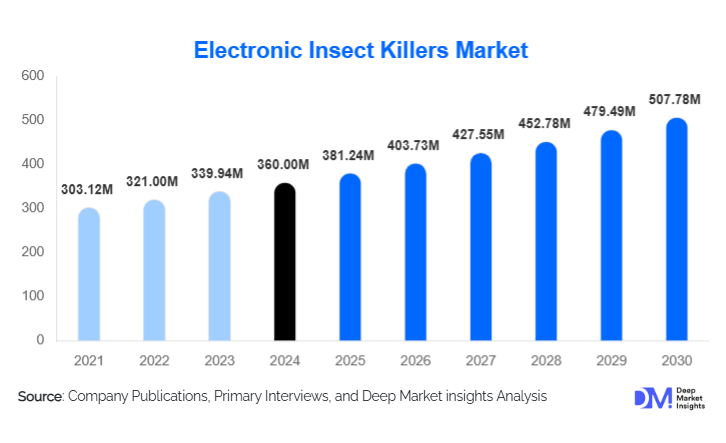
According to Deep Market Insights, the global electronic insect killers market size was valued at USD 360.00 million in 2025 and is projected to grow from USD 381.24 million in 2026 to reach USD 507.78 million by 2031, expanding at a CAGR of 5.9% during the forecast period (2026–2031). The growth of the electronic insect killers market is primarily driven by increasing consumer awareness regarding insect-borne diseases, rising adoption of chemical-free pest control solutions, and rapid technological advancements in smart and IoT-enabled devices.
Key Market Insights
- UV light-based insect killers dominate the market, attracting residential and commercial consumers due to high efficiency, affordability, and low maintenance requirements.
- Technological innovations such as IoT-enabled and hybrid systems are driving growth, offering remote monitoring, automation, and energy-efficient pest control solutions.
- North America and Europe dominate the market in 2025, due to stringent hygiene regulations, high disposable incomes, and awareness of eco-friendly pest control methods.
- Asia Pacific is the fastest-growing region, fueled by urbanization, industrialization, and rising demand from residential and commercial segments in India, China, and Southeast Asia.
- Online retail channels are expanding rapidly, providing consumers with easy access to smart and advanced EIK devices, enhancing market penetration.
- Government initiatives and public health programs promoting chemical-free insect control are creating significant opportunities for manufacturers to expand in commercial and industrial applications.
Electronic Insect Killers Market Trends
Smart and IoT-Enabled Pest Control
Manufacturers are increasingly developing smart EIK devices equipped with IoT capabilities, remote monitoring, and automation. These devices allow users to track insect activity, optimize energy consumption, and receive real-time alerts via mobile applications. Smart insect killers are particularly gaining traction in commercial spaces such as restaurants, hotels, and warehouses, where efficiency and data-driven pest control are critical. Hybrid devices that combine UV light with electromagnetic or electric grid technologies are also emerging, offering more comprehensive solutions for consumers and industrial users alike.
Eco-Friendly and Chemical-Free Solutions
Global consumers are shifting away from chemical insecticides toward environmentally safe alternatives. Electronic insect killers, being chemical-free and energy-efficient, align with sustainable living trends. Residential consumers, food processing industries, and healthcare facilities are increasingly adopting these devices to comply with regulations, maintain hygiene, and reduce the environmental footprint associated with traditional pest control methods. Manufacturers are emphasizing green marketing, highlighting energy efficiency and non-toxic insect control benefits to attract health-conscious and environmentally aware customers.
Electronic Insect Killers Market Drivers
Growing Awareness of Insect-Borne Diseases
The increasing prevalence of mosquito-borne diseases such as dengue, malaria, and Zika virus is driving demand for effective insect control solutions. Both residential and commercial consumers are adopting electronic insect killers as a safer alternative to chemical pesticides. Heightened health consciousness post-pandemic has further accelerated the shift toward automated, efficient pest control solutions.
Technological Advancements in EIK Devices
Modern EIK devices now integrate advanced technologies such as UV-C light, electric zappers, electromagnetic systems, and smart sensors. IoT-enabled devices allow real-time monitoring, automation, and predictive maintenance, particularly in industrial and commercial settings. Such innovations increase the effectiveness, convenience, and energy efficiency of pest control, driving adoption globally.
Eco-Friendly Trends and Government Support
Governments, NGOs, and consumers are increasingly advocating for chemical-free pest control solutions. Public health programs promoting insect control in schools, hospitals, and urban public spaces are supporting market growth. Eco-friendly devices align with sustainability trends and energy efficiency standards, creating strong incentives for both residential and commercial adoption.
Electronic Insect Killers Market Restraints
High Initial Cost of Advanced Devices
Smart and hybrid EIK devices have higher upfront costs compared to conventional insecticides or basic electronic devices. Price sensitivity in emerging economies and rural areas can limit adoption, particularly for residential users with budget constraints.
Limited Awareness in Certain Regions
Despite urban adoption, rural and semi-urban regions in Asia, Africa, and Latin America show low penetration due to a lack of awareness and limited access to advanced devices. Manufacturers must invest in awareness campaigns and affordable product solutions to overcome this barrier.
Electronic Insect Killers Market Opportunities
Emerging Regional Demand in Asia Pacific and LATAM
Rapid urbanization, growing middle-class income, and heightened awareness of insect-borne diseases in countries like India, China, Brazil, and Mexico are driving demand for both residential and commercial EIK devices. Localized products that meet regional energy standards and user preferences can capture high-growth potential in these emerging markets.
Integration of Smart and IoT Technologies
IoT-enabled EIK devices with remote monitoring, data analytics, and automation capabilities present new growth avenues. Smart devices allow predictive maintenance, real-time alerts, and energy optimization, making them attractive for commercial establishments and high-end residential consumers seeking efficiency and convenience.
Government Initiatives and Public Health Programs
Several governments are actively promoting chemical-free and sustainable pest control through grants, subsidies, and public-private collaborations. Public health campaigns and sanitation drives create opportunities for manufacturers to supply hospitals, schools, and urban spaces with advanced EIK solutions, further expanding market reach.
Report Scope
| Report Metric | Details |
|---|---|
| Market Size in 2025 | USD 360 Million |
| Market Size in 2026 | USD 381.24 Million |
| Market Size in 2031 | USD 507.78 Million |
| CAGR | 5.9% (2026-2031) |
| Base Year for Estimation | 2025 |
| Historical Data | 2022-2024 |
| Forecast Period | 2026-2031 |
| Report Coverage | Revenue Forecast, Competitive Landscape, Supply Chain Disruption, Growth Factors, Environment & Regulatory Landscape and Trends |
| Geographies Covered | North America, Europe, APAC, Middle East and Africa, LATAM |
| Countries Covered | U.S., Canada, U.K., Germany, France, Spain, Italy, Russia, Nordic, Benelux, Rest of Europe, China, Korea, Japan, India, Australia, Singapore, Taiwan, South East Asia, Rest of Asia-Pacific, UAE, Turky, Saudi Arabia, South Africa, Egypt, Nigeria, Rest of MEA, Brazil, Mexico, Argentina, Chile, Colombia, Rest of LATAM |
Explore more data points, trends and opportunities Download Free Sample Report
Product Type Insights
UV light insect killers dominate the market, accounting for 42% of the 2025 market. Their efficiency, affordability, and low maintenance requirements make them popular among residential and commercial consumers. Electric zappers and hybrid systems are gaining traction in industrial and large commercial applications due to their high coverage and instant insect elimination capabilities. Smart, IoT-enabled devices are the fastest-growing segment, offering automation, monitoring, and energy-saving benefits.
Application Insights
Residential applications represent 40% of the market in 2025, driven by consumer preference for chemical-free pest control and compact device designs. Commercial applications, including restaurants, hotels, and offices, contribute significantly due to hygiene compliance requirements. Industrial applications, particularly in food processing, warehousing, and pharmaceuticals, are emerging as high-value segments, adopting large-scale EIK systems for operational safety and regulatory adherence.
Distribution Channel Insights
Online retail channels hold 35% of the 2025 market, fueled by e-commerce penetration, ease of comparison, and availability of advanced devices. Offline retail, including hypermarkets, specialty stores, and B2B supply chains, remains significant. Direct B2B sales to industrial and commercial clients are expanding as manufacturers offer large-scale customized solutions and maintenance services.
Explore more data points, trends and opportunities Download Free Sample Report
Electronic Insect Killers Market Segmentations
By Product Type
- UV Light Insect Killers
- Electromagnetic Insect Killers
- Electronic Traps
- Hybrid Systems
By Technology
- UV-C Technology
- Electric Zapper Technology
- Electromagnetic/Ultrasonic Technology
- Smart/IoT-Enabled Systems
By End-Use Industry
- Residential
- Commercial
- Industrial
- Healthcare & Pharmaceutical Facilities
By Distribution Channel
- Online Retail
- Offline Retail
- B2B Supply
Regional Insights
North America
North America holds 30% of the global market in 2025, driven by high disposable incomes, stringent hygiene regulations, and early adoption of advanced EIK technologies. The U.S. and Canada lead demand, particularly in residential and commercial segments, with strong interest in smart and hybrid devices.
Europe
Europe accounts for 28% of the market in 2025, led by Germany, France, and the U.K. High awareness of insect-borne diseases, eco-friendly trends, and regulatory compliance are major growth factors. Smart and IoT-enabled devices are increasingly preferred in commercial and industrial applications.
Asia Pacific
Asia Pacific is the fastest-growing region, with strong demand from China, India, Japan, and Southeast Asia. Urbanization, industrialization, and rising disposable incomes are driving adoption in residential and commercial segments. China leads demand for large-scale industrial solutions, while India is driving residential and mid-range device sales.
Latin America
Latin America is emerging steadily, particularly in Brazil, Mexico, and Argentina, with growth driven by affluent urban consumers and increasing awareness of insect-borne diseases. Demand is mainly for residential and small commercial devices.
Middle East & Africa
MEA represents both a source and consumption region, with high adoption in the UAE, Saudi Arabia, and South Africa. Public health initiatives, luxury commercial applications, and urban residential adoption are supporting market growth. Intra-regional trade and tourism-related demand are additional growth drivers.