Electrical Supplies Market Size
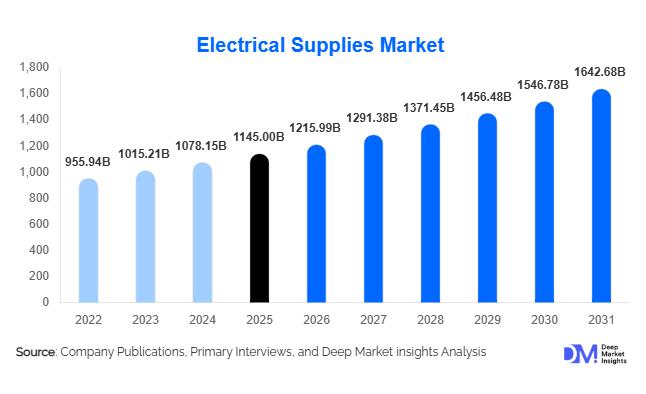
According to Deep Market Insights, the global electrical supplies market size was valued at USD 1,145 billion in 2025 and is projected to grow from USD 1,215.99 billion in 2026 to reach USD 1,642.68 billion by 2031, expanding at a CAGR of 6.2% during the forecast period (2026–2031). The electrical supplies market growth is primarily driven by rising investments in power infrastructure modernization, rapid industrial automation, expansion of renewable energy projects, and increasing electrification across residential, commercial, and industrial sectors globally.
Key Market Insights
- Grid modernization and renewable energy integration are accelerating demand for advanced switchgear, cables, protection systems, and smart electrical infrastructure globally.
- Asia-Pacific dominates the electrical supplies market, supported by large-scale infrastructure investments, industrial expansion, and urbanization across China, India, and Southeast Asia.
- Smart electrical systems and IoT-enabled power management solutions are rapidly gaining adoption across utilities, commercial buildings, and industrial facilities.
- Data center expansion and EV charging infrastructure are emerging as major demand generators, increasing the need for high-capacity cabling, busway systems, and power distribution equipment.
- Copper-based electrical products continue to dominate the market due to superior conductivity, reliability, and durability in industrial and utility applications.
- Governments worldwide are increasing investments in transmission and distribution infrastructure, driving sustained long-term demand for electrical supplies and grid equipment.
What are the latest trends in the electrical supplies market?
Smart Electrical Infrastructure and Digital Grid Expansion
The electrical supplies market is witnessing a rapid transformation through the adoption of smart electrical infrastructure and digital grid technologies. Utilities and industrial operators are increasingly deploying IoT-enabled switchgear, intelligent protection systems, smart meters, and automated distribution networks to improve energy efficiency and grid reliability. Advanced monitoring systems capable of predictive maintenance and remote diagnostics are becoming critical components of modern electrical infrastructure. The integration of artificial intelligence and cloud-based energy management systems is enabling real-time monitoring of electrical loads, fault detection, and energy optimization across industrial and commercial facilities. Smart substations and digitally connected electrical panels are also becoming mainstream in developed economies as utilities modernize aging transmission and distribution networks.
Growing Demand for Sustainable and Energy-Efficient Electrical Systems
Sustainability is emerging as a key trend shaping the electrical supplies industry. Governments and corporations are prioritizing energy-efficient electrical systems, recyclable materials, and low-carbon manufacturing practices to align with decarbonization targets. Demand for low-loss cables, energy-efficient transformers, fire-resistant wiring systems, and intelligent lighting controls is increasing significantly across commercial buildings and industrial facilities. Manufacturers are investing in eco-friendly insulation materials, halogen-free cables, and advanced copper recycling initiatives to reduce environmental impact. The growing adoption of renewable energy infrastructure, electric vehicles, and green buildings is also accelerating demand for electrical supplies designed for higher energy efficiency and sustainability compliance.
What are the key drivers in the electrical supplies market?
Rapid Expansion of Global Electrification and Infrastructure Projects
Increasing urbanization, industrialization, and infrastructure development are among the primary growth drivers for the electrical supplies market. Governments worldwide are investing heavily in transportation systems, industrial parks, commercial buildings, residential housing, and smart city projects, all of which require extensive electrical infrastructure. Rapid electrification initiatives in developing economies across Asia-Pacific, Africa, and Latin America are driving strong demand for wiring systems, conduits, switchgear, distribution boards, and protection devices. Major infrastructure modernization projects in the United States, Europe, China, and India are also increasing investments in transmission and distribution networks, creating sustained demand for electrical supply manufacturers.
Industrial Automation and Renewable Energy Integration
The increasing adoption of industrial automation and renewable energy systems is significantly boosting demand for advanced electrical supplies. Factories are integrating robotics, smart manufacturing systems, programmable logic controllers (PLCs), and industrial IoT technologies that require highly reliable electrical infrastructure and specialized industrial electrical components. Simultaneously, renewable energy projects such as solar farms, wind power plants, battery storage systems, and smart grids require advanced switchgear, transformers, high-voltage cables, connectors, and energy management systems. The rapid growth of electric vehicle charging infrastructure and hyperscale data centers is also strengthening demand for high-capacity electrical systems globally.
What are the restraints for the global market?
Volatility in Raw Material Prices
Fluctuations in copper, aluminum, steel, and polymer prices remain a major restraint for the electrical supplies market. Copper, in particular, accounts for a significant portion of manufacturing costs for cables, connectors, and power distribution systems. Supply chain disruptions, geopolitical instability, and global commodity price volatility have increased cost pressures for manufacturers in recent years. Rising raw material prices can compress profit margins and create pricing uncertainties for large infrastructure and utility projects.
Complex Regulatory and Compliance Requirements
The electrical supplies industry operates under strict international and regional safety standards, energy efficiency regulations, and fire protection requirements. Manufacturers must comply with certifications such as IEC, UL, IEEE, and region-specific electrical safety regulations. Varying compliance frameworks across countries increase operational complexity and certification costs for global suppliers. Smaller manufacturers often face difficulties investing in advanced testing, certification, and digital product development necessary to compete in regulated global markets.
What are the key opportunities in the electrical supplies industry?
Expansion of EV Charging and Data Center Infrastructure
The rapid global expansion of electric vehicle charging infrastructure presents a major opportunity for electrical supplies manufacturers. EV charging stations require advanced electrical distribution systems, high-capacity cables, busbars, connectors, and protection devices capable of handling higher electrical loads. Simultaneously, the growth of hyperscale data centers and AI computing facilities is significantly increasing demand for intelligent power distribution units, smart switchgear, energy-efficient cabling systems, and backup power infrastructure. Companies developing high-performance electrical products for these applications are expected to benefit from sustained long-term growth opportunities.
Smart Manufacturing and Industry 4.0 Adoption
The global transition toward Industry 4.0 and smart manufacturing is creating substantial opportunities for industrial electrical supplies. Automated factories require advanced industrial connectors, relays, control panels, PLC-compatible components, and intelligent energy management systems. Emerging manufacturing hubs in India, Vietnam, Indonesia, and Mexico are driving new investments in factory automation and industrial infrastructure. Additionally, government-led localization initiatives such as “Make in India” and “Made in China 2026” are encouraging domestic production of electrical infrastructure products and increasing investments in industrial electrical manufacturing facilities.
Report Scope
| Report Metric | Details |
|---|---|
| Market Size in 2025 | USD 1145 Billion |
| Market Size in 2026 | USD 1215.99 Billion |
| Market Size in 2031 | USD 1642.68 Billion |
| CAGR | 6.2% (2026-2031) |
| Base Year for Estimation | 2025 |
| Historical Data | 2022-2024 |
| Forecast Period | 2026-2031 |
| Report Coverage | Revenue Forecast, Competitive Landscape, Supply Chain Disruption, Growth Factors, Environment & Regulatory Landscape and Trends |
| Geographies Covered | North America, Europe, APAC, Middle East and Africa, LATAM |
| Countries Covered | U.S., Canada, U.K., Germany, France, Spain, Italy, Russia, Nordic, Benelux, Rest of Europe, China, Korea, Japan, India, Australia, Singapore, Taiwan, South East Asia, Rest of Asia-Pacific, UAE, Turky, Saudi Arabia, South Africa, Egypt, Nigeria, Rest of MEA, Brazil, Mexico, Argentina, Chile, Colombia, Rest of LATAM |
Explore more data points, trends and opportunities Download Free Sample Report
Product Type Insights
Wiring and cable products dominate the electrical supplies market, accounting for nearly 32% of the global market share in 2025. Strong demand from construction, renewable energy projects, utility transmission infrastructure, and industrial automation continues to support growth in this segment. Power distribution equipment, including switchgear, circuit breakers, and distribution boards, represents another major category due to rising investments in smart grids and industrial electrification. Electrical protection devices such as relays, surge protection systems, and residual current devices are increasingly adopted across residential and commercial buildings to improve electrical safety and reliability. Smart electrical infrastructure products, including digital switchgear, smart meters, and IoT-enabled monitoring systems, are emerging as one of the fastest-growing segments as utilities and industries prioritize energy efficiency and digital grid modernization.
Voltage Range Insights
Low-voltage electrical supplies account for the largest share of the market, representing nearly 51% of global demand in 2025. These products are extensively used across residential buildings, commercial complexes, manufacturing facilities, and data centers. Medium-voltage electrical supplies are witnessing strong growth due to rising industrial electrification and renewable energy integration projects. High-voltage and extra-high-voltage systems are increasingly deployed in utility-scale transmission infrastructure and large renewable power installations, particularly across the Asia-Pacific and the Middle East. Growing investments in smart substations and long-distance transmission networks are expected to support continued expansion of high-voltage electrical equipment demand globally.
Material Type Insights
Copper-based electrical supplies dominate the market with over 58% share due to their superior conductivity, thermal performance, and durability. Copper remains the preferred material for industrial wiring systems, high-performance connectors, and power distribution applications. Aluminum-based electrical products are gaining traction in utility transmission and large infrastructure projects due to their lower cost and lighter weight. Polymer and PVC-based electrical products continue to see strong demand for insulation systems, conduits, and cable management applications, while composite materials are emerging in specialized industrial and high-performance electrical infrastructure applications.
End-Use Industry Insights
Utilities and power infrastructure remain the largest end-use industry for electrical supplies, accounting for nearly 29% of the market in 2025. Investments in grid modernization, renewable energy integration, and transmission network upgrades are driving substantial demand for switchgear, transformers, cables, and protection systems. Industrial manufacturing is among the fastest-growing end-use segments due to increasing automation and smart factory deployment. Commercial buildings, hospitals, airports, and smart city projects are also generating strong demand for energy-efficient electrical systems and digital power management infrastructure. Emerging applications such as EV charging infrastructure and hyperscale data centers are creating new opportunities for high-capacity electrical equipment and intelligent distribution systems.
Distribution Channel Insights
OEM and direct industrial supply channels dominate the electrical supplies market due to large-scale procurement requirements from utilities, industrial operators, and infrastructure developers. Electrical wholesalers and specialized distributors continue to play a critical role in supplying commercial and residential electrical products. EPC contractors remain key procurement channels for utility-scale infrastructure projects, renewable energy installations, and industrial construction activities. Online B2B procurement platforms are rapidly gaining popularity, particularly among small and medium enterprises seeking transparent pricing, product comparison, and efficient supply chain management. Manufacturers are also strengthening direct digital sales channels to improve customer engagement and expand global reach.
Explore more data points, trends and opportunities Download Free Sample Report
Electrical Supplies Market Segmentations
By Product Type
- Wiring & Cable Products
- Power Distribution Equipment
- Electrical Protection Devices
- Conduit & Cable Management Products
- Connectors & Termination Components
- Lighting Electrical Supplies
- Industrial Automation Electrical Supplies
- Smart & Digital Electrical Infrastructure
By Voltage Range
- Low Voltage
- Medium Voltage
- High Voltage
- Extra-High Voltage
By Material Type
- Copper-Based Electrical Supplies
- Aluminum-Based Electrical Supplies
- Polymer/PVC-Based Electrical Supplies
- Composite Material Electrical Supplies
- Steel & Metal Fabricated Electrical Systems
By Installation Type
- Indoor Electrical Systems
- Outdoor Electrical Systems
- Underground Electrical Infrastructure
- Overhead Electrical Infrastructure
By Distribution Channel
- OEM & Direct Industrial Supply
- Electrical Wholesalers
- Specialized Electrical Distributors
- EPC Contractors
- Online B2B Procurement Platforms
- Retail Hardware & Construction Chains
By End-Use Industry
- Residential
- Commercial
- Industrial
- Utilities & Power Infrastructure
- Infrastructure & Transportation
Regional Insights
North America
North America accounted for approximately 24% of the global electrical supplies market in 2025, driven primarily by infrastructure modernization, renewable energy investments, and rapid data center expansion in the United States. Aging electrical grids across the U.S. are being upgraded through large-scale federal infrastructure spending programs, increasing demand for advanced switchgear, transformers, and smart electrical systems. Canada is also investing heavily in renewable energy transmission infrastructure and industrial electrification projects, supporting regional market growth.
Europe
Europe remains a major market for electrical supplies due to stringent energy-efficiency regulations, renewable energy deployment, and industrial automation leadership. Germany dominates regional demand through strong investments in smart manufacturing and renewable integration infrastructure. The United Kingdom, France, and Italy are also increasing investments in EV charging networks, smart grids, and energy-efficient commercial buildings. European demand is increasingly focused on sustainable electrical products, digital energy management systems, and advanced protection technologies.
Asia-Pacific
Asia-Pacific dominates the global electrical supplies market with nearly 43% share in 2025. China remains the largest market globally due to extensive investments in power transmission infrastructure, renewable energy projects, industrial automation, and urban construction. India is emerging as one of the fastest-growing markets supported by railway electrification, smart city projects, industrial corridor development, and “Make in India” manufacturing initiatives. Southeast Asian countries including Vietnam, Indonesia, and Thailand are also witnessing rising demand due to rapid industrialization and infrastructure expansion.
Latin America
Latin America is witnessing steady growth in demand for electrical supplies, led by Brazil and Mexico. Industrial expansion, utility modernization, and renewable power investments are supporting regional growth. Mexico’s manufacturing sector expansion and nearshoring trends are creating increased demand for industrial electrical infrastructure and automation systems. Brazil continues to invest in transmission infrastructure and renewable energy integration projects.
Middle East & Africa
The Middle East & Africa region is emerging as one of the fastest-growing electrical supplies markets globally. Saudi Arabia and the UAE are investing heavily in smart cities, renewable energy projects, and industrial diversification initiatives, increasing demand for advanced electrical infrastructure. Africa’s electrification programs and urban development projects are also supporting demand for basic electrical systems, transmission equipment, and grid infrastructure. The region is expected to witness CAGR growth exceeding 7% during the forecast period.
Key Players in the Electrical Supplies Market
- Schneider Electric
- ABB
- Siemens
- Eaton
- Legrand
- Prysmian Group
- Hubbell
- Mitsubishi Electric
- Hitachi Energy
- General Electric
- LS Electric
- Nexans
- Panduit
- Atkore
- Fuji Electric