Electric Mop Market Size
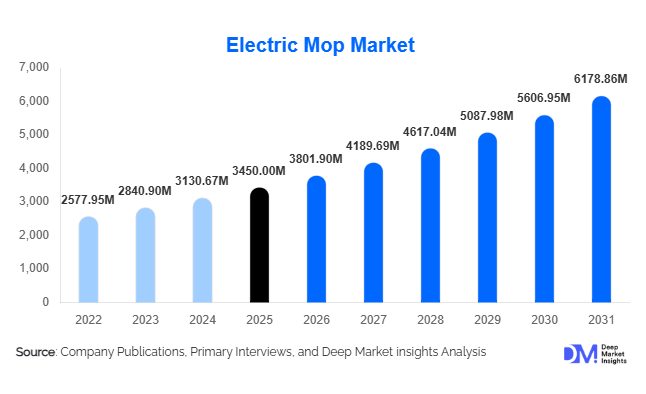
According to Deep Market Insights, the global electric mop market size was valued at USD 3,450 million in 2025 and is projected to grow from USD 3,801.90 million in 2026 to reach USD 6,178.86 million by 2031, expanding at a CAGR of 10.2% during the forecast period (2026–2031). The electric mop market growth is primarily driven by increasing demand for time-efficient cleaning solutions, rising hygiene awareness post-pandemic, and rapid adoption of cordless and multifunctional cleaning appliances across residential and commercial sectors.
Key Market Insights
- Cordless electric mops dominate the market, accounting for over 60% share, driven by portability and convenience.
- Steam-based cleaning solutions are gaining traction due to rising demand for chemical-free sanitation.
- Asia-Pacific leads the market, supported by strong manufacturing and growing middle-class consumption.
- Online retail channels dominate distribution, contributing nearly 58% of global sales.
- Residential applications remain the primary demand driver, accounting for over 70% of market share.
- Technological advancements, including smart connectivity and battery efficiency, are reshaping product innovation.
What are the latest trends in the electric mop market?
Shift Toward Cordless and Smart Cleaning Solutions
The electric mop market is witnessing a significant shift toward cordless and smart-enabled devices. Consumers increasingly prefer lightweight, battery-operated models that offer flexibility and ease of use without the constraints of power cords. Additionally, integration with smart home ecosystems is gaining traction, allowing users to control cleaning schedules and monitor performance through mobile applications. Features such as adjustable water flow, automated cleaning modes, and ergonomic designs are becoming standard, particularly in mid-range and premium segments. This trend is driven by the growing adoption of connected home appliances and rising consumer expectations for convenience and efficiency.
Rising Demand for Eco-Friendly and Multi-Functional Products
Sustainability is emerging as a key trend in the electric mop market. Manufacturers are focusing on reusable mop pads, energy-efficient motors, and reduced water consumption technologies to align with environmental concerns. Additionally, multifunctional devices that combine vacuuming and mopping capabilities are gaining popularity, offering greater value to consumers. These hybrid solutions reduce the need for multiple cleaning appliances, making them attractive for urban households with limited storage space. The trend is particularly strong in developed markets where eco-conscious purchasing decisions are more prevalent.
What are the key drivers in the electric mop market?
Growing Demand for Convenience and Time-Saving Appliances
Modern lifestyles characterized by busy schedules and dual-income households are driving demand for efficient cleaning solutions. Electric mops significantly reduce manual effort and cleaning time compared to traditional methods, making them an essential household appliance. This convenience factor is a primary driver of market growth, particularly in urban areas where time-saving products are highly valued.
Increasing Hygiene Awareness and Sanitization Needs
The heightened focus on cleanliness and hygiene following the COVID-19 pandemic has accelerated demand for electric mops, especially steam-based models that provide chemical-free disinfection. Consumers are increasingly prioritizing products that ensure deeper cleaning and eliminate bacteria, driving adoption across both residential and commercial sectors such as healthcare and hospitality.
What are the restraints for the global market?
High Initial Cost of Advanced Models
Premium electric mops equipped with advanced features such as smart connectivity and multifunctionality often come at a higher price point. This can limit adoption in price-sensitive markets, particularly in developing regions where consumers may opt for traditional cleaning methods or lower-cost alternatives.
Maintenance and Durability Concerns
Issues related to battery life, replacement costs, and wear-and-tear of mop pads pose challenges for long-term usage. Consumers may face additional expenses for maintenance, which can impact overall product satisfaction and slow market growth. Addressing these concerns through improved product durability and after-sales support remains critical for manufacturers.
What are the key opportunities in the electric mop market?
Expansion in Emerging Markets
Emerging economies such as India, Brazil, and Southeast Asian countries present significant growth opportunities due to rising disposable incomes and increasing urbanization. The growing middle class in these regions is driving demand for affordable and efficient home appliances. Companies can capitalize on this by offering cost-effective products and strengthening distribution networks, particularly through e-commerce platforms.
Integration with Smart Home Ecosystems
The growing adoption of smart home technologies provides an opportunity for manufacturers to integrate electric mops with IoT platforms. Features such as app-based controls, voice assistant compatibility, and automated cleaning schedules can enhance user experience and attract tech-savvy consumers. This trend is expected to drive premium segment growth.
Report Scope
| Report Metric | Details |
|---|---|
| Market Size in 2025 | USD 3450 Million |
| Market Size in 2026 | USD 3801.90 Million |
| Market Size in 2031 | USD 6178.86 Million |
| CAGR | 10.2% (2026-2031) |
| Base Year for Estimation | 2025 |
| Historical Data | 2022-2024 |
| Forecast Period | 2026-2031 |
| Report Coverage | Revenue Forecast, Competitive Landscape, Supply Chain Disruption, Growth Factors, Environment & Regulatory Landscape and Trends |
| Geographies Covered | North America, Europe, APAC, Middle East and Africa, LATAM |
| Countries Covered | U.S., Canada, U.K., Germany, France, Spain, Italy, Russia, Nordic, Benelux, Rest of Europe, China, Korea, Japan, India, Australia, Singapore, Taiwan, South East Asia, Rest of Asia-Pacific, UAE, Turky, Saudi Arabia, South Africa, Egypt, Nigeria, Rest of MEA, Brazil, Mexico, Argentina, Chile, Colombia, Rest of LATAM |
Explore more data points, trends and opportunities Download Free Sample Report
Product Type Insights
Cordless electric mops dominate the global market, accounting for approximately 62% of the total market share in 2025. This leadership is primarily driven by the growing consumer preference for convenience, portability, and flexible cleaning solutions. Advances in lithium-ion battery technology have significantly improved runtime, charging speed, and overall product efficiency, making cordless variants more practical for everyday use. Additionally, the increasing availability of swappable battery systems and lightweight ergonomic designs has enhanced user experience, particularly in urban households. Cordless models are also benefiting from the broader shift toward wireless home appliances within smart home ecosystems.
In contrast, corded electric mops are gradually losing market share due to limitations in mobility and user convenience. However, they still maintain relevance in certain commercial applications where continuous operation without battery constraints is required. The ongoing transition from corded to cordless products is expected to continue, supported by declining battery costs and ongoing innovation, further reinforcing the dominance of cordless electric mops globally.
Application Insights
Steam electric mops lead the functionality segment, capturing approximately 34% of the global market share in 2025. Their dominance is driven by increasing consumer awareness regarding hygiene and the growing preference for chemical-free cleaning solutions. Steam mops are particularly effective in eliminating bacteria and allergens, making them highly suitable for households with children and pets, as well as for healthcare environments where sanitation standards are critical.
Spray and scrubbing electric mops continue to hold significant shares due to their suitability for routine cleaning tasks and cost-effectiveness. Meanwhile, vacuum-integrated electric mops are emerging as the fastest-growing segment, driven by demand for multifunctional appliances that combine sweeping, vacuuming, and mopping in a single device. These hybrid products are especially popular in space-constrained urban households and among consumers seeking time-efficient cleaning solutions. The trend toward multi-functionality is expected to reshape the competitive landscape, with manufacturers increasingly focusing on integrated cleaning technologies.
Distribution Channel Insights
Online retail channels dominate the electric mop market, accounting for approximately 58% of global sales in 2025. The growth of e-commerce platforms has significantly transformed consumer purchasing behavior, offering advantages such as wider product selection, competitive pricing, easy comparison, and doorstep delivery. The increasing penetration of smartphones and digital payment systems, particularly in emerging markets, has further accelerated online sales.
Brand-owned websites and major e-commerce marketplaces play a crucial role in driving online growth, supported by targeted digital marketing strategies and customer reviews that influence purchase decisions. Offline retail channels, including supermarkets, specialty electronics stores, and home improvement outlets, continue to play an important role, particularly for first-time buyers who prefer product demonstrations and immediate availability. However, the long-term trend clearly favors online channels, which are expected to further strengthen their dominance due to convenience and expanding logistics infrastructure.
End-User Insights
The residential segment remains the largest end-user category, accounting for approximately 72% of the global electric mop market in 2025. This dominance is driven by increasing urbanization, rising disposable incomes, and the growing need for efficient home cleaning solutions. The proliferation of nuclear families and busy lifestyles has further accelerated the adoption of electric mops in households worldwide.
The commercial segment, comprising hospitality, healthcare facilities, corporate offices, and retail spaces, is the fastest-growing segment with a projected CAGR exceeding 12%. Growth in this segment is driven by stringent hygiene standards, especially in healthcare and hospitality industries, and the need for efficient cleaning solutions in high-traffic environments. The expansion of global tourism and healthcare infrastructure is expected to further boost demand from commercial end-users, creating new growth opportunities for market participants.
Explore more data points, trends and opportunities Download Free Sample Report
Electric Mop Market Segmentations
By Product Type
- Corded Electric Mops
- Cordless Electric Mops
By Application
- Spray Electric Mops
- Steam Electric Mops
- Scrubbing/Spin Electric Mops
- Vacuum-Integrated Electric Mops
By Distribution Channel
- Online Retail
- Offline Retail
By End-User
- Residential Users
- Commercial Users
Regional Insights
Asia-Pacific
Asia-Pacific leads the global electric mop market, accounting for approximately 38% of the total market share in 2025. China is the dominant contributor, representing nearly 20% of global demand, supported by its strong manufacturing base, cost advantages, and large domestic consumer market. The region’s growth is driven by rapid urbanization, rising disposable incomes, and increasing adoption of modern household appliances.
India is emerging as one of the fastest-growing markets in the region, fueled by expanding middle-class populations, increasing awareness of hygiene, and the rapid growth of e-commerce platforms. Japan and South Korea, as mature markets, contribute steady demand driven by technological innovation and high consumer preference for advanced home appliances. Additionally, the presence of key manufacturers and export-oriented production hubs in the region further strengthens Asia-Pacific’s leadership position.
North America
North America holds approximately 27% of the global electric mop market share, with the United States being the largest contributor. The region’s growth is driven by high disposable incomes, strong consumer inclination toward smart home technologies, and widespread adoption of premium cleaning appliances. The increasing trend of home automation and connected devices has further accelerated demand for advanced electric mops with smart features.
Additionally, heightened awareness of hygiene and cleanliness, particularly in the post-pandemic environment, has significantly boosted demand. The commercial sector, including healthcare and hospitality, also contributes to regional growth due to stringent sanitation requirements. The presence of leading global brands and strong distribution networks further supports market expansion in North America.
Europe
Europe accounts for approximately 22% of the global electric mop market, with major contributions from Germany, the United Kingdom, and France. The region’s growth is primarily driven by stringent environmental regulations and strong consumer preference for sustainable and energy-efficient products. European consumers are increasingly adopting eco-friendly cleaning solutions, including steam mops and products with reusable components. Additionally, high urbanization rates, well-established retail infrastructure, and growing awareness of indoor hygiene contribute to market growth. Technological innovation and product quality remain key differentiators in this region, with consumers willing to invest in premium appliances that offer durability and efficiency.
Latin America
Latin America represents around 7% of the global market, with Brazil and Mexico being the primary contributors. Market growth in this region is driven by increasing urbanization, expanding middle-class populations, and the gradual adoption of modern household appliances. The expansion of organized retail and e-commerce platforms is also supporting product accessibility. However, price sensitivity remains a key challenge, influencing consumer preference toward mid-range and budget products. Despite this, improving economic conditions and rising awareness of hygiene are expected to drive steady growth in the region over the forecast period.
Middle East & Africa
The Middle East & Africa region accounts for approximately 6% of the global electric mop market, with key demand centers in the UAE and South Africa. Growth in this region is primarily driven by increasing investments in hospitality, tourism, and commercial infrastructure, particularly in Gulf countries. The rising number of hotels, shopping malls, and healthcare facilities is generating demand for efficient cleaning solutions. Additionally, growing urbanization and improving living standards are contributing to increased adoption of electric mops in residential applications. While the market is still in a developing stage, strong infrastructure development and rising consumer awareness are expected to drive future growth.
Key Players in the Electric Mop Market
- Bissell Inc.
- SharkNinja
- Tineco
- Kärcher
- iRobot Corporation
- Dyson Ltd.
- Black+Decker
- Hoover
- Vax Ltd.
- Philips
- Panasonic Corporation
- LG Electronics
- Samsung Electronics
- Eureka Forbes
- Xiaomi Corporation