Electric Griddle Market Size
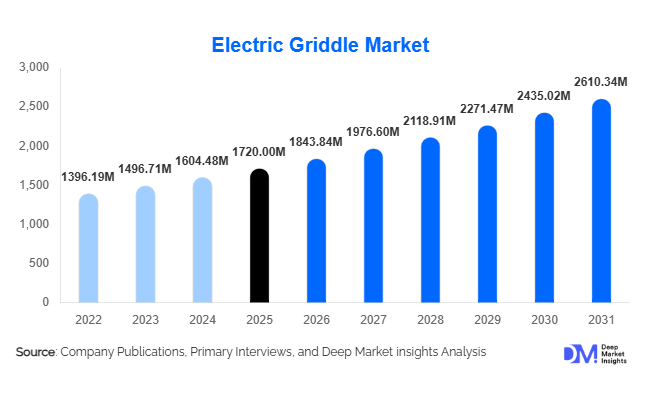
According to Deep Market Insights, the global electric griddle market size was valued at USD 1,720 million in 2025 and is projected to grow from USD 1,843.84 million in 2026 to reach USD 2,610.34 million by 2031, expanding at a CAGR of 7.2% during the forecast period (2026–2031). The electric griddle market growth is primarily driven by rising adoption of countertop kitchen appliances, the expansion of quick-service restaurants (QSRs), and increasing consumer demand for convenient, energy-efficient cooking equipment.
Electric griddles have become an essential appliance in both residential kitchens and commercial foodservice environments. Their ability to provide uniform heat distribution, large cooking surfaces, and precise temperature control makes them suitable for preparing a wide variety of foods, including pancakes, eggs, burgers, sandwiches, and grilled items. Compared with traditional stovetop cooking, electric griddles offer improved cooking consistency and easier cleaning through non-stick coatings and removable grease trays.
The growth of urban households and smaller living spaces has also increased demand for compact, multifunctional appliances that simplify cooking. Manufacturers are responding by introducing innovative electric griddles with ceramic coatings, smart temperature control systems, and multi-zone cooking surfaces. Furthermore, the rapid growth of online retail platforms has improved product accessibility globally, enabling manufacturers to reach new consumer segments across emerging economies.
Key Market Insights
- Household adoption is the primary demand driver, accounting for nearly 58% of total electric griddle consumption globally.
- Flat electric griddles dominate the product category due to their versatility and ability to cook multiple food items simultaneously.
- North America leads the global market, driven by strong demand from residential kitchens and the quick-service restaurant industry.
- Asia-Pacific is the fastest-growing region, supported by rapid urbanization and expanding middle-class consumer spending.
- E-commerce platforms are reshaping distribution, with online sales accounting for more than one-third of global electric griddle purchases.
- Technological innovation, including smart temperature sensors, ceramic non-stick coatings, and energy-efficient heating elements, is transforming product development.
What are the latest trends in the electric griddle market?
Rise of Smart and Connected Kitchen Appliances
The integration of smart technology into kitchen appliances is becoming a significant trend in the electric griddle market. Modern electric griddles are increasingly being equipped with digital temperature controls, programmable cooking modes, and connectivity features that allow users to monitor and control cooking processes through mobile applications. These smart features enhance cooking precision and convenience, particularly for tech-savvy consumers who are adopting connected home ecosystems. Manufacturers are also integrating automatic shut-off systems and real-time temperature sensors that improve safety and energy efficiency. As smart kitchens gain popularity across North America, Europe, and developed Asian markets, connected electric griddles are expected to become a premium product segment with higher profit margins.
Growing Demand for Eco-Friendly Non-Stick Surfaces
Consumer awareness regarding health and environmental safety has increased demand for eco-friendly cooking surfaces. Traditional non-stick coatings are gradually being replaced with ceramic-based coatings that are free from harmful chemicals and allow cooking with minimal oil. These coatings also enhance durability and simplify cleaning, making them highly attractive for both residential and commercial kitchens. Manufacturers are investing in research and development to create advanced non-stick surfaces that maintain performance over extended periods of use. As sustainability becomes a key purchasing factor for consumers, eco-friendly materials are expected to play an increasingly important role in product innovation.
What are the key drivers in the electric griddle market?
Expansion of the Global Foodservice Industry
The growth of the global foodservice industry is a major driver of electric griddle demand. Restaurants, cafés, and quick-service chains rely on high-efficiency cooking equipment capable of preparing large volumes of food consistently. Electric griddles provide even heat distribution and faster cleaning compared with traditional cooking surfaces, making them ideal for commercial kitchens. The rapid expansion of quick-service restaurants and casual dining establishments worldwide has significantly increased demand for compact and reliable cooking equipment, strengthening the electric griddle market.
Increasing Adoption of Countertop Cooking Appliances
Consumers are increasingly adopting countertop appliances that simplify everyday cooking tasks. Electric griddles enable users to prepare multiple food items simultaneously, saving time and energy. Their portability and ease of use make them particularly appealing to urban households with limited kitchen space. Additionally, rising interest in home cooking and breakfast preparation appliances has further boosted demand for electric griddles across residential markets.
What are the restraints for the global market?
Competition from Multifunction Cooking Appliances
The electric griddle market faces competition from other multifunction kitchen appliances such as air fryers, induction cooktops, sandwich makers, and electric grills. Many consumers prefer appliances that combine multiple cooking capabilities in a single device. As multifunction cooking appliances become more advanced, they may reduce the standalone demand for electric griddles, forcing manufacturers to innovate and differentiate their products through enhanced features.
Volatility in Raw Material Costs
Electric griddle manufacturing relies heavily on metals such as aluminum, stainless steel, and copper-based heating elements. Fluctuations in raw material prices can significantly impact production costs and profit margins for appliance manufacturers. Additionally, supply chain disruptions or trade restrictions may increase procurement expenses, posing a challenge for companies attempting to maintain competitive product pricing.
What are the key opportunities in the electric griddle industry?
Growth of Mobile Food Businesses and Food Trucks
The global expansion of food trucks and mobile kitchens presents a strong opportunity for electric griddle manufacturers. These businesses require compact and portable cooking equipment that can operate efficiently without complex gas infrastructure. Electric griddles are particularly suitable for such environments due to their quick heating capabilities and consistent cooking performance. As urban street food culture continues to grow worldwide, demand for commercial electric griddles is expected to increase.
Emerging Consumer Markets in Developing Economies
Rapid urbanization and rising disposable incomes in emerging economies such as India, Indonesia, Brazil, and Mexico are creating significant opportunities for the electric griddle market. Consumers in these regions are increasingly purchasing modern kitchen appliances that simplify cooking processes. Manufacturers that localize production, offer affordable models, and adapt products to regional cooking preferences can capture substantial market share in these fast-growing markets.
Report Scope
| Report Metric | Details |
|---|---|
| Market Size in 2025 | USD 1720 Million |
| Market Size in 2026 | USD 1843.84 Million |
| Market Size in 2031 | USD 2610.34 Million |
| CAGR | 7.2% (2026-2031) |
| Base Year for Estimation | 2025 |
| Historical Data | 2022-2024 |
| Forecast Period | 2026-2031 |
| Report Coverage | Revenue Forecast, Competitive Landscape, Supply Chain Disruption, Growth Factors, Environment & Regulatory Landscape and Trends |
| Geographies Covered | North America, Europe, APAC, Middle East and Africa, LATAM |
| Countries Covered | U.S., Canada, U.K., Germany, France, Spain, Italy, Russia, Nordic, Benelux, Rest of Europe, China, Korea, Japan, India, Australia, Singapore, Taiwan, South East Asia, Rest of Asia-Pacific, UAE, Turky, Saudi Arabia, South Africa, Egypt, Nigeria, Rest of MEA, Brazil, Mexico, Argentina, Chile, Colombia, Rest of LATAM |
Explore more data points, trends and opportunities Download Free Sample Report
Product Type Insights
Flat electric griddles represent the dominant product category, accounting for approximately 46% of global market revenue in 2025. Their popularity is attributed to their large cooking surface and versatility, allowing users to prepare a variety of foods simultaneously. Ribbed or grill plate electric griddles are widely used in commercial kitchens for grilling meats and sandwiches, while reversible plate models that combine griddle and grill functions are gaining popularity among consumers seeking multifunction cooking appliances. Teppanyaki-style electric griddles have also gained traction in Asian markets and premium restaurants, offering specialized cooking experiences that replicate traditional Japanese cooking techniques.
Application Insights
Residential applications dominate the electric griddle market, driven by increasing adoption of countertop kitchen appliances in households. Consumers frequently use electric griddles for breakfast preparation, family meals, and casual cooking. Commercial applications such as restaurants, cafés, and catering services represent another significant segment, as these establishments require reliable cooking equipment capable of handling large volumes of food. Emerging applications include food trucks and mobile kitchens, where electric griddles are preferred due to their portability and efficient energy usage. Institutional kitchens in schools, hospitals, and corporate cafeterias are also adopting electric griddles to streamline food preparation processes.
Distribution Channel Insights
Online retail channels have become the fastest-growing distribution segment in the electric griddle market. E-commerce platforms allow consumers to compare product features, read customer reviews, and access a wide range of brands at competitive prices. Specialty kitchen appliance stores remain important for premium product sales, as consumers often prefer in-store demonstrations before purchasing high-end appliances. Hypermarkets and supermarkets continue to play a significant role in mass-market distribution, particularly for entry-level models. Commercial kitchen equipment suppliers cater to restaurants and hospitality businesses that require heavy-duty electric griddles for professional use.
End-Use Insights
The household segment accounts for nearly 58% of the global electric griddle market demand, driven by rising consumer interest in convenient cooking appliances. Restaurants and cafés represent approximately 25% of market demand due to the growing popularity of quick-service dining formats worldwide. The fastest-growing end-use segment is food trucks and mobile kitchens, expanding at an estimated annual growth rate of around 9%. Institutional kitchens in schools, hospitals, and military facilities also contribute to demand as they seek efficient equipment capable of preparing large quantities of food consistently.
Explore more data points, trends and opportunities Download Free Sample Report
Electric Griddle Market Segmentations
By Product Type
- Flat Electric Griddles
- Ribbed / Grill Plate Electric Griddles
- Reversible Plate Electric Griddles (Grill + Griddle)
- Teppanyaki Electric Griddles
- Multi-Zone / Dual Temperature Electric Griddles
By Application
- Residential / Household Cooking
- Commercial Foodservice
- Quick Service Restaurants (QSRs)
- Food Trucks & Mobile Kitchens
- Institutional Kitchens
By Distribution Channel
- Online Retail / E-Commerce
- Hypermarkets & Supermarkets
- Specialty Kitchen Appliance Stores
- Commercial Kitchen Equipment Suppliers
- Direct-to-Consumer Brand Stores
By End-Use
- Households
- Restaurants & Cafés
- Hotels & Hospitality
- Food Trucks & Street Food Vendors
- Institutional Catering
Regional Insights
North America
North America holds the largest share of the global electric griddle market, accounting for approximately 34% of total revenue in 2025. The United States represents the dominant country within the region due to its strong consumer appliance market and large quick-service restaurant industry. Electric griddles are widely used in American households for breakfast preparation, while commercial kitchens rely on them for cooking burgers, eggs, and sandwiches. Canada also contributes to regional demand, supported by growth in casual dining establishments and increasing adoption of countertop cooking appliances.
Europe
Europe represents approximately 23% of global market demand. Countries such as Germany, the United Kingdom, France, and Italy are major consumers of electric kitchen appliances. European consumers prioritize energy efficiency, durable construction, and eco-friendly materials, which has encouraged manufacturers to develop advanced electric griddles with ceramic coatings and digital temperature control systems. The region also benefits from a well-established hospitality industry that drives demand for professional cooking equipment.
Asia-Pacific
Asia-Pacific accounts for roughly 31% of the global electric griddle market and is the fastest-growing regional market. China leads demand due to its massive appliance manufacturing ecosystem and large domestic consumer base. India is experiencing rapid market growth driven by urbanization and increasing household appliance penetration. Japan and South Korea contribute significantly through demand for premium kitchen appliances and specialized cooking equipment such as teppanyaki griddles.
Latin America
Latin America represents around 5% of the global electric griddle market. Brazil and Mexico are the largest markets in the region due to the expansion of street food vendors and quick-service restaurant chains. Increasing consumer spending on kitchen appliances is also supporting market growth.
Middle East & Africa
The Middle East and Africa region accounts for approximately 7% of the global market. Demand is primarily driven by the hospitality industry, particularly in countries such as the United Arab Emirates and Saudi Arabia, where tourism infrastructure and hotel investments are expanding rapidly. Growing restaurant chains and catering services are also contributing to regional market growth.
Key Players in the Electric Griddle Market
- Hamilton Beach Brands
- Spectrum Brands (Black+Decker)
- Groupe SEB
- Breville Group
- De’Longhi Group
- SharkNinja
- Conair Corporation (Cuisinart)
- National Presto Industries
- Philips Domestic Appliances
- Zojirushi Corporation
- Panasonic Corporation
- Midea Group
- Electrolux AB
- TTK Prestige
- Bajaj Electricals