Electric Baseboard Heater Market Size
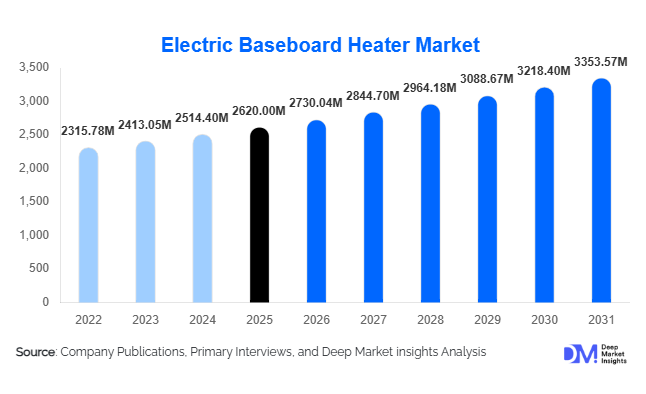
According to Deep Market Insights, the global electric baseboard heater market size was valued at USD 2,620 million in 2025 and is projected to grow from USD 2,730.04 million in 2026 to reach USD 3,353.57 million by 2031, expanding at a CAGR of 4.2% during the forecast period (2026–2031). The electric baseboard heater market growth is primarily driven by increasing demand for energy-efficient space heating systems, rising residential and commercial retrofitting activities, and expanding electrification initiatives aimed at reducing dependence on fossil-fuel-based heating technologies.
Key Market Insights
- Demand for zoned and room-specific heating solutions is increasing globally, particularly in residential retrofitting applications across colder regions.
- Smart electric baseboard heaters are witnessing strong adoption, supported by IoT connectivity, programmable thermostats, and mobile app integration.
- Europe dominates the global electric baseboard heater market, driven by strict energy-efficiency regulations and growing electrification policies.
- Asia-Pacific is emerging as the fastest-growing region, fueled by urbanization, smart home adoption, and rising apartment construction.
- Residential applications account for the largest market share, especially in apartments, multi-family housing, and retrofit home heating projects.
- Hydronic and energy-efficient electric heating technologies are gaining popularity due to improved heat retention and reduced operating costs.
What are the latest trends in the electric baseboard heater market?
Smart and Connected Heating Systems
Manufacturers are increasingly integrating smart technologies into electric baseboard heaters to improve energy efficiency and user convenience. Wi-Fi-enabled heaters, programmable thermostats, voice-assistant compatibility, and mobile application controls are becoming mainstream across residential and commercial applications. Consumers are increasingly seeking connected heating systems that can optimize room temperatures automatically and reduce energy consumption. Smart home ecosystems in North America, Europe, Japan, and South Korea are accelerating demand for intelligent heating products. AI-based adaptive temperature control systems are also emerging, allowing heaters to adjust settings based on occupancy patterns, weather forecasts, and energy pricing trends.
Shift Toward Low-Carbon and Energy-Efficient Heating
Governments across developed economies are promoting building electrification and discouraging fossil-fuel-based heating systems. This trend is significantly boosting demand for electric baseboard heaters in residential retrofits and new energy-efficient construction projects. Manufacturers are focusing on hydronic electric baseboard heaters and eco-mode systems that provide better heat retention and lower electricity consumption. Energy-efficiency certifications and sustainable building standards are increasingly influencing purchasing decisions, particularly in Europe and North America. The transition toward renewable electricity generation is also strengthening the long-term viability of electric heating technologies.
What are the key drivers in the electric baseboard heater market?
Growth in Residential Construction and Retrofit Projects
Increasing residential construction activity and aging building infrastructure are major factors supporting market growth. Older homes and apartments in North America and Europe are undergoing heating system upgrades to improve energy efficiency and comply with modern building standards. Electric baseboard heaters are widely preferred in retrofit projects because they are easy to install, require minimal maintenance, and eliminate the need for ductwork. Apartment developments, modular housing, and affordable urban housing projects are also contributing to rising product demand.
Rising Demand for Zoned Heating Systems
Consumers are increasingly shifting toward zoned heating systems that allow independent temperature control in individual rooms. Electric baseboard heaters provide localized heating, enabling homeowners to reduce energy waste in unused spaces. This capability is especially attractive in colder climates where heating expenses account for a significant portion of household energy costs. The trend toward personalized indoor climate control is further increasing demand for programmable and room-specific heating systems.
Electrification and Decarbonization Policies
Government initiatives focused on reducing greenhouse gas emissions are encouraging the adoption of electric heating technologies. Several countries are implementing policies that discourage the installation of fossil-fuel-based heating systems in new buildings. Incentive programs supporting energy-efficient home upgrades and electrification are positively influencing market demand. Rising investments in renewable electricity infrastructure are also strengthening the adoption of electric baseboard heaters as part of broader clean-energy transitions.
What are the restraints for the global market?
High Electricity Operating Costs
Electric baseboard heaters can become expensive to operate in regions with high electricity prices, particularly in large residential and commercial facilities. Compared with heat pumps and high-efficiency HVAC systems, electric resistance heating technologies may result in higher long-term operational expenses. This remains a key challenge for widespread adoption in cost-sensitive markets.
Competition from Advanced HVAC Technologies
Technologies such as ductless heat pumps, radiant floor heating systems, and central HVAC solutions are creating strong competitive pressure within the market. Heat pumps, in particular, offer significantly higher energy efficiency and dual heating-cooling functionality. Government subsidies for advanced HVAC technologies in several developed economies are further intensifying competition for electric baseboard heaters.
What are the key opportunities in the electric baseboard heater industry?
Expansion of Smart Home Integration
The rapid growth of smart home ecosystems presents substantial opportunities for electric baseboard heater manufacturers. Consumers increasingly prefer connected appliances that integrate seamlessly with home automation systems and energy-management platforms. Manufacturers investing in IoT-enabled heaters, AI-driven controls, and energy-monitoring solutions are expected to gain competitive advantages in premium residential markets.
Large-Scale Residential Retrofit Opportunities
North America and Europe contain extensive volumes of aging residential infrastructure requiring modernization. Electric baseboard heaters are highly suitable for retrofit applications because they can be installed without extensive structural modifications. Government incentives supporting residential energy-efficiency improvements are further expanding opportunities in the retrofit segment.
Urban Housing and Compact Living Demand
Rapid urbanization and growth in compact apartment developments are creating strong demand for low-profile and space-saving heating systems. Asia-Pacific markets, particularly China, Japan, and South Korea, are witnessing increased demand for compact and efficient electric heating technologies in urban residential construction projects. Modular housing and smart residential developments are also creating new growth opportunities for advanced electric heating products.
Report Scope
| Report Metric | Details |
|---|---|
| Market Size in 2025 | USD 2620 Million |
| Market Size in 2026 | USD 2730.04 Million |
| Market Size in 2031 | USD 3353.57 Million |
| CAGR | 4.2% (2026-2031) |
| Base Year for Estimation | 2025 |
| Historical Data | 2022-2024 |
| Forecast Period | 2026-2031 |
| Report Coverage | Revenue Forecast, Competitive Landscape, Supply Chain Disruption, Growth Factors, Environment & Regulatory Landscape and Trends |
| Geographies Covered | North America, Europe, APAC, Middle East and Africa, LATAM |
| Countries Covered | U.S., Canada, U.K., Germany, France, Spain, Italy, Russia, Nordic, Benelux, Rest of Europe, China, Korea, Japan, India, Australia, Singapore, Taiwan, South East Asia, Rest of Asia-Pacific, UAE, Turky, Saudi Arabia, South Africa, Egypt, Nigeria, Rest of MEA, Brazil, Mexico, Argentina, Chile, Colombia, Rest of LATAM |
Explore more data points, trends and opportunities Download Free Sample Report
Product Type Insights
Standard electric baseboard heaters continue to dominate the global electric baseboard heater market, accounting for approximately 52% of total market revenue in 2025. The dominance of this segment is primarily attributed to its affordability, ease of installation, minimal maintenance requirements, and widespread adoption across residential applications. These systems are extensively used in apartments, single-family homes, multi-family residential complexes, and retrofit housing projects where cost-effective localized heating solutions are preferred. The segment also benefits from strong replacement demand in North America and Europe, where aging residential infrastructure requires modernization of legacy heating systems. In addition, the ability of standard electric baseboard heaters to operate without complex ductwork makes them particularly attractive for older buildings and urban apartment developments. Hydronic electric baseboard heaters are emerging as one of the most attractive premium product categories due to their superior heat retention capabilities, quieter operation, and improved energy efficiency compared to conventional convection-based systems. Consumers increasingly prefer hydronic systems in colder climates because they provide more consistent and comfortable heating while reducing temperature fluctuations. Rising electricity prices and growing focus on energy conservation are further supporting adoption of hydronic technologies in residential and light commercial applications.
Smart electric baseboard heaters represent the fastest-growing product segment globally, driven by increasing penetration of smart home technologies and connected HVAC ecosystems. Wi-Fi-enabled heaters integrated with programmable thermostats, voice assistants, occupancy sensors, and mobile applications are gaining strong traction among energy-conscious consumers. Manufacturers are increasingly incorporating AI-based heating optimization and remote monitoring capabilities to differentiate products and improve energy management. This trend is especially prominent in North America, Europe, Japan, and South Korea, where smart home adoption rates are expanding rapidly. Portable electric baseboard heaters continue to serve a niche but stable demand across temporary and supplemental heating applications. These products are widely utilized in seasonal housing, cabins, workshops, temporary commercial spaces, and emergency heating environments where flexibility and mobility are important purchasing factors. Demand for portable systems is also supported by rising preference for compact and plug-and-play heating solutions in urban residential environments.
Application Insights
Supplemental zone heating remains the leading application segment within the electric baseboard heater market, accounting for a significant share of global demand due to growing consumer preference for room-specific temperature control and energy optimization. Consumers increasingly prefer localized heating systems that allow selective heating of occupied spaces, reducing unnecessary energy consumption associated with centralized HVAC systems. This trend is particularly strong in colder regions across North America and Europe, where heating expenses constitute a substantial portion of household utility costs. The increasing adoption of programmable thermostats and smart heating controls is further accelerating demand for supplemental zone heating applications. Residential applications continue to represent the largest share of market demand, driven by strong adoption in apartments, vacation homes, student accommodation, modular housing, and retrofitted residential properties. The residential sector benefits from rising investments in energy-efficient home renovation projects and government incentives supporting electrification of residential heating systems. Multi-family housing developments are emerging as an important growth area due to increasing urbanization and rising demand for compact and cost-effective heating technologies.
Commercial applications are also witnessing steady expansion as offices, educational institutions, healthcare facilities, retail stores, and hospitality buildings increasingly adopt electric baseboard heaters for room-specific heating and supplemental comfort applications. Commercial property owners are investing in energy-efficient building modernization programs to reduce operating expenses and comply with stricter sustainability standards. In healthcare and educational facilities, electric baseboard heaters are particularly valued for their quiet operation, low maintenance requirements, and ability to provide individualized room heating. Temporary and emergency heating applications are emerging as niche growth opportunities in industrial and utility environments. Warehouses, workshops, utility buildings, and construction sites increasingly utilize electric baseboard heaters for localized heating support during seasonal operations and temporary occupancy requirements. The simplicity of installation and portability of certain product categories make them highly suitable for these applications.
Distribution Channel Insights
Offline retail channels continue to dominate the electric baseboard heater market, accounting for the majority of global sales due to strong consumer preference for physical product evaluation and professional consultation before purchase. HVAC distributors, electrical equipment dealers, specialty heating stores, and large home improvement retailers remain the primary distribution channels for residential and commercial buyers. Consumers often prefer offline channels because they can directly compare heating capacity, energy efficiency, build quality, and installation requirements before making purchasing decisions. Professional contractor recommendations and bundled installation services also strengthen the dominance of offline retail networks. However, online sales channels are rapidly expanding and represent one of the fastest-growing distribution segments within the market. The growth of e-commerce platforms, digital product comparison tools, and direct-to-consumer sales models is transforming purchasing behavior, particularly among younger and technology-oriented consumers. Online platforms provide transparent pricing, broader product availability, customer reviews, and convenient delivery options, making them increasingly attractive for residential buyers.
Manufacturers are significantly strengthening their digital sales strategies through brand-owned websites, virtual product demonstrations, AI-powered product recommendation engines, and online installation guidance services. Direct-to-consumer channels are enabling manufacturers to improve profit margins while strengthening customer engagement and brand loyalty. In addition, integration of augmented reality tools and smart configuration systems is helping customers evaluate heater placement and performance within residential spaces before purchase. Digital marketing and social media advertising are also playing a growing role in influencing consumer purchasing decisions. Manufacturers are increasingly leveraging influencer marketing, online educational campaigns, and smart home integration demonstrations to target modern homeowners seeking connected and energy-efficient heating solutions.
End-User Insights
Residential end-users account for the largest share of the global electric baseboard heater market due to strong adoption across single-family homes, apartments, condominiums, and residential retrofit projects. The residential segment continues to benefit from increasing demand for energy-efficient and room-specific heating systems that provide greater control over electricity consumption. Older residential buildings across North America and Europe are increasingly replacing outdated heating infrastructure with modern electric baseboard heaters because of lower installation costs and compatibility with existing electrical systems. Multi-family housing developments and student accommodation projects are becoming particularly important demand generators within the residential sector. Urbanization, rising population density, and increasing investments in affordable housing projects are driving installation of compact and low-maintenance heating systems in modern apartment complexes. Vacation homes and cabins in colder regions also contribute significantly to seasonal demand for supplemental heating solutions.
Commercial end-users are increasingly adopting electric baseboard heaters in offices, educational institutions, healthcare facilities, hospitality buildings, retail stores, and government infrastructure projects. The commercial sector values electric baseboard heaters for their flexibility, quiet operation, and ability to provide individualized heating in specific rooms or zones. Educational and healthcare facilities are particularly important contributors because they require reliable and low-maintenance localized heating systems for patient rooms, classrooms, administrative offices, and waiting areas. Industrial demand remains comparatively smaller but is steadily increasing in warehouses, workshops, utility rooms, light manufacturing facilities, and technical buildings that require supplemental or temporary heating support. Industrial users prefer electric baseboard heaters because they are durable, easy to install, and effective for localized heating applications without extensive HVAC infrastructure investment.
Explore more data points, trends and opportunities Download Free Sample Report
Electric Baseboard Heater Market Segmentations
By Product Type
- Standard Electric Baseboard Heaters
- Hydronic Electric Baseboard Heaters
- Smart Electric Baseboard Heaters
- Portable Electric Baseboard Heaters
By Application
- Primary Space Heating
- Supplemental Zone Heating
- Retrofit Heating Applications
- Temporary and Emergency Heating
- Energy-Efficient Building Heating
By Distribution Channel
- Offline Retail
- HVAC Specialty Stores
- Electrical Equipment Dealers
- Home Improvement Stores
- Online Retail and E-Commerce Platforms
By End User
- Residential
- Commercial
- Industrial and Utility Buildings
By Control Technology
- Manual Thermostat Heaters
- Digital Thermostat Heaters
- Smart Thermostat-Enabled Heaters
- Mobile App and Remote-Controlled Heaters
Regional Insights
North America
North America accounted for approximately 31% of the global electric baseboard heater market in 2025 and remains one of the most mature regional markets worldwide. The United States represents the largest contributor within the region due to strong residential retrofitting activity, cold-weather conditions in northern states, and increasing investments in energy-efficient building modernization. Demand is particularly strong across the northeastern and northwestern United States, where zoned heating systems are widely preferred in apartments, cabins, and multi-family housing projects.
Canada also represents a significant regional market because of prolonged winter seasons and widespread reliance on electric heating technologies in residential housing. Government initiatives promoting energy-efficient home upgrades and electrification of buildings continue to support market growth across both the United States and Canada. The region is also witnessing rising adoption of smart heating technologies, including programmable thermostats, Wi-Fi-enabled systems, and connected HVAC ecosystems. Increasing consumer awareness regarding energy optimization and rising investments in smart residential infrastructure are expected to sustain long-term regional growth.
Europe
Europe dominates the global electric baseboard heater market with approximately 39% share in 2025, supported by strict energy-efficiency regulations, aggressive decarbonization policies, and widespread transition away from fossil-fuel-based heating systems. Germany, the United Kingdom, France, Sweden, Norway, and Finland are among the largest demand centers due to their cold climatic conditions and strong focus on sustainable residential infrastructure.
The Nordic countries exhibit particularly high adoption of electric heating systems because of extensive renewable electricity generation and government incentives encouraging low-carbon heating technologies. Retrofitting of aging residential buildings across Western Europe remains a major growth driver as property owners seek compliance with modern energy-efficiency standards. In addition, rising energy prices and growing awareness regarding indoor climate management are increasing consumer demand for smart and energy-efficient electric heating products. Expansion of green building initiatives and stricter carbon-emission targets are expected to further strengthen market demand across the region.
Asia-Pacific
Asia-Pacific is projected to be the fastest-growing regional market during the forecast period, driven by rapid urbanization, expanding residential construction activity, and increasing adoption of smart home technologies. China, Japan, South Korea, and Australia are emerging as major demand centers for energy-efficient electric heating systems. China is witnessing rising installation of smart electric heating products in urban residential developments and premium apartment complexes. Government support for energy-efficient appliances and increasing middle-class spending on home comfort solutions are key growth drivers within the country. Japan and South Korea continue to emphasize connected home technologies, energy-efficient appliances, and compact residential heating systems, supporting demand for advanced electric baseboard heaters integrated with smart controls.
Australia is also experiencing moderate demand growth in colder southern regions and energy-efficient housing developments. India represents a developing opportunity, particularly in colder northern states and premium urban residential projects where consumers are increasingly investing in modern home heating solutions. Rising disposable incomes, growth in modular housing construction, and increasing awareness regarding energy-efficient appliances are expected to support long-term market expansion across the Asia-Pacific.
Latin America
Latin America represents a comparatively smaller share of the global electric baseboard heater market but continues to witness moderate growth across selected countries such as Chile, Argentina, and Brazil. Demand is primarily concentrated in colder southern regions and high-altitude urban areas where supplemental heating systems are essential during winter months.
Rising middle-income housing developments and the gradual expansion of modern residential infrastructure are supporting the adoption of compact electric heating systems. Growth in tourism infrastructure, including hospitality facilities and mountain resorts, is also contributing to increasing demand for supplemental heating applications. However, higher electricity costs and relatively warm climatic conditions across several countries continue to limit widespread adoption across the broader region.
Middle East & Africa
The Middle East & Africa market remains relatively niche because of predominantly warm climatic conditions across much of the region. Nevertheless, demand for electric baseboard heaters is increasing steadily in colder African regions and premium commercial infrastructure projects across GCC countries.
South Africa represents one of the leading markets within the region due to seasonal heating requirements in the residential and hospitality sectors. Saudi Arabia and the UAE are emerging as important growth markets supported by the rapid expansion of hospitality infrastructure, luxury residential developments, and commercial modernization projects. Rising investments in smart buildings, premium apartments, and energy-efficient infrastructure are also supporting demand for connected electric heating systems. In addition, increasing adoption of modular commercial spaces and temporary accommodation facilities is generating niche opportunities for supplemental electric heating products across the region.
Key Players in the Electric Baseboard Heater Market
- Glen Dimplex Group
- Cadet Manufacturing Company
- Stelpro Design Inc.
- Marley Engineered Products
- King Electric Manufacturing Co.
- Danfoss A/S
- STIEBEL ELTRON GmbH & Co. KG
- Ouellet Canada Inc.
- Honeywell International Inc.
- TPI Corporation
- Broan-NuTone LLC
- Friedrich Air Conditioning Co.
- Runtal North America Inc.
- Econo-Heat Inc.
- Lasko Products LLC